Business Asset Disposal Relief, formerly Entrepreneurs’ Relief, can reduce Capital Gains Tax on qualifying business gains to 18% for disposals from 6 April 2026, according to HM Revenue & Customs. The lifetime limit is £1 million for qualifying disposals in 2026/27, falling to £500,000 for disposals from 6 April 2027.
The former name still appears in older records, and previous Entrepreneurs’ Relief claims count towards the lifetime limit. But the name change is only part of the picture: eligibility depends on what you’re disposing of and, for share sales, your role and interest in the company. This guide has business asset disposal relief explained in practical terms, covering who may qualify, how rates and limits apply, and the claim deadlines to keep in view. It also explains the relief’s former name, helping you connect older records with a current claim.
Key Takeaways
- Identify whether your disposal involves a business, qualifying shares or a partnership interest, as the eligibility tests differ.
- Assess how your role in the company, shareholding and the company’s trading activity affect a potential claim.
- Understand how earlier Entrepreneurs’ Relief claims can affect the amount of relief available now.
- Plan for the claim deadline and consider professional tax support to calculate the gain and prepare your claim.
Need help claiming or calculating BADR?
Business Asset Disposal Relief (BADR) can reduce Capital Gains Tax on qualifying business disposals, but eligibility and the disposal date determine the rate. The lifetime limit also affects how much gain can qualify for relief.
BADR qualifying gains and tax rate
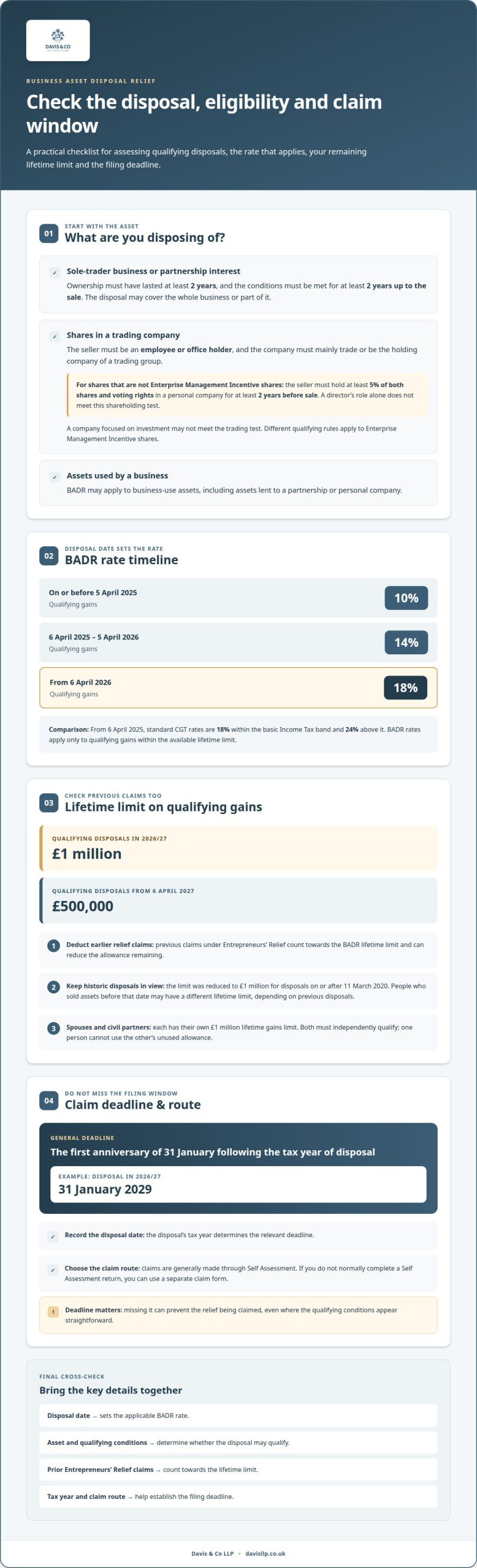
BADR applies a reduced Capital Gains Tax rate to qualifying gains, subject to a lifetime limit. In 2026/27, the limit is £1 million; for qualifying disposals from 6 April 2027, it falls to £500,000. HM Revenue & Customs states that qualifying gains are taxed at 10% for disposals on or before 5 April 2025, 14% between 6 April 2025 and 5 April 2026, and 18% from 6 April 2026.
For shares that aren’t from an Enterprise Management Incentive, HM Revenue & Customs requires the seller to hold at least 5% of both shares and voting rights in a personal company for at least 2 years before sale. A director’s role alone doesn’t satisfy that shareholding test. Gains outside BADR are subject to standard CGT rates, which from 6 April 2025 are 18% within the basic Income Tax band and 24% above it. The applicable rate affects the tax calculation on the capital gain.
Claiming deadline after disposal
A BADR claim must be made by the first anniversary of 31 January following the tax year of disposal. For a disposal in 2026/27, the general deadline is 31 January 2029. The deadline matters even where the qualifying conditions appear straightforward, because missing it can prevent the relief being claimed.
Claims are generally made through Self Assessment. If you don’t normally complete a Self Assessment return, you can use a separate claim form. The disposal’s tax year determines the relevant deadline, so keep the sale date and claim route in view when preparing your tax calculation.
Common BADR pitfalls and risks
Common pitfalls include assuming every business sale qualifies, overlooking the 5% share and voting-rights tests, or applying a rate based on the wrong disposal date. Each can change whether relief applies or how much tax is due.
For example, a sale after 5 April 2026 uses the 18% BADR rate, not the earlier 14% rate. Previous Entrepreneurs’ Relief claims also count towards the lifetime limit, reducing the remaining allowance. A careful calculation should account for the disposal date, qualifying conditions, prior claims and filing deadline together.
BADR rates and lifetime limits
BADR combines a reduced Capital Gains Tax rate with a cap on gains eligible for relief. For owners seeking business asset disposal relief explained in context, the disposal date and any earlier claims are central to the calculation.
BADR rates
The BADR rate is the percentage of Capital Gains Tax applied to qualifying gains within the available lifetime limit. It changed across three disposal periods: 10% on or before 5 April 2025, 14% between 6 April 2025 and 5 April 2026, and 18% from 6 April 2026. The date of disposal therefore affects the CGT rate, even when an owner’s qualifying holding has not changed.
For comparison, from 6 April 2025, standard CGT rates are 18% within the basic Income Tax band and 24% above it. A qualifying disposal may therefore receive a lower rate, but only on gains meeting BADR’s conditions. Holding shares or voting rights alone does not establish eligibility; the relevant tests also consider the company and the seller’s connection to it.
Lifetime relief limit
The lifetime limit caps the total qualifying gains an individual can receive BADR on across eligible disposals. It is £1 million for qualifying disposals in 2026/27 and falls to £500,000 for qualifying disposals from 6 April 2027. Previous Entrepreneurs’ Relief claims count towards this limit, so earlier relief can reduce the allowance remaining for a later sale.
The limit has changed over time: it was £2 million following the 2010 Budget, rose to £5 million effective 23 June 2010, then to £10 million effective April 6, 2011. It was reduced to £1 million for disposals made on or after 11 March 2020. People who sold assets before 11 March 2020 may have a different lifetime limit, depending on their previous disposals.
Each spouse or civil partner has their own £1 million lifetime gains limit. That distinction can matter where both independently qualify for BADR; it does not mean one person can use the other’s unused allowance. Owners seeking business asset disposal relief explained against their own disposal plans should consider the lifetime limit alongside previous claims.
Business Asset Disposal Relief and its former name
Business Asset Disposal Relief (BADR) was previously called Entrepreneurs’ Relief. It can apply when an individual sells a business, shares in a trading company, or an interest in a trading partnership.
BADR’s former name
Entrepreneurs’ Relief became Business Asset Disposal Relief for the 2020/21 tax year onwards. The relief has been available since 6 April 2008, so older tax records may use its former name.
The name changed, but earlier claims under Entrepreneurs’ Relief still count towards the BADR lifetime limit. When reviewing a sale, distinguish the relief’s name from the tax year and disposal date. These details help connect historic claims with current eligibility and the allowance calculation.
Relief for shares, partnerships, and assets
For a sole trader or partner selling a business, HM Revenue & Customs requires ownership for at least 2 years and the conditions to be met for at least 2 years up to the sale. A disposal may involve the whole business or part of it. The ownership period and the nature of the transaction both matter.
For shares, eligibility depends on the seller’s role and the company’s activity. The seller must be an employee or office holder, and the company must mainly trade or be the holding company of a trading group. A company focused on investment may not meet the trading test. Different qualifying rules apply to Enterprise Management Incentive shares.
BADR may also apply to assets used by a business, including assets lent to a partnership or personal company. The owner must have allowed the business to use the assets for at least one year up to the sale or closure, and must sell at least 5% of their partnership interest or personal-company shares. For example, a premises owner selling business-used property alongside a qualifying business interest may need to consider both disposals and their separate conditions.
First identify what is being sold: a business, shares, a partnership interest, or an asset used by the business. That classification determines the relevant eligibility test and helps support an accurate BADR claim.
What is the deadline for claiming BADR after a business disposal?
A Business Asset Disposal Relief claim must be made by the first anniversary of 31 January following the tax year of disposal. The tax year determines the deadline, so identifying the disposal date is the starting point.
For a disposal in the 2026/27 tax year, the general claim deadline is 31 January 2029. A disposal in the tax year ending 5 April 2027 also has a stated deadline of 31 January 2029. For a disposal in the 2025-26 tax year, the deadline is 31 January 2028. These dates show why a claim should be linked to the correct tax year, rather than simply counted from the day a sale completes.
Claims are generally made through Self Assessment. If you don’t normally complete a Self Assessment return, you can use a separate claim form. Both routes require submission by the applicable deadline. The sale agreement, completion date and gain records help establish the relevant tax year and claim period.
For example, a disposal during 2026/27 falls under the 31 January 2029 deadline, not the deadline for the preceding tax year. The tax calculation should also reflect the qualifying gain, any previous relief claims and the rate applying on the disposal date. Keeping these elements together helps avoid treating a timely return as a complete BADR claim when the relief itself has not been claimed correctly.
Plan the claim alongside the disposal’s tax reporting. Record the completion date, identify the tax year, calculate the gain and select the appropriate claim route. Then work back from the relevant 31 January deadline to allow time for the calculation and return. A claim made after the deadline may lose access to the relief. For help considering the financial impact of a planned sale, discuss your business growth plans.
Davis & Co LLP: Business Growth Acceleration
Davis & Co LLP helps business owners connect disposal decisions with wider financial and growth planning. If you’re considering a sale, Business Growth Acceleration can support strategic decisions about the business, while Cash Flow Management can inform planning for the proceeds and future cash requirements.
If the disposal also affects your personal tax position or involves cross-border considerations, Personal Tax Services and International Tax Planning may be relevant. The right focus depends on your circumstances, including the type of disposal and how it fits with your plans beyond the sale.
For advice on your business’s next stage and the financial considerations around a disposal, contact Davis & Co LLP.
Make your disposal part of a wider plan
A business sale can mark the start of a new phase, not simply the end of an ownership interest. Consider how the proceeds, your personal financial position and future business ambitions fit together before decisions are finalised. Having business asset disposal relief explained in the context of your wider plans can help bring these considerations into focus.
Davis & Co LLP can help you consider the tax and commercial implications alongside your next steps. A tailored discussion can connect the disposal with your priorities, whether you’re preparing to exit, reinvesting or planning a different direction.
Contact Davis & Co LLP to discuss your BADR position and the decisions surrounding your disposal. A considered plan can give you a clearer basis for moving forward with confidence.
Frequently Asked Questions
What is Business Asset Disposal Relief?
Business Asset Disposal Relief reduces Capital Gains Tax on gains from qualifying business disposals. It applies to qualifying gains, not automatically to the full sale proceeds, so both the gain and the eligibility conditions matter. Selling a business asset alone does not establish entitlement. The disposal type, ownership history and relevant business conditions determine whether you can claim.
How are Capital Gains calculated?
A capital gain is generally worked out by comparing the amount received for an asset with its acquisition cost, then accounting for relevant adjustments. The resulting gain is the amount assessed for Capital Gains Tax, rather than the gross sale proceeds. For 2026/27, the annual exemption is £3,000. The calculation should also distinguish qualifying gains from any amount that does not meet BADR conditions.
How has the BADR lifetime limit changed?
The lifetime limit is a cumulative ceiling, not a fresh allowance for each tax year. It was reduced from £10 million to £1 million for disposals made on or after 11 March 2020, and qualifying disposals from 6 April 2027 have a £500,000 limit. Earlier Entrepreneurs’ Relief claims count towards the available allowance, so previous relief use affects the remaining capacity.
How to qualify for BADR?
Qualification depends on the disposal type and the seller’s relationship with the business. For a sole trader or partner, business ownership and the relevant conditions must cover the required period before sale. For non-EMI shares, the seller must meet shareholding and voting-rights tests, have the required employment or office-holder connection, and satisfy the company’s trading conditions. These tests are distinct, so meeting one condition alone is not enough.
Planning a business sale or disposal?
Start by identifying what will be sold: the business, shares, a partnership interest or an asset used by the business. Then map the proposed completion date, ownership records, company trading activity and any earlier relief claims. This preparation connects the commercial terms with the tax calculation and claim timetable. If the transaction involves overseas interests, include cross-border tax considerations in your planning.
What is Business Asset Disposal Relief (BADR) in the UK?
In the UK, BADR is a Capital Gains Tax relief for individuals disposing of qualifying business interests or assets. It has been available since 6 April 2008 and was called Entrepreneurs’ Relief before the 2020/21 tax year onwards. The former name can appear in older tax records, so use the disposal date and claim history to interpret them correctly.