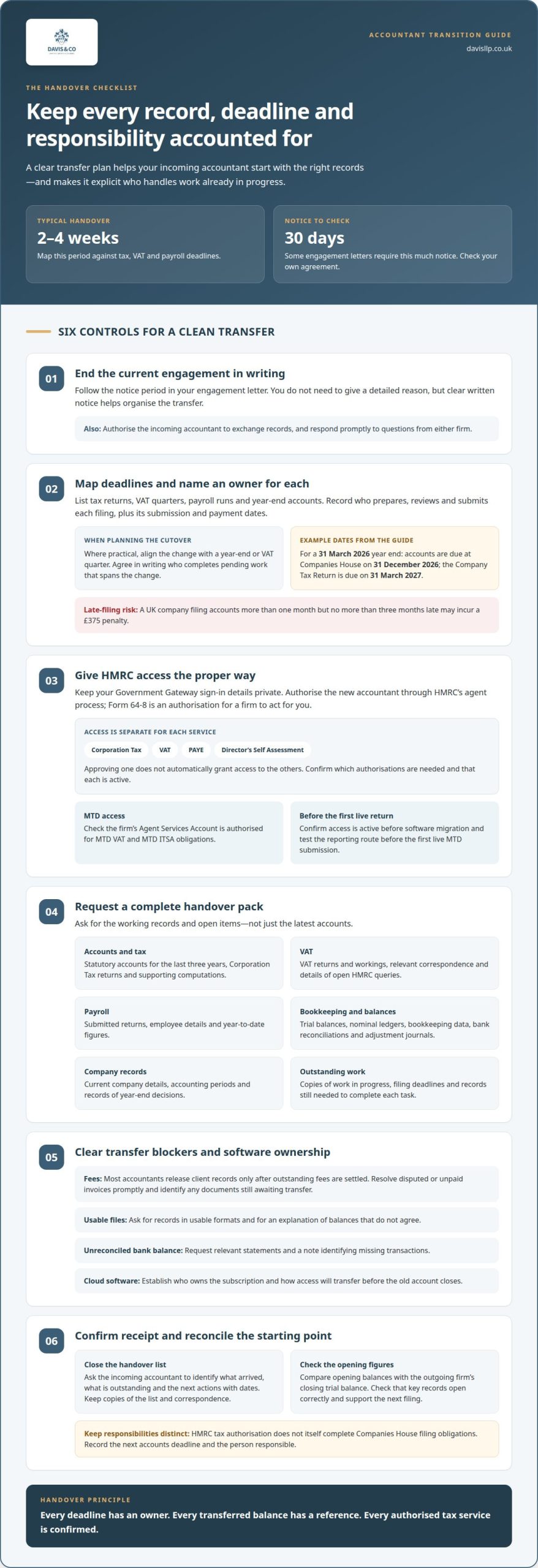
A UK accountant handover often takes two to four weeks. You can switch accountants at any point in the year, but agree who is responsible for upcoming deadlines and work already in progress. A clear checklist for switching accounting firms helps organise the handover and reduces the risk of missing records or tasks.
The timing matters, but so does what transfers and how responsibilities are divided. This guide explains what to request from your outgoing accountant, how to authorise your new accountant through HMRC without sharing your sign-in details, and how to compare the services and scope you need. It also covers practical steps for software, records and deadlines, so you can plan the change clearly.
Key Takeaways
- Give your new accountant HMRC authorisation through the proper process, not your sign-in details.
- Gather accounts, tax and VAT records, payroll information and company documents to support a complete handover.
- Set clear responsibility for upcoming filings and payroll, especially when work spans the transition date.
- Compare the proposed service scope with your business’s needs, including any bookkeeping, tax or cash-flow support required.
Should I give my new accountant my HMRC sign-in details?
No. Keep your HMRC sign-in credentials private and authorise your new accountant through HMRC’s agent process. This protects your Government Gateway account while allowing the firm to manage the tax services you approve.
HMRC authorisations are separate for Corporation Tax, VAT, PAYE and a director’s Self Assessment. Approving one does not automatically grant access to the others. Form 64-8 is an authorisation for an accounting firm to act for you and deal with your tax affairs. Your new accountant can explain which authority is needed for each service, and you approve it, usually online in a couple of clicks.
- List the tax services: identify Corporation Tax, VAT, PAYE and Self Assessment access required for your files.
- Approve each request: use HMRC’s authorisation process rather than sharing a password or sign-in code.
- Check MTD access: confirm the new firm’s Agent Services Account is authorised for MTD VAT and MTD ITSA obligations.
- Confirm activation: establish that each authorisation is active before the software migration goes live.
For Making Tax Digital (MTD) submissions, ask the incoming accountant to test the reporting route before the first live return. A test submission can help confirm that data is transmitted to HMRC correctly. Record which service you authorised, whether it is active and who is responsible for the next submission.
Include the handover letter and any signed Form 64-8 in your transition records. Check that the correct company and tax services appear in the new firm’s HMRC access, then reconcile opening figures against the closing balance from the previous system. This helps avoid gaps between bookkeeping software and HMRC reporting.
Keep Companies House responsibilities distinct from HMRC permissions: authorising an agent for tax does not itself complete company filing obligations. A UK company that files its accounts more than one month but no more than three months late may incur a £375 penalty, according to Companies House. Record the next accounts deadline and its responsible person alongside HMRC authorisations.
Can my old accountant refuse to hand over my records?
Tell your current accountant in writing that you are ending the engagement, following the notice period in your engagement letter. Some engagement letters require thirty days’ notice. You do not need to give a detailed reason, but clear communication helps organise the transfer.
Your incoming accountant will typically send a professional clearance letter to the outgoing firm. It requests relevant information and gives the firms a chance to discuss professional matters. Authorise them to exchange records and respond promptly to any questions.
Request a complete handover pack, not just the latest accounts. Include:
- Statutory accounts for the last three years, plus corporation tax returns and supporting computations.
- VAT returns, VAT workings, relevant correspondence and details of open HMRC queries.
- Payroll records, including submitted returns, employee details and year-to-date figures.
- Trial balances, nominal ledgers, bookkeeping data, bank reconciliations and adjustment journals.
- Company records, such as the current company details, accounting periods and records of year-end decisions.
- Copies of outstanding work, filing deadlines and records still needed to complete each task.
Ask for files in usable formats and an explanation of any balances that do not agree. For example, an unreconciled bank balance should be accompanied by the relevant statements and a note identifying missing transactions. If you use cloud software, establish who owns the subscription and how access will transfer before the old account closes.
Most accountants will release a client’s records only after outstanding fees are settled. Resolve disputed or unpaid invoices promptly, and ask the firms to identify any documents still awaiting transfer. Keep copies of the handover list and correspondence so both sides can track what has arrived.
Before the cutover, agree in writing who will complete pending tax returns, VAT returns and year-end work. A structured transfer of bookkeeping services records can help the incoming accountant establish a reliable starting point.
What is an accountant handover checklist?
Check the notice period in your engagement letter and give notice in writing. Some UK accountants’ engagement letters require thirty days’ notice before the engagement ends.
A handover checklist records what must transfer, who is responsible for each task and when it is due. An accountant handover often takes two to four weeks, so map that period against tax, VAT and payroll deadlines before choosing a cutover date. Where practical, align the change with a year-end or VAT quarter.
For example, a UK company with a 31 March 2026 year end has accounts due at Companies House on 31 December 2026. Its Company Tax Return is due on 31 March 2027. Use dates like these to clarify which firm prepares, reviews and submits each filing, rather than assuming the incoming accountant will take over unfinished work.
- List each deadline: include tax returns, VAT quarters, payroll runs and year-end accounts.
- Assign responsibility in writing: name the firm preparing and approving each submission, and record its submission and payment dates.
- Track outstanding items: note missing records, open HMRC queries and the person responsible for resolving them.
- Confirm receipt: ask the incoming accountant to identify records received, anything outstanding and next actions with dates.
After the transfer, compare opening balances with the outgoing firm’s closing trial balance. Check that key records open correctly and that the new accountant can prepare the next filing from the transferred information. Keep the agreed task list with your company records.
For an audit change, prepare the previous year’s accounts and audit report, board and committee minutes, group structure charts, trial balances, reconciliations and prior-year management letters. The handover may involve sharing relevant audit materials and correspondence with the incoming auditor. A first-year audit may involve more questions as the new auditor learns the business. Record who is responding and which supporting documents remain outstanding.
Comparing an accountant’s services and scope
Compare the work each firm will complete, not just the service names in a proposal. For every task, establish what is included, what you need to provide, when the work will be delivered and who will answer questions. This makes differences clear before the transition, especially when a tax period or VAT quarter is already underway.
- Define recurring work: list bookkeeping, VAT returns, payroll and management reporting, then record the frequency and required records for each.
- Separate preparation from submission: establish who prepares, reviews and files each return, and who approves figures before submission.
- Identify one-off work: record whether bringing bookkeeping up to date, correcting historic entries or completing year-end accounts sits within the proposed scope.
- Set reporting expectations: agree which management reports you’ll receive, when they arrive and what decisions they should support.
- Clarify the transition: note which firm finishes upcoming work, including a VAT return or payroll run that crosses the changeover.
Set the scope according to your actual workload. If bookkeeping is three months behind, agree a plan to bring those three months up to date rather than assuming routine bookkeeping includes historic catch-up. If your records are current, specify when the new firm takes responsibility and how opening balances will be carried forward.
Check that related tasks are covered, too. For payroll, agree a clear handover point and identify who will process the next pay run. Management accounts should specify the reporting period and information used. For audit work, compare technical expertise, geographic reach, price and how each firm will work with your team.
Use the written scope as the final comparison: it should show deliverables, responsibilities, timing and exclusions in plain terms. If you’re ready to discuss an accounting arrangement shaped around your business, start a conversation about your requirements.
Davis & Co LLP: Property Accounting
Davis & Co LLP can support you when an accounting change raises wider questions about tax planning, personal tax or cash flow. If property income is part of your personal finances, Personal Tax Services can help you consider how it fits into your tax affairs. If your business is growing or cash flow needs closer attention, Business Growth Acceleration and Cash Flow Management can address those priorities.
The right support depends on the questions you need to resolve, from organising financial information after a handover to understanding how tax and cash flow affect your decisions. Davis & Co LLP’s International Tax Planning may also be relevant if your affairs involve more than one country.
Contact Davis & Co LLP to discuss the support that suits your circumstances.
Make the next accounting relationship work for you
Changing accountants can also be a useful opportunity to reconsider what financial information you need to make decisions. Before the new arrangement becomes routine, identify the business questions you want your figures to answer, such as where cash is tied up or which activities support growth. This gives the relationship a practical purpose beyond completing filings.
Use your checklist for switching accounting firms to carry those priorities into your first planning conversation. A focused discussion can shape support around your circumstances and upcoming decisions, rather than simply continuing the previous routine. Davis & Co LLP can discuss how its services may fit your needs.
Discuss your accounting transition with Davis & Co LLP, and take the next step with a clearer view of what you want from the relationship.
Davis & Co LLP can support your move to a new accounting firm
Davis & Co LLP provides services including bookkeeping, management accounts, payroll services, VAT compliance, audit and assurance, and company secretarial services. If your checklist shows that you need support in any of these areas, you can consider whether the firm’s services fit your requirements.
For personal or specialist needs, Davis & Co LLP also provides personal tax services, trust tax services, international tax planning, property accounting and specialist dental tax services. Contact the firm when you are ready to discuss the services you need from your next accounting firm.
Frequently Asked Questions
How long does switching actually take?
A UK accountant handover often takes two to four weeks. Timing depends on how quickly records transfer, the outgoing firm’s clearance process and whether deadlines are approaching. A live VAT quarter or payroll run, for example, may require both firms to coordinate responsibilities before the change is complete. Agree a target cutover date and track outstanding items against it, rather than treating the handover as complete as soon as access changes.
Can I change accountants during the financial year?
Yes. A UK business can change accountants during its financial year. The practical issue is dividing up work already underway: agree which firm will prepare and submit the next return, complete year-end work or process the next payroll. Set out each responsibility in writing, including the required records and relevant dates. Directors remain responsible for company records, accounts and performance, even when an accountant handles day-to-day work.
Do I have to settle my old accountant’s fees first?
Outstanding fees may complicate a records transfer, so discuss any unpaid balance with the outgoing firm. Review the final invoice against your engagement terms and raise any dispute directly with the firm. In the meantime, tell the incoming accountant what work is in progress and which deadlines are approaching. This helps identify tasks needing attention while the firms resolve the transfer arrangements.
Switching auditors: what does the process look like?
Changing auditors involves formal steps as well as transferring records. The incoming auditor contacts the outgoing auditor before accepting the appointment, while the company’s board and, in some cases, shareholders approve the change. The outgoing auditor files a formal note with Companies House and notifies relevant audit authorities. Prepare prior accounts, audit reports, minutes and reconciliations to help the incoming auditor understand the business and its controls.
What should be on a checklist for switching accounting firms in the UK?
Include the proposed start date, notice arrangements, upcoming filing dates, HMRC authorisations, records to transfer and software access. Assign an owner to each open task, such as approving the next VAT return or resolving an HMRC query. Ask the new firm to confirm what has arrived and what is outstanding. This turns the checklist into a working transition record, not just a one-off list of documents.
What documents and records should I request from my current accountant?
Request statutory accounts, corporation tax returns and computations, VAT returns and workings, payroll records, trial balances, bookkeeping data and relevant HMRC correspondence. Also ask for details of open queries, unresolved adjustments and upcoming work. If the business has an audit, include relevant audit files and correspondence for transfer between auditors. Confirm receipt against an itemised record and keep copies in file formats you can still read.