Moving incorporation abroad does not, by itself, take a company outside the UK tax net. The offshore company tax implications in the UK depend in part on where the company is centrally managed and controlled. An overseas-incorporated company managed from the UK may be treated as UK tax resident and charged Corporation Tax on its worldwide profits. A non-UK-resident company may still be liable on profits attributable to a UK permanent establishment.
An overseas structure does not automatically change a company’s tax position. The outcome depends on how it is run, where it operates and what it owns. This article explains when UK Corporation Tax may apply, how gains made by an offshore company may be attributed to a UK-resident owner, and what to consider if a company leaves the UK. Property, continuing UK activities and the destination country can all affect the decision, so assess the options against the company’s actual arrangements.
Key Takeaways
- Assess where the company’s real strategic decisions are made; overseas incorporation alone doesn’t settle its UK tax residence.
- Identify whether UK operations create a permanent establishment, as this can bring profits attributable to those activities within UK Corporation Tax.
- Consider how gains held by an offshore company may be attributed to a UK-resident owner, alongside the company’s own tax position.
- Before relocating, weigh continuing UK activities, possible exit charges and the destination country’s tax treatment together.
What is an offshore company?
An offshore company is incorporated outside the country where its beneficial owner resides. For UK taxation, incorporation alone doesn’t decide residence: central management and control can make a foreign company UK resident. The question is where strategic decisions are genuinely made, not simply where paperwork is filed. In Wood v Holden (2005), central management and control was found overseas.
Board meetings matter, but they are not the whole picture. Decisions made outside meetings, and whether directors act in person abroad or remotely from the UK, can also be relevant. Overseas directors or a foreign registered address alone do not establish non-UK residence. If UK owners direct nominee directors, those directors may not demonstrate genuine overseas control. A UK-incorporated company is generally UK tax resident and taxable on worldwide income and gains, subject to treaty rules.
Property creates separate UK exposure. According to HM Revenue & Customs, gains on UK residential property held as an investment have been taxable since April 2015; gains on non-residential property and qualifying interests in property-rich companies have been taxable since April 2019. HM Revenue & Customs states that non-UK resident companies buying UK residential property in England and Northern Ireland face an additional 2% SDLT surcharge. For qualifying residential property costing more than £500,000, a 17% higher SDLT rate for corporate bodies may apply unless relief is available, according to HM Revenue & Customs.
Reverse hybrids raise a distinct issue for UK-resident individual members of US LLCs and similar entities. In 2026, the government published consultation responses on a proposed treatment that could treat specified entities as opaque, taxing members on distributions.
For related-party transactions, UK transfer pricing rules require intra-group prices to be arm’s length. Dividends received by UK-resident shareholders from an offshore company may be taxable in the UK. The outcome depends on the shareholder’s circumstances and the treatment of the payment.
Where a trust holds UK residential property, inheritance tax requires separate consideration. An individual could be deemed UK domiciled for inheritance tax after UK residence in the previous 17 years, making the ownership and trust arrangements relevant.
When is an overseas company subject to UK corporation tax?
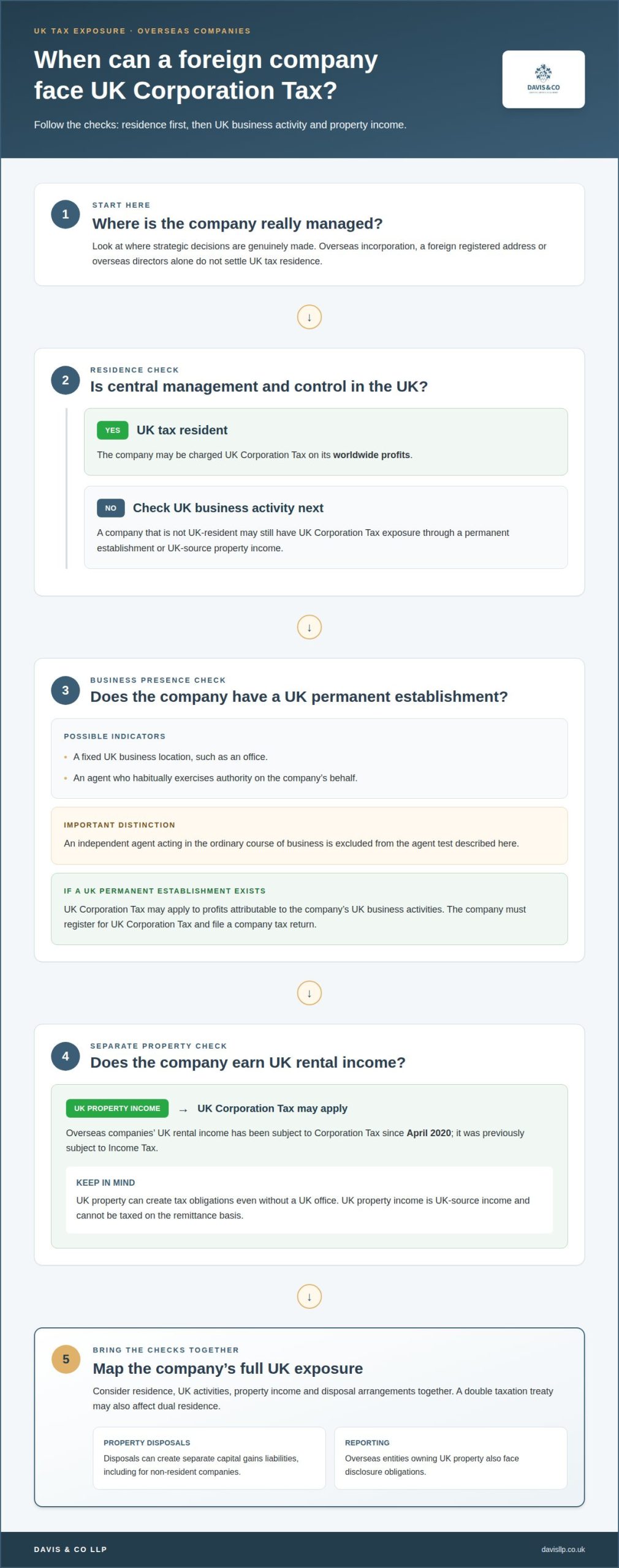
An overseas company can face UK Corporation Tax because it is UK resident or carries on business in the UK. For a non-UK-resident entity, a permanent establishment may arise through a fixed UK business location, such as an office, or an agent who habitually exercises authority on its behalf. An independent agent acting in the ordinary course of business is excluded. For an overseas company, UK Corporation Tax may apply to profits attributable to business activities carried on in the UK.
UK property can create tax obligations even without a UK office. According to HM Revenue & Customs, overseas companies’ UK rental income has been subject to Corporation Tax since April 2020, having previously been subject to Income Tax. A company with a UK permanent establishment must register for UK corporation tax and file a company tax return. UK property income is UK-source income, so it cannot be taxed on the remittance basis.
Overseas entities owning UK property also face disclosure obligations. Entities owning UK property had to provide Companies House with information about beneficial owners and relevant trusts by 31 January 2023. Property disposals can create separate capital gains liabilities, including for non-resident companies. The company’s residence, UK activities, property income and disposal arrangements all affect the obligations.
Operating in a low-tax jurisdiction does not, by itself, remove UK tax exposure. UK residence, a UK permanent establishment and UK-source income remain key factors. A double taxation treaty may also affect dual residence. A foreign registered address or overseas directors alone do not establish that a company is non-UK resident.
Setting up an overseas trust before moving to the UK does not automatically prevent UK taxation. Beneficiaries who become UK resident need to understand how trust income, distributions and UK property are treated. UK property income remains UK-source. The analysis depends on the trust’s structure and the beneficiary’s circumstances.
For compliant use, map management, UK operations, property ownership, income and reporting obligations before transactions or relocation. International tax planning can help assess how those elements interact, including trust and property tax considerations.
Attribution of offshore company capital gains
Depending on the asset, ownership and profits, UK tax may apply at both company and shareholder level. The distinction matters: a company’s liability does not necessarily determine whether gains are attributed to an individual.
Gains Made by Offshore Companies
Gains made by an offshore company can be taxable in the UK when they arise from UK property. Gains on UK residential property held as an investment have been taxable since April 2015, according to HM Revenue & Customs. Gains on UK non-residential property held as an investment, or qualifying interests in property-rich companies, have been taxable since April 2019.
For non-resident companies, UK land and property remain within the UK capital gains tax net. Offshore companies also have no annual exempt amount for UK gains, so a disposal cannot use an individual’s annual exemption. SDLT is separate: it applies to property purchases in England and Northern Ireland whether the buyer is an offshore company or an individual. The relevant jurisdiction and transaction affect the charge.
Shareholder attribution is a distinct issue. Historically, UK-resident non-UK-domiciled shareholders could use the remittance basis for gains realised by an offshore company from 6 April 2008. Changes in the 2013 Finance Bill raised the relevant shareholding threshold from over 10% to over 25%, with retrospective effect from 6 April 2012. These rules illustrate why the company’s gain and the shareholder’s circumstances require separate analysis.
Controlled Foreign Company Rules
UK controlled foreign company rules can attribute some foreign subsidiary profits to a UK company when UK shareholders control the subsidiary and the profits are considered artificially diverted from the UK. The company’s jurisdiction alone therefore does not determine whether its profits face a UK charge.
The rules contain exemptions, including a de minimis profits limit. Under the regime described as applying from 2012, that limit was raised from £50,000 to £500,000. A UK company may have tax on apportioned overseas-company profits where the percentage apportioned is at least 25%. The relevant legislation and profit calculation determine whether attribution applies.
Offshore company tax planning after leaving the UK
Moving a company’s management abroad is more than changing its address. The UK tax result depends on where management and control sit, whether trading continues through a UK permanent establishment, and which assets remain here. Profits may fall outside UK Corporation Tax where management and control, the permanent establishment and trading activity are offshore. A mailbox or co-working desk alone does not meet the economic substance requirements described for the destination.
Before a UK company ceases to be UK tax resident, consider the exit consequences. Under TCGA 1992 s185, it may face an exit charge. HMRC may treat its assets as sold at market value immediately before migration, even without an actual sale. Failure to notify HMRC of the intention to migrate can lead to penalties equal to relevant outstanding tax liabilities at the migration date.
Leaving the UK does not automatically end UK obligations. UK-based employees may mean PAYE obligations continue, while ongoing UK supplies of goods or services may require VAT registration. Related-party transactions remain subject to transfer pricing rules, which require arm’s-length pricing. A UK company with a foreign subsidiary may also face controlled foreign company rules if profits are considered artificially diverted.
If a company is resident in both the UK and its new jurisdiction, consider whether a double tax treaty applies and how it resolves dual residence. The destination’s tax treatment, continuing UK investment and any UK property income or gains also matter. Separately, an individual’s inheritance tax position can continue for three years after losing UK domicile, so company migration and personal residence planning should be considered separately.
Map the proposed transfer, remaining UK activities, employees, assets and reporting duties before migration. Discuss international tax planning to assess the company’s position and the consequences of leaving the UK.
Davis & Co LLP: Company Secretarial Services
Davis & Co LLP provides Company Secretarial Services for businesses managing company changes alongside cross-border tax considerations. This support can be useful when ownership, management or a proposed relocation affects company records and obligations. International Tax Planning can help clarify the tax implications of those decisions.
The right support depends on the company’s circumstances. A business considering an overseas structure may need to assess how its planned arrangements relate to UK tax residence, property, trading activity and future reporting. Where relevant, Davis & Co LLP can also support wider business decisions through Business Growth Acceleration and Cash Flow Management.
Contact Davis & Co LLP to discuss Company Secretarial Services and international tax planning for your circumstances.
Make your next decision with clarity
An overseas structure should support the company’s commercial direction, not create avoidable uncertainty for its owners. Before changing where the business is managed, investing through an offshore entity or transferring operations, consider governance, tax position and longer-term plans together. Planning for offshore company tax implications in the UK is most useful when it reflects both the business’s international arrangements and the people behind them.
Davis & Co LLP offers International Tax Planning to help assess cross-border tax considerations. Business Growth Acceleration and Cash Flow Management can also support wider commercial planning where relevant. The right focus depends on the company’s objectives and circumstances.
Contact Davis & Co LLP to discuss the next step for your business. With a clear view of the decisions ahead, you can move forward with greater confidence.
Davis & Co LLP can help you assess offshore company tax implications
If you are considering an offshore company or reviewing one you already operate, Davis & Co LLP provides International Tax Planning to help you understand the UK tax issues relevant to your circumstances.
Turn to Davis & Co LLP when you need to consider your company’s tax position alongside your business and personal tax affairs. The firm also offers Personal Tax Services, VAT Compliance, Company Secretarial Services and Cash Flow Management.
Frequently Asked Questions
What are better alternatives?
There is no universally better structure: the right option depends on the business purpose. Offshore company tax implications in the UK depend on where the business operates, who makes decisions and how profits are used, not just on the jurisdiction’s tax rate. A UK company may suit a business operating mainly here, while direct ownership may fit some personal investments. Compare governance, ownership and reporting needs before choosing.
What does this mean for you?
Your position depends on the connection between you, the company and its activities. For example, a UK resident who owns an overseas company may face personal tax on money received, while the company may have separate UK obligations. A property investment, UK-based workforce or planned relocation can change the analysis. Consider these factors together before committing funds or changing the company’s management, so both business and personal consequences inform the decision.
How does the UK tax an offshore company owned by a UK resident?
For a UK-resident owner, offshore company tax implications in the UK depend on the company’s residence, UK activities and assets. Ownership alone does not automatically make the company UK tax resident. Separately, the owner may face UK tax on salary or dividends received. If UK shareholders control a foreign subsidiary and its profits are considered artificially diverted from the UK, controlled foreign company rules may also be relevant.
When is an offshore company treated as UK tax resident?
An offshore company may be treated as UK tax resident when its central management and control is exercised in the UK. The practical distinction is between formal arrangements and where the people directing the company make strategic decisions. Overseas directors and meeting records may not demonstrate overseas control if UK owners make substantive decisions. A double taxation treaty can affect how dual residence is resolved.
What UK tax applies when an offshore company sells assets or distributes profits?
The asset’s location and the company’s tax residence shape the outcome. UK property gains can remain taxable even when a non-resident company owns the property. Overseas trading profits may fall outside UK tax where the company is genuinely non-resident and relevant activity is offshore. A UK-resident shareholder may also be taxed on dividends received. Distinguish the company’s asset disposal from the owner’s later receipt of distributed profits.
How do UK anti-avoidance rules apply to offshore income and structures?
UK rules can address arrangements that shift profits or produce mismatched tax outcomes. Controlled foreign company rules may attribute certain foreign subsidiary profits to a UK company where UK shareholders control it and the profits are considered artificially diverted. Transfer pricing rules require relevant intra-group transactions to use arm’s-length prices. Hybrid mismatch rules may deny deductions or include additional taxable income to neutralise a mismatch between tax treatments.