Share option schemes for employees can support retention by giving staff a potential stake in future business value. But an option does not make an employee a shareholder until it is exercised. For business owners, a scheme can help align incentives with company goals, while also bringing administration and decisions about ownership and control.
It is understandable to focus on whether a scheme could help attract and retain employees. Its practical effect also depends on the design and how the scheme fits with employment terms and workplace policies. Repeated assurances or consistent past practice can shape employee expectations, even when scheme documents describe participation as discretionary.
This article explains how share schemes may affect retention, what owners should consider, and where costs and complexity can arise. It also looks at how scheme terms interact with employment relationships and why clear, consistent administration matters. Use these points to assess the commercial case and workplace implications before deciding whether a scheme suits your business.
Key Takeaways
- Assess whether an ownership incentive supports your retention goals and fits the people you want to reward.
- Weigh potential business benefits against the effect on ownership, control and future succession planning.
- Factor in administration and reporting obligations when evaluating the scheme’s overall cost and complexity.
- Align scheme documents and workplace practices so employees receive clear, consistent expectations about participation.
Do employee share schemes improve retention in practice?
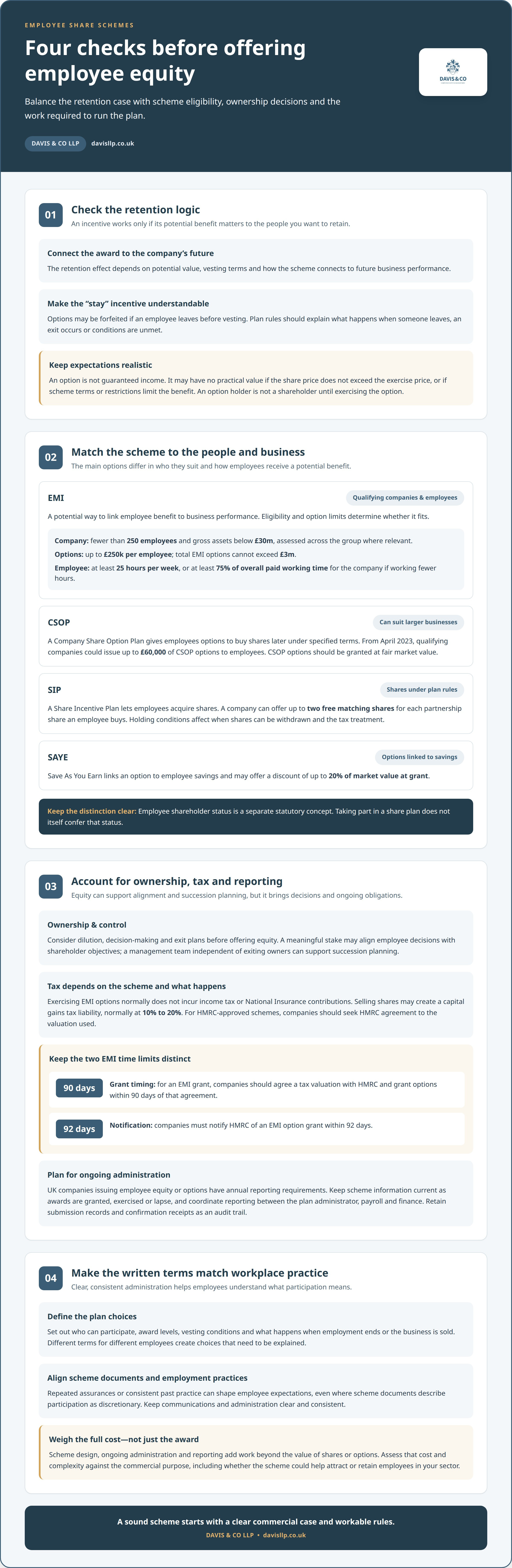
Share options can support retention by giving employees an incentive they may forfeit if they leave. The effect depends on the scheme’s potential value, vesting terms and connection to the company’s future.
A Company Share Option Plan (CSOP) gives employees options to buy shares later under specified terms. According to HM Revenue & Customs, from April 2023 qualifying companies could issue up to £60,000 of CSOP options to employees. Eligibility depends on the company and scheme meeting the relevant qualifying conditions. An option holder is not a shareholder until exercising the option.
Employee shareholder status is a distinct statutory concept, not another name for joining an employer’s share plan. Taking part in a plan does not itself confer that status or make an employee a shareholder.
For UK tax, treatment depends on the scheme and what happens to the options. Exercising EMI options normally does not incur income tax or National Insurance contributions; selling shares may create a capital gains tax liability, normally at 10% to 20%.
The option agreement and scheme rules set the exercise price. For HMRC-approved schemes, companies should seek HMRC agreement to the valuation used; CSOP options should be granted at fair market value.
SIP Shares and Holding Periods
A Share Incentive Plan (SIP) lets employees acquire shares under plan rules, with holding conditions affecting when they can access them. A company can offer up to two free matching shares for each partnership share an employee buys. The holding period can affect when shares may be withdrawn and the tax treatment that applies.
Vesting Terms and Plan Rules
Vesting is the process by which an employee earns the ability to exercise options, according to agreed conditions and timing. The plan rules and option agreement explain what happens when someone leaves, when an exit occurs, or when conditions are unmet. Clear terms make the incentive more efficient and structured, and help employees understand what continued service may mean for their options.
For EMI options, companies must notify HMRC of a grant within 92 days. UK companies issuing employee equity or options also have annual reporting requirements. Retaining submission records and confirmation receipts supports a clear audit trail.
Risks and Disadvantages for Employees
Options may have no practical value if the share price does not exceed the exercise price or an employee cannot meet the scheme terms. Leaving before vesting or facing restrictions on selling shares can also limit the benefit. An option is not guaranteed income: its potential value depends on future business performance and the scheme rules.
Employee share schemes – what are the advantages for business owners?
An enterprise management incentive (EMI) can help a qualifying trading company reward employees while linking part of their potential benefit to business performance. It may support recruitment and succession planning, but eligibility and option limits affect whether it is suitable.
For EMI, the company must have fewer than 250 employees and gross assets below £30m, assessed across the group where relevant. The UK EMI limit for options is £250k per employee, according to HM Revenue & Customs. A company limit also applies: EMI options cannot exceed £3m in total.
Employee eligibility matters too. According to HM Revenue & Customs, an employee must work at least 25 hours per week, or spend at least 75% of their overall paid working time working for the company if they work fewer hours. These criteria help determine whether EMI can serve as an effective incentive for the intended team.
EMI, CSOP, SIP and SAYE differ in structure: EMI targets qualifying companies and employees, while CSOP can suit larger businesses. SIP plans provide shares, whereas SAYE links an option to employee savings and may offer a discount of up to 20% of market value at grant.
For an EMI grant, companies should agree a tax valuation with HMRC and grant options within 90 days of that agreement. Clear records of the valuation, grant terms and employee eligibility support the process. Potential tax advantages, including a more favourable tax rate, should follow the commercial case rather than drive it.
Owners should also consider dilution, decision-making and exit plans before offering equity. A meaningful stake may help align employee decisions with shareholder objectives, while a strong management team independent of exiting owners can support succession planning. Business growth planning can help connect incentive design with wider commercial objectives.
Costs and complexity of share schemes
Employee share schemes involve more than the value of shares or options awarded. Owners should weigh design and administration against the scheme’s purpose, including whether it could help attract or retain employees in their sector. Some companies decide against a scheme because of the cost and potential complexity.
Scheme design affects the work involved. A plan may cover all employees or selected individuals, with award levels reflecting those choices. The company needs to define participation, vesting and what happens when employment ends or the business is sold. Each variation brings decisions to make and explain, especially when employees receive different terms.
Ongoing administration also matters. UK companies issuing employee equity or options have annual reporting requirements. The company must keep scheme information current as awards are granted, exercised or lapse, and ensure reports reflect those events. This work requires coordination between the plan administrator, payroll and finance.
Tax treatment adds another consideration. A company receives a corporation tax deduction against its profits for an employee share scheme award, while employees may face tax consequences when options are exercised or shares sold. The outcome depends on the scheme and transaction. Potential tax relief can inform the decision, but should not replace the commercial case for offering equity.
Cash flow matters too. Depending on the arrangement, an employee may be able to meet the cost of an award from future proceeds rather than paying upfront. That can affect the employee’s experience, but the company still needs to explain the terms clearly. Before proceeding, owners should assess the administrative commitment, employee communication and effect on ownership alongside the incentive’s intended value.
How share schemes interact with employment contracts and workplace policies
A share plan may have separate documents from an employment contract, but that separation does not resolve every workplace issue. In the UK, scheme terms may sit outside the contract while the employer’s conduct still creates obligations. For example, repeated assurances about an award can shape what an employee reasonably expects.
Consistency matters. If managers routinely use discretion to let departing employees retain options, others may expect the same treatment. That practice can limit future flexibility, even where written rules reserve discretion. Employers should explain decisions clearly and apply the scheme’s stated criteria consistently in comparable cases.
Workplace policies should explain how employees participate and what limits apply. Plan rules can set out eligibility, vesting, exercise and leaver provisions, while employment materials should avoid conflicting descriptions. If an option’s potential value depends on market value at exercise or sale, explain the distinction clearly: holding an option is not the same as owning shares.
Share schemes remain connected to the employment relationship, even when documents call them discretionary or separate. Participation cannot remove statutory employment rights. Provisions that seek to penalise employees for exercising legal rights may be challenged. Avoid wording or practices that make an employee’s rights appear conditional on keeping an award.
A practical governance review can compare the plan rules, employment documents and workplace policies, then identify inconsistent promises or decision-making. This helps employers explain how awards operate without implying that every employee receives the same terms. For financial reporting and control considerations, discuss share-scheme reporting support as part of a wider review of the company’s records.
Davis & Co LLP
Davis & Co LLP can help business owners assess how an employee share scheme fits their wider financial and commercial plans. International Tax Planning can inform consideration of tax implications, while Cash Flow Management helps owners assess the potential effect on business finances. Business Growth Acceleration offers a broader commercial perspective when weighing an incentive against recruitment, retention and future plans.
Consider this support when assessing whether a scheme is financially practical, reviewing how it fits your growth plans, or considering personal tax implications connected with participation. The analysis depends on your company’s circumstances and the purpose of the arrangement.
For a considered discussion of your circumstances, contact Davis & Co LLP.
Make the next decision with purpose
Before introducing share option schemes for employees, define what you want the arrangement to achieve. A clear objective, such as supporting succession or strengthening long-term commitment, gives the decision a commercial basis and helps shape consistent communication with employees.
Next, consider how the proposed arrangement fits your company’s wider plans and financial position. The right approach should reflect your circumstances, ownership priorities and intended workforce outcomes, rather than follow a standard template. Assessing these factors can help turn a general idea into a considered decision.
Davis & Co LLP can bring relevant tax planning and business perspectives to that assessment. Contact Davis & Co LLP to discuss your position and consider a suitable next step.
A well-considered decision gives you a firmer basis for planning ahead with confidence.
Davis & Co LLP can support your next steps
Davis & Co LLP offers International Tax Planning, Payroll Services, Company Secretarial Services and other business and tax services. These can help you consider how an employee share option scheme fits with your company’s payroll, tax and administration.
For help assessing these areas or managing related compliance, contact Davis & Co LLP to discuss its services, including Personal Tax Services, VAT Compliance, Management Accounts and Bookkeeping Services.
Frequently Asked Questions
When do employee share schemes become a people-risk rather than a benefit?
Share options can become a people risk when employees’ expectations differ from how the scheme is administered. For example, a manager might suggest an award will continue after someone leaves, while the plan rules say otherwise. That gap can undermine trust. Explain the scheme during recruitment, promotion and exit so employees understand its purpose and do not mistake potential value for guaranteed pay.
How do employee share schemes affect employee behaviour and expectations?
An ownership incentive can encourage employees to consider longer-term business outcomes, particularly when they understand how their contribution relates to company performance. Participation in decision-making alongside ownership is associated with greater engagement. However, employees may expect more influence or information than the scheme provides. Explain what participation means in practice, including how the company shares information about performance and decisions affecting the plan.
What are the main HR and organisational risks of employee share schemes?
Key risks include perceived unfairness in selecting participants, inconsistent award decisions and confusion about how the plan relates to workplace policies. Different award levels can prompt questions, for example, if managers cannot explain the selection rationale. HR and management should communicate consistently, record decisions and coordinate scheme administration with employment processes, particularly during promotion, restructuring or an employee’s departure.
What happens to employee shares when someone leaves?
The outcome depends on whether the employee holds shares or unexercised options, and on the scheme’s leaver provisions. Options may be subject to vesting conditions or lapse when someone leaves; some plans distinguish between reasons for departure. Someone who already owns shares may continue to hold them, subject to the company’s share terms. The agreement and plan rules determine the treatment.
What are employee share option schemes in the UK?
Share option schemes for employees give eligible staff a contractual opportunity to acquire shares later, subject to conditions in the company’s plan and individual agreement. Receiving an option does not itself make an employee a shareholder. UK arrangements include tax-advantaged plans such as EMI and CSOP, as well as non-tax-advantaged options that may suit participants who do not qualify for approved schemes.
What are the current UK limits and thresholds for employee share option schemes?
Limits depend on the scheme. HM Revenue & Customs states that qualifying companies could issue up to £60,000 of CSOP options to employees from April 2023; the EMI limit is £250k per employee and £3m per company. EMI eligibility also considers company size, gross assets and employee working time. These scheme-specific limits don’t form one universal allowance for all plans.