The era of low-rate capital disposals has fundamentally shifted; investors and business owners now face a more rigorous fiscal regime than in previous years. We recognize that the increasing complexity of capital gains tax reporting can feel overwhelming, particularly when you’re managing international assets or tight HMRC deadlines. It’s a common concern that without a precise strategy, you might overpay or fail to utilize the reliefs you’ve earned through years of hard work.
This guide provides the definitive clarity you require to navigate the 2026 tax year with confidence. We’ll ensure you understand how to manage the current £3,000 annual exempt amount and the prevailing 18% and 24% tax rates effectively. By exploring the nuances of the 18% Business Asset Disposal Relief and structured reporting methods, we’ll help you maintain full compliance while protecting your wealth. From individual property sales to complex corporate restructuring, we’ve outlined a logical path to optimize your position and secure your financial interests.
Key Takeaways
- Gain a precise understanding of the 2026 capital gains tax rates and the £3,000 annual exempt amount to manage your asset portfolio with greater foresight.
- Identify all allowable deductions, including capital improvements and acquisition costs, to ensure your taxable gain is calculated with total accuracy.
- Explore the strategic application of Business Asset Disposal Relief to protect your commercial interests and optimize your position during a business sale.
- Master the mandatory 60-day reporting and payment requirements for residential property disposals to maintain a seamless relationship with HMRC.
- Learn how bespoke international tax planning and professional audit processes provide essential security for complex or cross-border asset disposals.
Understanding Capital Gains Tax in the 2026 Financial Landscape
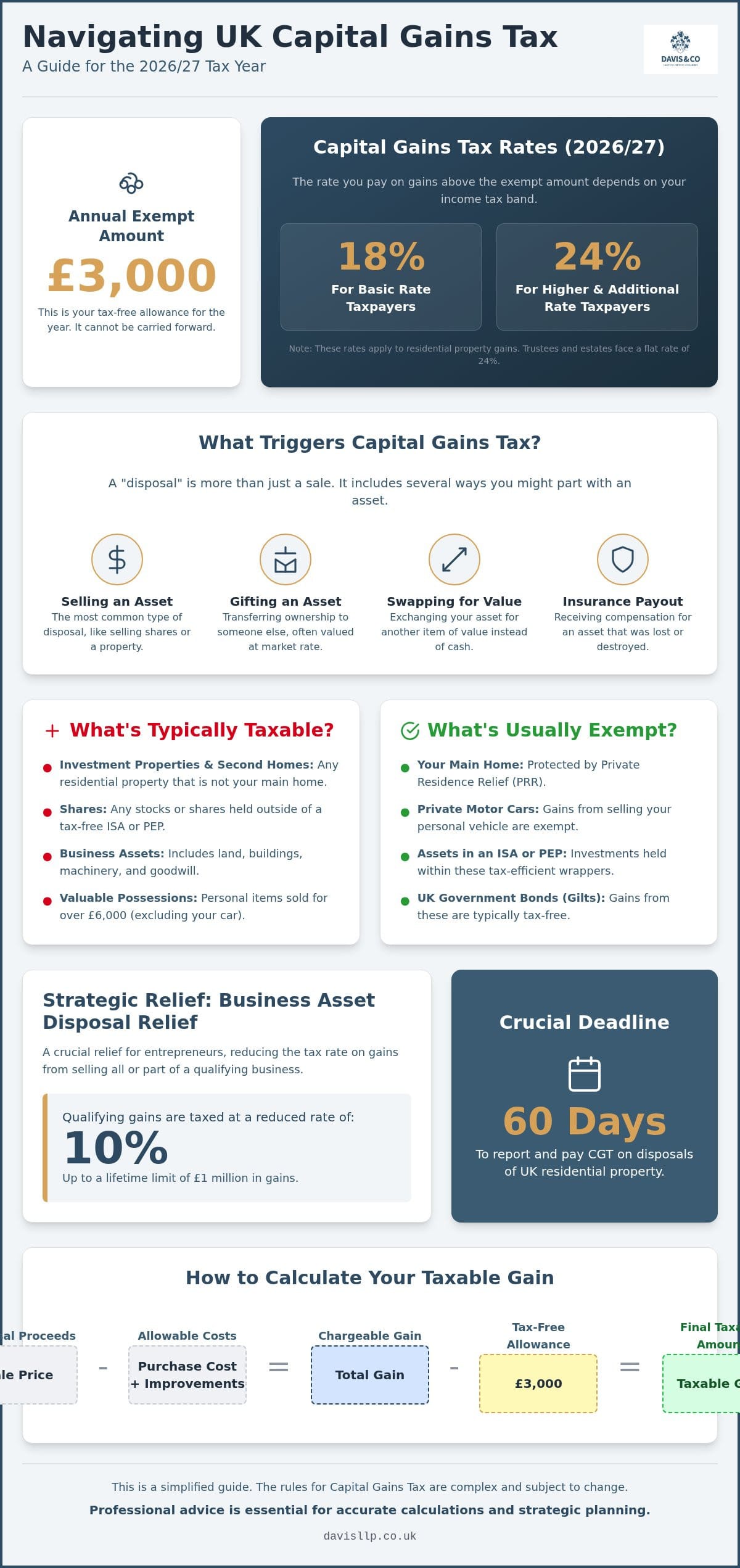
Capital gains tax is a levy on the profit realized when you dispose of an asset that’s increased in value. It’s the gain you make, rather than the total amount of money you receive, that’s taxable. For a broader historical context, an Overview of Capital Gains Tax in the UK reveals how these definitions have evolved to capture a wide range of financial movements. Within the current fiscal environment, a “disposal” isn’t limited to a straightforward sale. It encompasses gifting an asset to someone else, swapping it for something of value, or even receiving insurance compensation for a lost or destroyed item.
Proactive planning is now a necessity. We’ve seen a steady contraction of allowances, which makes it vital to structure disposals with precision. It’s also critical to distinguish between individual liabilities and corporate gains. While individuals pay capital gains tax, limited companies generally pay Corporation Tax on their profits from selling assets. This distinction often dictates the most tax-efficient vehicle for holding long-term investments and influences how we approach cash flow management for our clients.
The 2026 CGT Rates and Allowances
For the 2026/27 tax year, the Annual Exempt Amount is £3,000. This is the portion of your total gains that remains tax-free. Notably, this allowance cannot be carried forward to future years. Beyond this threshold, the rate you pay depends on your taxable income. Basic rate taxpayers pay 18% on gains, while higher and additional rate taxpayers are charged 24%. These rates apply specifically to residential property gains that don’t qualify for Private Residence Relief. Trustees and personal representatives of a deceased person’s estate also face a flat rate of 24% on chargeable gains.
Chargeable Assets vs. Exempt Possessions
Most personal possessions worth more than £6,000 are chargeable, alongside second homes, shares not held in an ISA, and business assets such as land or machinery. Conversely, several items remain exempt from the levy. You won’t usually pay tax on gains from your main home, private motor cars, or assets held within ISAs or Gilts. Determining the exact status of an asset can be nuanced, often requiring expert tax advice in the UK to ensure you aren’t inadvertently overpaying.
Common chargeable assets include:
- Investment properties and second homes.
- Shares not sheltered in an ISA or PEP.
- Business assets like land, buildings, or machinery.
- Personal possessions worth over £6,000, excluding cars.
Specialist Asset Disposal: Property, Shares, and Business Interests
Disposing of high-value or niche assets requires a level of precision that standard reporting often overlooks. When you’re dealing with substantial portfolios or specialized commercial interests, the financial stakes are significantly higher. One common area of complexity involves non-arm’s length transactions, such as gifting shares or property to family members. In these instances, HMRC doesn’t look at the actual price paid, which might be zero, but instead uses the “market value” at the time of the transfer. This can trigger a significant capital gains tax liability that wasn’t initially anticipated.
To mitigate the risk of an inquiry, we always recommend obtaining professional valuations. These provide a documented, defensible basis for your tax return, ensuring you’re not vulnerable to HMRC’s own valuation assessments. It’s also vital for business owners to distinguish between personal asset disposals and those involving the business entity. Mixing these can lead to the loss of valuable reliefs or accidental double taxation. Maintaining clear records allows you to track the acquisition and improvement costs of these assets over time, providing a clear audit trail for any future disposal.
Property Gains and Residential Property Accounts
Residential property remains one of the most scrutinized areas of UK tax law. While Private Residence Relief (PRR) protects most main homes, the situation changes if you’ve let the property out or if it’s been vacant for extended periods. For those residing abroad, selling UK property triggers specific reporting requirements that must be met within 60 days. Navigating these rules requires a structured approach to property accounting, especially when calculating the impact of previous letting periods. You should consult the official Capital Gains Tax rates and allowances to understand how the 18% and 24% residential rates apply to your specific gain. If you’re managing a diverse portfolio, our bespoke personal tax services can provide the planning needed to protect your returns.
Dental Practices and Professional Goodwill
For dental professionals, the disposal of a practice is a career-defining event that carries unique tax implications. The complexity lies in the valuation of professional goodwill versus tangible equipment. Goodwill is often the most valuable asset in a dental practice sale, yet its tax treatment depends heavily on how the sale is structured. A specialist dental accountant understands the nuances of the healthcare market and can help you navigate the distinction between personal and practice goodwill. Ensuring that equipment is valued at fair market rates while optimizing the goodwill component is essential for a tax-efficient exit strategy. This level of industry-specific insight ensures that you don’t overpay during the transition of your practice.
Calculating Your Liability: Gains, Losses, and Deductions
The calculation for capital gains tax is often perceived as a simple arithmetic exercise, yet the definition of the “cost base” requires careful scrutiny. The basic formula involves subtracting the acquisition cost and allowable expenses from the disposal proceeds. However, the precision with which you identify these costs determines whether you’re paying more than necessary. For business owners, maintaining robust management accounts is essential to ensure that every historical investment in an asset is recorded and ready for deduction.
When determining your gain, you should include incidental costs such as legal fees, surveyor valuations, and Stamp Duty Land Tax paid at the time of purchase. Similarly, costs incurred during the sale, such as advertising or estate agent commissions, are fully deductible. Adhering to the UK Capital Gains Tax rules ensures that these deductions are applied correctly to reduce the taxable portion of your profit. We often find that clients who keep meticulous records throughout the asset’s lifecycle are the ones best positioned to defend their calculations during an HMRC review.
Allowable Costs and Capital Improvements
A frequent point of confusion lies in the distinction between capital improvements and routine maintenance. While repairing a broken window or repainting a room are considered maintenance and generally not deductible for CGT, adding an extension or installing a new central heating system where none existed are capital enhancements. These improvements must still be reflected in the asset at the time of disposal to be eligible. You’ll need to retain every invoice and proof of payment, as HMRC requires clear documentation to validate these claims. Allowable Expenditure for 2026 tax purposes comprises the initial purchase price, incidental costs of acquisition and disposal such as legal fees and stamp duty, and any subsequent capital expenditure incurred to enhance the asset’s value.
Utilising Capital Losses Strategically
Losses are a vital component of a well-managed tax strategy. If you dispose of an asset for less than its cost base, you realize a capital loss that can offset gains made in the same tax year. If your total losses exceed your gains, you can carry the unused balance forward indefinitely to offset future liabilities. You can also make a “negligible value claim” for assets that haven’t been sold but have become worth next to nothing, such as shares in a liquidated company. You must report these losses to HMRC within four years of the end of the tax year in which they occurred to preserve your right to use them.
Strategic Mitigation: Reliefs and Planning Opportunities
Reliefs are not merely loopholes; they’re statutory instruments designed to reward long-term investment and commercial risk-taking. Effective mitigation requires a shift from reactive reporting to proactive structural planning. One of the most accessible methods involves the strategic transfer of assets between spouses or civil partners. Because these transfers typically occur on a no-gain, no-loss basis, they allow a household to utilize two sets of the £3,000 annual exempt amount. This effectively doubles the tax-free threshold for a single disposal, provided the transfer is completed well in advance of the final sale.
For those with more complex estate requirements, the use of trusts can offer a sophisticated layer of protection against immediate capital gains tax exposure. By transferring assets into a trust, you can often manage the timing of disposals more effectively, aligning them with years where your personal tax bracket or available allowances are most favorable. This approach requires a high degree of precision to ensure compliance with both capital gains and inheritance tax frameworks, but it serves as a cornerstone for preserving family wealth across generations.
The landscape for non-residents is equally nuanced. The interplay between UK liabilities and international tax planning is critical for those disposing of UK-based assets while living abroad. Navigating double taxation treaties and specific non-resident reporting deadlines is essential to avoid overpayment in multiple jurisdictions. If you’re managing cross-border interests, our personal tax services provide the bespoke oversight needed to ensure your global position is fully optimized.
Business Asset Disposal Relief (BADR)
From April 6, 2026, the rate for gains qualifying for Business Asset Disposal Relief has increased to 18%. While this is a rise from the previous 10% rate, it still represents a significant saving compared to the 24% higher rate. To qualify for this preferential treatment, you must meet strict criteria, including holding at least 5% of the shares and voting rights in a trading company for at least two years prior to the sale. You must also be an employee or officer of the business. A common pitfall that disqualifies many owners is the “trading” requirement; if your company holds too many non-trading assets, such as substantial investment properties, HMRC may challenge your eligibility for the relief.
Gift Holdover Relief and Rollover Relief
Succession planning often relies on Gift Holdover Relief, which allows you to defer the tax charge when gifting business assets to a successor. Instead of the donor paying tax on the market value at the time of the gift, the gain is “held over” and only becomes taxable when the recipient eventually disposes of the asset. This is a vital tool for families looking to pass on a business without triggering an immediate cash flow crisis. Similarly, Rollover Relief facilitates business growth by allowing you to defer the tax on gains from the sale of certain business assets if you reinvest the proceeds into new qualifying assets. This ensures that capital remains within the business to support expansion rather than being depleted by immediate tax liabilities.
Compliance and the Role of Professional Advisory
Compliance has transitioned from an annual administrative task to a process requiring near-continuous oversight. HMRC’s increasing focus on real-time reporting means the window for error has narrowed significantly. For many, the first encounter with these rigorous standards occurs during a property sale, where the 60-day rule for residential disposals demands immediate action. Beyond mere filing, the application of professional audit and assurance processes serves as a critical safeguard. These structured reviews ensure the data supporting your capital gains tax return is both accurate and defensible, minimizing the likelihood of a protracted HMRC inquiry.
Should an investigation arise, the value of robust disclosure can’t be overstated. HMRC’s scrutiny often focuses on the valuation of unlisted shares or the eligibility of specific reliefs discussed in previous sections. By maintaining a comprehensive audit trail, we help you manage these interactions with composure and clarity. It’s also essential to recognize that capital gains decisions inevitably ripple through your wider personal tax and inheritance strategy. A disposal today might reduce your immediate liability but could increase the future burden on your estate if it isn’t balanced against inheritance tax objectives.
Reporting Deadlines and Penalties
The 60-day window for reporting and paying tax on UK residential property is a hard deadline. Missing this threshold triggers immediate penalties and accruing interest, even if no tax is ultimately due. For non-residential assets, such as shares or business equipment, the reporting typically falls within the standard Self-Assessment cycle. However, waiting until the end of the tax year to calculate these figures is a risky strategy. Early notification allows for more precise cash flow management and ensures any available losses are captured within the correct period to offset your gains.
Why Strategic Tax Planning Matters
True financial security comes from moving beyond basic compliance toward proactive wealth preservation. A collaborative partnership with a Chartered Certified Accountant ensures your tax position is reviewed in the context of your long-term goals rather than as a series of isolated events. This holistic approach allows us to identify opportunities for mitigation that might otherwise be missed in the rush to meet a deadline. Davis & Co LLP integrates CGT planning into a tailored financial roadmap that aligns your immediate disposal needs with your broader legacy and business growth objectives.
Securing Your Financial Position for 2026 and Beyond
The landscape of capital gains tax in 2026 demands a shift from simple compliance to sophisticated, long-term strategy. We’ve explored how the reduced £3,000 annual exempt amount and the prevailing 18% and 24% rates necessitate a more precise approach to asset disposal. Whether you’re navigating the complexities of a dental practice sale, managing a diverse property portfolio, or overseeing international assets, the key to wealth preservation lies in the details of your cost-base calculations and the timely application of statutory reliefs.
As Chartered Certified Accountants with deep experience in specialist dental and property accounting, we provide the expert international tax planning required for such sensitive matters. Our role is to act as your strategic partner, ensuring your personal and business interests remain fully optimized within a logical and robust framework. We invite you to contact Davis & Co LLP for bespoke tax planning advice to discuss your specific requirements. Taking these steps now will provide the stability and clarity you need to manage your wealth with total confidence.
Frequently Asked Questions
What is the Capital Gains Tax allowance for the 2026/27 tax year?
The annual exempt amount for the 2026/27 tax year is £3,000 for individuals. This tax-free allowance is used to offset the total gains you make during the year, but it’s important to remember that it cannot be carried forward to future years if it remains unused. For couples, transferring assets to utilize both individuals’ allowances is a common strategy to maximize the total tax-free threshold for a household.
Do I pay Capital Gains Tax when I sell my main home?
You typically don’t pay capital gains tax on the sale of your main home because it’s covered by Private Residence Relief. This relief usually applies automatically if the property has been your only or main home throughout your period of ownership. However, a liability may arise if you’ve used part of the home exclusively for business, let out a portion of the property, or if the grounds exceed 0.5 hectares.
How long do I have to report a gain on a buy-to-let property?
For the disposal of UK residential property, you must report the gain and pay any tax due within 60 days of the completion date. This is a strict statutory deadline that applies to both UK residents and non-residents. Failure to meet this requirement results in immediate penalties and interest charges. We recommend preparing your calculations well in advance of completion to ensure your reporting is both accurate and timely.
Can I transfer assets to my spouse to avoid Capital Gains Tax?
Transfers of assets between spouses or civil partners are treated on a “no gain, no loss” basis, meaning no tax is due at the point of transfer. While this doesn’t eliminate the tax permanently, it allows you to utilize your partner’s £3,000 annual exempt amount or their lower tax bracket upon the eventual sale to a third party. The transfer must be a genuine gift made before the final disposal occurs.
What expenses can I deduct from my capital gain calculation?
You can deduct several allowable costs to reduce your taxable gain, including the initial purchase price and Stamp Duty Land Tax. Legal fees associated with the acquisition and disposal, as well as surveyor valuations and estate agent commissions, are also fully deductible. Additionally, you can claim for capital improvements that enhance the asset’s value, such as an extension. Routine maintenance and repairs, however, are not eligible for deduction.
Is Business Asset Disposal Relief still available in 2026?
Business Asset Disposal Relief is still available in 2026, though the applicable tax rate has increased to 18% as of April 6, 2026. This relief allows qualifying business owners to pay a lower rate on the first £1 million of lifetime gains. To qualify, you must have owned at least 5% of the business for at least two years while serving as an employee or office holder. Precision in meeting these criteria is essential.
Do non-UK residents have to pay CGT on UK assets?
Non-UK residents are liable for tax on gains made from the disposal of UK land and property, including residential and commercial interests. This also extends to assets used in a UK branch or agency. Reporting must be completed within the 60-day window, even if no tax is due. Our international tax planning services help non-residents navigate the complexities of double taxation treaties to ensure their global tax position remains efficient.
What happens if I make a loss on an asset sale?
If you sell an asset for less than its original cost base, you realize a capital loss. These losses are used to offset gains made in the same tax year, reducing your overall capital gains tax liability. If your total losses exceed your gains, the unused balance can be carried forward indefinitely to offset future gains. You must report these losses to HMRC within four years to preserve your right to use them.