The era of “good enough” ecommerce bookkeeping is ending. By 2026, the distance between a resilient brand and one that falters will be measured by the precision of its financial architecture. As your brand expands across borders, the initial thrill of international sales often gives way to a persistent anxiety over complex regulations. It’s frustrating to look at bundled payouts from platforms like Shopify or Amazon and realise you can’t actually see your true profitability beneath the surface. We understand the weight of this uncertainty when you’re trying to scale a business in a volatile global market.
This guide will help you master the complexities of online retail finance by providing professional insights on cross-border compliance and accrual accounting. We’ll show you how to move beyond basic data collection toward a robust framework that handles international VAT for ecommerce businesses with absolute precision. We’ll explore the transition to decision-ready financial statements, the nuances of the OSS scheme, and the strategic shifts necessary to ensure your brand’s growth is both compliant and sustainable for the years ahead.
Key Takeaways
- Learn why transitioning to the accrual method is essential for high-growth brands to untangle bundled payouts and identify true monthly profitability.
- Ensure total compliance across multiple tax jurisdictions by mastering international VAT for ecommerce businesses, including the latest 2026 UK and EU regulations.
- Discover how management accounts and advanced cash flow forecasting provide the clarity needed for confident inventory investment and strategic scaling.
- Understand the value of a professional financial architecture that combines traditional chartered expertise with the specific demands of modern digital commerce.
The Unique Challenges of Modern Ecommerce Accounting
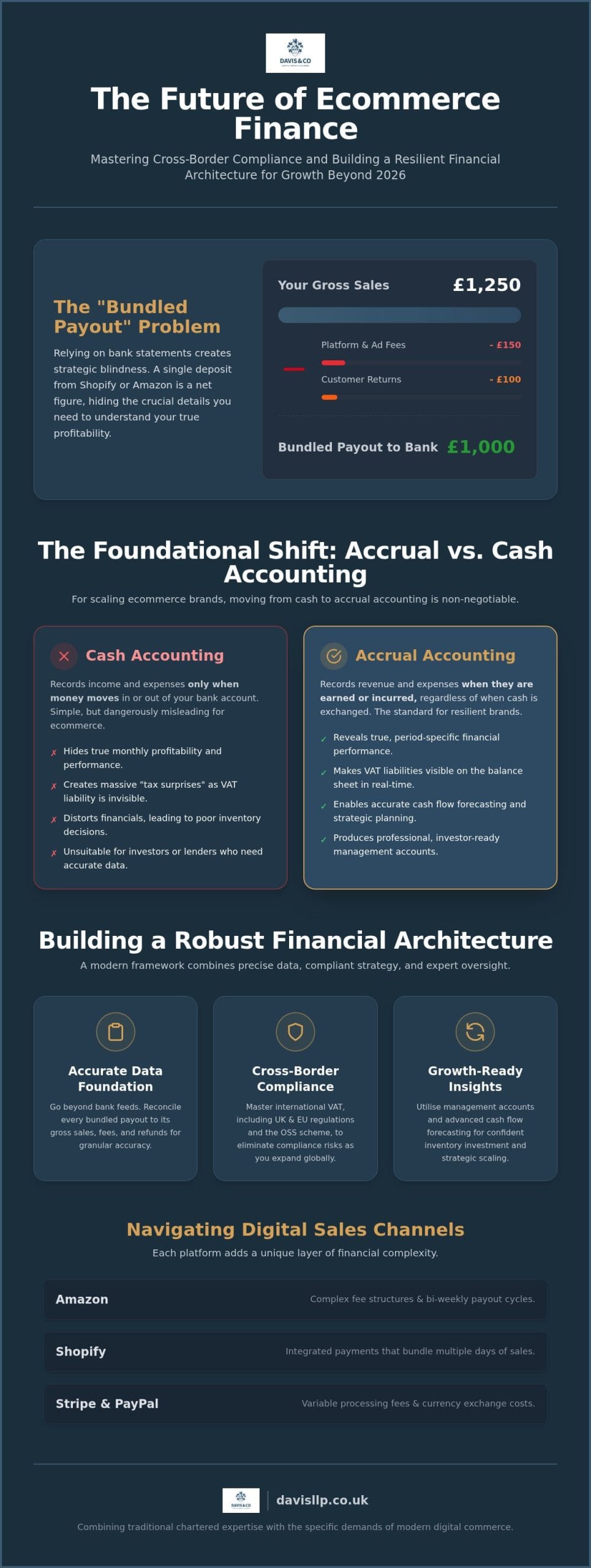
Modern ecommerce is a data management exercise as much as a retail one. High-volume transactions across multiple channels create a level of complexity that traditional accounting often fails to address. We’ve seen that relying on bank statements alone is a recipe for strategic blindness. When a deposit hits your account from Shopify or Amazon, it’s a net figure. It has already been stripped of commissions, shipping labels, and advertising costs. This creates the “Bundled Payout” problem. Your bank balance doesn’t reflect your actual turnover, making it impossible to see your true gross margins without deeper intervention.
Managing Value-Added Tax (VAT) on these transactions requires granular visibility. This is particularly true when considering international VAT for ecommerce businesses, where tax rates vary by the customer’s location and the specific rules of the destination country. There’s often a significant lag between the moment a sale is made and the final settlement in your bank account. Without professional oversight, this timing difference can distort your financial position and lead to poor stock-buying decisions.
Why Traditional Bookkeeping Fails Online Sellers
Traditional bookkeeping treats every bank entry as a single event. In digital commerce, a £1,000 deposit might represent £1,250 in sales, £150 in fees, and £100 in refunded returns. If you don’t account for these gross figures, your margins look healthier than they are. While automated software is helpful, it requires professional validation to ensure data feeds are mapping correctly. Automated tools lack the judgment to spot systemic errors in tax treatment or currency conversion, which can lead to costly HMRC enquiries later.
The Role of Digital Sales Channels in Financial Reporting
Platforms like Amazon, Shopify, and eBay each have distinct reporting cadences. Payment gateways such as Stripe, PayPal, and Klarna add another layer of complexity with varying settlement periods and reserve requirements. Payout reconciliation is the process of mapping bundled deposits to individual transactions and fees. This level of detail is vital for maintaining compliance with international VAT for ecommerce businesses, as it allows for the precise reporting of tax collected at the point of sale versus what is actually remitted to the business.
- Amazon: Complex fee structures and bi-weekly payouts.
- Shopify: Integrated payments that often bundle multiple days of sales.
- Stripe/PayPal: Variable processing fees and currency exchange costs.
Establishing a Robust Financial Architecture: Accrual vs. Cash Accounting
Many fledgling digital brands begin with cash accounting because it reflects the immediate reality of the bank balance. You record income when it arrives and expenses when they’re paid. While this works for a simple side project, it’s insufficient for a brand aiming for significant scale. Cash accounting hides the timing differences that define modern retail. By contrast, accrual accounting records revenue and expenses when they are earned or incurred, providing a much more accurate reflection of your business’s health.
This distinction is vital for managing international VAT for ecommerce businesses. When you sell a product today, the VAT liability is created immediately, even if the marketplace doesn’t release the funds for another fourteen days. Accrual accounting ensures these liabilities are visible on your balance sheet in real time. It prevents the “tax surprise” that often occurs when brands rely solely on cash flow to estimate their obligations for VAT on cross-border e-commerce.
The Strategic Advantage of Accrual Accounting
Accrual accounting offers a level of intellectual rigour that investors and lenders expect. It smooths out the financial noise created by large inventory orders or annual software subscriptions. By aligning your revenue with the specific period in which the sale occurred, you gain an unfiltered view of your brand’s performance. This clarity is essential for producing professional management accounts that drive high-level strategy. It builds a reliable financial history that proves your business is a stable, investable asset rather than a series of disconnected transactions.
Inventory Management and COGS Accuracy
The most significant benefit of an accrual-based architecture is the accurate tracking of Cost of Goods Sold (COGS). If you spend £20,000 on stock in January but don’t sell it until March, cash accounting shows a massive loss in winter and an inflated profit in spring. Accrual accounting holds that £20,000 on the balance sheet as an asset, only moving it to the profit and loss account as the items are sold. This process must include landed costs such as freight, insurance, and import duties to be truly accurate. Integrating your inventory management system with your core accounting software ensures these values remain precise. If you feel your current reporting lacks this level of detail, our specialists can help you refine your financial framework to support sustainable growth.
Cross-Border Compliance: Navigating International VAT and Global Tax
Expanding a digital brand beyond the UK requires more than just logistics; it demands a sophisticated understanding of global tax obligations. For many, the first milestone is the domestic VAT registration threshold, which remains a key consideration for 2026. However, the complexities of international VAT for ecommerce businesses often arise long before you reach significant scale in any single territory. We’ve found that early preparation is the only way to prevent compliance issues from throttling your expansion.
The EU’s One-Stop Shop (OSS) and Import One-Stop Shop (IOSS) systems were designed to simplify compliance, yet they require an uncompromising level of data accuracy. Adhering to OECD guidance on e-commerce taxation provides a framework for managing these multi-jurisdictional demands, especially when dealing with transfer pricing and profit allocation. Beyond Europe, brands must also monitor US Sales Tax nexus, where economic activity alone can trigger a requirement to collect and remit tax in individual states, regardless of physical presence.
VAT Compliance in a Post-Brexit Landscape
Selling to EU customers from a UK base involves navigating customs declarations and varying VAT rates across member states. We often advise clients on the benefits of voluntary VAT registration, even if they’re below the prevailing £90,000 threshold. This allows for the recovery of input tax on business expenses, which can significantly improve your bottom line. Accurate returns are not just a legal requirement; they’re your primary defence against HMRC scrutiny and the risk of costly penalties.
Strategic Tax Planning for Global Expansion
As your brand matures, the focus shifts from simple compliance to efficiency. Interpreting double taxation treaties is essential for digital operations that span multiple continents. Comprehensive international tax planning ensures that cross-border brands avoid redundant tax leakage while meeting all local obligations through the precise application of double taxation treaties and optimized entity structures. We work with you to ensure your corporate structure supports growth without creating unnecessary tax liabilities. This partner-led approach provides the discretion and rigour required to manage sensitive commercial interests effectively.
Beyond Bookkeeping: Growth Acceleration and Cash Flow Management
Precision in bookkeeping is the foundation, yet it’s the strategic application of that data that separates market leaders from their competitors. Management accounts serve as a bridge between historical records and future objectives. By transforming raw transactional data into actionable insights, we help you identify which product lines drive genuine profit and which are merely consuming capital. This level of clarity is particularly vital when managing the cash flow implications of international VAT for ecommerce businesses, where tax liabilities can fluctuate significantly based on seasonal demand and regional sales mix.
Effective financial management requires a transition from reactive reporting to proactive planning. We prioritise a partner-led approach that focuses on your brand’s long-term viability. This involves more than just ensuring the numbers are accurate; it’s about protecting the assets you’ve worked hard to build. Accessing expert tax advice ensures that your business remains resilient against regulatory shifts while maintaining a lean, efficient tax profile.
Mastering Cash Flow in the Ecommerce Cycle
Ecommerce is inherently capital-intensive. The requirement to purchase inventory months before a sale creates a persistent pressure on working capital. This is most evident during the preparation for Q4, where stock levels must be peaked to meet seasonal demand. We help you build advanced cash flow forecasts that predict these requirements with high accuracy. By managing the gap between supplier payments and customer receipts, you can avoid the liquidity traps that often stall scaling brands. Improving working capital efficiency allows you to reinvest in marketing or product development without compromising your operational stability.
Strategic Advisory for Scaling Brands
Scaling a brand requires a clear understanding of where you stand relative to the market. We provide benchmarking services that compare your performance against industry standards, highlighting areas for margin improvement. As you grow, your financial reporting must withstand the scrutiny of lenders or potential investors. Rigorous management accounts demonstrate a level of professional gravitas that builds trust and increases your brand’s valuation. We help you identify high-margin product lines and streamline your cost base, ensuring that every pound spent contributes to your strategic goals. To ensure your financial architecture is ready for the next stage of growth, you can partner with our growth specialists for a tailored consultation.
The Davis & Co LLP Approach to Ecommerce Excellence
Davis & Co LLP stands as a bridge between the enduring standards of the accountancy profession and the rapid evolution of digital retail. Established in 1901, we bring 125 years of heritage to the specific challenges of the 2026 marketplace. While many providers offer high-volume, automated solutions, we prioritise a partner-led model that delivers discretion and strategic depth. Managing international VAT for ecommerce businesses requires more than just an automated script; it requires the intellectual rigour of a firm that’s navigated shifting regulations for over a century. We understand that for an established brand, the goal isn’t just to stay compliant but to build a legacy of financial stability.
Understated Confidence and Professional Gravitas
The transition from a high-growth startup to an institutional-grade enterprise requires a shift in how you view your finance function. Moving away from high-volume, low-touch accounting models is a necessary step for brands that have outgrown basic software solutions. We offer a bespoke partnership that respects the complexity of your digital enterprise. By focusing on meticulous compliance and long-term planning, we ensure your business remains resilient against the volatility of global markets. Our approach is characterized by a quiet excellence that doesn’t need to shout to prove its value. We provide a steady, measured rhythm that builds trust and stability in an often hurried environment.
A Strategic Partner for Your Digital Journey
Our multi-disciplinary team provides comprehensive support that extends beyond the corporate balance sheet. We understand the intersection of business and personal tax needs, offering a cohesive strategy that protects both your commercial and individual interests. The peace of mind that comes from robust audit and assurance services is invaluable for brands preparing for a future exit or significant investment. We believe that finding a chartered accountant who understands the nuances of cross-border commerce is the first step toward professionalising your operations.
If your brand is ready to move beyond basic bookkeeping to a sophisticated financial architecture, we’re here to provide the guidance your growth demands. Our team combines traditional values with contemporary application, ensuring that your international VAT obligations and wider tax strategies are handled with absolute precision. We invite established digital brands to experience a level of service where reputation and expertise are evident in every communication.
Securing the Future of Your Digital Enterprise
Professionalising your finance function is the most significant step you can take toward sustainable growth in the years ahead. By moving beyond simple bookkeeping and embracing a robust accrual-based framework, you gain an unfiltered view of your brand’s true performance. Mastering the nuances of international VAT for ecommerce businesses ensures your expansion remains compliant across multiple jurisdictions, protecting your assets from regulatory scrutiny. We’ve spent over a century refining our approach to help brands navigate these complexities with absolute confidence.
As Chartered Certified Accountants since 1901, we combine deep expertise in international tax planning with a specific focus on business growth and management accounting. We invite you to discover how Davis & Co LLP can professionalise your ecommerce financial strategy through a partner-led relationship built on reliability and discretion. Your brand’s potential is significant, and with the right financial architecture, your path to scaling in 2026 becomes both clear and secure.
Frequently Asked Questions
What is the main difference between ecommerce accounting and traditional accounting?
Ecommerce accounting focuses on managing high-volume, multi-channel financial data rather than simple transactional records. Traditional accounting often struggles with “bundled payouts” where marketplaces deposit net amounts after fees and returns. We ensure every transaction is mapped to its gross value, providing the clarity needed to understand true profitability. This level of detail is essential for brands navigating the complexities of international VAT for ecommerce businesses across various global platforms.
When should an ecommerce business switch from cash to accrual accounting?
You should switch to accrual accounting as soon as your brand begins to scale or seeks external investment. Accrual accounting is essential because it matches your Cost of Goods Sold (COGS) with the actual period of the sale. This removes the financial noise created by large inventory purchases. It provides a reliable history of performance that satisfies lenders and helps you make informed decisions about your brand’s long-term trajectory.
Do I need to register for VAT if I only sell digital products internationally?
Yes, digital products are generally subject to VAT in the country where the customer resides. For UK businesses selling to EU consumers, this often requires registration for the One-Stop Shop (OSS) scheme regardless of your UK turnover. Managing international VAT for ecommerce businesses selling digital goods requires precise data collection at the point of sale to ensure the correct local tax rate is applied and remitted to the relevant authorities.
How do I handle accounting for multiple sales channels like Amazon and Shopify?
Handling multiple channels requires a process called payout reconciliation to map bundled deposits to individual transactions. Platforms like Amazon and Shopify provide different reporting structures, which must be consolidated into your core accounting software. We use professional frameworks to ensure that commissions, shipping labels, and advertising costs are accurately categorised. This prevents your financial statements from being distorted by the varying settlement periods of different payment gateways.
What are the common pitfalls in ecommerce bookkeeping that lead to HMRC investigations?
The most common pitfalls include failing to account for gross sales before marketplace fees and incorrect VAT treatment on cross-border shipments. HMRC often investigates businesses that cannot reconcile their bank deposits with their reported turnover. Inconsistent reporting across different sales channels or missing the registration thresholds for international tax obligations can also trigger audits. Maintaining meticulous records and seeking professional validation is the best way to ensure long-term compliance and stability.
Can a chartered accountant help with international sales tax compliance in the US and EU?
A chartered accountant provides the intellectual rigour necessary to interpret complex tax treaties and nexus rules in the US and EU. We move beyond simple software automation to offer strategic international tax planning. This includes determining when your economic activity triggers a sales tax nexus in specific US states or navigating the post-Brexit VAT landscape in Europe. Our partner-led approach ensures your global expansion is supported by robust compliance and efficient corporate structures.
How often should I receive management accounts for my online business?
We recommend that established digital brands receive management accounts on a monthly basis. This frequency allows you to react quickly to shifts in consumer behaviour or rising supplier costs. Monthly reporting provides the steady, measured rhythm necessary for effective cash flow management and inventory planning. It ensures that your strategic decisions are always based on recent, accurate data rather than outdated estimates or gut feeling.
What financial metrics are most important for an ecommerce brand to track for growth?
The most critical metrics include your true gross margin after all marketplace fees and landed costs. You should also monitor your inventory turnover and the ratio of customer acquisition cost to lifetime value. Understanding these figures allows you to identify high-margin product lines and allocate your marketing budget more effectively. We use management accounts to track these KPIs, providing the strategic value required to accelerate your brand’s growth.