What if the reported profits of your target dental practice are merely a reflection of the current owner’s personal lifestyle rather than sustainable business performance? We recognize that the transition from associate to owner is often accompanied by a legitimate fear of overpaying for a practice with hidden vulnerabilities, such as a declining patient base or an unstable NHS contract. It’s a complex process to separate private discretionary spending from essential operational costs when reviewing a seller’s accounts. This guide provides a professional framework for financial due diligence for buying a dental practice, offering you the tools to mitigate risk and secure a transaction based on genuine commercial value.
We’ll explore how to validate patient recall systems and production mixes while scrutinizing UDA values following the April 2026 NHS contract reforms. By moving beyond surface-level figures, we’ll help you arrive at a precise EBITDA that reflects the practice’s true earning potential. Our objective is to ensure your path to completion is both strategically sound and financially secure, providing the clarity needed to make an informed investment in your professional future.
Key Takeaways
- Understand why independent verification is essential for navigating the “buyer beware” principle in professional healthcare acquisitions.
- Master the framework of financial due diligence for buying a dental practice by reconciling P&L accounts with statutory filings to ensure data integrity.
- Learn to calculate a true EBITDA through the normalisation process, stripping out non-recurring personal expenses to reveal sustainable profit.
- Identify high-risk financial red flags, such as declining hygiene production or uncollectible debt, before they impact your investment.
- Gain clarity on the tax and commercial implications of structuring your deal as either a share or asset purchase for optimal post-completion performance.
The Critical Role of Financial Due Diligence in UK Dental Acquisitions
Financial due diligence for buying a dental practice isn’t just a box-ticking exercise; it’s a rigorous independent verification of a practice’s historical and projected performance. In the UK dental market, where valuations often hinge on complex NHS contracts and private patient loyalty, this process acts as your primary safeguard. Unlike a high-level summary, this targeted review peels back the layers of a practice’s financial health to ensure that what you’re buying is exactly what’s been advertised. We look beyond the surface to confirm that the numbers presented in the sales prospectus are rooted in reality.
The principle of caveat emptor, or “buyer beware,” remains a cornerstone of professional healthcare acquisitions. Sellers naturally present their business in the most favourable light, sometimes obscuring underlying inefficiencies or non-recurring revenue spikes. Without a comprehensive due diligence process, you risk inheriting liabilities or overestimating the stability of the patient base. This is particularly true in 2026, where economic volatility and fluctuating interest rates, currently ranging from 7.5% to 9.5% for conventional dental loans, mean that deeper scrutiny of cash flow is no longer optional.
Distinguishing between a statutory audit and a dental acquisition review is vital for any prospective owner. While an audit confirms that accounts are “true and fair” for regulatory purposes, a dental-specific review examines the quality and sustainability of earnings. We aren’t just looking at the existence of income, but the likelihood of that income continuing under your ownership. This involves a granular analysis of patient demographics, treatment mixes, and the impact of the April 2026 NHS contract reforms on your potential bottom line.
Protecting Your Investment and Future Cash Flow
Conducting thorough financial due diligence for buying a dental practice directly informs the final offer price and the specific warranties included in your Asset Purchase Agreement (APA). Lenders are increasingly cautious. The strength of your financial findings will dictate your ability to secure competitive rates and 100% financing if you’re a qualified borrower. By identifying “deal-breakers” early, such as undisclosed tax irregularities or unachievable UDA targets, you avoid wasting significant legal fees on a transaction that’s fundamentally flawed.
The Interplay Between Clinical and Financial Data
Financial records never tell the full story in isolation. We must verify that reported income aligns with actual chair-time and clinician activity recorded in the Practice Management Software (PMS). Discrepancies between bank statements and PMS reports can reveal unrecorded expenses or “ghost” revenue. If the accounts show high private revenue but the appointment book is sparse, there’s a disconnect that requires immediate investigation. We use this cross-referencing to ensure that the practice’s production is as robust as the bank balance suggests.
Scrutinising the Core Financial Records: A Strategic Framework
The foundation of financial due diligence for buying a dental practice rests upon a meticulous analysis of the previous three years of Profit & Loss (P&L) accounts and Corporation Tax returns. We don’t simply accept these figures at face value. Instead, we reconcile monthly management accounts with year-end statutory filings to identify timing discrepancies or sudden adjustments that might mask underlying performance issues. Guidelines from the British Dental Association emphasise that a historical perspective is vital to distinguish between a practice in genuine growth and one benefiting from a temporary, non-sustainable surge in patient activity.
Beyond the P&L, the balance sheet often holds the most significant risks. We scrutinise this document for hidden liabilities, such as outstanding equipment leases or employee benefit obligations that could transfer to you upon completion. VAT compliance is another area where precision is paramount. While most clinical dental services are exempt, practices with substantial cosmetic treatments or “sundry” retail income must be correctly registered and compliant. As a dental tax specialist, we frequently find that overlooked VAT liabilities on whitening kits or skin aesthetics can create significant post-acquisition headaches if not identified during the initial review.
NHS vs. Private Revenue Streams
We must validate the Units of Dental Activity (UDA) delivery history with clinical precision. Following the April 2026 reforms, which introduced a flat £75 fee for urgent care and required 8.2% of contract value to be delivered as unscheduled care, the risk of NHS BSA “clawbacks” has shifted. We assess the stability of private plans, such as Denplan, by analysing patient attrition rates and the “Production Mix.” It’s essential to ensure the practice isn’t overly dependent on a single high-value clinician whose departure could devalue the entire investment. Sustainable revenue should be distributed across the clinical team to ensure long-term stability.
Payroll and Associate Agreements
Staff costs typically range between 20% and 28% of gross income. We review associate pay scales to ensure they align with the 2026 UK market averages. A critical component of financial due diligence for buying a dental practice is checking for “disguised employment” risks under IR35 regulations. Long-term associates must have robust agreements that reflect their self-employed status to avoid future HMRC challenges. We also verify pension contributions and staff holiday accruals, as these liabilities can often be understated in the seller’s primary accounts, leading to unexpected costs after the keys have changed hands.
Normalising Earnings and EBITDA: Revealing the True Value of a Practice
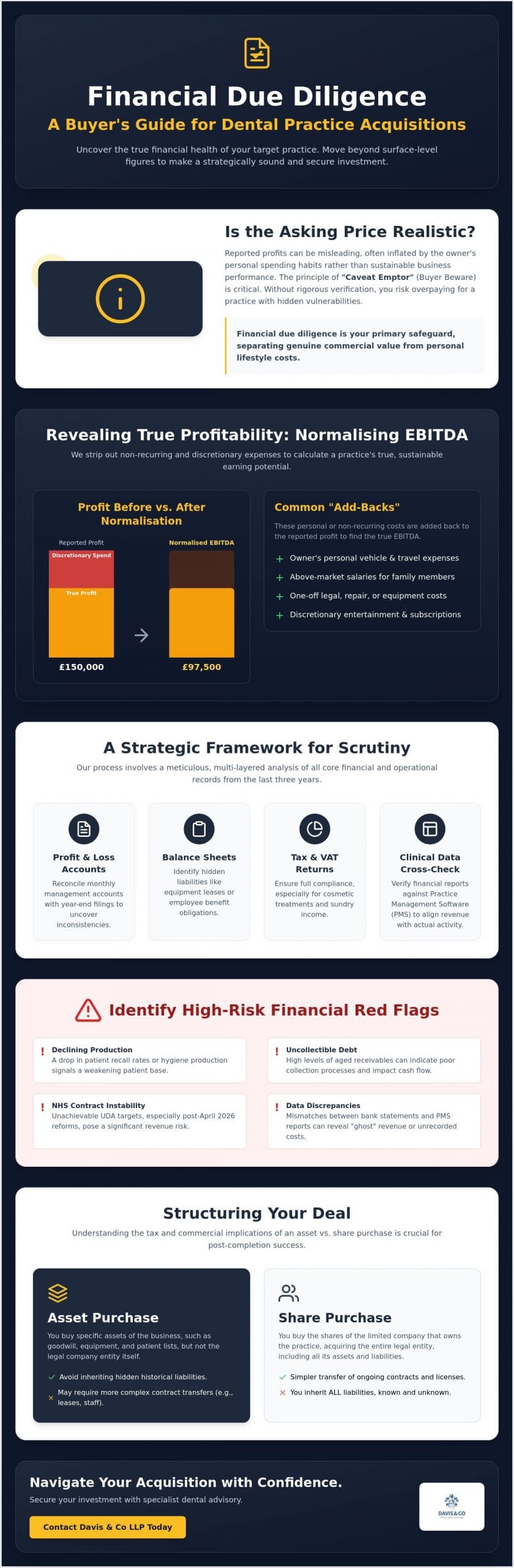
EBITDA (Earnings Before Interest, Taxes, Depreciation, and Amortisation) has established itself as the gold standard for dental valuation in the UK. While historical gross fees were once the primary metric, modern acquisitions focus on the actual cash-generative capacity of the business. Normalisation is the process of adjusting a practice’s financial statements to reflect its performance under typical, third-party management. This allows us to strip away the “lifestyle” adjustments often found in owner-managed practices to reveal the underlying profitability that a new owner can realistically expect to maintain.
When we conduct financial due diligence for buying a dental practice, we scrutinise the principal’s drawings with particular care. It’s essential to replace the owner’s personal income with a realistic “associate cost” to see how the practice would perform under management. If a principal is generating £300,000 in gross fees but not taking a market-rate salary, the EBITDA is artificially inflated. We adjust these figures to reflect the 35% to 45% associate pay scales typical in 2026, ensuring the valuation remains grounded in commercial reality. This approach aligns with the principles found in a comprehensive UK guide to buying a business, which highlights the necessity of adjusting historical data for future owner-occupier scenarios.
Identifying Add-Backs and Hidden Costs
We categorise legitimate “add-backs” as non-recurring or personal expenses that won’t continue post-acquisition. Common examples include one-off legal fees from previous disputes, personal pension contributions, or family vehicles run through the business accounts. However, we must also account for hidden costs. If a practice requires imminent equipment replacement or significant facility upgrades to maintain CQC compliance, these are capital expenditures that effectively reduce the practice’s true value. The multiple applied to EBITDA also fluctuates based on whether the practice is associate-led or principal-led, as the latter carries higher transition risks for the incoming buyer.
Benchmarking Overhead Against UK Averages
Benchmarking provides a secondary layer of verification during financial due diligence for buying a dental practice. We analyse lab bills and material costs to ensure they remain within industry norms; figures that are too low may suggest deferred maintenance or poor quality, while high costs indicate operational inefficiency. Staff cost ratios are particularly telling. While total staff costs, including clinicians, often sit between 20% and 28%, any support staff cost ratio exceeding 18-22% of turnover requires closer investigation. Finally, we verify lease terms, specifically looking for 2026 rent reviews that could impact future profitability and cash flow stability.
Identifying Financial Red Flags and Compliance Risks Before Completion
The most critical phase of financial due diligence for buying a dental practice involves identifying the subtle discrepancies that signal long-term instability. While the profit and loss statement may appear healthy on the surface, we look for leading indicators of decline. One such warning sign is the “Declining Hygiene” trap. Hygiene production acts as the primary pipeline for restorative dentistry; a downward trend in hygiene appointments typically precedes a collapse in overall dental revenue by six to nine months. If patient recall systems are failing, the practice’s future cash flow is already compromised, regardless of current turnover.
Inconsistent accounts receivable often mask uncollectible debt that inflates the practice’s perceived value. We categorise debt by age, typically discounting any balance older than 90 days as a potential bad debt risk. Similarly, large, unexplained entries in “sundry income” or “other income” categories require immediate scrutiny. These entries can sometimes be used to hide personal capital injections from the owner or non-recurring insurance payouts that won’t continue under your leadership. High staff turnover is another red flag, as the costs of recruitment and locum cover in the 2026 market can quickly erode your expected margins.
NHS Contractual Vulnerabilities
The April 2026 NHS dental contract reforms have introduced new complexities regarding contract stability and transferability. We verify that the practice has met its requirement to deliver 8.2% of its contract value as unscheduled care, as failure to do so can lead to contract termination or significant financial penalties. We also assess the risk of “clawbacks” from the NHS BSA, ensuring that the historical UDA delivery is robust and verifiable. With NHS dental charges now set at £27.90 for Band 1 and £332.10 for Band 3, any historical under-performance creates a liability that must be addressed in the final negotiations.
Tax and Regulatory Compliance Checks
We ensure that the practice has no outstanding HMRC enquiries, particularly given the April 2026 increase in Business Asset Disposal Relief (BADR) rates to 18%, which has prompted many sellers to rush their exits. It’s essential to verify that the small business accountant previously employed by the seller has correctly handled dental-specific tax nuances, such as associate IR35 status and VAT on cosmetic treatments. Furthermore, we cross-reference CQC registration status with required financial improvements to ensure you aren’t inheriting a practice with pending regulatory sanctions. To ensure your acquisition is built on a foundation of total transparency, we recommend a professional financial review before signing any binding agreements.
Executing a Secure Acquisition with Specialist Dental Advisory
Completing the financial due diligence for buying a dental practice marks a pivotal transition from investigation to execution. The insights gained during the scrutiny of P&L accounts and patient production data now serve as your primary leverage in final negotiations. We use these objective findings to justify adjustments to the purchase price or to insist on specific indemnities within the sale agreement. When a seller understands that your offer is grounded in a granular analysis of their normalized EBITDA, the conversation shifts from subjective valuation to commercial reality.
Structuring the deal correctly is as vital as the valuation itself. You’ll typically face a choice between a Share Purchase and an Asset Purchase. A Share Purchase involves acquiring the entire limited company, which can be attractive to sellers seeking Business Asset Disposal Relief, yet it requires deeper investigation into historical tax liabilities. Conversely, an Asset Purchase allows you to cherry-pick the practice’s goodwill and equipment, often providing superior opportunities for capital allowances and a “clean break” from the seller’s past obligations. Engaging a specialist dental tax accountant during this phase ensures that the chosen structure aligns with your long-term personal and professional tax objectives.
Collaborative Partnership for a Smooth Transition
We believe that a successful acquisition requires a unified front. Our team integrates closely with your legal advisors to ensure that financial findings are accurately reflected in the legal warranties. This collaborative approach provides a reassuring authority during high-pressure moments, allowing you to focus on clinical continuity while we handle the technical complexities of the transaction. We develop a bespoke tax strategy for your new entity from the outset, ensuring you’re positioned to take full advantage of the £1 million Annual Investment Allowance for any planned equipment upgrades in 2026.
Long-Term Strategic Support
The first 100 days of ownership are critical for establishing operational control. We help you transition from the initial financial due diligence for buying a dental practice to ongoing business growth and management accounting. By implementing robust cash flow management systems from day one, we ensure you have real-time visibility into your UDA delivery and private revenue growth. This steady, measured oversight transforms a successful purchase into a thriving, sustainable business. We invite you to contact us to discuss how we can provide the strategic partnership necessary for your upcoming dental practice acquisition.
Securing Your Professional Legacy
Transitioning from a clinical associate to a practice owner is a milestone that requires both ambition and meticulous calculation. By moving beyond surface-level figures to reveal a practice’s true EBITDA and identifying subtle red flags before they become liabilities, you protect your capital and your future peace of mind. The success of your acquisition depends on your ability to interpret complex data and choose a deal structure that supports sustainable growth. Undertaking thorough financial due diligence for buying a dental practice is the most significant investment you’ll make in ensuring your new venture is commercially viable from day one.
As Chartered Certified Accountants with deep-seated specialist dental industry expertise, we offer more than simple compliance. Davis & Co LLP provides over 120 years of professional gravitas and intellectual rigour, supporting you through every stage from international tax planning to domestic business growth. We act as your composed partner, helping you navigate high-pressure negotiations with clarity and confidence. Secure your dental practice acquisition with specialist due diligence from Davis & Co LLP. We look forward to helping you build a thriving professional future.
Frequently Asked Questions
How long does financial due diligence typically take for a UK dental practice?
The financial due diligence process for a dental practice acquisition typically takes between four and eight weeks. This timeline allows for a thorough review of the previous three years of accounts and clinical production data. The entire transaction, from the signed Letter of Intent to completion, usually spans 60 to 180 days for private sales. Ensuring a steady, measured pace during this phase is essential for identifying hidden risks.
Can I perform due diligence myself if I have the seller’s bank statements?
Reviewing bank statements alone is insufficient for a comprehensive assessment. While statements confirm cash flow, they don’t reveal the normalisation of earnings or the quality of clinical production. You need to reconcile bank data with Practice Management Software reports and statutory filings to see the true picture. Professional scrutiny is required to separate the owner’s personal lifestyle expenses from the practice’s core operational costs.
What is the most common financial red flag in dental acquisitions?
A decline in hygiene production is often the most significant red flag. Hygiene appointments serve as the primary pipeline for restorative work; a drop here suggests a future collapse in dental revenue. Other concerns include uncollectible debt older than 90 days and high staff turnover. These indicators suggest underlying operational instability that current profit figures might not yet reflect.
How does an NHS contract affect the due diligence process compared to a private practice?
NHS contracts introduce specific regulatory risks, such as UDA delivery targets and potential clawback risks from the NHS BSA. Following the April 2026 reforms, we must verify that the practice delivers 8.2% of its contract value as unscheduled care. Private practices require deeper analysis of patient plan stability and attrition rates. Both models demand a tailored approach to financial due diligence for buying a dental practice.
What is a “normalised” EBITDA and why is it used for valuation?
Normalised EBITDA represents the practice’s earnings after stripping away non-recurring expenses and the principal’s personal drawings. This metric is the gold standard for valuation because it reflects how the business would perform under typical, third-party management. It’s a critical component of financial due diligence for buying a dental practice, as it reveals the sustainable profitability available to a new owner.
Should I review the clinical records as part of the financial due diligence?
Yes, cross-referencing clinical records with financial data is vital. We verify that the income reported in the accounts aligns with actual chair-time and clinician activity recorded in the Practice Management Software. Discrepancies here can reveal unrecorded expenses or inflated revenue figures. This step ensures that the practice’s financial performance is rooted in genuine clinical production.
How much does professional financial due diligence cost for a dental practice?
The investment for professional due diligence varies depending on the practice’s size and the complexity of its revenue streams. Larger, multi-site practices or those with complex NHS and private splits require more intensive analysis. While we provide bespoke quotes based on your specific needs, the investment in professional scrutiny often pays for itself by identifying deal-breakers or providing leverage for price negotiations.
What happens if we find significant discrepancies during the due diligence process?
If significant discrepancies are discovered, the findings are used as leverage for the final negotiation. You might seek a reduction in the purchase price or request specific warranties and indemnities in the Asset Purchase Agreement. In some cases, identifying these risks early allows you to walk away from a fundamentally flawed transaction. This process ensures your path to completion is strategically sound and risk-mitigated.