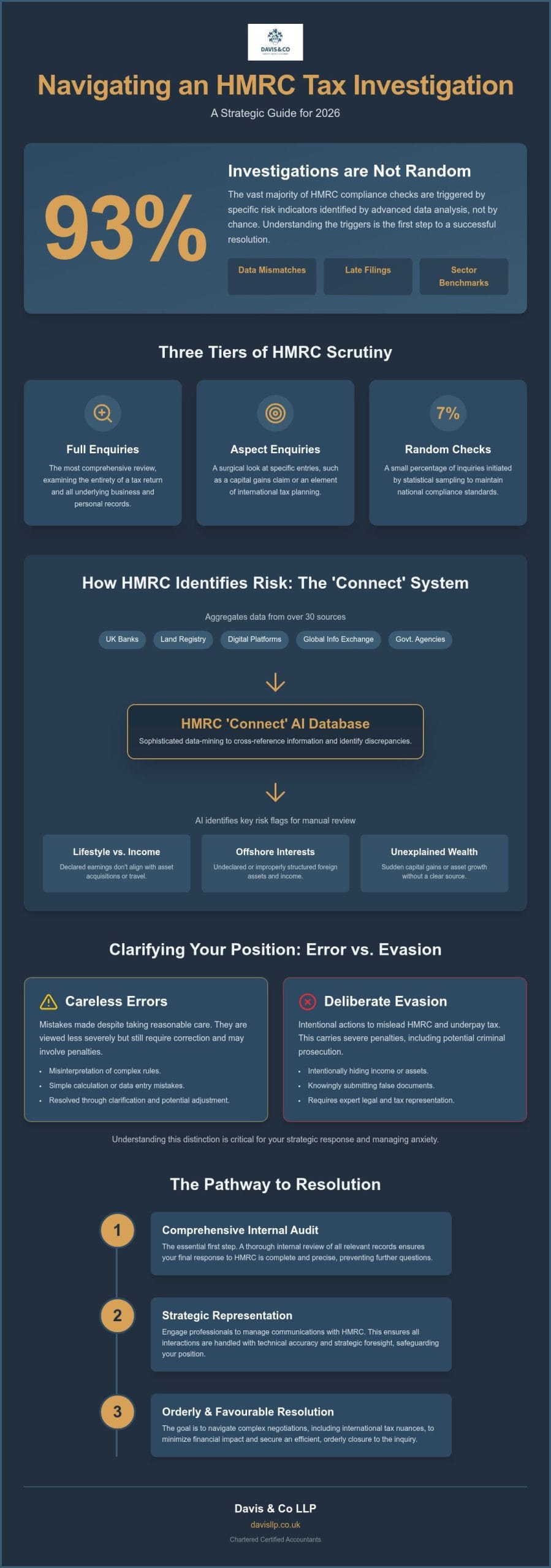
Did you know that 93% of inquiries are triggered by specific data mismatches, late filings, or sector-specific benchmarks rather than random selection? Receiving notification of an HMRC tax investigation can feel like a personal indictment of your professional integrity. It’s natural to feel a sense of unease regarding potential penalties and the significant administrative weight of a full inquiry. We understand that your primary concern is resolving the matter swiftly while safeguarding your reputation and financial standing.
We believe that a compliance check shouldn’t be viewed as a defensive crisis but as a manageable procedure requiring intellectual rigour and strategic composure. This guide provides a clear pathway to navigating the complexities of modern tax inquiries in 2026. You’ll learn how to address the latest Making Tax Digital requirements, manage the 7.75% late payment interest rates; and implement a resolution strategy that minimizes financial impact. We’ll explore the distinction between simple errors and more complex discovery assessments, ensuring you remain secure and well-advised throughout the process.
Key Takeaways
- Differentiate between “aspect” and “full” enquiries to accurately assess the scope and potential impact of an HMRC tax investigation.
- Understand how HMRC’s “Connect” database profiles risk so you’ll know why your specific records may have triggered an alert.
- Clarify the legal distinctions between careless errors and deliberate evasion so you don’t let anxiety over perceived accusations cloud your judgment.
- Learn why a comprehensive internal audit is the essential first step; it’s the most effective way to ensure your final response is precise.
- Discover how strategic representation helps you navigate complex international tax nuances to secure a more favourable and orderly resolution.
Understanding the Scope of an HMRC Tax Investigation in 2026
HMRC has transitioned away from the adversarial terminology of an “investigation” toward the more clinical “compliance check.” This linguistic shift reflects a strategic intent to present these reviews as routine verifications of accuracy rather than presumptive accusations of wrongdoing. For the taxpayer, however, the gravity of a tax investigation remains unchanged. In 2026, the mandate is clear: HMRC is leveraging advanced data-matching capabilities to aggressively close the tax gap by identifying and rectifying discrepancies in real-time.
The Three Tiers of HMRC Scrutiny
Understanding the level of scrutiny you face is the first step toward a composed resolution. HMRC generally categorizes its inquiries into three distinct tiers, each requiring a different depth of documentation and strategic oversight.
- Full Enquiries: These represent the most comprehensive level of review. HMRC examines the entirety of a tax return and the underlying primary records of a business or individual. It’s an exhaustive process that demands meticulous preparation and a clear narrative of your financial affairs.
- Aspect Enquiries: These are surgical in nature. They focus on specific entries or technical treatments, such as a particular capital gains claim or the nuances of International Tax Planning. While narrower in scope, they require high levels of precision to prevent the inquiry from expanding.
- Random Checks: Approximately 7% of inquiries are initiated through statistical sampling. These serve as a neutral mechanism to maintain national compliance standards across all industries and income brackets.
Taxes Under Review: From VAT to International Interests
A modern HMRC tax investigation rarely exists in a vacuum. The department’s 2026 strategy involves a “whole taxpayer” approach, where an inquiry into one area can quickly pivot to another if discrepancies are found. We often see reviews that encompass Corporation Tax, PAYE, and National Insurance records simultaneously. With the full implementation of Making Tax Digital (MTD) for Income Tax Self Assessment (ITSA) for those earning over £50,000, the accuracy of digital records is now a primary focal point. VAT Compliance also remains under heavy scrutiny, particularly for businesses with complex supply chains or international trade. There is a growing focus on personal tax and offshore financial interests. This makes it essential to have a strategic partner who understands the intersection of corporate and individual liabilities.
The Mechanism of Selection: How HMRC Identifies Risk
HMRC’s selection process for a compliance check is rarely a matter of chance. In 2026, the department relies heavily on its “Connect” database, a sophisticated data-mining tool that aggregates information from over 30 sources, including banks, land registries, and digital platforms. By cross-referencing this data against self-assessment filings, HMRC identifies discrepancies that previously went unnoticed. An HMRC tax investigation often begins when this digital analysis highlights an “outlier” whose financial performance deviates significantly from established industry benchmarks. This automated scrutiny ensures that 93% of inquiries are now triggered by specific risk indicators rather than random selection.
Data-Driven Risk Profiling
The sophistication of modern risk profiling means that AI now identifies inconsistencies between reported income and visible lifestyle indicators. If a taxpayer’s declared earnings don’t align with high-value asset acquisitions or international travel patterns, the system flags the profile for manual review. This scrutiny extends beyond domestic borders. Under global information exchange agreements, HMRC receives automated updates on offshore financial interests. For those involved in complex International Tax Planning, ensuring that all cross-border disclosures are technically sound is paramount to avoiding a discovery assessment. This data-driven approach means that unexplained wealth or sudden capital gains are frequently the catalysts for initial contact.
Sector-Specific Scrutiny: Why Some Industries Face Higher Risks
HMRC continues to target sectors where they perceive a higher risk of non-compliance. While high-cash businesses remain on the radar, there is a distinct 2026 emphasis on professional services and specialized healthcare sectors. We’ve observed increased activity regarding HMRC compliance checks within the dental profession, where complex associate contracts and expense claims require precise technical handling. Similarly, property accounting remains a high-priority area. Errors in reporting rental income or failure to navigate the nuances of capital gains tax on residential disposals can trigger multi-year enquiries. It’s often beneficial to engage a Dental tax specialist early to ensure your records withstand this level of scrutiny.
For practitioners and business owners, the key to resolution lies in understanding these digital triggers. When an inquiry is initiated, it’s usually the result of a specific data mismatch identified by Connect. Maintaining a posture of calm, professional readiness is essential. We often assist clients in conducting an internal audit before responding, ensuring that any explanation provided to HMRC is supported by robust documentation and a deep understanding of current regulatory requirements.
Myth-Busting: Deconstructing Common HMRC Misconceptions
The arrival of an official notification often triggers immediate apprehension, yet it’s essential to separate procedural reality from common myths. A common misconception is that an HMRC tax investigation automatically implies a suspicion of fraud. In practice, most inquiries are simply verifications of data accuracy. While HMRC’s “Connect” system identifies mismatches, these are often the result of complex accounting treatments rather than intentional evasion. Approaching the process with professional composure allows for a more orderly resolution.
Distinguishing between “careless” errors and “deliberate” behaviour is a critical technical nuance. HMRC applies different look-back periods and penalty scales based on this classification. For innocent errors, the window is generally four years; for careless mistakes, it extends to six. Only in cases of suspected deliberate evasion does the 20-year look-back apply. Understanding these boundaries helps us provide clear, strategic advice. Similarly, the term “reasonable excuse” isn’t a mere apology. It’s a specific legal standard that requires demonstrating that an unexpected or exceptional event prevented compliance despite taking reasonable care.
Fact vs. Friction: The Reality of Penalties
The penalty regime is designed as a sliding scale based on behaviour and cooperation. If an error is identified, making an “unprompted disclosure” before HMRC asks specific questions can significantly reduce financial liability. In some instances, penalties can be suspended entirely if the taxpayer agrees to improve their record-keeping. There’s also a persistent myth that HMRC officers will always visit your home or business premises. While they have the power to do so, most 2026 compliance checks are conducted through digital correspondence or meetings at an accountant’s office. This professional setting ensures that the discussion remains focused on technical facts rather than personal circumstances.
The Role of the Tax Advisor
Some taxpayers worry that appointing a specialist advisor signals a lack of transparency or a “guilty” conscience. The opposite is true. HMRC officers often prefer dealing with qualified Chartered Certified Accountants because it streamlines the inquiry. Professional representation ensures that requests for information are handled with precision, preventing the “scope creep” that can occur when a taxpayer inadvertently provides irrelevant or confusing data. We act as a strategic partner, protecting your interests by ensuring the process remains within its legal bounds. Our role is to provide the intellectual rigour necessary to resolve the HMRC tax investigation with minimal disruption to your professional life.
The Strategic Response: Essential Steps for Resolution
A measured response to an HMRC tax investigation is the cornerstone of a successful resolution. When the initial notification arrives, the priority is to maintain professional composure and avoid a hurried reaction. Instead of immediate disclosure, we recommend a period of internal reflection and rigorous analysis. This allows us to establish a comprehensive understanding of the facts before HMRC begins its formal questioning.
Strategic information management is vital. Providing excessive or irrelevant documentation can inadvertently lead to “scope creep,” where a focused enquiry expands into a full-scale review of unrelated periods. By carefully managing the flow of data, we ensure that the discussion remains centered on the specific items raised in the opening letter. If technical disagreements arise, we may utilize Alternative Dispute Resolution (ADR). This process involves a neutral HMRC facilitator who helps mediate complex disputes, often avoiding the need for a costly tribunal.
Immediate Actions Following Notification
Most HMRC notices operate on a strict 30-day window. This period is your opportunity to review the scope of the check and identify exactly which tax years and entities are under scrutiny. We begin by collating all relevant documentation, including bank statements, invoices, and board minutes. It’s a fundamental rule of professional practice to never provide original documents to HMRC without specific advice. Digital copies or certified extracts are usually sufficient and ensure that your primary records remain secure and under your control.
Negotiating the Outcome
Once the technical review concludes, the focus shifts to the “letter of offer.” This document outlines the proposed settlement, including any additional tax, interest, and penalties. For errors deemed “careless” rather than deliberate, we can often argue for suspended penalties. This means the penalty is waived provided you meet specific record-keeping improvements over a set period. Given that the late payment interest rate stands at 7.75% as of 2026, managing the financial settlement is critical. For businesses facing liquidity challenges, we can negotiate Time to Pay (TTP) arrangements to spread the liability over a manageable timeframe.
If you’ve received a compliance notice, engaging a strategic partner early is the most effective way to protect your interests. Our team provides the expert oversight needed to handle Audit and Assurance matters with precision. Contact our tax resolution specialists to discuss your strategy for a swift and orderly resolution.
The Value of Professional Gravitas in HMRC Negotiations
Managing an HMRC tax investigation requires more than technical knowledge; it demands a specific calibre of professional gravitas. We position ourselves not merely as service providers but as strategic partners who understand the intricate balance between compliance and commercial reality. Our background in Audit and Assurance provides the intellectual rigour necessary to construct a robust defense, ensuring that every response to HMRC is underpinned by verifiable data and sound technical reasoning. This high-level oversight is particularly crucial when dealing with nuanced areas like International Tax Planning or Trust Tax Services, where the margin for error is non-existent. By projecting a persona of quiet excellence, we ensure the inquiry remains a professional dialogue rather than an escalating crisis.
A Partnership of Discretion and Expertise
There is a distinct advantage in having a single, unified firm manage both your ongoing compliance and any necessary resolution. Since our establishment in 1901, we’ve maintained a philosophy of calm, authoritative representation. This legacy informs our approach to every inquiry, allowing us to act with the discretion required for sensitive commercial and personal matters. By integrating Personal Tax Services with Business Growth Acceleration goals, we ensure that the resolution of a compliance check doesn’t hinder your long-term objectives. We foster a sense of collaborative partnership, making our clients feel secure and well-advised while maintaining the professional distance of a trusted expert. Our national coverage means that regardless of your location, you receive the same high-calibre advisory service.
Beyond the Investigation: Future-Proofing Compliance
We view a compliance check as a catalyst for refining your internal systems. Once the immediate pressure of an HMRC tax investigation is resolved, our focus shifts to future-proofing your operations. This involves using the inquiry’s findings to enhance your Management Accounts and digital record-keeping, ensuring they meet the stringent 2026 MTD standards. Implementing proactive tax planning and advice serves as a primary defense against future scrutiny. For a more detailed exploration of maintaining a robust tax position, we invite you to read our guide on Expert Tax Advice in the UK.
Securing your professional reputation and financial standing requires a measured, expert-led approach. Whether you are a Dental tax specialist facing sector-specific scrutiny or a business owner managing complex international interests, we provide the steady, deliberate guidance needed to navigate these challenges. We invite you to contact us for a discreet consultation to discuss how we can resolve your current inquiry and strengthen your future compliance. Let us act as your dependable constant in a volatile regulatory environment.
Establishing Order and Resolving Your Compliance Inquiry
Navigating the complexities of an HMRC tax investigation requires a blend of technical precision and strategic composure. We’ve explored how the modern compliance landscape is shaped by sophisticated data-mining and a rigorous focus on cross-border interests. Success in these inquiries isn’t just about providing answers; it’s about managing the narrative through robust internal audits and expert representation. By distinguishing between simple errors and complex technical disputes, you can protect your reputation and minimize financial exposure.
As Chartered Certified Accountants since 1901, we bring over a century of expertise to every resolution strategy. Whether you’re a dental professional requiring specialist accounting or a business leader managing international tax planning, our role is to act as your strategic partner. We ensure your response is measured and your future compliance is secure. Contact Davis & Co LLP for a Discreet Tax Consultation to resolve your current inquiry with the gravitas it deserves. We’re here to provide the stability and expertise you need to move forward with confidence.
Frequently Asked Questions
How long does a typical HMRC tax investigation take to resolve?
Aspect enquiries focused on specific technical treatments are typically resolved within 3 to 6 months. Full investigations, which involve a comprehensive review of all business records and personal filings, generally take between 9 and 16 months to conclude. The duration often depends on the complexity of the records and the speed of communication. We aim for a swift and orderly resolution by managing the information flow with precision and professional composure.
Can HMRC check my personal bank accounts if they are investigating my business?
HMRC has the authority to request personal bank statements if they believe there’s a link between your personal finances and the business under review. This often occurs when business and personal transactions are intermingled or if reported income doesn’t support your visible lifestyle. During an HMRC tax investigation, we ensure that only relevant data is shared, protecting your privacy while satisfying the inspector’s statutory requirements for transparency and accuracy.
What is the “Connect” system and how does it affect my tax risk?
Connect is HMRC’s sophisticated data-mining tool that aggregates information from over 30 sources, including land registries, banks, and digital platforms. It identifies discrepancies by cross-referencing this data with your tax filings. In 2026, this system triggers approximately 93% of all inquiries. Understanding how this risk-profiling works allows us to conduct an internal audit of your records before responding, addressing any “outliers” identified by the software with technical rigour.
What should I do if I find an error in my tax return before HMRC contacts me?
You should initiate an unprompted disclosure to HMRC immediately. Notifying the department of an error before they open a compliance check significantly reduces potential financial penalties. We assist clients in preparing a formal disclosure that explains the technical nature of the error while demonstrating a commitment to future compliance. This proactive approach is a cornerstone of strategic tax resolution, often leading to more favourable settlement terms and suspended penalties.
What is the difference between a COP8 and a COP9 investigation?
Code of Practice 8 (COP8) is used when HMRC suspects significant tax avoidance or complex technical issues but doesn’t assume fraud. Code of Practice 9 (COP9) is reserved for cases where HMRC suspects deliberate tax fraud. Under COP9, you’re offered a Contractual Disclosure Facility (CDF), which provides immunity from criminal prosecution in exchange for a full, honest disclosure of all irregularities. Both require a high level of professional gravitas to manage successfully.
How far back can HMRC go when investigating my tax affairs?
The look-back period depends entirely on the taxpayer’s behaviour. For innocent errors, HMRC is limited to four years. If they deem an error was “careless,” the window extends to six years. In cases involving deliberate evasion or suspected fraud, the department can investigate up to 20 years of records. Identifying the correct classification is essential during an HMRC tax investigation, as it dictates the scope of the inquiry and the potential financial impact.
Will I have to pay a penalty even if the error was a genuine mistake?
Penalties aren’t mandatory for genuine, innocent mistakes where the taxpayer took reasonable care. However, if the error is classified as “careless,” a penalty of up to 30% of the tax due may apply. In such cases, we often negotiate for suspended penalties, where the charge is waived if you improve your record-keeping standards over a specified period. This helps protect your financial standing while ensuring full compliance with 2026 regulations.
Do I have to attend a face-to-face meeting with an HMRC inspector?
There’s no statutory requirement to attend a face-to-face meeting, and most modern compliance checks are conducted through digital correspondence. However, a meeting can sometimes expedite the resolution of complex technical disagreements. If a meeting is necessary, we recommend holding it at a professional office rather than your business premises. This setting ensures the discussion remains focused on technical facts, allowing us to represent your interests with the necessary distance and expertise.