Only 42% of UK SME owners have a clear exit strategy in place, a figure that suggests many are leaving their legacy to chance. When the time comes to step away, the difference between a disappointing offer and a premium valuation often comes down to the work done years in advance. If you’re currently getting your business ready for sale uk regulations and buyer expectations suggest a minimum 24-month preparation window is essential to ensure your financial house is in order.
We understand the anxiety that comes with a potential sale, especially with the 2026 Capital Gains Tax rates of 24% for higher rate taxpayers and the increased 18% rate for Business Asset Disposal Relief. It’s natural to worry about “price chipping” during due diligence or whether the company is too reliant on your personal involvement. Our objective is to guide you through a strategic financial roadmap that addresses these concerns directly. We’ll explore how to maximise your EBITDA, reduce operational risks, and structure a tax-efficient exit that preserves your wealth for the future.
Key Takeaways
- Establish a 24-month strategic timeline to ensure your trailing performance supports the highest possible valuation multiple.
- Master the process of normalising your accounts to avoid common pitfalls when getting your business ready for sale uk investors will examine.
- Implement operational changes that reduce owner dependency and secure the long-term commitment of your senior management team.
- Evaluate tax-efficient exit routes, including the latest 2026 Business Asset Disposal Relief criteria and the potential of Employee Ownership Trusts.
- Learn how to select a specialist advisory team that possesses the specific corporate finance expertise required for a successful transaction.
The Strategic Timeline: Why Preparation Starts Two Years Before Sale
A successful exit is rarely the result of a sudden decision; it’s the culmination of deliberate, long-term positioning. When getting your business ready for sale uk buyers will typically scrutinise the last three years of your accounts, but it’s the trailing twelve-month (TTM) performance that usually dictates the final multiple applied to your EBITDA. This 24-month lead time allows us to smooth out seasonal fluctuations and demonstrate a consistent upward trajectory. Achieving an exit-ready state means your company possesses absolute financial clarity, functions independently of its founders, and is structured for maximum tax efficiency.
Before entering negotiations, a foundational step involves understanding business valuation methodologies to ensure your expectations align with market realities. Different buyers seek different attributes. A trade buyer might pay a premium for strategic synergy, while private equity firms often prioritise scalable systems and robust management tiers. Alternatively, a Management Buy-out (MBO) offers continuity but may require more flexible financing structures. We believe the role of the strategic small business accountant is vital here; they act as a bridge between your current operations and your ultimate exit goals, ensuring every growth initiative adds tangible value to the balance sheet.
Establishing Your Exit Objectives
We encourage our clients to quantify their “walk-away” number early. This figure should account for your personal wealth requirements, the 2026 tax environment, and the capital needed for your next chapter. In the current economic climate, sector-specific multiples can shift quickly, so we must assess whether your target valuation is achievable within your desired timeframe. You also need to decide if you want a clean break or if you’re prepared to remain as a consultant during the transition period.
The Two-Year Preparation Roadmap
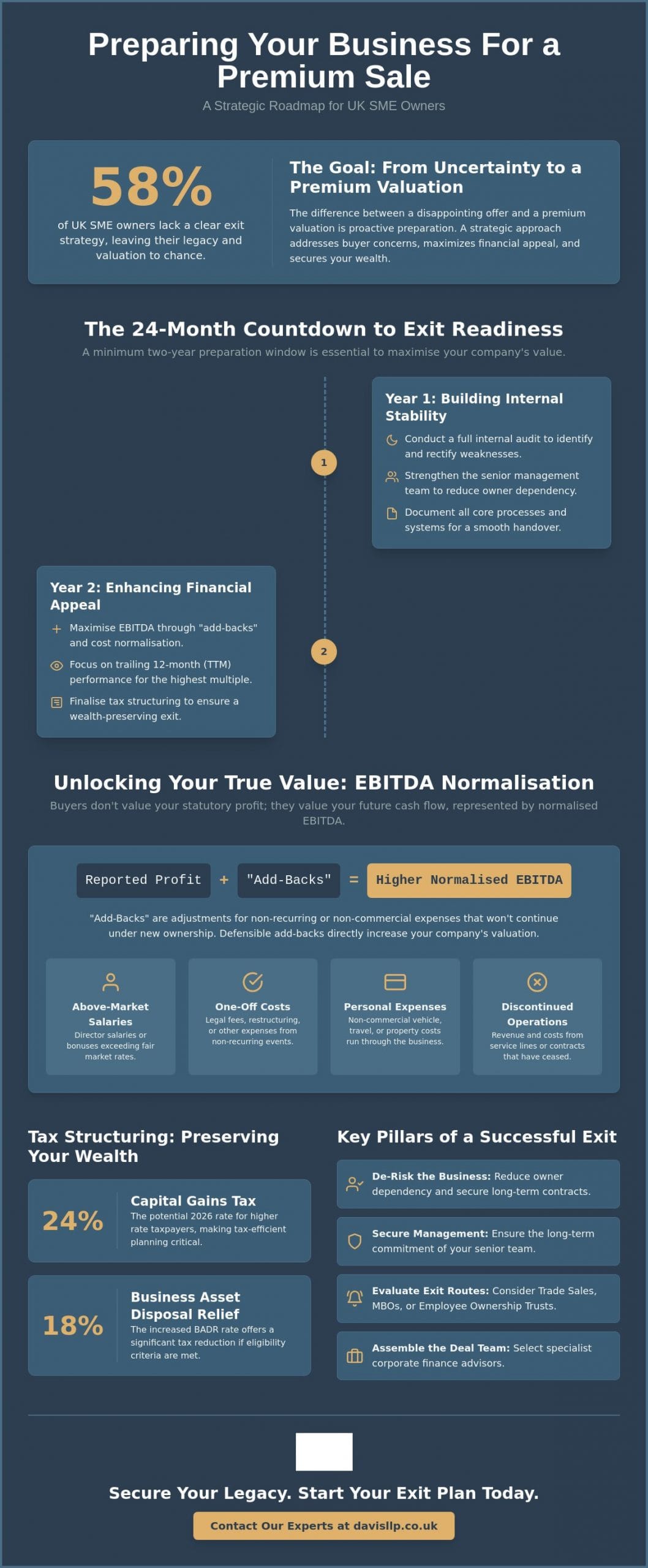
The first year focuses on internal stability. We conduct an internal audit to identify weaknesses, strengthen the management team, and document every core process. This ensures the business isn’t reliant on your daily presence. In the second year, we pivot toward EBITDA enhancement. We “remove the noise” by identifying one-off costs and personal expenses that don’t belong in a commercial valuation, while finalising the tax structuring. The pre-sale period serves as the critical window where strategic adjustments translate directly into increased shareholder value.
Financial Hygiene: Maximising Valuation Through Meticulous Accounting
Financial records serve as the primary evidence in any corporate transaction. While your statutory accounts satisfy the requirements of HMRC and Companies House, they rarely reflect the true underlying economic value of your enterprise. When getting your business ready for sale uk buyers will look beyond the surface of your profit and loss statement to find the “normalised” earnings. This process is essential because buyers aren’t just purchasing your history; they’re acquiring the right to your future cash flows.
A common pitfall is the “EBITDA Trap,” where an owner assumes their reported net profit is the figure buyers will multiply to reach a valuation. In reality, buyers focus on EBITDA (Earnings Before Interest, Taxes, Depreciation, and Amortisation) as a proxy for operational cash flow. Proving business resilience also requires demonstrating sophisticated cash flow management. A lean, efficient working capital cycle shows that the business doesn’t require excessive capital injections to maintain its current momentum.
EBITDA Normalisation and “Add-Backs”
Normalising your accounts involves identifying and adjusting for items that won’t continue under new ownership. These “add-backs” can significantly increase your valuation multiple. Common examples include:
- Director salaries or bonuses that exceed market rates.
- One-off legal fees or professional costs related to non-recurring events.
- Personal expenses or non-commercial property rents run through the business.
- Revenue from discontinued service lines or one-time contracts.
We ensure every add-back is defensible and supported by clear evidence. During due diligence, a buyer’s team will challenge these adjustments. If your management accounts provide a clear, monthly “story” behind the numbers, you maintain the upper hand in negotiations.
Pre-Sale Audit and Assurance
Many SME owners view an audit as a regulatory burden, but in a sale context, voluntary Audit and Assurance services act as a powerful de-risking tool. By commissioning an audit before going to market, you identify “skeletons in the closet” on your own terms. This might include historical VAT errors, payroll discrepancies, or complex revenue recognition issues. Addressing these early prevents “price chipping,” the tactic where buyers reduce their offer late in the process due to newly discovered risks. A clean audit report provides an independent stamp of approval that builds immediate buyer confidence.
De-Risking the Business: Operational Independence and Contracts
Value is inextricably linked to risk. While financial hygiene provides the necessary foundation for a transaction, operational resilience determines the long-term stability of those earnings. When getting your business ready for sale uk investors will scrutinise how much the company relies on your personal involvement. If you are the primary driver of sales or the sole keeper of technical knowledge, a buyer will likely apply an “owner dependency” discount to reflect the risk of your departure. Our goal is to transform your enterprise from an owner-led business into a management-led institution.
Customer concentration risk is another area where value can be eroded. If a single client accounts for more than 15% to 20% of your total revenue, Private Equity buyers may view the business as volatile. We recommend diversifying your revenue base and formalising informal “handshake deals” well before the 24-month preparation window closes. A buyer needs legal certainty that your supply chain and customer base won’t vanish the day after the acquisition. This process of getting your business ready for sale uk regulations require involves moving away from the informalities of a small firm toward the rigour of a corporate entity.
Building a Self-Sustaining Management Team
The most attractive businesses are those where the founder has successfully transitioned day-to-day decision-making to a senior leadership team. To secure this transition, we often advise using Enterprise Management Incentive (EMI) schemes or performance-linked bonuses. These mechanisms align the interests of your key staff with the success of the sale, ensuring they remain committed during and after the acquisition. Additionally, documenting all Standard Operating Procedures (SOPs) ensures that institutional knowledge is transferred safely to the new owners, rather than leaving with the founder.
Contractual and Compliance Review
A rigorous review of your contractual landscape is essential to prevent delays during due diligence. We focus on “Change of Control” clauses in critical customer and supplier agreements, which could allow a counterparty to terminate the contract upon a sale. We also verify that all intellectual property (IP), from software code to brand logos, is legally owned by the company rather than the individual founders. Finally, we ensure total statutory compliance across Companies House filings, GDPR protocols, and employment law to remove any potential hurdles that could give a buyer cause for concern.
Tax Structuring: Preserving Wealth in the 2026 Fiscal Landscape
The final value you retain from a sale is often determined by the tax structures established years before the first offer arrives. In the 2026/2027 tax year, higher and additional rate taxpayers face a Capital Gains Tax (CGT) rate of 24%. When getting your business ready for sale uk owners must navigate a narrowing gap between standard rates and available reliefs. Strategic tax planning isn’t about evasion; it’s about the legitimate application of current legislation to ensure your hard-earned equity isn’t unnecessarily eroded during the transition.
We often explore pre-sale restructuring as a means to ring-fence specific assets or simplify the corporate group. This might involve the use of holding companies or “demergers” to separate trading activities from investment assets like property. For those seeking an alternative to a traditional trade sale, Employee Ownership Trusts (EOTs) have become an increasingly popular route. An EOT can facilitate a tax-free sale of a majority stake, provided specific conditions are met, offering a compelling option for founders prioritising legacy and staff continuity. We recommend securing expert tax advice in the UK to evaluate these options against your specific exit objectives.
Maximising Business Asset Disposal Relief
Business Asset Disposal Relief (BADR) remains a cornerstone of exit planning, though its parameters have shifted. For disposals occurring on or after 6 April 2026, the tax rate for BADR is 18%, applicable to the first £1 million of qualifying lifetime gains. To secure this relief, you must meet the two-year ownership and employment requirements without interruption. Late-stage share transfers or changes in your role can inadvertently restart this clock, potentially costing you hundreds of thousands of pounds. We also monitor your “trading company” status closely, as excessive non-trading assets on the balance sheet, such as large cash reserves or investment properties, can jeopardise your eligibility for this 18% rate.
International and Cross-Border Considerations
If your business operations or personal residency extend beyond the UK, the complexity of the sale increases significantly. UK owners living abroad must account for the tax laws of their host country alongside HMRC’s “temporary non-residence” rules. Our approach to international tax planning ensures that global stakeholders are protected from double taxation through the careful application of tax treaties. We also manage the nuances of withholding taxes on deferred payments or earn-outs, ensuring that getting your business ready for sale uk based or otherwise, results in a seamless wealth transfer across borders.
Assembling the Deal Team: Your Partners in a Successful Exit
A corporate transaction is a high-stakes environment that requires a level of specialised expertise far beyond routine business operations. When getting your business ready for sale uk entrepreneurs often rely on their existing support networks, but a successful exit demands a dedicated “deal team.” This group, often referred to as the “Holy Trinity” of advisors, consists of corporate lawyers, corporate finance brokers, and specialist accountants. Each plays a distinct role in ensuring that the legal, commercial, and financial aspects of the deal align with your personal objectives.
Your day-to-day accountant is likely an expert in compliance and management accounts, yet they may lack the specific experience required for the rigours of a complex sale. A transaction involves intricate tax structuring and a level of scrutiny that requires a different perspective. At Davis & Co LLP, we provide the necessary Vendor Due Diligence (VDD) and strategic tax oversight to ensure your interests are protected from the outset. We also serve as an essential emotional buffer. Negotiations can become personal; a trusted advisor maintains the professional distance required to keep the deal moving toward a successful completion without sacrificing your position.
Selecting the Right Accounting Partner
Expertise in audit and assurance is critical when preparing your information pack for potential buyers. A buyer’s confidence is built on the quality and transparency of the data you provide. We believe discretion and gravitas are essential when dealing with acquirers, as these qualities signal that your business is a high-calibre target. A strategic partner will also manage the Virtual Data Room (VDR). This ensures the due diligence process remains orderly and secure, preventing the last-minute chaos that often leads to “price chipping” or renegotiations.
Next Steps: The Initial Business Health Check
The process of getting your business ready for sale uk markets will reward starts with an honest assessment of your current position. We recommend booking a confidential consultation to conduct a comprehensive business health check. This initial review identifies the “low-hanging fruit”—those specific adjustments in financial reporting or operational structure that can disproportionately boost your valuation in as little as six months. Taking this first step ensures you aren’t leaving value on the table when you finally reach the negotiating room. Contact Davis & Co LLP for a confidential discussion on your business exit strategy.
Securing Your Financial Legacy Through Strategic Preparation
Achieving a premium valuation is a deliberate process that requires time, meticulous accounting, and a sophisticated understanding of the current fiscal environment. By focusing on EBITDA normalisation and reducing owner dependency, you transform your company into a low-risk, high-reward asset for potential acquirers. Success in getting your business ready for sale uk markets reward depends on the strength of your preparation and the quality of the advisors you choose to have by your side.
As Chartered Certified Accountants since 1901, we bring over a century of professional reliability to every transaction. We specialise in international tax and business growth, offering the discreet, partner-led advisory necessary for complex SME exits. Secure your legacy with a strategic exit plan from Davis & Co LLP. Your exit is the final chapter of your business journey; we’re here to ensure it’s your most successful one yet.
Frequently Asked Questions
How long does it take to get a business ready for sale in the UK?
We recommend a lead time of at least 24 months to ensure your enterprise is fully prepared for market. This two-year window is necessary to demonstrate a consistent upward trend in your trailing twelve-month performance and to satisfy the two-year ownership and employment requirements for Business Asset Disposal Relief. Taking this time allows us to smooth out any financial irregularities and build a robust management tier that functions independently of your daily involvement.
What is the most important factor in a business valuation?
Sustainable EBITDA is the primary driver of value in most SME transactions. While your sector and growth prospects influence the valuation multiple, the quality and “normalisation” of your earnings are what buyers scrutinise most closely. When getting your business ready for sale uk buyers will focus on your ability to prove that these profits are recurring and not dependent on one-off contracts or the personal relationships of the founder.
Can I sell my business if I am the only person running it?
You can sell a business where you are the sole decision-maker, but you should expect a lower valuation or a substantial earn-out period. Acquirers pay a premium for “operational independence,” meaning they want a company that can thrive without the original owner. If the business is too dependent on you, we focus on transitioning your responsibilities to a senior leadership team well before you enter the final negotiation phase.
What is Business Asset Disposal Relief and does it still exist in 2026?
Business Asset Disposal Relief (BADR) remains a vital tool for UK sellers in 2026, though the applicable tax rate has changed. For qualifying disposals on or after 6 April 2026, the tax rate for BADR is 18%, an increase from the previous 14%. The lifetime limit for gains qualifying for this relief remains capped at £1 million for the 2026/2027 tax year, making it essential to meet all eligibility criteria precisely.
How can I reduce the tax I pay when selling my company?
Effective tax planning involves maximising your BADR eligibility and considering alternative exit routes like Employee Ownership Trusts. With the standard Capital Gains Tax rate for higher rate taxpayers at 24% in 2026, the difference between a structured and unstructured sale can be significant. We also look at pre-sale restructuring, such as using holding companies, to protect your wealth and ensure the most tax-efficient extraction of sale proceeds.
What documents do I need for the due diligence process?
You must provide three years of statutory accounts, current management accounts, and comprehensive tax records including VAT and payroll compliance. Buyers will also require copies of all material customer and supplier contracts, employee agreements, and evidence of intellectual property ownership. Organising these documents in a secure Virtual Data Room early in the process prevents delays and maintains your momentum during the final stages of the deal.
What is an Employee Ownership Trust (EOT) and is it right for me?
An EOT is a trust established to acquire a majority stake in a company for the long-term benefit of its employees. For the seller, this can facilitate a completely tax-free exit if the trust acquires more than 51% of the shares and specific HMRC conditions are met. This route is often ideal for founders who want to preserve their company’s culture and legacy while achieving a fair market value for their equity.
Should I get a business valuation before I start preparing for a sale?
We always advise an initial baseline valuation to establish your current market position. This allows us to quantify the “valuation gap” between what your business is worth today and your desired walk-away number. By identifying this gap early, we can tailor your 24-month roadmap to focus on the specific financial and operational improvements that will yield the highest return on your preparation efforts.