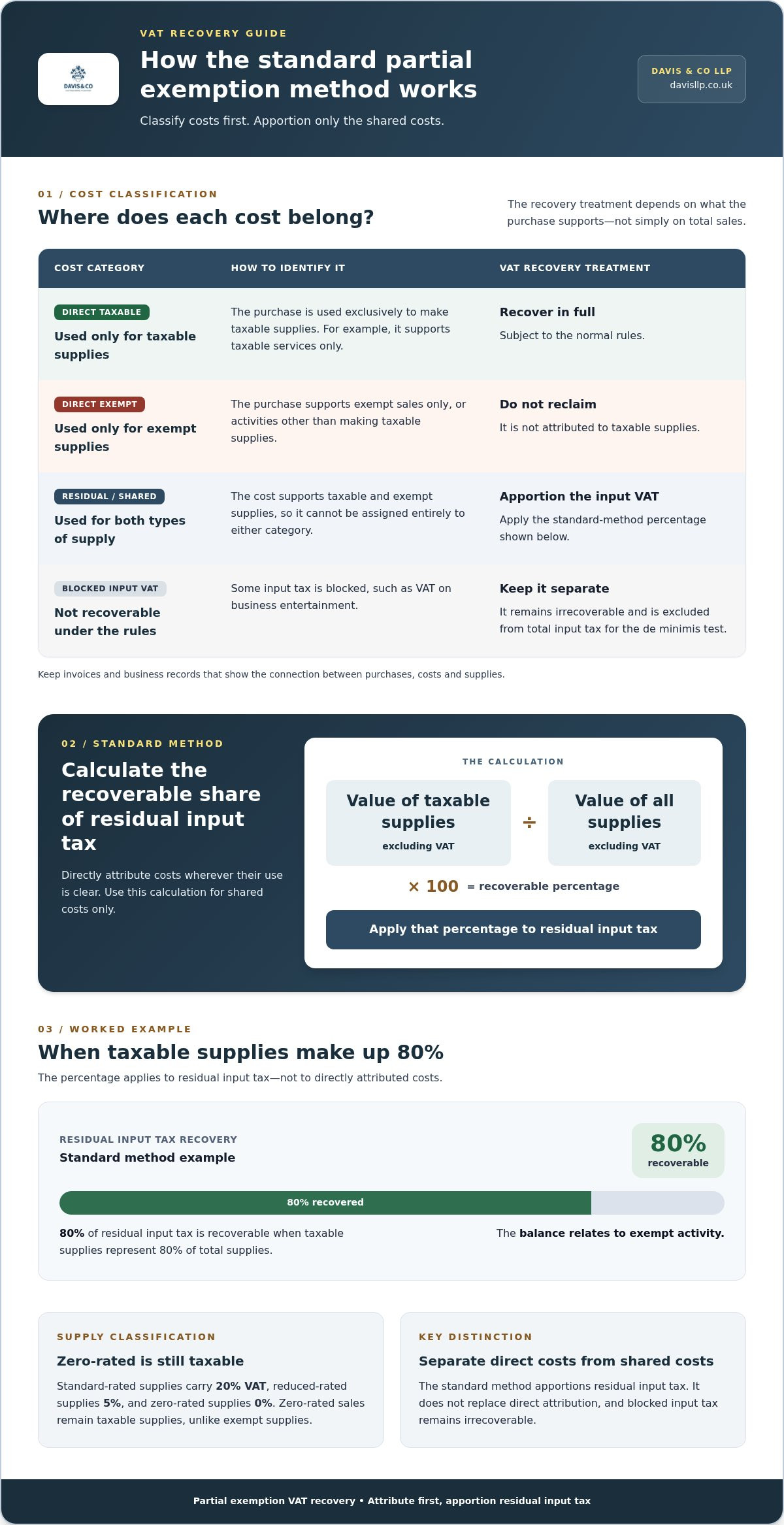
Your VAT recovery depends on how costs relate to taxable and exempt supplies, not simply on total sales. Under the standard partial exemption VAT calculation method, you recover input VAT linked exclusively to taxable supplies, exclude VAT linked exclusively to exempt supplies, and apportion VAT on shared costs according to the value of taxable supplies as a proportion of all supplies, excluding VAT. The standard method applies unless HMRC approves a special method.
It’s understandable to focus on the percentage, because it determines how much VAT on shared costs you can reclaim. But accurate sales and purchase records matter just as much: they show which costs are direct, which are shared, and how you reached the calculation.
This guide explains what counts as an exempt supply, how the standard calculation works, and when a special method may be appropriate. It also covers the annual adjustment and the records that support your VAT returns, helping you understand both the calculation and the evidence behind it.
Key Takeaways
- Separate costs used only for taxable supplies from those used only for exempt supplies, and identify shared costs before calculating recovery.
- Review provisional VAT claims against the full-year figures and account for any difference through the annual adjustment.
- Consider whether the standard method reflects how your costs are used; a special method requires HMRC’s written approval.
- Keep clear records linking invoices, costs and supplies so your calculations and adjustments can be supported.
What is an exempt supply?
An exempt supply is a sale on which a business doesn’t charge VAT. Medical services provided by registered health professionals are normally exempt, subject to conditions. Exempt supplies differ from taxable supplies: standard-rated supplies carry 20% VAT, reduced-rated supplies carry 5%, and zero-rated supplies carry 0%. Zero-rated sales remain taxable supplies, so the distinction affects input tax recovery.
Classify each purchase by what it supports. Under Regulation 101(2)(b), input tax on goods or services used exclusively to make taxable supplies is attributed to taxable supplies. It is recoverable in full, subject to the normal rules. Under Regulation 101(2)(c), input tax on purchases used exclusively for exempt supplies, or activities other than making taxable supplies, isn’t attributed to taxable supplies and cannot be reclaimed.
For example, a purchase used solely to provide taxable services is a direct taxable cost. A purchase used only to make exempt sales is a direct exempt cost. Keep invoices and business records that show the connection. If a cost supports both types of supply, treat its VAT as residual input tax rather than assigning it entirely to either category.
The standard method is the default approach to calculating deductible input tax. First, attribute costs directly wherever their use is clear. Then apportion residual input tax using the value of taxable supplies, excluding VAT, divided by the value of all supplies, excluding VAT, for the period. Multiply by 100 to find the recoverable percentage, then apply that percentage to residual input tax.
Suppose taxable supplies represent 80% of total supplies. Under the standard method, 80% of residual input tax is recoverable, while the balance relates to exempt activity. The calculation concerns shared costs only: it doesn’t replace direct attribution. Separate blocked input tax, such as VAT on business entertainment, remains irrecoverable and is excluded from total input tax for the de minimis test.
What is partial exemption VAT and how does it work?
Partial exemption apportions input tax where taxable and exempt supplies share costs. Businesses also review provisional recovery during an annual adjustment, comparing claims with actual figures.
Provisional Recovery Rates
A provisional recovery rate is the percentage used to reclaim residual input tax during VAT return periods, before the annual calculation. Treat claims as provisional: the rate used during the year may not match the final proportion of taxable supplies. At the annual adjustment, compare the amount recovered with the calculation based on actual figures, then correct the difference on the next VAT return.
Annual Adjustment Timing
An annual adjustment reconciles input tax recovered during the year with the annual calculation. The longer review period is normally a tax year, and the calculation is performed in March, April or May, depending on VAT return periods. A partially exempt business makes its adjustment at the end of its VAT year, adding an underclaim or correcting an overclaim on the next return.
Partial Exemption and Business Apportionment
Partial exemption apportions input tax between taxable and exempt supplies. Business/non-business apportionment, by contrast, separates costs used for business activities from those used outside the business. A cost used for a non-business activity isn’t treated as input tax for taxable supplies. If a business cost supports both taxable and exempt supplies, partial exemption then determines the recoverable proportion. Keeping these stages separate helps prevent non-business costs from being attributed to taxable activity.
De Minimis, Capital Goods, and Calculation Risks
The UK de minimis test allows exempt input tax to be treated as taxable if it averages no more than £625 per month and also meets the half-of-total-input-tax condition; the traditional annual threshold is £7,500. Blocked VAT, including business entertainment, is excluded from the test. Capital Goods Scheme adjustments can affect recovery when qualifying assets’ use changes; identified thresholds include £50,000 for computers and £250,000 for land or buildings, tax-exclusive. Common errors include misclassifying costs, omitting exempt supplies or failing to adjust provisional claims, which can distort recovery. Audit and assurance support can help strengthen review of VAT calculations and records.
Applying to HMRC for a partial exemption special method
A special method may be worth considering if the standard method does not reflect how a business uses its costs. HMRC’s written approval is required before using it.
Special Partial Exemption Methods
A special method is an alternative way to attribute or apportion input tax, tailored to how a business actually uses its costs. It can be relevant when the standard turnover-based calculation doesn’t reflect that use. For example, a business with distinct activities may need a method that allocates residual input tax more closely to each activity. The standard method remains in place until HMRC approves an alternative.
Applying for a Special Method
An application should explain why the standard method does not fairly reflect the input tax incurred and show how the proposed method would calculate recovery. Set out the proposed allocation for direct costs and apportionment of residual input tax, using records that link costs to activities and supplies. The method must produce a correct, consistent calculation.
Continue to use the standard method unless and until HMRC gives written approval. Provisional recovery claims should therefore follow the existing approved approach, with the annual adjustment based on actual figures. A de minimis result is a separate test and does not, by itself, authorise a special method.
Special method override provisions address substantial differences between the standard method result and a use-based calculation. A difference is substantial if it exceeds £50,000, or exceeds 50% of residual input tax incurred and £25,000. These thresholds help identify when the standard method may materially misstate recovery. Keep the comparison and supporting workings with the VAT records, so any change can be explained and applied consistently.
Record keeping for partially exempt businesses
A sound partial exemption calculation needs an audit trail from each purchase to the VAT return. For every VAT period, records should show how input tax was attributed to taxable supplies, exempt supplies or residual costs. This trail supports the partial exemption VAT calculation method by linking each recovery decision to its underlying transaction.
Keep evidence organised by period rather than relying on a year-end total. A practical record set includes:
- Purchase invoices and credit notes, showing the VAT amount and the activity each cost supports.
- Sales records distinguishing taxable and exempt supplies, with values excluding VAT for the standard-method percentage.
- A schedule separating direct input tax from residual input tax, with the calculation and percentage applied.
- VAT return workings, provisional recovery figures and the annual adjustment reconciling claims with actual results.
- Any HMRC written approval for a special method, alongside the workings used to apply it.
For example, link an equipment invoice to the taxable activity it supports. Record an overhead serving both taxable and exempt supplies in the residual schedule, showing how it was apportioned. For a purchase used only for exempt activity, note its business purpose and why its input tax wasn’t claimed. These details help another reviewer follow the decision without relying on the preparer’s memory.
Reconcile each VAT return to its supporting schedules, then carry provisional amounts into the annual adjustment. Keep the final calculation and adjustment entry together so you can trace the difference between amounts claimed during the year and the annual result. Well-documented workings also make it easier to explain how the partial exemption VAT calculation method was applied. HMRC doesn’t require these calculations to be completed in functional compatible software for Making Tax Digital for VAT, but organised workings remain valuable evidence.
For structured review of VAT records and supporting calculations, ask Davis & Co LLP about audit and assurance.
Davis & Co LLP: International Tax Planning
Davis & Co LLP provides International Tax Planning for businesses whose cross-border activities make tax considerations more complex. If your business also makes taxable and exempt supplies, the VAT calculation remains a separate exercise, though it may sit alongside wider decisions about international operations and business structure.
For businesses reviewing growth plans or cash-flow pressures, Davis & Co LLP also offers Business Growth Acceleration and Cash Flow Management. These services help owners consider the financial context of operational decisions, while Personal Tax Services support individuals with their own tax affairs.
To discuss how these services relate to your circumstances, contact Davis & Co LLP or visit davisllp.co.uk.
Make your next VAT decision with confidence
Your VAT position can influence wider business decisions, particularly when activities, costs or plans change. Treating the partial exemption VAT calculation method as part of ongoing financial management keeps VAT decisions connected to the realities of your operations, rather than viewing each return in isolation.
Davis & Co LLP offers VAT Compliance, alongside International Tax Planning, Business Growth Acceleration and Cash Flow Management. If you’re reviewing how VAT fits with changes to your business or its wider financial plans, tailored accounting support can help you assess the relevant considerations and keep your approach aligned with your circumstances.
For a considered discussion of VAT support and your next steps, contact Davis & Co LLP about VAT compliance. A clear view of your obligations can help you move forward with greater confidence.
How Davis & Co LLP can help with VAT compliance
Davis & Co LLP provides VAT Compliance services, a natural next step if you need support applying the partial exemption VAT calculation method to your business.
For help with VAT compliance, or related needs such as bookkeeping, management accounts or audit and assurance, contact Davis & Co LLP to discuss which services are relevant to your circumstances.
Frequently Asked Questions
How is the claimable input VAT calculated?
Claimable input VAT combines tax on direct taxable costs with the recoverable share of residual costs. Exclude input tax linked solely to exempt supplies and blocked VAT. For example, an illustrative calculation adds £9,600 of direct taxable input tax to £5,040 recoverable from shared costs, producing £14,640. Keep the direct-cost analysis separate from the apportionment so each figure has a clear basis.
The annual adjustment – safety net or shock?
The annual adjustment can increase or reduce the amount reclaimed during the year, depending on how actual figures compare with provisional claims. It is a reconciliation, not a separate allowance: any difference is adjusted on the next VAT return. For example, if actual taxable activity is lower than the provisional basis, the final recoverable share of residual input tax may fall. Regularly reviewing records helps you identify changes before year-end.
What is a special method?
A special method is an HMRC-approved alternative for calculating input tax recovery when the standard method doesn’t accurately reflect how costs are used. A business proposes how it will attribute direct costs and apportion shared costs, supporting its approach with evidence of its activities. It must receive HMRC’s written approval before applying the method; until then, the standard method remains in place.
How does partial exemption VAT work in the UK?
UK partial exemption applies when a business makes both taxable and exempt supplies. VAT on costs used for taxable activity may be recoverable, while costs supporting exempt activity generally aren’t; shared costs require apportionment. Zero-rated sales are taxable supplies, despite carrying a 0% VAT rate, so they count differently from exempt sales when assessing the business’s taxable activity and recovery.
How do you calculate the standard method VAT recovery percentage?
Divide taxable supplies’ value, excluding VAT, by the value of all supplies, excluding VAT, for the period, then multiply by 100. Apply the resulting percentage to residual input tax. If residual input tax doesn’t exceed £400,000 per month on average, round a non-whole percentage up to the next whole number. Above that monthly average, round up to 2 decimal places.
Which input VAT is directly attributable to taxable and exempt supplies?
Input VAT is directly attributable when a purchase is used exclusively for a particular type of supply. For example, an invoice for a service used only to make taxable sales is a direct taxable cost; a purchase used solely for exempt sales is a direct exempt cost. If a purchase supports both, classify the input tax as residual and keep records showing the cost’s purpose.