What if the conventional wisdom of holding UK property in your own name has transitioned from a wealth-building strategy into a significant financial risk? You likely recognise that the landscape for investors has become increasingly fraught, particularly with the mandatory implementation of Making Tax Digital for landlords as of April 2026. Engaging a specialist property tax accountant london is no longer just a matter of compliance; it’s a vital step for any investor seeking to protect their margins against rising tax burdens and complex cross-border regulations.
We’re here to ensure you aren’t merely reacting to legislative shifts but are strategically positioned to thrive within them. We’ll provide the expert guidance required to navigate modern ownership structures and international tax obligations with total confidence. This article outlines a clear roadmap for 2026, focusing on how to optimise your tax position for rental income and capital gains while building a robust framework for long-term portfolio growth and succession.
Key Takeaways
- Understand how a property tax accountant london provides the strategic oversight necessary to navigate the legislative shifts and mandatory digital reporting requirements of 2026.
- Identify methods to optimise rental yields and manage Capital Gains Tax liabilities effectively, ensuring your portfolio remains resilient in a higher-rate environment.
- Assess the viability of limited company structures and Special Purpose Vehicles to protect your interests against evolving corporate and personal tax bands.
- Master the intricacies of international compliance, including the Non-Resident Landlord Scheme, to maintain seamless cross-border property operations.
- Develop a holistic financial strategy that aligns individual tax planning with corporate objectives for long-term wealth preservation and growth.
The Evolving Role of a Property Tax Accountant in London and the UK
A specialist property tax accountant london serves as a strategic guardian for real estate assets, moving far beyond the scope of traditional bookkeeping. They manage complex compliance and forward-looking planning, ensuring that portfolios aren’t just compliant but are structured for maximum efficiency. As we move through 2026, the distinction between simple record-keeping and high-level advisory has never been more pronounced. While a bookkeeper records what has already happened, a strategic advisor anticipates what is coming next. Professional oversight is the most effective shield against the rising tide of HMRC investigations and the associated penalties that can derail an otherwise healthy investment.
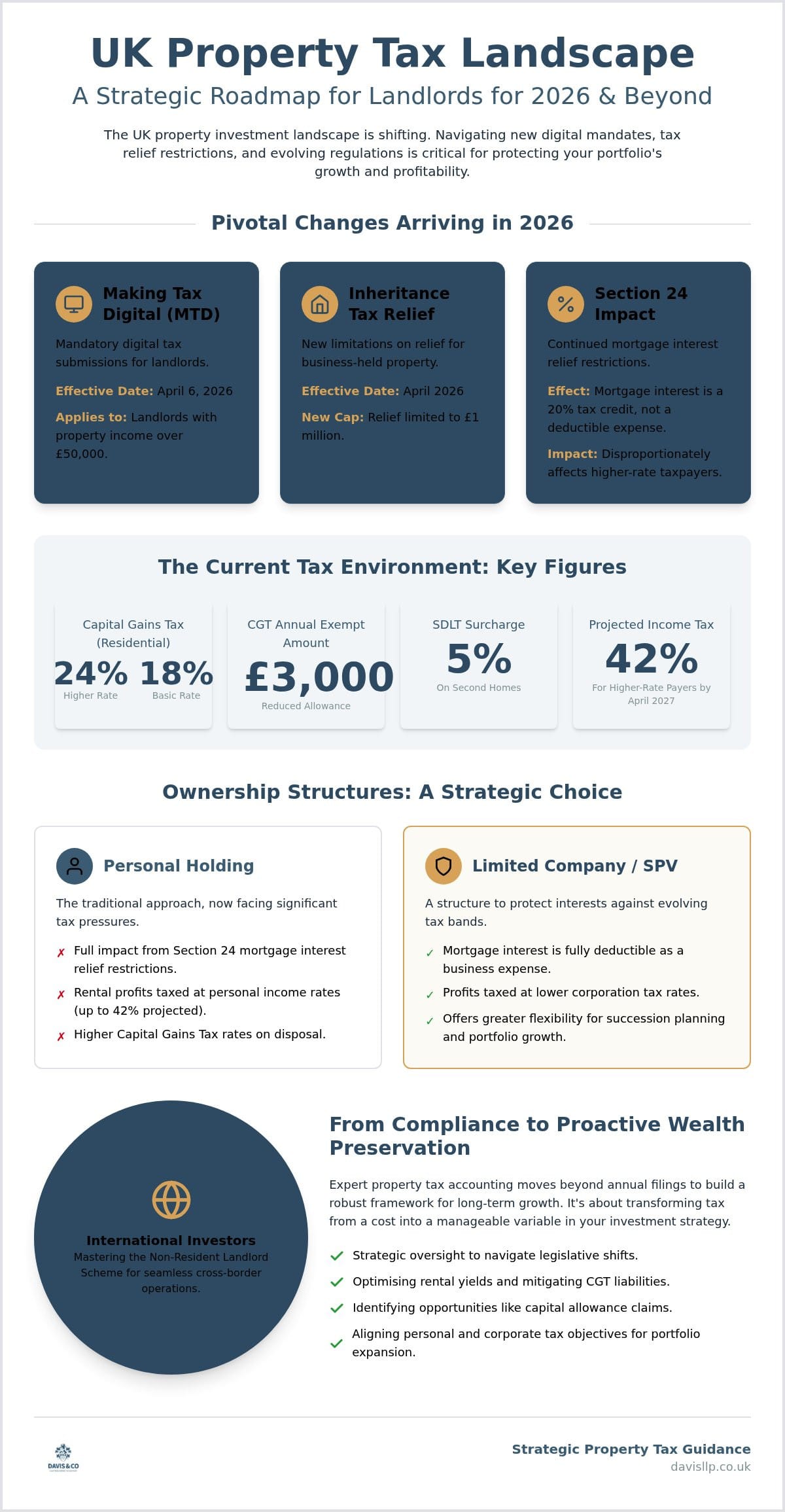
The 2026 fiscal year is a pivotal moment for UK landlords due to several cumulative legislative shifts:
- The mandatory implementation of Making Tax Digital (MTD) for landlords with property income over £50,000 as of April 6, 2026.
- New caps on Inheritance Tax relief for business-held property, limited to £1 million from April 2026.
- The continued impact of Section 24 interest relief restrictions which disproportionately affect higher-rate taxpayers.
Navigating the 2026 Regulatory Environment
The current regulatory landscape requires a sophisticated understanding of how various levies interact. For instance, the 5% Stamp Duty Land Tax (SDLT) surcharge on second homes and the higher rate of Capital Gains Tax (CGT) for residential sales, which remains at 24%, create a high-stakes environment for buying and selling. Understanding how these elements fit within the broader UK Taxation System is essential for maintaining profitability. Securing expert tax advice in the UK ensures that your filings aren’t just accurate but are structured to withstand rigorous compliance checks. We focus on providing a clear roadmap through these complexities, allowing you to focus on portfolio management rather than administrative hurdles.
From Compliance to Strategic Wealth Preservation
True value is found when moving beyond the annual Self Assessment cycle toward a model of proactive wealth preservation. We focus on identifying often-overlooked opportunities, such as capital allowance claims in commercial real estate, which can significantly offset tax liabilities. This level of oversight supports business growth acceleration by freeing up capital that would otherwise be lost to tax inefficiency. Professional property accounting integrates personal and corporate tax perspectives, ensuring that every decision serves the wider goal of portfolio expansion. It’s about transforming tax from an unavoidable cost into a manageable variable within your broader investment strategy, ensuring your legacy is protected for the next generation.
Strategic Management of Capital Gains and Rental Income Tax
Managing the fiscal performance of a portfolio requires a granular approach to both recurring income and eventual disposals. For landlords in the capital, partnering with a property tax accountant london provides the analytical rigour needed to navigate the increasingly thin margins caused by Section 24 interest relief restrictions. Since mortgage interest is no longer a deductible expense but a 20% tax credit, higher-rate taxpayers face an effective tax rate that can exceed their actual cash profit. This shift makes meticulous expense management the primary lever to counteract rising property income tax rates, which are set to reach 42% for higher-rate payers by April 2027.
Strategic loss utilisation also remains a critical component of portfolio health. If one property incurs a rental loss, perhaps due to a significant revenue repair or a period of vacancy, that loss can typically be carried forward to offset future profits within the same property business. This ensures that your tax liability over several years reflects your true economic gain rather than a snapshot of a single difficult year. We help you track these figures with precision, ensuring no relief is left unclaimed.
Capital Gains Tax Mitigation Strategies
The 2026 Capital Gains Tax (CGT) framework remains a significant consideration for any disposal. The higher rate for residential property remains at 24%, while the basic rate is 18%. With the annual exempt amount now set at £3,000, timing is everything. We often advise on the strategic use of Private Residence Relief (PRR) for properties that served as primary dwellings, though its application has become more restricted. It’s also vital to adhere to the 60-day reporting and payment window. Failing to report a sale to HMRC within this timeframe leads to immediate penalties, making professional oversight essential for compliance.
Maximising Allowable Revenue Expenses
Distinguishing between capital improvements and revenue repairs is a frequent point of contention. While a new extension is a capital cost deductible against CGT upon sale, the like-for-like replacement of a roof is a revenue expense deductible from your current rental income. Correctly categorising management fees, insurance, and professional services can significantly lower your taxable base. According to Official guidance on rental income tax, landlords must ensure all claims are wholly and exclusively for the business. Allowable expenses are the day-to-day costs of running and maintaining a property that do not result in a significant improvement to the asset’s value. Proactive property accounting ensures that every legitimate deduction is captured and documented for future scrutiny.
Ownership Structures: Personal Holding vs. Limited Company SPVs
Deciding how to hold property is no longer a secondary concern; it is the foundation of your tax strategy. For investors seeking a property tax accountant london, the conversation often begins with the merits of a Special Purpose Vehicle (SPV). Unlike personal ownership, where Section 24 limits finance cost relief to a basic rate credit, corporate structures allow for the full deduction of mortgage interest against rental profits. This distinction is vital as we approach the April 2027 income tax hike to 42% for higher-rate payers. We focus on helping you determine if the corporate veil offers the protection your specific portfolio requires.
Extracting profits from a company requires careful dividend tax planning. From April 2026, the ordinary dividend rate is 10.75% and the upper rate is 35.75%. While these rates are significant, the ability to retain and reinvest profits within a company at corporation tax rates often outweighs the immediate cost of personal extraction. Enveloping property within a company can also serve as a tool for inheritance tax planning, though you must consider the £1 million cap on business-held property relief that became effective on April 6, 2026. Our role is to ensure these structures remain a benefit rather than a burden.
The Case for Incorporation in 2026
Corporate entities act as a hedge against the restrictive interest relief rules affecting individuals. They offer the flexibility to distribute shares among family members, potentially utilising lower tax bands across a household. However, the transition isn’t without friction. Transferring existing properties into a company triggers Stamp Duty Land Tax (SDLT), including the 5% surcharge for additional dwellings. Additionally, properties valued over £500,000 attract the Annual Tax on Enveloped Dwellings (ATED), with charges starting at £4,600 for the 2026/27 tax year. We provide the rigorous analysis needed to ensure the long-term tax savings justify these entry costs.
Personal Ownership: When It Still Makes Sense
Direct personal ownership remains appropriate for smaller portfolios or basic-rate taxpayers who don’t benefit from the complexity of an SPV. It avoids the “double taxation” trap where profits are taxed at the corporate level and again upon extraction as dividends. Crucially, individuals can utilise their personal Capital Gains Tax (CGT) annual exempt amount, currently £3,000, which is unavailable to corporate bodies. Personal ownership offers a level of administrative simplicity that, for some, remains the most efficient path. We ensure that if you remain a personal landlord, your deductions are maximised to protect your net yields.
International Property Investment and Non-Resident Tax Compliance
Managing a UK property portfolio from overseas introduces layers of regulatory scrutiny that require a steady hand. For international investors, a property tax accountant london acts as a bridge between UK statutory requirements and global financial objectives. The Non-Resident Landlord Scheme (NRLS) remains the primary mechanism for tax collection, requiring letting agents or tenants to withhold tax from rental income. Currently, this withholding rate is 20%, though it is expected to rise to 22% in April 2027 to align with basic rate adjustments. We assist clients in applying for gross payment status, which allows for rent to be received in full, provided that tax obligations are met through the annual Self Assessment process.
Strategic international tax planning is particularly vital for non-domiciled individuals who must navigate the interplay between UK tax treaties and their home jurisdictions. These treaties are essential for mitigating double taxation on cross-border real estate income. High-value residential properties held by foreign entities are also subject to the Annual Tax on Enveloped Dwellings (ATED). For the 2026/27 tax year, the charge for properties valued between £500,000 and £1 million is £4,600. The deadline for both filing the return and paying the tax is April 30, 2026.
Tax Obligations for Non-Resident Landlords
Investors must maintain a rigorous reporting schedule to avoid HMRC scrutiny. Partnering with a property tax accountant london ensures that your Non-Resident Capital Gains Tax (NRCGT) obligations are met without delay. In 2026, non-residents selling UK land or residential property must report the disposal and pay any tax due within 60 days of completion. This timeline is strict and requires immediate coordination after a sale. We manage these filings to ensure that your global tax position remains optimised and that you remain in full compliance with UK law.
Managing International Family Offices and Trusts
For multi-generational wealth preservation, the role of trust tax services is indispensable. Trusts often provide a robust framework for holding UK assets, but they require careful administration to meet compliance standards like the Register of Overseas Entities (ROE). The ROE requires foreign entities that own UK land to identify their beneficial owners, a process that ensures transparency but adds administrative weight. We coordinate international advice to ensure that trust structures don’t inadvertently trigger double taxation traps, protecting your legacy through composed partnership and technical precision. Our team provides the specialised oversight necessary for complex cross-border interests. Learn more about our international tax planning and property accounting services.
Securing Your Portfolio with Davis & Co LLP
Davis & Co LLP brings a legacy of over 120 years of professional excellence to the management of complex real estate interests. As a dedicated property tax accountant london, we understand that a portfolio is more than a collection of assets; it’s a vehicle for wealth preservation and long-term security. Our approach is defined by a commitment to bespoke service delivery, where we move beyond standard compliance to provide high-level strategic oversight. By integrating personal tax services with corporate property accounting, we ensure that every decision is evaluated for its impact on both your immediate cash flow and your ultimate succession plans.
Technical rigour is the cornerstone of our practice. As Chartered Certified Accountants, we offer a level of precision that is essential in an era of heightened HMRC scrutiny. We support our clients through every stage of the property lifecycle, from the initial structuring of an acquisition to the final complexities of an exit strategy. This continuity of care allows us to build a deep understanding of your financial landscape, positioning us as a trusted advisor rather than a mere service provider. We’re here to ensure that your financial interests are protected with the same care you put into building them.
A Strategic Partnership for Growth
Maintaining the health of an expanding property business requires more than annual reviews. We utilise management accounts to provide a real-time perspective on portfolio performance, allowing for agile decision-making in a volatile market. Effective cash flow management is particularly vital for those looking to reinvest profits or secure further financing for expansion. Throughout our partnership, we maintain the highest standards of discretion and reliability, ensuring that your sensitive commercial and personal matters are handled with the professional gravitas they deserve.
Next Steps for Your Property Tax Plan
The legislative landscape of 2026 demands a proactive response. We invite you to request a comprehensive tax efficiency review of your current holdings to identify potential areas for optimisation. Whether your interests are focused in the capital or distributed across the UK, our teams in London and Harpenden deliver national expertise with a highly individualised touch. We’re ready to help you navigate the complexities of the current tax regime with confidence and clarity. Contact Davis & Co LLP today for a consultation to begin securing the future of your property portfolio.
Future-Proofing Your Property Interests for 2026 and Beyond
Success in the 2026 property market depends on a fundamental shift from reactive compliance to proactive strategic planning. We have detailed how meticulous expense management, the intelligent application of limited company structures, and rigorous international compliance serve as the essential pillars for portfolio resilience. Partnering with a specialist property tax accountant london ensures that your financial decisions are supported by technical precision and a sophisticated understanding of the evolving legislative landscape.
Davis & Co LLP, founded in 1901, offers the professional gravitas of over a century of heritage as Chartered Certified Accountants. We specialise in crafting tailored solutions for complex property portfolios, providing niche expertise in international and trust tax to protect your global interests. We invite you to secure your property wealth with expert tax planning from Davis & Co LLP. By aligning your immediate operational needs with long-term succession goals, we can help you build a stable and prosperous future for your property business. Your legacy deserves the protection of a partner committed to your long-term growth.
Frequently Asked Questions
Do I need a property tax accountant for a single buy-to-let?
While not legally required, professional oversight is highly beneficial for single-property owners due to the mandatory implementation of Making Tax Digital (MTD) in April 2026. If your property income exceeds £50,000, you must comply with quarterly digital reporting. A specialist property tax accountant london ensures you maximise allowable revenue expenses and correctly navigate the Section 24 interest relief restrictions to protect your net yields.
How has property tax for landlords changed in 2026?
The most significant change is the mandatory digital reporting under MTD for those earning over £50,000 in property income. Additionally, the dividend tax ordinary rate has risen to 10.75% and the upper rate to 35.75% as of April 2026. Inheritance Tax relief for business-held property is also now capped at £1 million, necessitating a comprehensive review of long-term succession and portfolio structures.
Is it still tax-efficient to buy property through a limited company?
Incorporation remains a powerful tool for higher-rate taxpayers because companies can deduct the full amount of mortgage interest from rental profits. This acts as a critical hedge against Section 24 restrictions that affect individual landlords. However, you must weigh these benefits against the 5% Stamp Duty Land Tax surcharge on second homes and the potential for double taxation upon eventual profit extraction.
What are the tax implications for non-residents owning UK property?
Non-residents are subject to the Non-Resident Landlord Scheme, where tax is typically withheld at a rate of 20% by letting agents. Engaging a property tax accountant london is essential for navigating cross-border treaties and applying for gross payment status. You must also report any UK property sale to HMRC within 60 days of completion to comply with Non-Resident Capital Gains Tax regulations.
Can I claim mortgage interest against my rental income in 2026?
For individual landlords, mortgage interest is no longer a deductible expense. Instead, you receive a tax credit restricted to the 20% basic rate. This can significantly increase the effective tax rate for higher-rate taxpayers whose income tax on property is set to reach 42% by April 2027. Conversely, if you hold property within a limited company, you can still deduct full finance costs before calculating corporation tax.
What is the 60-day rule for Capital Gains Tax reporting?
The 60-day rule requires you to report the disposal of a UK residential property and pay any estimated Capital Gains Tax due within 60 days of the completion date. This applies to both UK residents and non-residents. Failure to meet this strict deadline results in immediate penalties and interest charges. Prompt coordination with your advisor is vital to ensure your filings are accurate and timely.
How can I reduce Inheritance Tax on my property portfolio?
Reducing Inheritance Tax often involves a combination of gifting assets, utilising trusts, or restructuring holdings into business entities. However, as of April 6, 2026, Inheritance Tax relief on business-held property is capped at £1 million. Strategic planning might involve life insurance policies or the use of Family Investment Companies to manage the transfer of wealth to the next generation while maintaining control over the assets.
What is the Annual Tax on Enveloped Dwellings (ATED) threshold?
The ATED threshold applies to residential properties in the UK valued at more than £500,000 that are owned by a company or other “non-natural person.” For the 2026/27 tax year, the annual charge for properties valued between £500,000 and £1 million is £4,600. Returns must be filed and the tax paid by April 30, 2026. Maintaining compliance is essential to avoid significant penalties for high-value holdings.