The most resilient UK businesses don’t view their annual tax bill as a static cost of doing business, but as a dynamic variable that can be managed to support long-term growth. With the main rate confirmed at 25% for profits exceeding £250,000 in 2026, the margin for error in your fiscal strategy has never been narrower. Proactive corporation tax planning uk is no longer just about meeting deadlines; it’s about ensuring that your capital remains where it’s most effective. We recognize that the complexity of shifting legislation, such as the reduction in writing-down allowances to 14% from April 2026, often creates a sense of uncertainty rather than opportunity. It is natural to feel the pressure on your cash flow when regulatory updates seem constant and unforgiving.
This guide will demonstrate how sophisticated tax strategies transform a mandatory compliance obligation into a strategic lever for capital preservation and business acceleration. We’ll explore how to navigate the 2026 thresholds and the merged R&D scheme to achieve a lower effective tax rate while maintaining total peace of mind regarding HMRC compliance. By moving beyond simple filing, we can ensure your tax position provides the stability needed for confident, international scalability.
Key Takeaways
- Understand how the 2026 fiscal landscape necessitates a shift from simple compliance to strategic corporation tax planning uk to protect your business’s capital.
- Identify how to maximize statutory incentives, including permanent full expensing and the evolving requirements of the merged R&D tax relief scheme.
- Evaluate the benefits of robust corporate structures for facilitating efficient loss relief and managing the complexities of international expansion.
- Discover tax-efficient methods for profit extraction by balancing director salaries and dividends with deductible employer pension contributions.
- Learn to integrate tax planning into your broader growth strategy by using management accounts to monitor liabilities and improve cash flow predictability.
Navigating the UK Corporation Tax Landscape in 2026
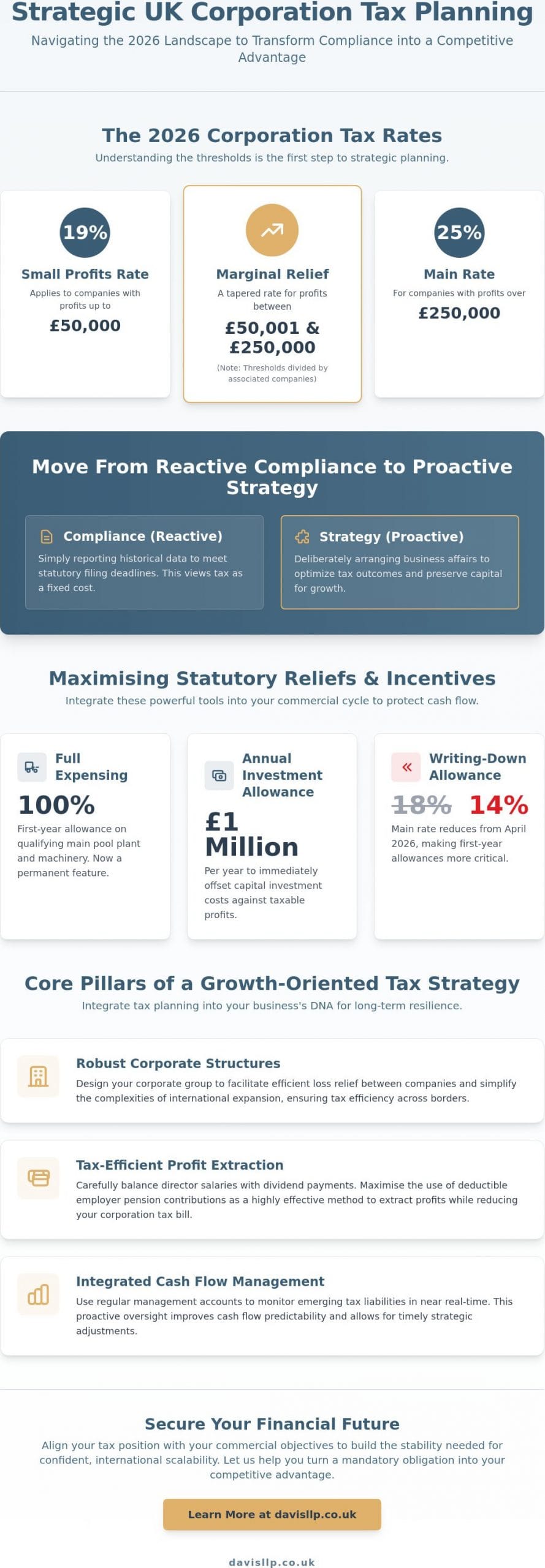
UK corporation tax applies to all profits earned by companies resident in the UK, alongside the UK-based trading profits of overseas branches. While the fundamental obligation remains constant, the 2026 fiscal environment introduces nuances that demand a more sophisticated approach. For the financial year beginning 1 April 2026, the main rate of 25% applies to companies with profits exceeding £250,000, while the small profits rate remains at 19% for those earning up to £50,000. Companies falling between these thresholds must navigate marginal relief, a calculation that becomes increasingly complex when the associated companies rule is factored in. This rule divides profit thresholds by the number of companies under common control, which can accelerate the transition into a higher tax bracket.
Effective corporation tax planning uk requires a transition from retrospective compliance to prospective strategy. Compliance is merely the act of accurately reporting what has already occurred to satisfy statutory requirements. Strategy, however, involves the deliberate arrangement of business affairs to optimize the timing and nature of transactions. This distinction is critical in a volatile economic climate where cash flow predictability is the foundation of resilience. For a broader context on the evolution of these regulations, a UK Corporation Tax Overview provides useful historical perspective on how these rates and structures have shifted to meet modern economic demands.
The Evolving Role of HMRC Scrutiny
The 2026 compliance environment is defined by a rigorous shift toward digital transparency. HMRC’s expansion of Making Tax Digital (MTD) now requires more businesses to maintain digital records and provide frequent updates, moving the goalposts from annual filings to near real-time data sharing. This level of corporate transparency means that inconsistencies are identified faster than ever before. We believe that maintaining professional gravitas in your reporting is the most effective deterrent against intrusive investigations. When your filings reflect intellectual rigour and precise analytical thought, it signals to HMRC that your tax affairs are managed with the utmost integrity and care.
Tax Planning as a Strategic Growth Lever
We encourage our partners to move beyond viewing taxation as a mere cost centre or a drain on resources. Instead, tax efficiency should be viewed as a mechanism that supports reinvestment and business scaling. By identifying relief opportunities before capital is committed, you can preserve the liquidity necessary for market expansion or talent acquisition. Securing expert tax advice in the UK ensures that your corporate structure isn’t just compliant, but is actively contributing to your long-term stability. This proactive alignment of tax position with commercial objectives transforms a mandatory obligation into a competitive advantage.
Maximising Statutory Reliefs and Incentives
Statutory reliefs shouldn’t be treated as afterthoughts during the annual filing process. Instead, they represent a core component of sophisticated corporation tax planning uk. While the official government guidance on Corporation Tax outlines the basic mechanics of these incentives, the real value lies in how they’re integrated into your broader commercial cycle. For instance, the permanent status of full expensing allows companies to claim a 100% first-year allowance on qualifying main pool plant and machinery. When combined with the Annual Investment Allowance (AIA), which remains at £1 million per year, businesses have significant scope to offset investment costs against taxable profits immediately.
Capital Allowances and Full Expensing
Strategic timing is essential when considering major capital investments. From April 2026, the main rate of writing-down allowance for plant and machinery reduces from 18% to 14%. This shift makes the immediate relief offered by full expensing and the AIA even more valuable for maintaining liquidity. It’s vital to distinguish between revenue expenditure, which is deductible as a day-to-day business cost, and capital investment, which must be claimed through these specific allowances. For those in sectors such as leasing that can’t claim full expensing, the new 40% first-year allowance, effective from 1 January 2026, provides a necessary alternative to support asset acquisition.
Innovation Incentives: R&D and Patent Box
The UK’s innovation landscape has undergone a significant transformation with the introduction of the merged R&D scheme. This unified approach provides a 20% taxable credit on qualifying expenditure, simplifying the process for many but requiring heightened attention to detail. Qualifying activities must seek to achieve an advance in science or technology through the resolution of scientific or technological uncertainty. This isn’t limited to laboratory work; it often encompasses complex software development or engineering challenges. We often help clients align these efforts with the Patent Box, which allows for a 10% effective tax rate on profits derived from patented inventions.
Beyond innovation and equipment, other niche reliefs like Land Remediation Relief offer a 150% deduction for costs incurred in cleaning up contaminated or derelict sites. Successfully navigating these incentives requires more than just technical knowledge; it requires a partnership that understands your industry’s specific operational realities. If you’re looking to refine your approach, our team can provide tailored Business Growth Acceleration strategies that ensure no relief is left unclaimed.
Structural and International Tax Optimisation
For firms with multiple entities or global aspirations, domestic corporation tax planning uk shouldn’t exist in a vacuum. The way you structure your group and manage cross-border flows determines whether you’re leaking capital through inefficient withholding taxes or trapped losses. We see structural optimisation as a way to ensure the whole is more tax-efficient than the sum of its parts. This involves a deliberate evaluation of how assets are held and how profits are repatriated. It’s about creating a framework that supports scalability without inviting unnecessary fiscal friction.
Group Relief and Subsidiary Management
Group relief allows for the seamless transfer of trading losses between UK-resident companies, effectively lowering the collective tax burden. This is particularly valuable during periods of expansion where one subsidiary might incur startup costs while another remains profitable. We also consider the Substantial Shareholdings Exemption (SSE), which can facilitate the tax-free disposal of subsidiaries, provided specific holding conditions are met. Managing intra-group financing also requires care to ensure interest deductions are optimised without falling foul of corporate interest restriction rules. A well-constructed group structure provides the flexibility needed to move assets and capital where they’re most effective.
Cross-Border Compliance and Transfer Pricing
Expanding beyond the UK introduces a layer of complexity that demands specialised international tax planning. From January 2026, the landscape shifts as Diverted Profits Tax is repealed and replaced with a new charge on unassessed transfer pricing profits at a rate of 31%. This change underscores the necessity of ensuring all international trade occurs at “arm’s length,” mirroring market conditions. We also help partners prepare for the mandatory foreign branch exemption, which becomes the default for most companies starting in January 2027, or September 2026 for those in the energy sector.
Strategic use of Double Taxation Agreements (DTAs) remains a primary tool for minimising withholding taxes on cross-border interest, royalties, and dividends. By aligning your corporate structure with these treaties, you protect your margins from being eroded by double taxation. For larger entities, addressing Global Minimum Tax standards (Pillar Two) is no longer a future consideration but a current operational requirement. We focus on providing the intellectual rigour needed to manage these moving parts, ensuring your global footprint remains a source of strength rather than a compliance burden.
Efficient Profit Extraction and Cash Flow Management
The extraction of value from a business is as much about timing as it is about the chosen vehicle. For directors and shareholders, the goal is to balance personal financial requirements with the need to maintain robust working capital within the company. This balance is a central pillar of effective corporation tax planning uk. Managing the timing of tax payments is equally vital; corporation tax is generally due nine months and one day after the end of your accounting period. By aligning extraction with these payment cycles, you ensure that the company retains the liquidity necessary for operational stability.
The Salary vs. Dividend Debate in 2026
The historical assumption that dividends are universally superior to salary requires fresh scrutiny in 2026. From 6 April 2026, dividend tax rates have increased to 10.75% for the basic rate and 35.75% for the higher rate, while the tax-free allowance remains at a modest £500. When these personal rates are combined with the 25% main rate of corporation tax, the total effective tax burden can be significant. We often recommend a strategy that sets a director’s salary at the National Insurance secondary threshold of £9,100 per year. This maintains state pension entitlement without incurring National Insurance contributions (NICs). Any extraction beyond this level requires a bespoke framework that accounts for fiscal drag, as frozen personal tax thresholds push more of your income into higher brackets.
Pensions and Long-Term Capital Preservation
Employer pension contributions remain one of the most efficient tools for both profit extraction and capital preservation. Unlike dividends or salary, these contributions are typically a deductible business expense, reducing the company’s taxable profit and its corporation tax liability. They’re also exempt from both employer and employee NICs. With the annual allowance generally set at £60,000 for 2026, there’s substantial scope for corporate pension funding. This approach doesn’t just lower your current tax bill; it integrates your corporate strategy with long-term wealth management goals.
For businesses looking to align employee interests with tax efficiency, share incentive schemes can provide a structured route to equity participation while offering statutory tax advantages. This ensures that the growth of the business benefits those who drive it, without creating an immediate or unnecessary tax burden. If you’re looking to refine your liquidity strategy, our team provides comprehensive Cash Flow Management services to help you navigate these competing priorities.
Integrating Tax Planning into Business Growth Strategy
Effective business leadership requires a shift in perspective, viewing tax not as an isolated annual hurdle but as a fundamental component of your growth engine. When corporation tax planning uk is embedded within your daily operations, it ceases to be a drain on resources and becomes a tool for capital preservation. This integration allows you to anticipate liabilities before they impact your liquidity, ensuring that your expansion plans remain on solid financial footing. By aligning your fiscal obligations with your commercial milestones, you create a more predictable and resilient enterprise that is better equipped to handle the demands of a competitive market.
Management Accounting and Tax Forecasting
The most common pitfall for expanding firms is the “year-end surprise,” where a lack of visibility leads to unexpected tax liabilities that disrupt cash flow. We solve this through the rigorous application of Management Accounts, which allow for quarterly tax reviews and real-time monitoring. Accurate bookkeeping isn’t just about compliance; it provides the data necessary for robust tax forecasting. When you understand your tax position month-by-month, you can make informed strategic investment decisions, such as timing the acquisition of plant and machinery to coincide with your most profitable periods. This level of foresight ensures that your tax strategy actively supports your strategic small business accountant in driving growth rather than hindering it.
The Davis & Co LLP Approach: A Partnership for Success
Our philosophy is built on a foundation of composed partnership and intellectual rigour. We don’t just provide services; we act as a strategic ally, combining our expertise in Audit and Assurance with deep tax knowledge to deliver holistic results. This approach is particularly vital when preparing for future exit strategies. Tax-efficient business structuring must begin years before a potential sale or transition to ensure that you’re positioned to benefit from specific exemptions and structural advantages. We maintain a steady, deliberate rhythm in our communication, ensuring you feel secure and well-advised at every stage of your corporate journey. Our commitment to individualized service delivery means that your specific commercial context is always the primary driver of our advice.
As you look toward the 2026 fiscal year, the first step is to transition from reactive filing to proactive strategy. Initiating a strategic tax review for your organisation will clarify your current position and identify the levers available for growth acceleration. We invite you to experience a level of service where reliability and discretion are the standard, and where your success is the measure of our expertise. By choosing a partner that values professional gravitas and quiet excellence, you ensure that your corporation tax planning uk is a source of stability in an often volatile environment.
Securing Your Corporate Future through Strategic Alignment
The 2026 fiscal landscape demands a shift from simple compliance to a proactive, growth-oriented mindset. We’ve explored how identifying statutory reliefs early and integrating real-time management data can transform your tax position into a source of capital stability. By aligning your corporate structure with international standards and refining profit extraction, you ensure that your business remains resilient against legislative shifts. Sophisticated corporation tax planning uk is not a seasonal task; it’s a continuous commitment to fiscal excellence and organizational health.
As Chartered Certified Accountants since 1901, we bring a history of success and specialist expertise in international and dental tax to every partnership. Our role as strategic advisors for business growth and audit ensures that your financial affairs are managed with the precision and discretion they deserve. We invite you to Contact Davis & Co LLP for a bespoke Corporation Tax consultation to discuss how we can support your long-term objectives. We look forward to helping you navigate the complexities of the modern tax environment with absolute confidence.
Frequently Asked Questions
What are the current UK Corporation Tax rates for 2026?
The main rate of corporation tax for the financial year starting 1 April 2026 is 25% for companies with taxable profits exceeding £250,000. For businesses with profits up to £50,000, the small profits rate remains at 19%. Companies with profits falling between these two thresholds are subject to marginal relief, which gradually increases the effective tax rate as profits rise toward the upper limit.
How can a company reduce its Corporation Tax liability legally?
A company can lower its liability through the strategic use of statutory reliefs such as the Annual Investment Allowance (AIA), which provides 100% relief on qualifying plant and machinery up to £1 million. Engaging in corporation tax planning uk also involves utilizing the Patent Box for a 10% rate on qualifying profits or making deductible employer pension contributions. These methods ensure you remain compliant while optimizing your capital position.
What is the deadline for paying Corporation Tax and filing the return?
The payment deadline is typically nine months and one day after the end of your company’s accounting period. While the payment is due earlier, you have twelve months after the accounting period ends to file your Company Tax Return (CT600). It is essential to manage these separate timelines carefully to avoid interest charges on late payments, even if the filing itself is submitted on time.
Can I claim R&D tax relief if my business is not in the tech sector?
Yes, R&D tax relief is available to any company that seeks to achieve an advance in science or technology by resolving scientific or technological uncertainty. This applies to various sectors, from manufacturing and engineering to food production and construction. The merged R&D scheme provides a 20% taxable credit on qualifying expenditure, provided the project meets the specific criteria for innovation defined by HMRC.
How do capital allowances differ from depreciation in accounting?
Depreciation is an accounting estimate used to spread the cost of an asset over its useful life, but it is not deductible for tax purposes. Capital allowances are the statutory equivalent used to calculate your taxable profit, allowing you to deduct the cost of certain assets from your income. For 2026, the reduction in writing-down allowances to 14% highlights the importance of using full expensing or the AIA where possible.
What are the tax implications of expanding my UK business overseas?
Expanding overseas introduces complexities regarding transfer pricing and the establishment of permanent bases in foreign jurisdictions. From 1 January 2026, a new 31% charge on unassessed transfer pricing profits replaces the Diverted Profits Tax. Additionally, the elective corporation tax exemption for foreign permanent establishments becomes mandatory for most companies starting in January 2027, which prevents foreign losses from being used to shelter UK profits.
Is it more tax-efficient to take a salary or dividends in 2026?
Determining the most efficient route requires a bespoke analysis of both corporate and personal tax positions. For 2026, dividend tax rates are set at 10.75% for basic rate taxpayers and 35.75% for higher rate taxpayers. Effective corporation tax planning uk often involves a combination of a salary set at the £9,100 National Insurance secondary threshold and dividends to minimize the combined tax and National Insurance contribution burden.
What happens if I miss the Corporation Tax filing deadline?
Missing the filing deadline results in an automatic £100 penalty, which increases if the return is more than three months late. If you miss the deadline for three consecutive years, the initial penalty rises to £500. HMRC also charges interest on any unpaid tax from the date it was due until the date it is paid, which can create significant pressure on your company’s working capital.