The VAT margin scheme for used cars can make standard VAT the wrong comparison. A VAT-registered dealer may use it for an eligible second-hand vehicle bought without reclaiming VAT. VAT is calculated as one-sixth of the gross margin, not the full selling price. The scheme is optional, and not every used car qualifies.
This distinction matters when assessing a vehicle’s selling price, purchase cost and VAT position. Preparation expenses may affect your profit, for example, without reducing the margin used to calculate VAT.
This guide explains who can use the scheme, how to calculate VAT and which costs count towards the margin. It also compares the result with standard VAT, helping you understand how eligibility and the chosen VAT treatment affect a sale.
Key Takeaways
- Check how you acquired the vehicle and whether VAT was reclaimed to assess if it may qualify for the scheme.
- For an eligible sale, VAT is one-sixth of the gross margin, according to HM Revenue & Customs (HMRC).
- Separate vehicle purchase costs from preparation expenses: they may affect profit differently from the VAT margin.
- Compare the margin calculation with standard VAT, which HMRC states is 20% in the UK example, before considering the treatment of a sale.
How does the VAT margin scheme affect your VAT return?
For an eligible second-hand vehicle sold under the UK VAT margin scheme, VAT due is one-sixth of the gross margin, according to HM Revenue & Customs (HMRC). A dealer must be VAT-registered to use it. HMRC says a car dealer must register when taxable turnover exceeds £90,000 in the last 12 months or is expected to exceed £90,000 in the next 30 days. The margin scheme requires no separate registration.
Eligibility depends on the vehicle’s condition and purchase history. It must be second-hand, meaning it has been driven on the road for business or pleasure, or is suitable for further use. Dealers can generally use the scheme for cars, vans, lorries and motorcycles bought from a private individual or another source where VAT was not reclaimed.
A vehicle bought on an invoice showing VAT separately, already sold under normal VAT rules, or imported into the UK is not eligible. New vehicles, category A or B write-offs, and vehicles subject to the End Of Life Directive are also excluded. A dealer may choose standard VAT instead for an eligible vehicle.
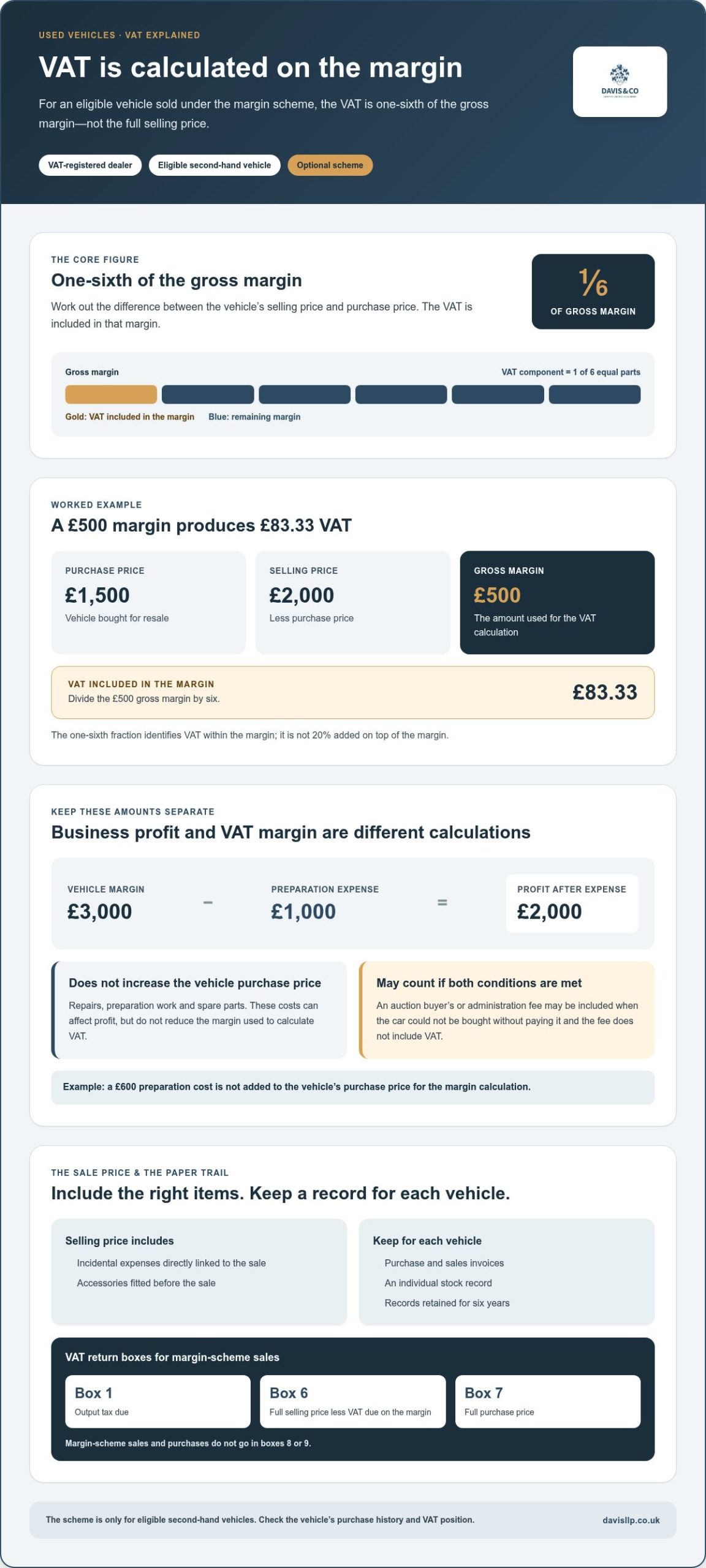
For the VAT return, report the output tax due in box 1. Box 6 includes the full selling price less VAT due on the margin, while box 7 includes the full purchase price. Margin scheme sales and purchases don’t go in boxes 8 or 9. Keep an individual stock record for each vehicle and retain relevant records for six years, as HMRC requires. Errors such as applying the scheme to an ineligible vehicle can lead to an incorrect return and VAT being due under standard rules.
The separate second-hand motor vehicle payment scheme applies to eligible vehicles bought in Great Britain and moved to Northern Ireland or the EU for resale. It began on 1 May 2023. A VAT-registered business in Northern Ireland claims the payment on its VAT return; an EU-established business claims using form VAT67. The UK Global Accounting Scheme is different: HMRC says an individual item must have a purchase price of £500 or less to be included.
How the VAT Margin scheme calculates VAT on second-hand goods
The VAT margin scheme for used cars calculates VAT from the difference between a vehicle’s purchase price and selling price, not the dealer’s overall profit. This matters because business expenses can reduce profit without changing the amount used for the VAT calculation.
Calculating VAT on the Margin
The gross margin is the difference between the vehicle’s purchase price and selling price. VAT applies to that margin, not the full selling price. For a dealer considering the VAT margin scheme for used cars, this calculation determines the output tax due on each eligible vehicle.
Purchase Costs and Margin Calculations
Only qualifying amounts form part of the purchase price used in the margin calculation. An auction buyer’s fee or administration fee may be included if the car could not be bought without paying it and the fee does not include VAT. Repairs, preparation and spare parts do not increase the vehicle’s purchase price for this calculation. Keep the purchase invoice and supporting records separate from other costs.
Using the One-Sixth Fraction
Divide the gross margin by six to calculate the VAT included in it. For a car bought for £1,500 and sold for £2,000, the £500 margin produces £83.33 VAT. The fraction isn’t 20% added on top of the margin. Applying it correctly distinguishes the VAT component from the dealer’s remaining margin.
The selling price includes incidental expenses directly linked to the sale and accessories fitted before sale. If a dealer sells on behalf of another person and invoices in its own name, it accounts for output tax as the seller for VAT purposes. The invoice and stock record should accurately reflect the transaction.
A vehicle imported into the UK is excluded from the margin scheme. A separate second-hand motor vehicle payment scheme applies to eligible vehicles bought in Great Britain and moved to Northern Ireland or the EU for resale; it began on 1 May 2023. For international tax considerations, cross-border tax planning can help businesses assess the relevant treatment.
Purchase costs and preparation expenses
For a margin-scheme vehicle, keep the car’s purchase price distinct from preparation costs. The purchase price forms one side of the margin calculation; workshop work and spare parts don’t increase it. A £600 preparation cost, for example, isn’t added to the vehicle’s purchase price. Treating it as part of the purchase could understate the taxable margin and the VAT due.
An auction buyer’s fee or administration fee may count towards the purchase price if the car could not be bought without paying it and the fee does not include VAT. Record the fee separately, retain its invoice and confirm it meets those conditions before including it. If a purchase invoice shows VAT separately, the vehicle cannot be sold under the margin scheme. The invoice therefore helps establish eligibility and support the purchase record.
Preparation expenses can reduce the dealer’s profit without changing the VAT margin. If the dealer spends £1,000 preparing the vehicle, profit after that expense is £2,000, while VAT is still calculated on the full £3,000 margin. Keep repair and preparation invoices separate from the vehicle’s purchase and sales records.
Can a dealer reclaim VAT on costs or repairs for a margin-scheme car? VAT on the vehicle purchase itself cannot be reclaimed when it is bought for resale under the scheme. Repair costs do not reduce the margin. Account for any VAT on those invoices separately rather than deducting it from the scheme calculation.
Keep copies of purchase and sales invoices for each vehicle, alongside an individual stock record. The record should let you trace the seller, purchase price, selling price and calculation for that car. A private seller’s receipt and an auction invoice document different purchase routes, while the sales invoice records the final transaction. Clear records help reconcile each vehicle’s margin with the dealer’s reported profit and VAT return.
Margin scheme compared with standard VAT
The key difference is the amount on which VAT is calculated. For an eligible vehicle, the margin scheme calculates VAT on the margin; under normal VAT rules, VAT applies to the full selling price. HM Revenue & Customs (HMRC) states that the standard VAT rate used in its UK example is 20%. The scheme is optional, so dealers can choose standard VAT for an eligible car.
Consider a vehicle sold for £10,000 plus standard-rate VAT. The dealer accounts for £2,000 output VAT, and the buyer pays £12,000. This is a full-price calculation. It differs from a margin sale, where the VAT calculation relates to the difference between the purchase and selling prices, not the full amount paid by the buyer.
The UK example calculates £2,166.67 VAT on the full selling price under standard VAT. If the vehicle instead qualifies for the margin scheme, the calculation applies to the eligible margin. The difference can be material, but eligibility and the vehicle’s purchase history determine which treatment is available.
A car bought on an invoice showing VAT separately cannot qualify for the margin scheme. Nor can a vehicle already sold under normal VAT rules or one for which the buyer reclaimed, or was entitled to reclaim, VAT. If a vehicle does not qualify, or the dealer does not use the scheme, VAT is charged on its full price. A VAT-registered dealer should assess the purchase invoice before deciding how to account for a resale.
For each sale, compare the VAT due under the eligible margin calculation with the full-price treatment, then account for the chosen basis consistently in the VAT return. Do not assume the lower calculation applies: buying a used vehicle alone does not establish eligibility. Comparing purchase records, sale terms and VAT treatment supports sound accounting decisions.
For a tailored review of VAT accounting and supporting records, arrange an audit and assurance discussion.
Davis & Co LLP: International Tax Planning
Davis & Co LLP provides International Tax Planning for businesses assessing tax implications across borders. If your vehicle trade involves buying in Great Britain and moving stock to Northern Ireland or the EU, or includes other international transactions, consider how those activities fit your wider tax position and business structure.
VAT decisions also affect cash-flow forecasts and management reporting. Davis & Co LLP’s Business Growth Acceleration, Cash Flow Management and Management Accounts services can support wider planning as your trading activity develops. The right focus depends on your circumstances, including how you source vehicles, where you sell them and how you record each transaction.
For advice on your business’s international tax planning, contact Davis & Co LLP or visit davisllp.co.uk.
Build a consistent approach to future vehicle sales
As your vehicle activity develops, make VAT decisions part of a repeatable commercial process. Consider how purchasing choices, sales terms and cash-flow planning work together, rather than treating each transaction as an isolated accounting question. A consistent approach can help your team make timely decisions and keep business records aligned with operational needs.
Using the VAT margin scheme for used cars may also raise wider questions about cross-border activity or business growth. Davis & Co LLP offers International Tax Planning, Business Growth Acceleration and Cash Flow Management to support businesses reviewing these priorities. The right focus depends on how your organisation operates and the decisions it needs to make.
For practical guidance on how VAT treatment fits your business, contact Davis & Co LLP about VAT advice. A considered next step can help you plan with greater clarity as your trading activity moves forward.
Frequently Asked Questions
Who can use the scheme?
VAT-registered motor dealers can use the scheme for eligible second-hand vehicles acquired without reclaiming VAT. A typical example is a dealer buying from a private individual, where no VAT was charged on the purchase. The vehicle must have been driven or be suitable for further use. New or imported vehicles, and cars with VAT shown separately on the purchase invoice, are excluded. The scheme is optional.
Do you pay VAT on used cars?
VAT treatment depends on who sells the car and how a dealer accounts for the sale. A private individual selling their own used car directly does not charge VAT. A dealer may sell an eligible vehicle under the margin scheme, accounting for VAT within the margin, or apply standard VAT to the full price. VAT also applies to new and pre-registered cars in the UK.
Can a company reclaim VAT for a second-hand car?
A company can reclaim VAT on a second-hand car only if it is VAT-qualifying and meets the business-use condition. A VAT-registered company may reclaim VAT on a qualifying car only when it is used exclusively for business purposes; private use prevents that treatment. A private individual cannot reclaim VAT. The vehicle’s purchase history and invoice help distinguish a qualifying purchase from a margin-scheme sale.
Do car dealers have to pay VAT?
VAT-registered dealers must account for VAT on taxable vehicle sales, but the calculation depends on the applicable treatment. Under standard rules, VAT is calculated on the full selling price; an eligible margin-scheme sale uses the margin. According to HM Revenue & Customs (HMRC), a dealer must register when taxable turnover exceeds £90,000 in the last 12 months or is expected to exceed £90,000 in the next 30 days.
Do you pay VAT on a pre-registered car?
Yes, VAT applies to pre-registered cars in the UK. Pre-registration alone does not establish eligibility for the margin scheme; the vehicle’s history and purchase paperwork also matter. If the dealer’s purchase invoice shows VAT separately, the margin scheme cannot be used. When comparing vehicles, distinguish the advertised price from the stated VAT treatment, as this affects the buyer’s total cost.
What does VAT qualifying mean on a used car?
The phrase “VAT qualifying” refers to a car’s VAT status, which should be checked against its purchase history. The term relates to the car’s VAT history; it does not automatically mean every buyer can reclaim VAT. A VAT-registered business may reclaim VAT on a qualifying car only if it is used exclusively for business purposes. A private individual cannot reclaim VAT, even when a car is described as VAT qualifying.