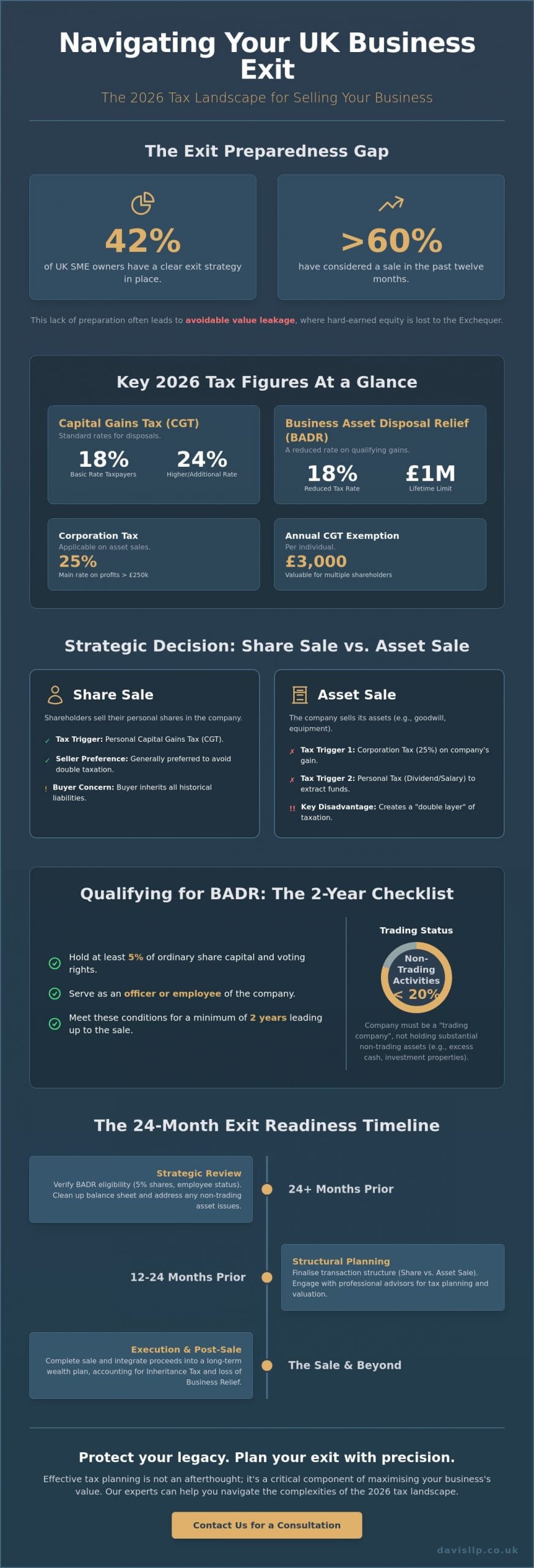
Did you know that only 42% of UK SME owners have a clear exit strategy in place, despite over 60% considering a sale in the past twelve months? This lack of preparation often leads to avoidable value leakage, where a substantial portion of your hard-earned equity is lost to the Exchequer. We recognize that the recent 2025 and 2026 budget adjustments have introduced significant complexity, making effective tax planning for selling a business uk a critical priority for any director looking to secure their legacy. It’s understandable to seek clarity when the fiscal landscape feels increasingly volatile.
We’re here to help you navigate this transition with professional gravitas and precision. By following this guide, you’ll discover how to navigate the 2026 UK tax landscape to protect your business exit value and optimise your personal financial future. We’ll provide a clear analysis of the 18% Business Asset Disposal Relief rate, the new £2.5 million cap on inheritance tax reliefs, and the most robust sale structures available to ensure your wealth is preserved for the years ahead.
Key Takeaways
- Understand the evolving Capital Gains Tax landscape and how recent fiscal policy shifts influence the net value of your disposal.
- Discover how to maximise Business Asset Disposal Relief within the current £1 million lifetime limit as part of a comprehensive approach to tax planning for selling a business uk.
- Evaluate the strategic advantages of share sales versus asset sales to ensure your transaction structure aligns with your long-term financial objectives.
- Implement a structured 24-month lead-in period to address eligibility requirements and enhance the tax efficiency of your eventual exit.
- Secure your personal legacy by integrating sale proceeds into a sophisticated wealth structure that accounts for the loss of Business Relief post-transaction.
Navigating the 2026 UK Tax Landscape for Business Disposals
The 2026/27 tax year has introduced a more rigorous environment for business owners seeking an exit. For many, the primary concern remains the preservation of value against a backdrop of evolving legislation. We’ve seen a shift where the margins for error in tax planning for selling a business uk have narrowed. This requires a more forensic approach to pre-sale preparation. Precision is now paramount.
Capital Gains Tax Rates and Thresholds for 2026
For disposals occurring on or after 6 April 2026, the standard Capital Gains Tax (CGT) rates are set at 18% for basic rate taxpayers and 24% for those in the higher or additional rate brackets. Your total annual income for the year of sale dictates your applicable rate. If a sale pushes your income into the higher bracket, the 24% rate will apply to the majority of your gains. The annual exempt amount for individuals is now £3,000. While modest, it remains a valuable tool when applied across multiple shareholders, such as spouses or civil partners.
The Impact of Recent Legislative Shifts
The 2025 Autumn Budget fundamentally reshaped the exit strategy for UK entrepreneurs. The most notable change is the adjustment to Business Asset Disposal Relief (BADR), which now carries an 18% tax rate on qualifying gains up to a £1 million lifetime limit. This increase from the previous 10% rate means the tax cost of selling a business has risen. Timing is everything. Waiting until a future tax year is often a high-risk strategy. We’ve observed HMRC increasing its scrutiny on “anti-phoenixing” rules and the conversion of income into capital. They’re looking closely at transactions that appear to be structured solely for tax advantages rather than commercial substance.
A key strategic decision involves choosing between a share sale and an asset sale. A share sale typically triggers personal CGT for the shareholders. Conversely, an asset sale means the company itself sells its goodwill or equipment, incurring Corporation Tax at the main rate of 25% for profits over £250,000. Extracting those funds personally then incurs further dividend or salary taxes. This double layer of taxation is why many sellers prefer share disposals, though buyers often push for assets to avoid historical liabilities. Effective tax planning for selling a business uk requires balancing these competing interests to secure the most favourable net outcome. Your tax residency status also remains a pivotal factor. If you’ve spent significant time abroad, your liability could change dramatically, potentially exposing you to double taxation or missed UK reliefs.
Maximising Business Asset Disposal Relief (BADR) and Statutory Reliefs
For many entrepreneurs, the cornerstone of tax planning for selling a business uk is the effective utilisation of Business Asset Disposal Relief. While the fiscal landscape has shifted, this relief remains a vital mechanism for reducing your Capital Gains Tax liability. For disposals occurring on or after 6 April 2026, the applicable rate is 18% on qualifying gains. This still offers a notable advantage over the standard 24% higher rate, provided you remain within the £1 million lifetime limit. We view this limit as a finite strategic resource that requires careful management throughout your career as a business owner.
Eligibility is not an automatic entitlement; it’s a status that must be actively maintained. You must hold at least 5% of the ordinary share capital and voting rights, while also serving as an officer or employee of the company. These conditions must be met for a minimum of two years leading up to the date of sale. We’ve seen many instances where a last-minute resignation or a dilution of shares during a funding round inadvertently disqualified a founder. Verifying these details early is essential to avoid a costly surprise during the due diligence phase of your exit.
Qualifying for the 18% Rate
The definition of a “trading company” is a frequent area of HMRC scrutiny. To qualify for the 18% rate under Business Asset Disposal Relief (BADR), your business must not carry out substantial non-trading activities. This often becomes an issue when a company accumulates significant cash reserves or holds investment properties. If these non-trading elements account for more than 20% of the company’s assets, turnover, or management time, your relief could be at risk. We often recommend a “cleansing” process, where excess cash is extracted or non-trading assets are demerged well in advance of a sale to ensure the company’s trading status remains robust.
Secondary Reliefs: Rollover and Hold-Over
While BADR is the most prominent relief, it’s not the only tool available. Business Asset Rollover Relief allows you to defer the tax on your gains if you reinvest the proceeds into new qualifying business assets. This is particularly useful for serial entrepreneurs who intend to start or acquire a new venture within three years of their exit. Additionally, Gift Hold-Over Relief can be utilised to transfer shares to family members or trusts before a sale. This effectively shifts the gain to the recipient, who may then be able to utilise their own annual exempt amounts or lower tax brackets upon the eventual disposal.
Structuring these reliefs requires a high degree of technical precision to ensure they don’t conflict with your overall objectives. Our team provides highly individualised personal tax services to help you align these statutory tools with your long-term wealth preservation goals, ensuring no value is unnecessarily lost to the Exchequer during your transition.
Strategic Structuring: Share Sales, Asset Sales, and International Complexity
Choosing the right vehicle for your exit is as critical as the final sale price. In the context of tax planning for selling a business uk, the distinction between selling shares and selling assets is fundamental to your net return. Most sellers gravitate toward a share sale because it offers a cleaner break and a more direct path to personal capital gains treatment. However, buyers often have competing interests, frequently pushing for an asset purchase to mitigate historical liabilities and gain tax advantages through capital allowances. Balancing these opposing goals requires a firm grasp of the underlying fiscal mechanics.
Share Sale vs. Asset Sale: A Tax Comparison
In a share sale, you sell your interest in the company directly to the buyer. The proceeds flow to you as an individual, typically triggering Capital Gains Tax. This structure is generally the most efficient for owners because it preserves eligibility for Business Asset Disposal Relief on the full value of the disposal. Conversely, an asset sale involves the company selling its goodwill, equipment, or intellectual property. This often leads to a “double taxation” trap. The company first pays Corporation Tax, which is 25% for profits over £250,000 in 2026, on the gain. You then face a second layer of taxation, such as dividend or salary tax, when you attempt to extract that cash from the business.
- Stamp Duty: Share sales attract Stamp Duty at 0.5%, whereas asset sales may involve higher Stamp Duty Land Tax (SDLT) if property is included.
- VAT: Asset sales can be complex regarding VAT, though they may qualify as a Transfer of a Going Concern (TOGC) if specific conditions are met.
- BADR Access: Selling assets within a company often disqualifies the individual from claiming the 18% BADR rate because they haven’t sold their shares in a trading entity.
International and Cross-Border Considerations
For owners with interests spanning multiple jurisdictions, the exit process becomes significantly more nuanced. If you have non-domiciled status or are considering relocating abroad following the sale, the timing of your disposal is vital. The UK’s Statutory Residence Test will determine whether you’re subject to UK tax on your global gains during the year of departure. We’ve seen that failing to account for these windows can lead to unexpected liabilities in both the UK and your new country of residence.
Navigating Double Taxation Treaties is essential to protect your exit proceeds from being taxed twice. This is where sophisticated international tax planning becomes indispensable. We work to ensure that your sale structure respects the tax laws of all involved jurisdictions while maintaining the efficiency of your UK-based tax planning for selling a business uk. Whether you’re dealing with offshore holding companies or foreign tax credits, a proactive approach ensures your global wealth remains secure and well-structured for your future as a private investor.
The Exit Readiness Timeline: Planning Milestones Before the Sale
Many owners view a sale as a single transaction. We view it as the culmination of a multi-year strategy. Effective tax planning for selling a business uk requires a lead time of at least 24 months. This window isn’t arbitrary. It aligns with the statutory holding periods required for key reliefs and allows for the correction of structural imbalances that could otherwise compromise your valuation. When you rush an exit, you leave your net proceeds to chance. A structured timeline replaces that uncertainty with a controlled, professional progression.
Phase 1: Structural Optimisation (12-24 Months Out)
This initial phase focuses on the “trading status” of your entity. You must ensure your balance sheet isn’t weighed down by non-trading assets like excess cash or investment properties, which could jeopardise your BADR eligibility. Implementing business growth acceleration strategies during this period helps maximise your enterprise value while ensuring your operational model remains tax-efficient. It’s also the ideal time to review family shareholdings. If you intend to involve a spouse or civil partner to utilise multiple CGT allowances, these transfers should happen now to satisfy the two-year ownership rule before the anticipated sale date.
At the 12-month mark, we recommend a “gap analysis” of your internal records. Are all shareholders who expect to claim relief officially registered as employees or officers? Is the company’s trading history documented clearly in your board minutes? Resolving these issues a year in advance prevents the high-risk, last-minute restructuring that often triggers HMRC scrutiny. It’s about building a defensible position long before the due diligence process begins.
Phase 2: Execution and Compliance (0-6 Months Out)
As the sale approaches, the focus shifts to tactical certainty. We often advise obtaining formal statutory clearance from HMRC for any reorganisations or share exchanges. This provides a vital layer of protection against future challenges. Your management accounts must be beyond reproach. Buyers will scrutinise these during due diligence, and any discrepancies can lead to aggressive tax indemnities in the Sale and Purchase Agreement (SPA). We work alongside your legal team to ensure these indemnities are fair and that the tax warranties reflect the reality of your tax planning for selling a business uk.
Preparing your business for a 2026 exit requires more than just a buyer. It requires a partner who understands the nuances of the UK’s evolving tax code. If you’re beginning to plan your transition, contact our specialist advisors to begin your readiness review and secure your financial future.
Post-Exit Strategy: Integrating Sale Proceeds into a Long-Term Wealth Plan
The transition from entrepreneur to private investor is often more complex than the sale itself. While the primary focus of tax planning for selling a business uk is usually the transaction, the immediate aftermath presents a significant fiscal shift. Your capital is no longer protected by the trading status of a company. It becomes a liquid asset, subject to a different set of rules and liabilities. We view the completion of a sale not as an end, but as the beginning of a sophisticated wealth preservation phase.
Protecting Your Capital from Inheritance Tax
One of the most overlooked consequences of a business sale is the “IHT Trap.” While you owned the company, it likely qualified for 100% Business Relief (BR), effectively shielding its value from Inheritance Tax. Once sold, that protection vanishes. Your estate’s exposure to the 40% IHT rate increases overnight. For disposals occurring after 6 April 2026, the landscape is even more demanding. The new £2.5 million cap on 100% relief means that values above this threshold only receive 50% relief. We help you mitigate this exposure through several strategic avenues:
- Family Investment Companies (FICs): Establishing a corporate structure to manage investments while allowing for the gradual transfer of value to the next generation.
- Trust Tax Services: Utilizing trusts to ring-fence capital, providing both protection and a controlled distribution of wealth.
- BR-Qualifying Reinvestment: Exploring the reinvestment of proceeds into new qualifying assets to “reset” the two-year clock for Business Relief.
Accessing expert tax advice in the UK is essential during this window. We ensure that your post-exit structures are not only tax-efficient but also respect the delicate balance between your personal financial security and your family’s long-term legacy.
The Value of Composed Partnership
The successful management of substantial sale proceeds requires a steady, measured hand. A chartered accountant acts as the strategic pivot point, coordinating with your legal and investment advisors to ensure a unified approach. We maintain a high level of discretion, which is vital when dealing with sensitive commercial and personal matters. Our role is to provide a sense of order and intellectual rigour, ensuring that your transition from business leadership to private wealth is seamless. By focusing on the human impact of these complex issues, we position ourselves as a strategic partner, helping you navigate the 2026 tax landscape with understated confidence and professional gravitas.
Securing Your Legacy Through Proactive Preparation
A successful exit is defined as much by what you retain as by the headline figure on your sale agreement. We’ve explored how the 2026 landscape requires a rigorous 24-month lead time to satisfy eligibility criteria and how the choice of sale structure fundamentally dictates your net proceeds. It’s clear that the transition from business leadership to private wealth is a multi-layered process that demands technical precision. Effective tax planning for selling a business uk ensures that your hard-earned equity is protected from unnecessary leakage while positioning your capital for long-term growth.
As Chartered Certified Accountants since 1901, we bring a century of reliability and specialist international tax expertise to every transaction. We provide bespoke advisory for high-net-worth business owners, acting as a strategic partner to navigate the complexities of both corporate disposal and personal wealth preservation. Your journey doesn’t end at the point of sale; it evolves into a new chapter of financial stewardship. We invite you to consult our specialist tax partners for a bespoke exit strategy that aligns with your unique objectives. You’ve built an exceptional business, and you deserve an exit that reflects that achievement.
Frequently Asked Questions
Do I pay tax immediately after selling my business?
You generally don’t pay the tax at the moment of completion. Instead, you must report the disposal through your Self Assessment tax return by 31 January following the end of the tax year in which the sale occurred. For a sale in the 2026/27 tax year, your payment deadline would be 31 January 2028. However, it’s prudent to set aside the estimated liability immediately to ensure your cash flow remains stable during your transition to private investment.
Can I sell my business without paying Capital Gains Tax?
Total exemption from Capital Gains Tax is rare, but you can defer or reduce the liability through strategic tax planning for selling a business uk. While every individual has a £3,000 annual exempt amount for the 2026/27 tax year, larger gains typically attract tax. You might utilize Rollover Relief if you’re reinvesting in new trading assets or Gift Hold-Over Relief for transfers to family members, but these mechanisms often defer the tax rather than eliminating it entirely.
What is the current lifetime limit for Business Asset Disposal Relief in 2026?
The lifetime limit for gains qualifying for Business Asset Disposal Relief remains at £1 million for the 2026/27 tax year. It’s vital to remember that for disposals on or after 6 April 2026, the rate for qualifying gains has increased to 18%. Once you exceed this £1 million limit, any additional gains from the sale of your business assets will be taxed at the standard higher CGT rate of 24%.
How does a share sale differ from an asset sale for tax purposes?
A share sale involves selling the entity itself, which usually results in a single layer of Capital Gains Tax for the shareholders. An asset sale means the company sells its individual components, such as goodwill or equipment, triggering Corporation Tax at rates up to 25% on profits over £250,000. Extracting the remaining cash personally then incurs a second layer of tax, making share sales the preferred route for most sellers seeking tax efficiency.
What happens if I move abroad after selling my UK business?
Relocating abroad doesn’t automatically exempt you from UK tax on the sale proceeds. If you were a UK resident when the gain was made, you’re typically liable for UK tax. Additionally, the “temporary non-residence” rules mean that if you return to the UK within five years of leaving, any gains made while abroad may become taxable upon your return. This area requires sophisticated international tax planning to navigate double taxation treaties effectively.
Can I claim BADR if I am only a silent partner in the business?
No, you cannot claim Business Asset Disposal Relief as a silent partner. To qualify, you must be an officer or employee of the company and hold at least 5% of the ordinary share capital and voting rights. These conditions must be satisfied for a minimum of two years prior to the disposal. We often find that “consultancy” roles without formal employment contracts fail to meet HMRC’s strict criteria for this relief.
Is it possible to gift shares to my spouse before a sale to save tax?
Gifting shares to a spouse or civil partner is a common strategy to utilize two sets of annual exempt amounts and lower tax bands. While these transfers happen on a “no gain, no loss” basis, the recipient must meet the BADR qualifying conditions for at least two years to claim the 18% rate. We recommend initiating these transfers well in advance of a sale to ensure the holding period requirements are fully satisfied.
How do the 2026 tax changes affect dental practice sales?
Dental practice owners are subject to the same 18% BADR rate and the new £2.5 million cap on Inheritance Tax reliefs for business assets. As a dental tax specialist, we recognize that the valuation of clinical goodwill requires specific attention to ensure it qualifies for capital treatment rather than being taxed as income. The 2026 landscape demands that practice owners review their incorporation status early to avoid the higher corporation tax brackets on asset-based disposals.