A business valuation is often perceived as a static figure on a balance sheet, yet in the current economic climate, it serves as your most critical strategic asset. As we move through 2026, the shift toward higher-quality, larger-scale transactions means that precision is no longer optional. You likely recognize the quiet pressure of ensuring your life’s work isn’t undervalued or the specific concern of an HMRC inquiry regarding share valuations. These are valid anxieties that require a measured, expert response. Our professional business valuation services for smes are designed to replace this uncertainty with a sense of composed security.
This guide demonstrates how a robust, evidence-based valuation report empowers you to navigate M&A, tax compliance, and strategic growth with absolute confidence. We’ll explore the methodologies that satisfy both internal stakeholders and external regulators, including the nuances of the 90-day validity for EMI schemes and the typical 3x to 7x EBITDA multiples seen in today’s market. You’ll gain a clear understanding of how to transform complex financial data into a defensible narrative that supports your long-term objectives and protects your commercial interests.
Key Takeaways
- Distinguish between earnings multiples and discounted cash flow models to choose the methodology that best captures your unique commercial strengths.
- Leverage professional business valuation services for smes to provide the evidence-based reports necessary for tax compliance and successful M&A negotiations.
- Strengthen your market position by aligning internal financial audits with cash flow management strategies that highlight operational stability.
- Integrate valuation insights with international tax planning to navigate the complexities of cross-border operations and regulatory requirements.
- View valuation not as a finality, but as a strategic benchmark for business growth acceleration and future enterprise development.
Beyond the Balance Sheet: Why Business Valuation Matters for UK SMEs
The UK commercial environment in 2026 is defined by a shift toward high-quality, high-value transactions. In this climate, a business valuation is far more than a compliance exercise; it’s a strategic instrument that bridges the gap between current operations and future enterprise value. While online calculators and generic templates offer a tempting shortcut, they often fail to account for the nuanced primary business valuation methodologies required to produce a robust, defensible figure. Professional business valuation services for smes ensure that every intangible asset and market variable is considered, providing the gravitas necessary for serious investor negotiations or complex exit strategies.
A formal valuation report acts as a stabilizer within shareholder agreements. It provides a clear, pre-agreed mechanism for share transfers, which is essential for maintaining partnership stability and resolving potential disputes before they escalate. When presenting your business to sophisticated investors or buyers, an ICAEW-grade report signals that your financial claims are rooted in intellectual rigour rather than optimism. This level of detail is a prerequisite for any business leader who views their company as a sophisticated investment rather than just a lifestyle asset.
Trigger Events for Professional Valuations
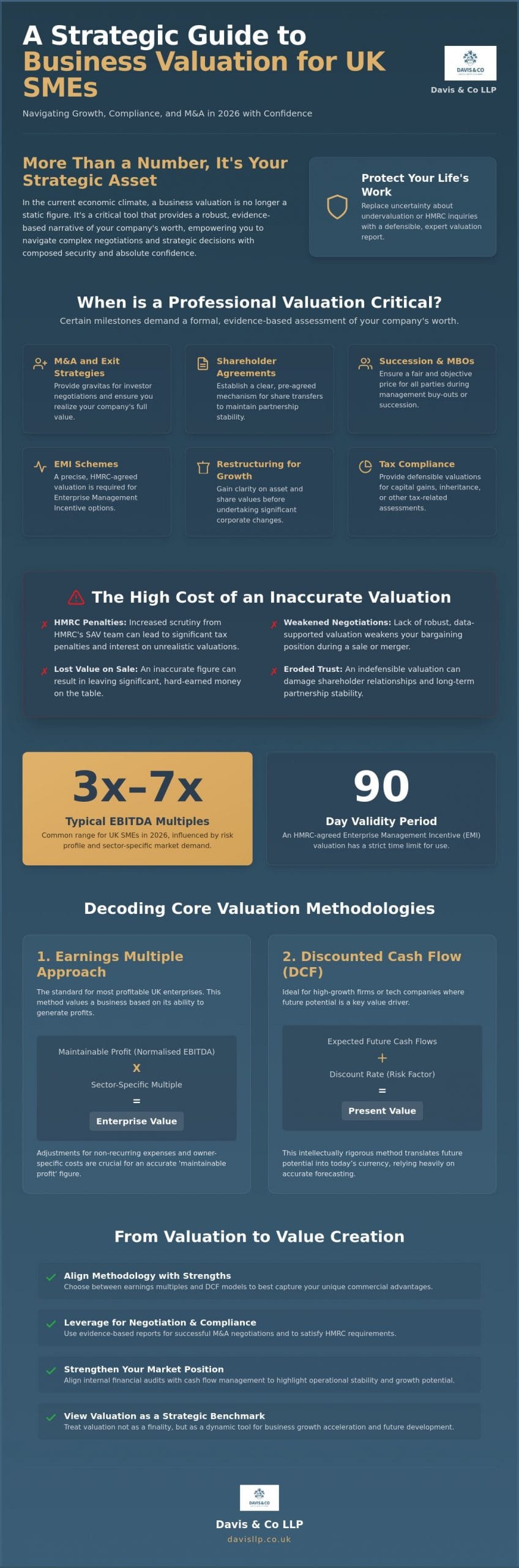
Certain milestones in a company’s lifecycle demand a formal assessment of worth. Succession planning and Management Buy-Outs (MBOs) rely on an objective figure to ensure fairness for all parties involved. Similarly, implementing employee incentive schemes, such as Enterprise Management Incentive (EMI) options, requires a precise valuation. It’s vital to remember that an HMRC-agreed EMI valuation remains valid for only 90 days. We often see restructuring for growth or tax efficiency as another critical juncture where professional business valuation services for smes provide the clarity needed to proceed with confidence.
The Risk of Inaccurate SME Valuations
The consequences of an indefensible valuation are often severe. HMRC’s Shares and Assets Valuation (SAV) team has increased its scrutiny, particularly regarding tax-related assessments for capital gains or inheritance tax. If a valuation is deemed unrealistic, it can lead to significant tax penalties and interest charges. Beyond regulatory risks, an inaccurate figure can result in significant lost value during a sale. Without a robust model supported by current market data, such as the 3x to 7x EBITDA multiples common in 2026, sellers find themselves in a weakened bargaining position. This lack of evidence doesn’t just impact the final sale price; it erodes the trust that is fundamental to shareholder relationships and long-term partnership stability.
Primary Methodologies: Decoding Business Valuation Services for SMEs
Selecting the appropriate methodology is the cornerstone of a defensible valuation. It’s a deliberate strategic choice that must reflect the specific nature of your operations and the purpose of the report. While several frameworks exist, the most effective business valuation services for smes will often employ a combination of approaches to cross-reference and validate the final figure. This multi-lensed perspective provides the intellectual rigour required to satisfy both sophisticated buyers and regulatory bodies.
The Earnings Multiple Approach
For most profitable UK enterprises, the earnings multiple approach remains the standard. It begins with EBITDA (Earnings Before Interest, Tax, Depreciation, and Amortisation) as the primary indicator of operational performance. However, a raw figure is rarely sufficient. We must normalise these earnings by adjusting for non-recurring expenses, one-off gains, or owner-specific costs that wouldn’t persist under a different management structure. The resulting maintainable profit is then multiplied by a sector-specific factor. In 2026, we typically observe multiples ranging from 3x to 7x for SMEs, though this is heavily influenced by your specific risk profile and current market demand.
The DCF Method for Growth-Oriented SMEs
High-growth firms or those in the technology sector often require a Discounted Cash Flow (DCF) analysis. This method calculates the present value of expected future cash flows, essentially translating future potential into today’s currency. It’s an intellectually rigorous process that relies heavily on accurate Management Accounts to build credible, evidence-based forecasts. A critical component of this model is the “terminal value,” which accounts for the business’s worth beyond the explicit forecast period. Without this level of detail, growth-led companies risk being significantly undervalued by traditional asset or earnings-based models.
Industry nuances play a pivotal role in these calculations. A dental practice valuation, for example, hinges on patient list stability and associate contract structures. Conversely, a manufacturing firm is judged on machinery lifecycle, inventory turnover, and supply chain resilience. Guidance found within the HMRC Shares and Assets Valuation (SAV) Manual confirms that while no single method is prescribed, the reasoning must be robust and well-documented. If you’re unsure which methodology aligns with your specific objectives, our strategic advisors can provide the necessary clarity to move forward with confidence.
Navigating HMRC Scrutiny and International Tax Compliance
HMRC’s interest in business valuations is rarely academic. It’s rooted in the precise calculation of tax liabilities, particularly concerning Capital Gains Tax (CGT) and Inheritance Tax (IHT). When you engage business valuation services for smes, the primary objective is to produce a report that withstands the rigorous examination of the Shares and Assets Valuation (SAV) team. This specialist unit doesn’t just look for a final figure; they look for the intellectual rigour behind the model. Valuing intellectual property and intangible assets often presents the greatest challenge. Goodwill, trademarks, and proprietary technology must be quantified using methodologies that reflect their actual contribution to the bottom line, rather than arbitrary estimates.
To ensure your valuation is audit-ready, it must be defensible under scrutiny. This means providing a clear audit trail that links your financial data to the chosen valuation multiple or discount rate. A well-constructed report details the assumptions made and the evidence used to support them, leaving little room for ambiguity. This level of preparation is essential for maintaining a transparent relationship with tax authorities and avoiding the penalties associated with undervalued assets or incorrect tax filings.
Share Valuations and HMRC Agreements
Negotiating share scheme valuations is a delicate process. For schemes like the Enterprise Management Incentive (EMI), obtaining a prior agreement from HMRC provides a significant layer of protection for both the company and the employees. It is essential to remember that these agreed valuations have a strict 90-day validity. Falling outside this window can lead to administrative complications and potential tax exposures. Common pitfalls regarding Tax Advice UK often involve a misunderstanding of gift rules or the fair market value requirement in regulatory reporting. A robust valuation ensures that transfers are conducted at a price that satisfies statutory requirements, preventing costly retrospective challenges.
Cross-Border Valuation Challenges
The complexity of valuation intensifies when an SME operates across multiple jurisdictions. Valuing subsidiaries or overseas branches requires a deep understanding of how International Tax Planning influences a company’s total net worth. International tax treaties often dictate how assets are treated for tax purposes, and inconsistency in financial reporting across borders is a common red flag for regulators. We ensure that our valuation reports account for these cross-border dynamics, maintaining a cohesive narrative that reflects the true global value of the enterprise. This approach is vital for businesses with international footprints that seek to maintain compliance while optimizing their global tax position.
Enhancing Enterprise Value: A Preparation Framework
Maximising the eventual sale price or investment potential of your enterprise requires more than a passive awareness of its worth. It’s a proactive process of operational refinement. When we provide business valuation services for smes, we often find that the difference between an average multiple and a premium one lies in the quality of preparation. A business that demonstrates disciplined financial hygiene is inherently less risky to a buyer, and lower risk invariably translates to higher value. The primary benefit of engaging professional business valuation services for smes is the ability to uncover and resolve these underlying issues before they impact your market standing.
- Step 1: Conduct a thorough internal audit of financial records to ensure every transaction is accounted for and transparent.
- Step 2: Optimise Cash Flow Management to demonstrate stability; consistent liquidity is a primary indicator of a healthy, resilient business.
- Step 3: Document all intangible assets, ensuring that intellectual property, trademarks, and long-term client contracts are legally secured and clearly valued.
- Step 4: Resolve outstanding disputes or contingent liabilities that might otherwise depress the final figure or stall negotiations.
- Step 5: Engage a professional advisor for a preliminary assessment to identify potential weaknesses before they are exposed during formal due diligence.
The Role of Management Accounts
Relying solely on year-end accounts is a strategic disadvantage. Up-to-date monthly reports are essential for a smooth valuation process. These documents bridge the gap between basic bookkeeping and high-level strategic advisory, allowing us to identify “value leakers” in real time. Whether it’s unoptimised inventory or escalating overheads, addressing these inefficiencies before a valuation can significantly bolster your bottom line. By maintaining this level of oversight, you ensure that the data presented to investors is both current and compelling, reflecting the true pulse of the business.
Preparing for Due Diligence
Due diligence is often the most taxing phase of any transaction. Anticipating the questions a buyer will ask allows you to maintain control of the narrative. This involves ensuring that VAT Compliance and payroll records are flawless. With Making Tax Digital (MTD) for Income Tax now mandatory for those with income over £50,000 since April 6, 2026, your digital record-keeping must be beyond reproach. Organising a comprehensive “Data Room” for external examination not only speeds up the process but also reinforces the professional gravitas of your organisation. To begin refining your enterprise value today, we invite you to contact Davis & Co LLP for a confidential consultation.
Strategic Valuation Advisory: The Davis & Co LLP Approach
At Davis & Co LLP, we believe a valuation should be more than a retrospective calculation. It’s a forward-looking strategic asset. Our business valuation services for smes are designed to provide the intellectual rigour and commercial context necessary for high-stakes decision-making. We recognize that your business represents years of dedication, and our role is to ensure its worth is captured with absolute precision. By engaging with Chartered Certified Accountants, you gain access to a level of expertise that transcends basic accounting, offering the defensibility required in a 2026 regulatory environment where HMRC scrutiny is increasingly sophisticated.
We provide support across the entire business lifecycle. From the early stages of structuring employee incentive schemes to the final negotiations of a multi-million-pound exit, our advice remains a dependable constant. We don’t just deliver a report; we integrate our findings into broader Business Growth Acceleration strategies. This ensures that the insights gained during the valuation process are used to refine operations, optimize cash flow, and ultimately enhance the enterprise value before a transaction takes place. This holistic approach ensures that every financial detail aligns with your long-term commercial objectives.
A Partnership Built on Professional Gravitas
Our firm is built on a foundation of understated confidence and discreet expertise. We understand that matters of business value are deeply personal and commercially sensitive. This is why we prioritize a composed partnership, acting as a strategic advisor rather than a mere service provider. While we maintain a national reach across the UK, our focus remains on highly individualized service delivery. We take the time to understand the specific nuances of your sector, ensuring that our reports reflect the practical realities of your operations and the current market dynamics of 2026, such as the implications of the 3.75% Bank of England base rate on discount models.
Next Steps for Your Business
Securing a robust valuation is the first step toward strategic clarity. We invite you to book a consultation to discuss your specific requirements, whether you’re navigating a management buy-out or preparing for an acquisition. During this process, we coordinate seamlessly with your other professional advisors, including legal teams and financial stakeholders, to ensure a unified approach. We’ll help you organize your data, address any contingent liabilities, and position your business for its highest possible value. In an era of economic volatility, having a trusted partner who provides steady, measured advice is your greatest competitive advantage.
Securing Your Enterprise Legacy
Establishing the true worth of your business requires a sophisticated blend of analytical precision and commercial foresight. As we’ve explored, a robust valuation serves as a foundational element for both regulatory compliance and long-term strategic clarity. By refining your financial hygiene and selecting methodologies that accurately reflect your sector’s specific drivers, you transform a static figure into a powerful negotiating tool. Engaging professional business valuation services for smes ensures that your report is not only audit-ready for HMRC but also compelling to sophisticated investors who value transparency and intellectual rigour.
Davis & Co LLP brings over 120 years of heritage as Chartered Certified Accountants to every engagement. We combine our deep-seated expertise in international tax and business growth acceleration with a commitment to discreet, professional advisory. Whether you’re preparing for a transition or seeking to optimize your current structure, we provide the steady guidance necessary to navigate complex SME environments. We invite you to contact Davis & Co LLP for a strategic business valuation consultation to discuss your specific objectives. With the right partnership, you can move forward with the clarity and confidence your life’s work deserves.
Frequently Asked Questions
What is the most common method for valuing an SME in the UK?
The earnings multiple approach, specifically using EBITDA, is the most prevalent method for valuing profitable UK SMEs. This involves calculating a maintainable profit figure and applying a sector-specific multiple, which typically ranges from 3x to 7x in the current 2026 market. We ensure these figures are normalised to reflect the true operational performance of the enterprise rather than just the raw accounting data.
How long does a professional business valuation typically take?
A professional business valuation typically requires two to four weeks to complete, depending on the complexity of the company structure and the availability of data. This timeframe allows for a thorough analysis of financial records, market benchmarking, and the drafting of a defensible report. We prioritise accuracy and intellectual rigour over speed to ensure the final assessment withstands external scrutiny from buyers or regulators.
Can HMRC challenge a business valuation used for tax purposes?
HMRC can and frequently does challenge business valuations, particularly when they are used for tax-related purposes such as EMI schemes or Capital Gains Tax. Their Shares and Assets Valuation (SAV) team reviews the underlying assumptions and methodologies to ensure they meet fair market value standards. Our business valuation services for smes focus on providing the robust evidence necessary to mitigate the risk of such challenges.
Do I need a valuation if I am not planning to sell my business immediately?
You don’t need an immediate plan to sell to benefit from a formal valuation. It serves as a vital tool for strategic growth acceleration, internal restructuring, and succession planning. Regular assessments help shareholders understand the impact of operational decisions on enterprise value and ensure that shareholder agreements remain relevant and fair as the business evolves through different stages of its lifecycle.
What documents do I need to prepare for a business valuation?
Preparation requires several key documents, including at least three years of statutory accounts and the most recent management accounts. We also examine budgets, forecasts, and details of intangible assets such as patents or long-term client contracts. Having these records organised in a digital data room facilitates a more efficient process and ensures that the final report is based on a complete financial narrative.
How does a business valuation differ from an audit?
A business valuation differs fundamentally from an audit in its objective and scope. While an audit provides assurance that historical financial statements are a true and fair reflection of past performance, a valuation assesses the current market worth and future earning potential. We use audited data as a foundation, but the valuation process involves significant analytical judgement regarding market trends, risk profiles, and maintainable earnings.
Is a business valuation different for a dental practice compared to other SMEs?
A business valuation for a dental practice involves specific industry nuances that differ from standard manufacturing or service-based SMEs. We assess unique factors such as the stability of the patient list, the ratio of NHS to private income, and the structure of associate contracts. As a dental tax specialist, we understand how these professional variables directly influence the final multiple applied to the practice’s earnings.
What is the difference between enterprise value and equity value?
Enterprise value represents the total value of the business operations, inclusive of both debt and equity, while equity value is the portion attributable to shareholders. To arrive at the equity value, we subtract the company’s net debt from the enterprise value. Understanding this distinction is essential during M&A negotiations to ensure you’re comparing offers on a cash-free, debt-free basis and understanding the actual proceeds available to owners.