If you receive a distribution from a trust, does the full value belong to you, or are you merely holding a portion of it for HMRC? It’s a question that creates significant anxiety for many, especially when the distinction between gross and net distributions remains unclear. We understand that the fear of double taxation or the pressure of a looming Self Assessment deadline can turn a financial benefit into a source of persistent stress. The complexity of different trust structures often leaves beneficiaries feeling uncertain about their true financial standing.
Managing the tax implications for beneficiaries of a trust requires a proactive approach to your personal reporting obligations. You deserve to feel secure in your position, knowing exactly which liabilities apply to your specific circumstances under current UK law. This guide provides the clarity you need to navigate these requirements with confidence. We’ll examine the specific forms you must request from your trustees, the impact of the £500 standard rate band on your income, and the critical steps necessary to avoid HMRC penalties. By the end of this article, you’ll have a strategic framework for handling your distributions with professional precision.
Key Takeaways
- Understand the shared nature of compliance and why beneficiaries must take a proactive role in reporting rather than relying solely on trustees.
- Identify the specific tax implications for beneficiaries of a trust across different structures, focusing on how tax credits function to prevent double taxation.
- Navigate the complexities of capital distributions, including the calculation of ‘Exit Charges’ and personal Capital Gains Tax liabilities.
- Learn the step-by-step requirements for HMRC reporting, specifically the importance of obtaining Form R185 to certify tax already paid by the trust.
- Discover how coordinating with professional advisors ensures the strategic timing of distributions to optimize your overall tax position.
Understanding the Tax Landscape for Trust Beneficiaries in 2026
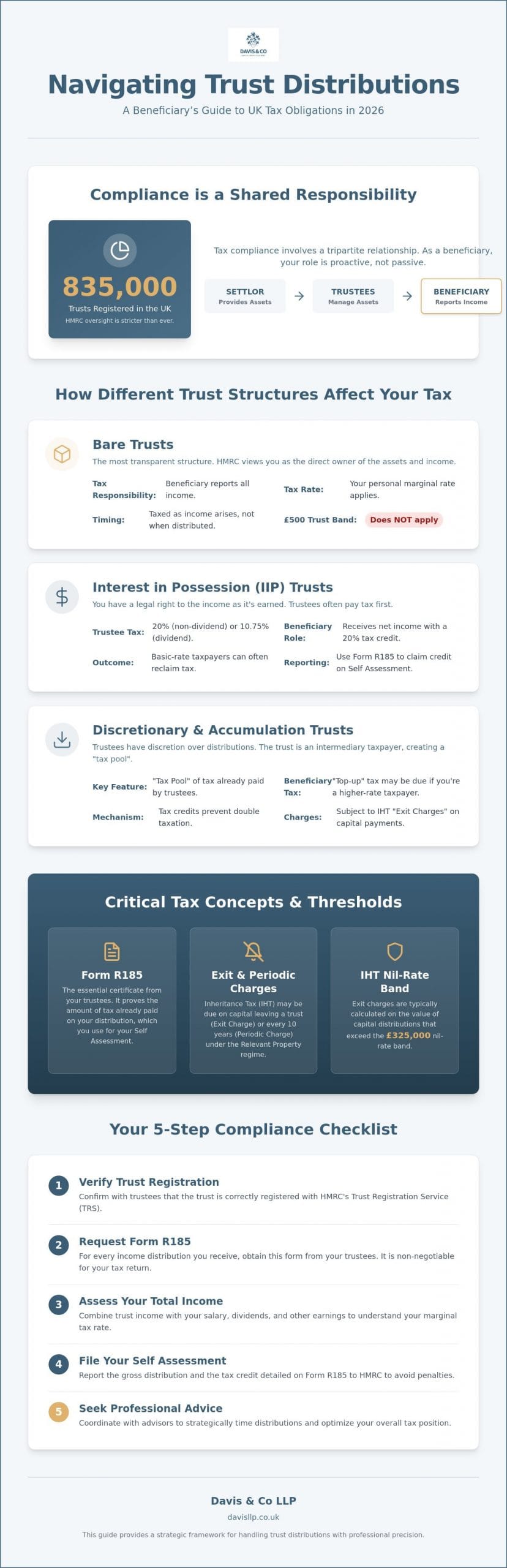
The structural integrity of a trust rests upon a tripartite relationship between the settlor, the trustees, and the beneficiaries. While the settlor provides the assets and the trustees manage them, it’s the beneficiary who ultimately enjoys the economic benefit. Understanding the basics of a trust is essential for anyone receiving distributions, as your role is rarely passive. A frequent and potentially costly misconception is that tax compliance begins and ends with the trustees. In reality, the tax implications for beneficiaries of a trust often include personal reporting requirements that, if overlooked, can lead to significant HMRC penalties.
As we move through 2026, transparency has become the cornerstone of UK tax policy. With 835,000 trusts now registered in the UK, HMRC’s oversight via the Trust Registration Service (TRS) is more stringent than ever. We’ve observed that beneficiaries must now be more vigilant. You should verify that your trustees have fulfilled these registration duties, as an unregistered trust can complicate your own Self Assessment filings and delay distributions.
The Beneficiary’s Legal and Fiscal Standing
Your tax position depends heavily on whether you’re receiving trust income, such as dividends or rent, or a capital distribution. While income is typically taxed at your marginal rate, capital payments may trigger different liabilities. Your personal tax residence also plays a decisive role; if you’re a UK resident receiving funds from an offshore structure, the reporting requirements are notably more rigorous. The Relevant Property regime in 2026 applies to most discretionary trusts, imposing periodic ten-year charges and exit charges when capital is distributed, calculated on the value exceeding the £325,000 nil-rate band.
The Interplay with Personal Tax Allowances
Trust distributions don’t exist in a vacuum. They interact directly with your personal tax allowances. For example, dividend income from a trust will utilize your remaining dividend allowance, which could push other personal earnings into a higher tax bracket. Seeking holistic tax advice uk is vital to ensure you don’t fall into common tax traps. Higher-rate taxpayers often face a “top-up” tax liability if the tax already paid by the trustees is lower than their personal marginal rate. We’ve seen many individuals surprised by an unexpected bill because they didn’t account for how trust income aggregates with their salary or professional fees. These nuances make the tax implications for beneficiaries of a trust a matter of careful, year-round management rather than a once-a-year filing concern.
Income Tax Liabilities: Comparing Trust Structures
The architecture of a trust acts as the primary determinant for the timing and magnitude of your tax liability. While some vehicles offer a direct flow-through of income, others involve a multi-stage process where the trust itself acts as an intermediary taxpayer. We’ve observed that the tax implications for beneficiaries of a trust vary significantly between simple bare arrangements and more complex discretionary structures. At the heart of this system lies the tax pool. This is a cumulative record of the tax the trustees have already paid to HMRC. This pool is essential because it ensures that when you receive a distribution, the accompanying tax credit is backed by actual payments. This mechanism is what prevents the burden of double taxation.
Bare Trusts and Interest in Possession
Bare trusts are the most transparent from a fiscal perspective. HMRC views the beneficiary as the direct owner of the assets, meaning you’re responsible for reporting the income on your personal return as it arises. This applies regardless of whether the funds are actually distributed to you. Crucially, the £500 tax-free band for trusts doesn’t apply to bare trusts; all income is taxed at your personal marginal rates. In contrast, an Interest in Possession (IIP) trust grants you a legal right to the income as it’s earned. Trustees typically pay tax at 20% on non-dividend income or 10.75% on dividends before passing the remainder to you. If the income is mandated directly to you, you report it as your own. If it passes through the trustees first, you receive a 20% tax credit to offset against your own liability, which often results in a tax reclaim for basic-rate taxpayers.
Accumulation and Discretionary Trusts
Discretionary trusts carry a heavier initial compliance burden. Once the £500 standard rate band is exceeded, income is taxed at 45% and dividends at 39.35%. While these rates seem punitive, they often create a strategic advantage for the recipient. When a discretionary payment is made, it’s grossed up to include a 45% tax credit. For a beneficiary who is a non-taxpayer or a basic-rate taxpayer, this usually results in a significant tax refund from HMRC. Strategic timing of these distributions is vital. By coordinating payments with years where your other income streams are lower, you can maximize the value of these credits. Understanding the UK tax implications for trusts is the first step in this optimization. If you require assistance in calculating these specific credits or managing your reporting, our Trust Tax Services can provide the necessary technical oversight to ensure your position remains secure.
Navigating Capital Gains and Inheritance Tax Exit Charges
The transition from receiving annual income to accepting a capital distribution represents a significant shift in your fiscal relationship with a trust. While income tax is a recurring consideration, capital events often trigger one-off charges that require a different analytical framework. We’ve observed that the tax implications for beneficiaries of a trust become particularly complex when assets, rather than cash, are transferred out of the structure. These events typically involve a dual layer of taxation: Capital Gains Tax (CGT) on the growth of the asset and Inheritance Tax (IHT) in the form of an exit charge.
We often find that the “Exit Charge” mechanism causes the most confusion among recipients. When assets leave a discretionary trust, HMRC applies a charge that is effectively a pro-rata portion of the tax that would have been due at the next 10-year anniversary. In 2026, these calculations have become more rigorous, particularly as Agricultural Property Relief and Business Property Relief are now ignored when determining the effective rate for exit charges. While the maximum rate is capped at 6%, the underlying math depends on how long the assets were held since the last 10-year milestone and the value of the trust relative to the £325,000 nil-rate band.
The 10-year anniversary charge itself acts as an indirect tax on your future wealth. Every decade, the trust must pay up to 6% on its value exceeding the nil-rate band. Although you don’t pay this personally, it reduces the capital pool available for eventual distribution. Understanding these internal trust taxes is vital for long-term financial planning, as they directly impact the net value you’ll eventually receive.
Utilizing Hold-Over Relief
If trustees transfer a physical asset to you, such as property or shares, a “dry” tax charge could arise where CGT is due but no cash has been realized to pay it. To manage this, we often utilize hold-over relief. This allows the CGT liability to be deferred and attached to the asset itself. You essentially inherit the trustees’ original base cost, meaning you won’t pay tax at the point of transfer, but you’ll face a larger bill when you eventually sell the asset at the 2026 rate of 24%. Hold-over relief is a joint claim between trustees and beneficiaries, requiring a formal election to HMRC to confirm the deferral.
Inheritance Tax (IHT) and the Relevant Property Regime
Most discretionary structures operate under the relevant property regime, which prioritizes periodic charges over the traditional death-bed IHT model. For those with assets spanning multiple jurisdictions, international tax planning is indispensable to ensure that non-UK assets aren’t inadvertently pulled into this net. Special provisions exist for “vulnerable person” trusts, which may offer relief from these periodic charges. We recommend a careful review of the trust deed to determine if your specific status allows for these exemptions, as the tax implications for beneficiaries of a trust can be significantly mitigated through these targeted legislative protections.
Compliance Checklist: Reporting Trust Income to HMRC
Compliance is the bridge between receiving a distribution and securing your personal financial position. While trustees handle the trust’s internal reporting via the SA900 return, you must manage your personal obligations with equal diligence. The tax implications for beneficiaries of a trust often hinge on the accuracy of your individual Self Assessment. To avoid the 31 January pitfalls, we recommend starting your preparations as soon as the tax year ends on 5 April. HMRC expects you to maintain records of all distributions and associated tax certificates for at least 22 months after the tax year they cover; this includes bank statements and correspondence with trustees.
Your reporting process should follow a logical progression to ensure no credits are overlooked. We suggest the following steps:
- Identify whether the distribution is classified as income or capital.
- Formally request the necessary tax certificates from your trustees.
- Aggregate your trust income with other personal earnings, such as salary or dividends.
- Determine if you owe a “top-up” tax or if you’re eligible for a significant refund.
The Essential Form R185
Form R185, specifically the “Certificate of Deduction of Income Tax,” is your most critical document. You must demand this from your trustees annually. It provides the grossed-up figure of your income and the specific amount of tax the trustees have already settled with HMRC. Interpreting these figures requires care. If the trustees haven’t paid sufficient tax into the “tax pool” to cover the 45% credit on a discretionary distribution, your personal return could be flagged for investigation. If you’re unsure how to translate your R185 into a compliant filing, our Personal Tax Services provide the precise oversight required to protect your financial standing.
Reclaiming Overpaid Tax
Many beneficiaries find themselves in a position to claim a refund from HMRC. This is particularly common for non-taxpayers, students, or basic-rate taxpayers receiving discretionary distributions. Since these payments carry a 45% tax credit, and your personal rate may be significantly lower, the difference is reclaimable. If you don’t typically file a full Self Assessment because your other income is low, you can use Form R40 to recover this overpaid tax. We’ve assisted many clients in recovering thousands of pounds by correctly applying these credits, which would otherwise be lost to the Exchequer. Ensuring you have the correct certificate is the only way to facilitate this recovery process.
Strategic Oversight: How Professional Advice Protects Beneficiaries
The management of trust interests requires more than mere compliance; it demands a high level of strategic oversight. While trustees are bound by fiduciary duties, their primary focus is often on the preservation of the trust fund rather than the optimization of your personal tax position. We believe an independent review of distributions and tax credits is essential for any high-net-worth individual. This ensures that the tax implications for beneficiaries of a trust are not just reported but actively managed. By coordinating with trustees on the timing of payments, we can help you align distributions with years where your marginal tax rates are most favorable.
For those who have built their own enterprises, trust distributions often serve as vital capital for growth. In these instances, utilizing small business accountant services allows for a seamless integration of trust income with corporate tax planning. At Davis & Co LLP, we act as a discreet strategic partner for complex family offices, providing the intellectual rigor necessary to handle multi-generational wealth while maintaining the necessary professional distance. We understand that your financial affairs are deeply personal, and our approach reflects the discretion required for such sensitive matters.
International and Cross-Border Considerations
Cross-border interests introduce a layer of complexity that standard domestic advice rarely covers. If you’re a UK resident beneficiary of an offshore trust, you face the “Transfer of Assets Abroad” legislation. This regime is designed to prevent tax avoidance by attributing the income of the non-resident trust directly to the UK beneficiary. Strict adherence to international reporting standards, such as the Common Reporting Standard (CRS) and FATCA, remains non-negotiable. We ensure that your global reporting is consistent, protecting you from the severe penalties associated with undisclosed offshore interests. This global perspective is essential for maintaining the integrity of your international portfolio.
Long-Term Wealth Preservation
Long-term wealth preservation is as much about family harmony as it is about fiscal efficiency. Integrating trust distributions into a wider personal tax strategy requires a nuanced understanding of both current law and family dynamics. This underscores the importance of finding a chartered accountant who possesses specific expertise in trust law and capital taxes. A well-advised beneficiary is one who understands that the tax implications for beneficiaries of a trust are a single component of a much larger financial legacy. Our goal is to provide the stability and clarity you need to move forward with confidence, ensuring your wealth serves your long-term objectives without unnecessary friction.
Securing Your Financial Legacy Through Strategic Oversight
Managing trust distributions requires more than just passive receipt; it demands a thorough understanding of how these funds interact with your personal tax profile. We’ve explored the critical role of the R185 certificate and the necessity of aligning capital exits with long-term wealth preservation strategies. By mastering the tax implications for beneficiaries of a trust, you transform a complex regulatory burden into an opportunity for fiscal efficiency. Whether you’re navigating the nuances of the 45% discretionary tax credit or managing cross-border reporting, the key remains proactive engagement with your trustees and a clear view of your total income landscape.
At Davis & Co LLP, we’ve served as Chartered Certified Accountants since 1901. Our specialists in international and trust tax planning provide the discreet, high-calibre advice required by family offices and high-net-worth individuals. We invite you to consult with our trust tax specialists for a discreet review of your position. With the right professional partnership, you can navigate the evolving 2026 landscape with absolute confidence and ensure your wealth is protected for generations to come.
Frequently Asked Questions
Do I pay tax on money I receive from a trust?
You generally owe tax on income received from a trust, although the specific rate depends on your personal circumstances and the trust’s structure. For income distributions, you’re often credited with the tax the trustees have already paid, which may cover your liability or even result in a refund. Capital distributions are treated differently and may trigger Capital Gains Tax or Inheritance Tax exit charges. It’s essential to aggregate these payments with your other earnings to determine your final liability.
What is an R185 form and why do I need it?
Form R185 is a formal certificate provided by trustees that details the gross income you’ve received and the tax already deducted at source. You need this document to complete your Self Assessment return accurately and to prove to HMRC that tax has been paid on the distribution. Without it, you cannot claim the 45% tax credit associated with discretionary trusts or demonstrate that you’ve fulfilled the tax implications for beneficiaries of a trust.
Can I reclaim tax paid by the trustees on my behalf?
You can often reclaim tax if your personal marginal rate is lower than the rate paid by the trustees. For instance, discretionary trusts pay tax at 45%, but if you’re a basic-rate taxpayer or have unused personal allowances, you can claim the difference back from HMRC. This process is typically handled through your annual tax return or by submitting Form R40 if you don’t usually file a full return. We’ve seen this result in significant recoveries for non-taxpayers.
Is Inheritance Tax due when I receive assets from a trust?
Inheritance Tax may be due in the form of an “exit charge” when capital assets are distributed from a discretionary trust. This charge is calculated as a proportion of the tax that would’ve been due at the next ten-year anniversary, with a maximum rate of 6%. While the trustees are responsible for paying this, the cost is effectively borne by the beneficiary as it reduces the net value of the assets you receive. Specific rules apply to vulnerable person trusts.
What are the tax implications if the trust is based outside the UK?
Offshore trusts involve significantly more complex reporting requirements due to the “Transfer of Assets Abroad” legislation. If you’re a UK resident beneficiary, HMRC may attribute the trust’s income directly to you, regardless of whether it’s distributed. You must also ensure compliance with international standards such as the Common Reporting Standard to avoid severe penalties. Managing the tax implications for beneficiaries of a trust in a cross-border context requires specialist oversight to ensure global consistency and compliance.
Do I need to register with the Trust Registration Service as a beneficiary?
Beneficiaries are not personally required to register with the Trust Registration Service; this duty falls solely on the trustees. However, you should confirm that the trust is registered and that your details are accurate, as HMRC uses this data to verify your personal tax filings. An unregistered trust can lead to administrative delays and increased scrutiny of your distributions during the Self Assessment process. Reliability in these records is essential for a smooth reporting cycle.
How does trust income affect my personal tax bracket?
Trust income is added to your other personal earnings, such as salary or dividends, which could push you into a higher tax bracket. Because distributions are often “grossed up” to include the tax paid by the trustees, they can have a substantial impact on your total taxable income. This aggregation makes it vital to plan the timing of distributions strategically. We recommend coordinating payments with years where your other income streams are lower to maintain your overall tax efficiency.
What is hold-over relief for trust beneficiaries?
Hold-over relief allows you to defer Capital Gains Tax when a trustee transfers an asset to you instead of selling it. By making a joint claim with the trustees, the tax liability isn’t triggered at the point of transfer but is instead “held over” until you eventually sell the asset. You effectively take on the trustees’ original base cost, which preserves the trust’s capital in the short term but creates a larger future personal tax obligation for you.