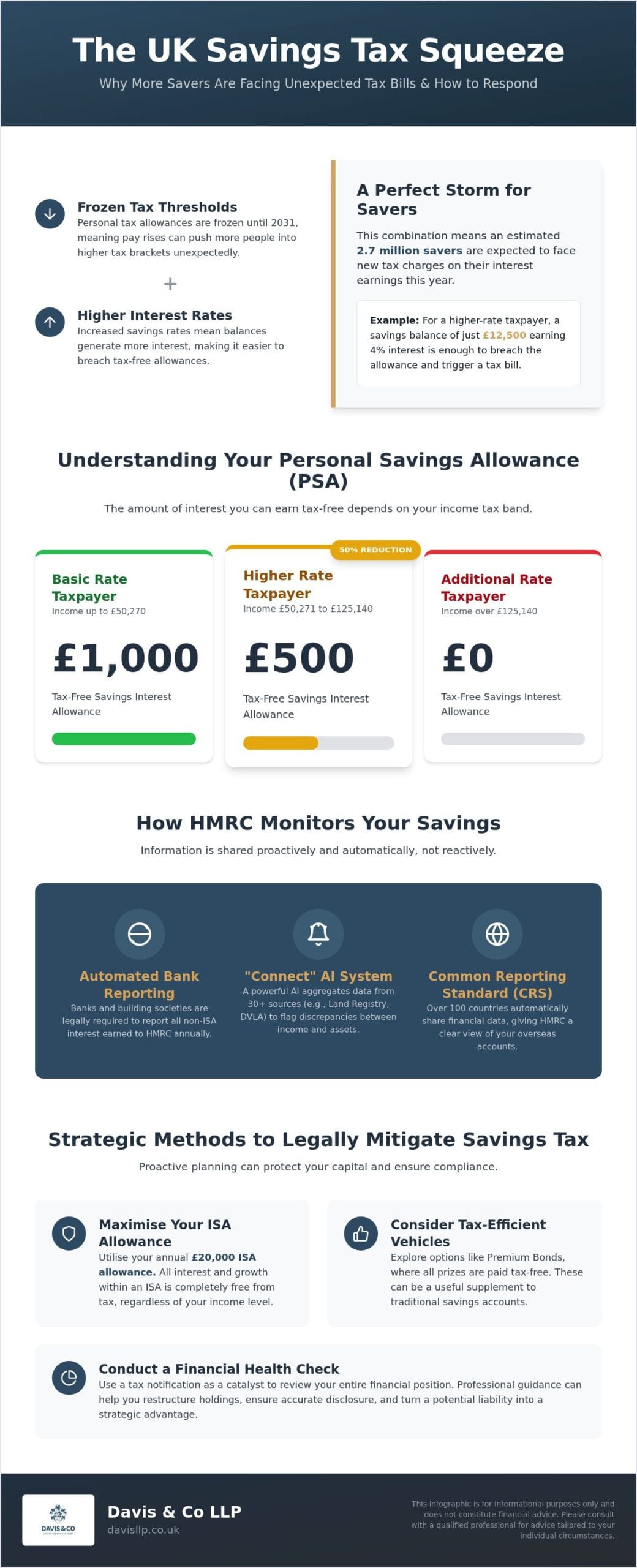
For a higher-rate taxpayer in 2026, a savings balance of just £12,500 earning 4% interest is now enough to breach the Personal Savings Allowance and trigger a tax bill. With tax thresholds frozen until 2031, an estimated 2.7 million savers are expected to face new charges on their interest this year. If you’ve recently received an hmrc tax warning, it’s natural to feel concerned about how your financial data is being monitored and what it means for your liabilities. We understand that the sudden shift from tax-free growth to unexpected demands can feel like an unnecessary complication in your financial planning.
We’re committed to helping you understand these changes and regain a sense of control over your tax position. This article provides a comprehensive overview of why HMRC is issuing more notices and how their automated data-sharing systems identify unreported interest. We’ll examine the specific limits of the Personal Savings Allowance and discuss practical, compliant methods to restructure your holdings. Our goal is to ensure you have the knowledge to manage your savings strategically, providing peace of mind in an increasingly transparent regulatory environment.
Key Takeaways
- Understand why an hmrc tax warning is more likely in 2026 due to the combination of frozen tax bands and sustained higher interest rates.
- Learn how HMRC’s automated data-sharing agreements with financial institutions provide them with a clear view of your annual interest earnings without the need for specific warrants.
- Identify how crossing the £50,270 higher-rate threshold slashes your Personal Savings Allowance from £1,000 to just £500, which can significantly increase your tax liability.
- Explore strategic methods to protect your capital, such as maximising your £20,000 ISA allowance and utilising tax-efficient vehicles like Premium Bonds.
- Discover how to transform a tax notification into a strategic advantage through a comprehensive financial health check and professional disclosure management.
Understanding the HMRC Savings Tax Warning in 2026
An hmrc tax warning serves as a formal notification that the authorities have identified interest income that hasn’t been correctly accounted for in your tax code or Self-Assessment return. In 2026, we’re seeing a marked increase in these “nudge letters” as the revenue utilises sophisticated data-matching technology to cross-reference bank records. It’s vital to distinguish between a Simple Assessment, where HMRC calculates the tax for you based on bank data, and a full compliance check, which is a more rigorous inquiry into your financial records. We advise against viewing these letters as mere suggestions. Failing to respond promptly can result in penalties that scale with the duration of the delay, alongside accruing interest on the unpaid tax.
The Personal Savings Allowance (PSA) Explained
The amount of interest you can earn tax-free is dictated by your broader income profile and its relationship with the UK Personal Allowance. For the 2026/27 tax year, the Personal Allowance is fixed at £12,570, after which the PSA tiers apply. Basic rate taxpayers enjoy a £1,000 allowance, while higher rate taxpayers, those earning between £50,271 and £125,140, have their allowance halved to £500. For additional rate earners, the allowance is removed entirely. Lower earners may also benefit from the £5,000 starting rate for savings, provided their non-savings income remains below £17,570. This complex interplay often catches savers off guard, particularly when modest pay rises push them into a higher tax bracket and inadvertently slash their allowance.
Why You May Have Received a Letter Now
The timing of an hmrc tax warning often surprises taxpayers due to the inherent reporting lag in the system. Financial institutions typically share interest data with HMRC at the end of the tax year, meaning you might receive a notification months after the interest was actually credited to your account. We often see letters triggered by specific financial shifts, such as moving significant sums into high-interest fixed bonds or easy-access accounts that have recently become more competitive. Additionally, if your total savings interest exceeds £10,000 in a single year, you’re legally obligated to register for Self-Assessment. Crossing this specific threshold is a major trigger for HMRC intervention, making professional oversight essential to ensure all figures are reported accurately and timely.
How HMRC Monitors Your Bank Accounts: Myth vs. Reality
A common misconception suggests that tax authorities operate in a state of reactive observation, only peering into financial records when a specific suspicion arises. In reality, the flow of information between financial institutions and the revenue is both proactive and automated. Banks and building societies are legally mandated to report the total interest paid on all non-ISA accounts directly to the authorities at the end of each tax year. When an hmrc tax warning arrives, it’s often the direct result of this streamlined data exchange, which requires no specific warrant or individual court order for annual aggregate figures. This system ensures that the revenue maintains a clear view of the interest you’ve earned, regardless of whether you’ve proactively declared it.
The core of this monitoring capability is the “Connect” AI system. This sophisticated analytical hub aggregates data from over 30 different sources, including the Land Registry, the DVLA, and even digital platforms, to build a comprehensive profile of a taxpayer’s financial life. It’s designed to flag discrepancies where a lifestyle or asset accumulation doesn’t appear to align with declared income levels. If the interest reported by your bank suggests a capital base that hasn’t been accounted for in your filings, the system automatically triggers a notification. Understanding the official rules for Tax on your savings interest is the first step in ensuring your declarations are accurate and avoiding these automated flags.
The Role of the Common Reporting Standard (CRS)
International boundaries no longer provide the fiscal opacity they once did. Under the Common Reporting Standard, more than 100 countries now share financial account information to combat tax evasion. This means HMRC receives data on overseas savings accounts and investments with the same regularity as domestic holdings. Offshore accounts aren’t the “blind spot” they were a decade ago. For those with global interests, robust international tax planning has become a necessity to ensure cross-border interest is managed with total transparency and compliance.
Does HMRC See Individual Transactions?
It’s important to clarify that an hmrc tax warning usually stems from annual totals rather than granular, day-to-day oversight. Under routine data matching, the revenue sees the total interest credited to your accounts, not your individual supermarket spend or monthly utility bills. However, the situation changes if a formal tax inquiry is opened. In these specific cases, HMRC has the power to request full bank statements to verify the source of deposits or the nature of expenditures. Most taxpayers will only ever interact with the automated side of the system, but maintaining precise records remains the best defence. If you’re concerned about how your accounts are being viewed, our Personal Tax Services can help you conduct a proactive review of your compliance position.
The High-Earner Trap: Why the Warning Hits Harder Above £50,270
The transition from the basic rate to the higher rate tax band at £50,271 represents more than just a shift in your income tax percentage. It triggers a significant reduction in your Personal Savings Allowance, which is halved from £1,000 to £500. For many professionals, this shift occurs without a corresponding change in their savings strategy, leading to an unexpected hmrc tax warning. The situation is even more stark for those crossing the additional rate threshold of £125,140, where the allowance is removed entirely. In this bracket, every penny of interest earned is taxable at 45%, making traditional savings accounts far less efficient than they once were.
It’s not just salary that causes these issues. Dividend income from private companies or rental profits from property portfolios can push your total income into these higher brackets. According to official guidance on savings tax, all taxable income is considered when determining which tier applies. This means a modest bonus or a rise in rental yields could inadvertently trigger a tax liability on savings interest that was previously exempt. The High Income Child Benefit Charge adds another layer of complexity, as the tax on savings interest contributes to the overall income figure used to calculate the clawback of benefit payments.
The Impact of the £100,000 Income Threshold
Earnings exceeding £100,000 introduce a particularly challenging “tax trap” due to the tapering of the Personal Allowance. For every £2 earned above this limit, your allowance is reduced by £1. This creates an effective marginal tax rate of 60% on income between £100,000 and £125,140. Savers in this bracket often find that an hmrc tax warning highlights a broader inefficiency in their financial structure. We often advise clients to consider strategic pension contributions to reduce their adjusted net income below these critical thresholds, which can effectively restore their Personal Allowance and preserve their tax position.
Joint Accounts and the 50/50 Rule
HMRC generally assumes that interest earned on joint accounts is split equally between the account holders. This 50/50 rule can be problematic if one partner is a higher rate taxpayer while the other remains in the basic rate band. It can lead to “double warnings” where both individuals are flagged for exceeding their respective allowances simultaneously. If the actual beneficial interest in the funds is not equal, it’s possible to report a different split to the authorities. However, this requires formal notification and supporting evidence. Managing these nuances is a core part of our personal tax services, ensuring that joint assets don’t lead to unnecessary compliance burdens.
Strategic Methods to Legally Mitigate Savings Tax
The £20,000 Individual Savings Account (ISA) allowance remains the most effective barrier against unintended tax liabilities. Because interest earned within an ISA doesn’t contribute towards your Personal Savings Allowance, it’s a critical tool for those nearing the higher-rate threshold. For individuals who’ve already maximised this limit, Premium Bonds offer a tax-free alternative. While the “win rate” is variable, the absence of tax on prizes makes them particularly attractive for higher and additional rate payers who would otherwise lose 40% or 45% of their interest to the revenue. Receiving an hmrc tax warning is often the catalyst for a more robust review of how these vehicles are utilised within your portfolio.
Strategic asset distribution between spouses can also provide immediate relief. If one partner hasn’t utilised their £1,000 PSA or their £5,000 starting rate for savings, gifting capital to them can effectively move the interest income into a lower-taxed environment. However, these transfers must be outright gifts to be effective for tax purposes. To ensure these adjustments align with your broader financial goals, seeking expert tax advice in the UK is essential for maintaining both efficiency and compliance. It’s about more than just avoiding a bill; it’s about structuring your wealth to remain resilient against future fiscal shifts.
Investing for Capital Growth vs. Interest
Shifting the focus from yield-heavy accounts to assets that prioritise capital growth can significantly reduce your income tax exposure. Capital Gains Tax (CGT) rates are traditionally lower than higher-rate income tax bands. By utilising multi-asset portfolios that focus on growth, you can control the timing of your tax liabilities through the disposal of assets, rather than being at the mercy of annual interest payments. This approach requires a balanced view of risk and liquidity, but it’s a proven method for those looking to avoid a recurring hmrc tax warning. We help our clients evaluate the trade-offs between immediate yield and long-term, tax-efficient growth.
Trusts and Long-Term Inheritance Planning
Trusts offer a sophisticated layer of protection for family wealth. Bare Trusts, for instance, allow assets to be held for children where the interest is taxed as the child’s income. This keeps the earnings off the parents’ tax records, provided the funds didn’t originate from the parents themselves. Integrating these structures into a wider inheritance tax strategy ensures that your capital remains productive for future generations without creating immediate tax friction. If you’re looking to protect your family’s financial legacy, our Trust Tax Services provide the discreet, expert guidance required for managing complex estates and ensuring long-term compliance.
Beyond the Warning: Proactive Compliance with Davis & Co LLP
Receiving a notification from the revenue shouldn’t be a source of undue stress. Instead, it serves as a prompt for a comprehensive financial health check. We view an hmrc tax warning as the starting point for a deeper analysis of your overall tax affairs. Our team manages all correspondence with the authorities on your behalf, ensuring that every response is technically accurate and professionally presented. This level of oversight is essential for maintaining a positive relationship with the revenue while protecting your interests. It’s about ensuring your voice is heard through a lens of professional gravitas and intellectual rigour.
Adhering to the HMRC tax warning 2026 compliance standards is about more than just settling a single bill. It’s about establishing a robust framework that withstands future scrutiny. We provide a discreet service tailored to the needs of high-net-worth individuals and international clients, where privacy and precision are paramount. By addressing the root cause of a warning, we help you avoid becoming a recurring target for automated inquiries. This proactive stance is the hallmark of a well-managed financial life and a stable partnership with your advisors.
Professional Self Assessment Submission
Errors in reporting often stem from fragmented data across multiple accounts. We consolidate your interest, dividends, and foreign income into a single, cohesive submission. This meticulous approach helps you avoid the common pitfalls that trigger the “Connect” AI system. By choosing a firm of Chartered Certified Accountants with a history stretching back to 1901, you gain the peace of mind that comes from seasoned expertise. We ensure your filings are not just compliant, but strategically sound. Accuracy is our primary objective, and we don’t leave your professional reputation to chance.
Specialist Advice for Complex Situations
Certain professions face unique fiscal challenges that require more than generic advice. As a dental tax specialist, we understand the specific income structures and practice arrangements that can complicate your tax position. Property investors also require a tailored approach to ensure rental profits don’t inadvertently lead to a breach of the Personal Savings Allowance. If you’ve been moved from a “simple assessment” to full Self Assessment, the transition requires careful management. We focus on proactive planning for the 2026/27 tax year, identifying potential triggers before they result in further notifications. Our goal is to position you as a well-advised partner to the revenue, rather than a subject of investigation. We provide the steady, deliberate guidance necessary to navigate these sensitive commercial matters.
Securing Your Financial Future in a Transparent Fiscal Environment
The fiscal landscape of 2026 demands a higher degree of vigilance regarding savings interest. The combination of frozen tax bands and automated data sharing means many savers are crossing thresholds into taxable territory for the first time. An hmrc tax warning is no longer a rare occurrence; it’s a systematic outcome of modern compliance monitoring. By understanding the limits of your Personal Savings Allowance and utilising tax-efficient vehicles such as ISAs or strategic spousal transfers, you can effectively manage your exposure while maintaining full transparency with the revenue.
Maintaining compliance shouldn’t be a solitary burden. Our firm has operated as Chartered Certified Accountants since 1901, providing the discreet and expert guidance necessary to navigate complex personal and international tax matters. As an independent partnership, we offer a composed partnership to safeguard your interests, whether you’re a dental professional seeking specialist advice or an individual with global holdings. We invite you to Consult Davis & Co LLP for expert personal tax management to ensure your financial affairs are structured with precision and foresight. With the right strategic oversight, you can approach your tax obligations with total confidence and peace of mind.
Frequently Asked Questions
What should I do if I receive an HMRC savings tax letter?
You should immediately verify the figures against your bank statements for the relevant tax year. HMRC often relies on automated data which might not account for joint account splits or specific exemptions you’re entitled to. If the figures are correct, you’ll need to report the income via Self Assessment or accept a tax code adjustment. Ignoring an hmrc tax warning can lead to escalating penalties and interest charges on any unpaid tax.
Can HMRC check my private bank account without me knowing?
HMRC receives automated annual reports from all UK financial institutions detailing the total interest paid on non-ISA accounts. While they don’t typically monitor individual daily transactions without a formal investigation, they have a clear view of your total annual earnings. This data-sharing is proactive and doesn’t require a specific warrant for aggregate figures. If discrepancies arise, they may request more detailed records to verify your declared income levels and lifestyle.
Do I need to do a Self Assessment if my savings interest is over £1,000?
The requirement depends on your total income and how the tax is collected. If you’re employed or receive a pension, HMRC often collects tax on interest up to £10,000 by adjusting your PAYE tax code. However, you must register for Self Assessment if your savings interest exceeds the £10,000 threshold or if your affairs are complex. It’s vital to monitor your Personal Savings Allowance, which drops significantly for higher-rate taxpayers.
Is interest from an ISA included in the HMRC tax warning calculation?
No, interest earned within an Individual Savings Account is entirely tax-free and excluded from these calculations. It doesn’t count towards your Personal Savings Allowance and won’t trigger an hmrc tax warning. This makes the £20,000 annual ISA allowance a primary tool for protecting your capital from the effects of fiscal drag and frozen tax thresholds in the 2026/27 tax year. We recommend maximising this allowance before using traditional interest-bearing accounts.
How does HMRC know exactly how much interest I have earned?
UK banks and building societies are legally required to provide HMRC with annual reports of interest paid to every account holder. This data is fed into the “Connect” AI system, which cross-references bank figures with your tax returns and PAYE records. This automated process identifies individuals who have exceeded their Personal Savings Allowance without declaring the excess. The system is highly efficient and covers both domestic and many international accounts under global transparency agreements.
Will I be fined if I forgot to declare my savings interest in previous years?
You may face penalties, but proactive disclosure usually results in more lenient treatment from the revenue. HMRC applies charges based on whether the omission was a simple mistake, failure to take reasonable care, or deliberate concealment. Interest is also charged on any unpaid tax from the date it was originally due. We advise making a voluntary disclosure before HMRC identifies the error, as this significantly reduces the risk of heavy financial penalties.
Can I split my savings with my partner to avoid paying tax?
You can legally transfer savings to a spouse or civil partner to utilise their unused Personal Savings Allowance or a lower tax band. For these transfers to be valid for tax purposes, the gift must be outright and the partner must have full control of the funds. This is a common strategy to mitigate tax, though you should ensure all joint accounts are reported correctly to reflect the actual beneficial ownership and prevent double-counting.
What happens if I earn more than £10,000 in interest in one tax year?
Earning over £10,000 in savings interest in the 2026/27 tax year triggers a mandatory requirement to register for and submit a Self Assessment tax return. This threshold is independent of your other income levels. At this volume of interest, HMRC expects a formal declaration rather than a simple tax code adjustment. Failing to register can lead to failure-to-notify penalties, even if the tax is eventually paid through other collection methods.