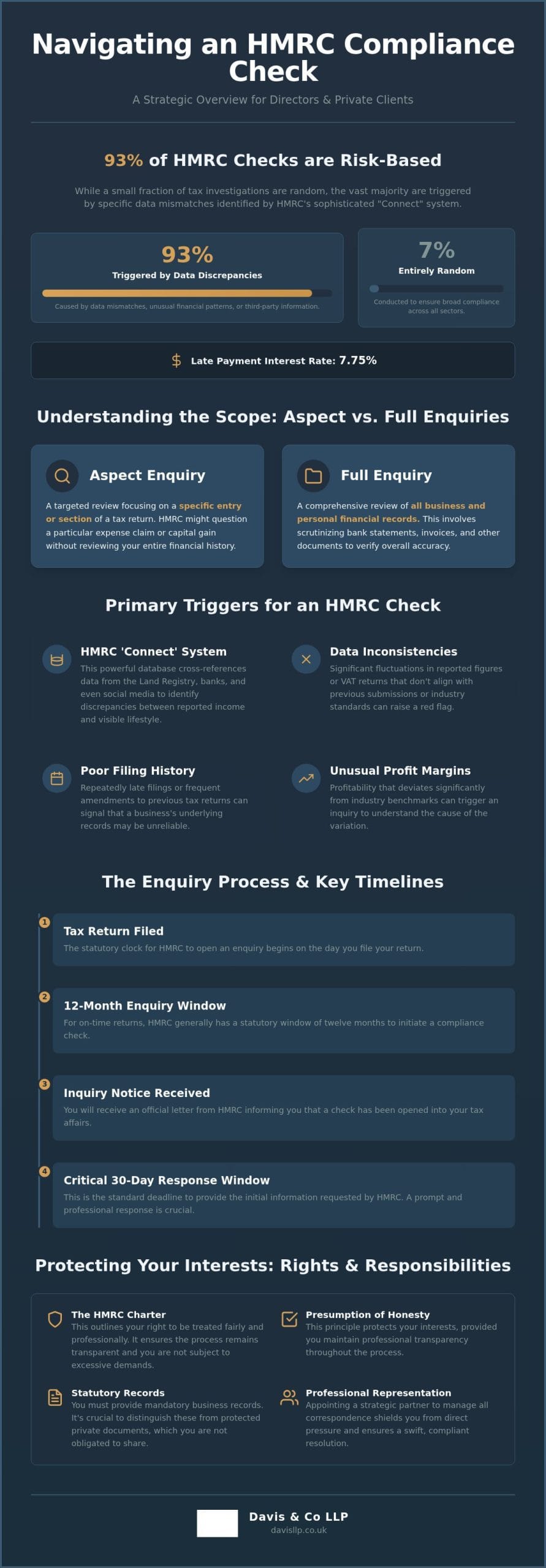
Did you know that while 7% of tax investigations are entirely random, the remaining 93% are triggered by specific data mismatches identified by HMRC’s increasingly sophisticated digital tools? Receiving a notice for an hmrc compliance check in 2026 can feel like a sudden disruption to your professional focus, often sparking concerns over unintentional errors or the time-consuming nature of document gathering. We recognise that for many directors and private clients, the primary source of anxiety isn’t the tax itself, but the uncertainty surrounding HMRC’s powers and the fear of disproportionate financial penalties.
We’re here to ensure you manage this process with professional clarity and absolute confidence. This guide outlines how to handle an inquiry strategically, protecting your rights while demonstrating that your tax planning remains fully compliant. We’ll examine the current 2026 landscape, including the points-based penalty system for Making Tax Digital and the 7.75% late payment interest rates. Our objective is to help you facilitate a swift resolution that confirms your tax affairs are robust, allowing you to return your full attention to your core business operations with total peace of mind.
Key Takeaways
- Learn how HMRC’s “Connect” database cross-references diverse data sources to trigger inquiries and the fundamental differences between “Aspect” and “Full” compliance checks.
- Understand the critical 30-day response window and how to correctly distinguish between mandatory statutory records and protected private documents.
- Discover how the HMRC Charter’s “Presumption of Honesty” protects your interests during an hmrc compliance check, provided you maintain professional transparency throughout the process.
- Recognise the value of appointing a strategic partner to manage all correspondence, shielding you from direct pressure and ensuring a swift, compliant resolution with minimal disruption.
- Explore how pre-emptive audit and assurance services can identify potential risks early, ensuring your tax planning remains robust and defensible under any level of scrutiny.
Understanding the HMRC Compliance Check Framework
An hmrc compliance check is a procedural verification of accuracy rather than a criminal investigation; it’s a mechanism used to ensure that the correct amount of tax is being paid at the right time. While the term “investigation” often carries a heavy emotional weight, HMRC prefers the term “enquiry.” These enquiries are initiated under the Taxes Management Act 1970 for individuals and partnerships, or the Finance Act 1998 for companies. The scope of these checks is broad, encompassing Income Tax, Corporation Tax, VAT, and PAYE compliance. For those managing complex portfolios, Understanding Tax Evasion vs. legal avoidance is crucial, as HMRC’s primary goal is to identify discrepancies that fall into the former category, even if they’re unintentional.
The Legal Basis for Inquiries
Modern compliance procedures are largely governed by the Finance Act 2008, which standardised HMRC’s powers across different tax regimes. HMRC generally has a statutory “window” of twelve months to open an inquiry after a return has been filed. If you file your return on time, the window usually closes one year after the filing date. However, if a return is filed late or if HMRC discovers information suggesting tax has been underpaid due to “careless” or “deliberate” behaviour, they can look back much further. This legal structure provides a predictable timeline for most taxpayers, though it requires meticulous record-keeping to ensure any queries can be resolved swiftly.
Aspect vs. Full Enquiries
Not every hmrc compliance check is identical in its intensity or breadth. HMRC categorises their inquiries into two primary types:
- Aspect Enquiries: These are targeted reviews focusing on a specific entry or section of a tax return. For example, HMRC might question a particular capital gain or a specific high-value expense claim without reviewing your entire financial history.
- Full Enquiries: These involve a comprehensive review of all business and personal financial records. HMRC will typically request bank statements, invoices, and meeting minutes to ensure every facet of your tax affairs is accurate.
While approximately 7% of checks are conducted at random to maintain a presence across all sectors, the vast majority are “risk-based.” HMRC uses data analytics to select cases where they perceive a higher likelihood of error or omission. This selection process is rarely arbitrary. It’s often the result of sophisticated cross-referencing between your reported figures and data from third-party sources.
The relationship between the taxpayer and the authority is defined by the HMRC Charter. This document outlines your right to be treated fairly and to receive professional assistance. It’s a vital safeguard, ensuring that the process remains transparent and that you’re not subjected to arbitrary or excessive demands. We find that maintaining rigorous audit and assurance standards is the most effective way to ensure these frameworks work in your favour, confirming that your tax affairs are defensible from the outset.
Primary Triggers: Why You Might Be Selected for Scrutiny
HMRC’s selection process for an hmrc compliance check is rarely a matter of chance. While random audits exist, the vast majority of inquiries result from sophisticated data analytics performed by the “Connect” system. This powerful database cross-references information from the Land Registry, financial institutions, and even social media platforms to identify discrepancies. If a taxpayer’s reported income doesn’t align with their visible lifestyle or recent asset acquisitions, it creates an immediate risk profile. Understanding how the authority gathers this information is the first step in maintaining a defensible position. For official guidance on the scope of these inquiries, the government provides a detailed overview of HMRC compliance checks and the support available to taxpayers.
Data Inconsistencies and Red Flags
HMRC looks for patterns that suggest a lack of internal financial control. Repeated late filings or frequent amendments to previous tax returns often signal that a business’s underlying records may be unreliable. Fluctuations in profit margins that deviate significantly from industry benchmarks also trigger automated alerts. We’ve observed that businesses utilising professional bookkeeping services are far less likely to face these automated triggers. Accurate, real-time record-keeping ensures that your data remains consistent, reducing the likelihood of an unnecessary inquiry based on simple clerical errors.
Specialised Sector Risks
Certain industries face inherently higher scrutiny due to their complex financial structures. For dental professionals, HMRC often focuses on the distinction between associate and principal status, ensuring that employment taxes are correctly applied. Property investors are equally high on the priority list. The authority closely scrutinises Buy-to-Let expense claims and the timing of Capital Gains Tax reporting on disposals.
Those with international interests face even greater transparency requirements. Under the Common Reporting Standard (CRS), HMRC automatically receives data regarding offshore bank accounts and investments from over 100 jurisdictions. This global data sharing makes it virtually impossible to maintain undisclosed offshore assets without detection. Managing an hmrc compliance check becomes significantly simpler when your records have been pre-emptively reviewed for these sector-specific triggers. If you’re concerned about how your specific risk profile might be perceived, our team can provide a tailored tax review to ensure your affairs are fully aligned with current regulations.
The Anatomy of an HMRC Inquiry: Process and Timeline
The formal commencement of an hmrc compliance check is marked by the receipt of a “Notice of Enquiry.” This correspondence defines the parameters of the investigation and typically provides a 30-day window for an initial response. It’s a critical period where the tone of the entire inquiry is established. While the request for information can feel overwhelming, it’s essential to distinguish between statutory records—those you’re legally required to keep for tax purposes—and private documents. HMRC may request personal bank statements or private diaries, but their power to demand these is more restricted than it is for business ledgers. Understanding these boundaries ensures you don’t over-disclose sensitive information that falls outside the inquiry’s legal scope.
Step-by-Step: From Letter to Resolution
Managing the progression from the initial letter to a final resolution requires a disciplined, logical approach. We find that a structured response often prevents the inquiry from expanding into other tax years or entities. The process generally follows these stages:
- Receipt and Analysis: Identifying the specific tax years and entries under scrutiny to understand HMRC’s underlying concerns.
- Information Gathering: Collating supporting evidence, where robust Management Accounts and digital records are indispensable for providing a clear audit trail.
- Formal Response: Presenting the data in a professional format that addresses queries directly while minimising the risk of further ambiguity.
- Negotiation: Engaging with the inspector on technical interpretations of tax law to reach a fair conclusion, often resolving disputes before they escalate to a tribunal.
Statutory Information Notices
If information isn’t provided voluntarily, HMRC may issue a formal notice under Schedule 36 of the Finance Act 2008. These notices carry financial penalties for non-compliance, but they are not absolute. Taxpayers can appeal a notice if they have a “reasonable excuse,” such as a serious illness or an unforeseen digital failure. It’s also vital to recognise that HMRC’s powers are limited regarding documents protected by legal professional privilege. Professional guidance is essential here to ensure you comply with valid requests while protecting your privileged communications. Navigating tax compliance checks effectively means knowing when to provide data and when to challenge a request that exceeds statutory authority.
The inquiry concludes with a “Closure Notice” or a formal settlement agreement. This final document confirms the tax position and any agreed adjustments, bringing a definitive end to the scrutiny. Our goal is always to secure this closure as swiftly as possible, confirming that your affairs are robust and allowing you to move forward without the weight of an open investigation.
Protecting Your Interests: Rights, Responsibilities, and Risk Mitigation
Facing an hmrc compliance check without professional support is a risk that few high-net-worth individuals or directors should take. While HMRC officers are required to act with fairness, their primary objective is to protect the exchequer’s revenue. Appointing a strategic partner to manage all correspondence provides a vital buffer, ensuring that every response is technically accurate and legally sound. This partnership doesn’t just reduce your administrative burden; it signals to HMRC that you take your obligations seriously and are committed to professional transparency. The HMRC Charter explicitly outlines your right to be represented, and exercising this right is the most effective way to ensure the inquiry doesn’t exceed its intended scope.
Central to the relationship between the taxpayer and the authority is the “Presumption of Honesty.” The HMRC Charter commits the authority to treat you as honest unless they have reason to believe otherwise. This isn’t merely a platitude; it’s a procedural safeguard that defines how evidence should be gathered and interpreted. We find that maintaining a composed, cooperative stance—supported by robust digital records—helps to preserve this presumption throughout the process. If you find yourself needing to clarify your position, our team provides the professional tax representation required to navigate these discussions with authority.
Managing Penalties and Surcharges
If an hmrc compliance check reveals an underpayment of tax, the resulting penalty is determined by the “quality of disclosure” and the underlying behaviour that led to the error. HMRC categorises these behaviours into three tiers: careless, deliberate, and deliberate and concealed. For a careless error, penalties can range from 0% to 30% of the potential lost revenue, whereas deliberate and concealed actions can attract charges of up to 100%.
You can significantly mitigate these costs through “telling, helping, and giving access.” Providing an unprompted disclosure—revealing an error before HMRC discovers it—leads to the most substantial reductions. Professional tax advice can often establish “reasonable care,” negating many penalty charges. Even if an inquiry has already begun, being proactive in providing data and explaining discrepancies can lead to penalty suspension, particularly for careless errors where you agree to implement improved record-keeping systems.
The Right to Appeal
HMRC’s word is not final. If you disagree with the outcome of a check, you have a statutory right to request an independent internal review. This review is conducted by an HMRC officer who wasn’t involved in the original inquiry, providing a fresh perspective on the facts and the law. If the dispute remains unresolved, it can be escalated to the First-tier Tribunal (Tax), where a judge will make a legally binding decision. For many, Alternative Dispute Resolution (ADR) offers a faster, less formal path to settlement. ADR involves a neutral HMRC mediator who helps both parties reach an agreement, often avoiding the time and expense of a full tribunal hearing. Understanding these avenues of recourse ensures that you’re never left without a strategy for resolution.
Strategic Professional Support: The Davis & Co LLP Approach
At Davis & Co LLP, we view an hmrc compliance check as a procedural event to be managed with precision rather than an adversarial conflict. Our role is to act as a strategic buffer between you and the tax authority, managing every piece of correspondence and shielding you from the direct pressure of an inquiry. By integrating your compliance requirements into a broader framework of international tax planning, we ensure that your global interests are articulated clearly and defended robustly. This comprehensive oversight is essential for clients with cross-border assets, where data sharing under the Common Reporting Standard makes transparency a necessity rather than an option.
Our approach is rooted in the value of pre-emptive audit and assurance. We identify potential vulnerabilities long before a formal notice arrives, ensuring that your financial structures are built on a defensible foundation. For our clients in specialised sectors, such as dental practices, we provide highly individualised support that addresses the specific nuances of their industry, from associate status disputes to complex practice accounting. This deep-seated expertise allows us to navigate sector-specific scrutiny with a level of authority that generic practices cannot match.
Proactive Risk Management
We believe in moving beyond reactive compliance. Our strategy involves year-round tax health checks that transform the way you interact with HMRC. When your management accounts are maintained to the highest standards, responding to a document request becomes a matter of minutes, not weeks. This level of preparation removes the stress of document gathering and allows us to present your data with professional gravitas. Our commitment to discretion ensures that sensitive commercial and personal matters remain protected throughout every stage of the process.
Securing Your Financial Future
A well-managed inquiry shouldn’t derail your long-term objectives for business growth acceleration. By handling the complexities of the hmrc compliance check, we allow you to maintain your focus on your organisational impact and personal goals. The peace of mind that comes from a partnership with Chartered Certified Accountants with over a century of history is a stabilising force in a volatile regulatory environment. If you’ve received an inquiry letter or simply wish to ensure your current planning is robust, we invite you to contact us. We’ll provide the steady, deliberate guidance needed to secure a swift and favourable resolution.
Securing a Defensible Future for Your Tax Affairs
Successfully managing a tax inquiry requires more than just technical accuracy; it demands a strategic approach that prioritises discretion and professional clarity. We’ve explored how understanding the framework of an inquiry, identifying potential triggers in specialised sectors like dentistry, and exercising your statutory rights can transform a period of uncertainty into a manageable procedural exercise. By maintaining rigorous management accounts and seeking expert oversight, you don’t just mitigate the risk of penalties; you ensure your tax affairs remain robust for the long term.
As Chartered Certified Accountants since 1901, we offer the composed partnership and deep-seated expertise required to manage complex tax inquiries. Whether you’re navigating international tax planning or sector-specific scrutiny, our specialists act as a dedicated buffer between you and the authority. You don’t have to face this process alone. We invite you to Secure professional representation for your HMRC compliance check to ensure your rights are protected. With the right strategic advisor, a compliance inquiry becomes a definitive confirmation of your financial integrity and professional excellence.
Frequently Asked Questions
What is the most common trigger for an HMRC compliance check in 2026?
The primary trigger is a data mismatch identified by the “Connect” system, which cross-references bank records, land registry data, and third-party information. While 7% of checks are conducted at random, the remaining 93% stem from specific anomalies. HMRC’s intensification of digital tools in 2026 means that inconsistencies between reported income and lifestyle indicators are more likely than ever to be flagged automatically for further scrutiny.
How long does a standard HMRC compliance check usually take to complete?
The duration depends entirely on the scope of the inquiry and the complexity of the tax affairs. A targeted “aspect” inquiry focusing on a single entry might be resolved within three to six months. However, a full hmrc compliance check involving multiple tax years or international assets can often extend beyond twelve months. Providing clear, organised digital records from the outset is the most effective way to accelerate the timeline.
Can HMRC check my personal bank accounts during a business compliance check?
HMRC has the power to request personal bank statements if they believe business transactions have been processed through private accounts. They may also scrutinise personal records if there’s a significant discrepancy between your reported drawings and your visible standard of living. While they can’t access these accounts arbitrarily, they can issue a formal information notice if the request is deemed “reasonably required” for the check.
What should I do if I find an error in my tax return during an inquiry?
You should disclose the error to the HMRC inspector as soon as it’s identified. Making a “prompted” disclosure during an hmrc compliance check can still lead to significantly lower penalties than if the inspector discovers the omission themselves. We recommend preparing a formal disclosure letter that quantifies the error and explains the underlying cause, demonstrating that you’re taking reasonable care to rectify your tax position.
Is an HMRC compliance check the same as a tax investigation?
Yes, “compliance check” is the official terminology HMRC uses to describe what was traditionally referred to as a tax investigation. The term encompasses everything from simple letter-based queries about a single expense to comprehensive reviews of a company’s entire financial history. Regardless of the label, the legal powers HMRC exercises and the potential for financial penalties remain identical across all types of formal tax scrutiny.
Can I refuse to meet with an HMRC inspector in person?
You aren’t legally required to attend a face-to-face meeting in most circumstances. While HMRC often requests interviews to accelerate the process, you have the right to request that all queries be handled via written correspondence. This approach allows for more considered, technically accurate responses. If an inspector insists on a meeting, it’s vital to have professional representation present to ensure the discussion stays within the agreed scope.
What are the penalties if HMRC finds an underpayment of tax?
Penalties are calculated as a percentage of the “potential lost revenue” based on the taxpayer’s behaviour. For careless errors, the penalty can reach 30%, while deliberate errors can attract charges up to 70%. If HMRC determines that an error was both deliberate and concealed, the penalty can rise to 100%. These rates are in addition to the late payment interest rate, which is set at 7.75% as of January 2026.
How much does it cost to have professional representation during an HMRC check?
The cost of representation is determined by the complexity of the inquiry and the volume of records that require review. While fees vary, professional support should be viewed as a strategic investment in risk mitigation. Expert advisors often save clients more than their fee by successfully challenging excessive assessments and negotiating the suspension of penalties. We provide tailored fee structures that reflect the specific scope of each individual case.