Many couples view a joint account as a simple administrative convenience, yet HMRC treats it as a rigid legal framework that can lead to significant, unintended tax liabilities. If you’ve moved capital into a high-yield account to combat inflation, you might find that the 50/50 default split is no longer the most efficient way to hold your assets. Understanding the nuances of hmrc joint bank accounts savings tax is essential for any household looking to navigate the 2026/27 tax year without facing unexpected scrutiny or inflated bills.
We understand the frustration of seeing savings eroded by fiscal drag as thresholds remain frozen while interest rates remain competitive. It feels counterintuitive to be penalised for prudent financial management. Our guide provides the clarity you need to strategically manage beneficial interest and optimise your position. We’ll examine when Form 17 is appropriate, how to document unequal shares through a declaration of trust, and the specific reporting requirements that ensure your IHT and income tax compliance remains beyond reproach.
Key Takeaways
- Learn how the default 50/50 split for spouses interacts with individual Personal Savings Allowances to affect your total tax liability.
- Identify the strict criteria for submitting Form 17 to HMRC to ensure your tax reporting accurately reflects unequal beneficial ownership.
- Understand the nuances of hmrc joint bank accounts savings tax to prevent unexpected bills on high-yield interest as thresholds remain frozen.
- Differentiate between the immediate right of survivorship and the long-term Inheritance Tax obligations for jointly held funds.
- Recognise when professional strategic planning is required to manage complex beneficial interests and cross-border financial structures.
Understanding HMRC Rules for Joint Bank Accounts and Savings
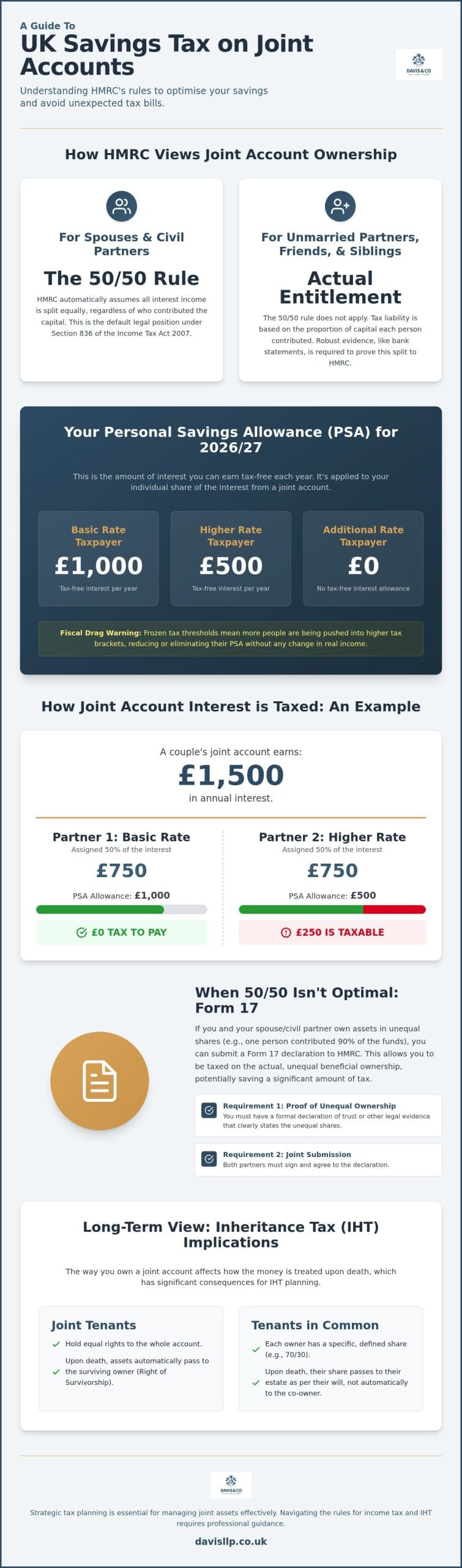
HMRC’s approach to joint assets is designed for administrative efficiency, yet it often overlooks the nuances of individual capital contributions. Under UK tax law, the default treatment for married couples and civil partners is the “50/50 rule.” This means the Revenue assumes each partner owns an equal share of the income, regardless of whose money actually resides in the account. While this provides a straightforward framework for many, it can create significant tax inefficiencies for high-net-worth households.
The 50/50 Rule for Spouses and Civil Partners
For most households, this equal split offers a degree of simplicity. It removes the daily burden of tracking every deposit and withdrawal for tax purposes. This statutory assumption, rooted in Section 836 of the Income Tax Act 2007, applies even if one spouse provides the entirety of the capital. While this is convenient, it can lead to higher tax bills if one partner has already exhausted their Personal Savings Allowance. In such cases, the default 50/50 split may inadvertently push a portion of interest into a higher tax bracket, making the management of hmrc joint bank accounts savings tax a priority for strategic planning.
Tax Rules for Non-Married Joint Account Holders
HMRC treats joint accounts held by friends, siblings, or unmarried partners quite differently. In these instances, the 50/50 default does not apply. Instead, tax is based on “actual entitlement,” which is typically determined by who contributed the funds. If two siblings hold an account but one deposited 80% of the balance, that individual is generally responsible for 80% of the tax on the interest earned. Proving this entitlement to HMRC requires robust evidence, such as bank statements showing the original source of funds or a written agreement detailing the intended split.
The legal distinction between “joint tenants” and “tenants in common” also plays a role in how assets are viewed. Joint tenants usually hold equal rights to the whole account, mirroring the standard tax treatment. Conversely, holding assets as tenants in common allows for specific, unequal shares to be defined legally. This distinction is vital for accurate reporting and ensuring compliance with Inheritance Tax rules, as the structure of ownership dictates how funds are treated both for income tax today and for estate planning in the future.
Banks and building societies are required to report interest data directly to HMRC. If your portion of the interest exceeds your Personal Savings Allowance, you’re responsible for reporting this via a Self Assessment return. For the 2026/27 tax year, the allowance remains £1,000 for basic rate taxpayers and £500 for those on the higher rate. Staying ahead of these requirements prevents the stress of unexpected discovery assessments or penalties for underpaid tax.
How the Personal Savings Allowance Applies to Joint Interest
The Personal Savings Allowance (PSA) serves as a critical buffer against taxation on interest, yet its application to joint holdings requires careful arithmetic. Under current HMRC rules on joint accounts, the interest earned is split equally between account holders for the purpose of testing against their individual allowances. For many, this calculation is the difference between a tax-free return and a surprising bill at the end of the fiscal year.
PSA Limits for Basic, Higher, and Additional Rate Taxpayers
For the 2026/27 tax year, the PSA thresholds are strictly defined by your total taxable income. Basic rate taxpayers enjoy a £1,000 allowance, while higher rate taxpayers see this halved to £500. Additional rate taxpayers, those earning over £125,140, receive no allowance at all. This creates a distinct “cliff edge” effect; a minor increase in salary or a modest bonus that pushes you into a higher tax bracket can instantly reduce or eliminate your tax-free interest buffer. Because thresholds remain frozen, fiscal drag is increasingly pulling savers into these more restrictive bands, making the management of hmrc joint bank accounts savings tax more complex than in previous years.
Calculating Your Share of Taxable Interest
Consider a couple where the husband is a basic rate taxpayer and the wife is in the higher rate bracket. If their joint account earns £1,500 in annual interest, HMRC attributes £750 to each. The husband remains within his £1,000 PSA, incurring no tax on his share. However, the wife exceeds her £500 allowance by £250, leaving that portion subject to tax at her marginal rate of 40%. This disparity often necessitates expert tax advice in the UK to determine if assets should be held differently to maximise the combined allowances of the household.
HMRC typically collects this tax through two primary channels. For those employed under PAYE, banks report interest figures directly to the Revenue, which then adjusts tax codes to collect the balance through monthly payroll. If you are self-employed or if your untaxed income exceeds certain limits, you must report these figures via your Self Assessment return. High interest rates have made breaching these thresholds a common reality for many who previously never gave their savings interest a second thought. For those with significant joint holdings, seeking professional Personal Tax Services can ensure that these nuances are managed efficiently before the tax year concludes.
Form 17 and Beneficial Interest: When 50/50 Isn’t Optimal
While the default equal split provides a baseline for simplicity, it often proves disadvantageous for households where income is significantly weighted toward one partner. For married couples and civil partners, Form 17 serves as the formal mechanism to notify the Revenue that you wish to be taxed on your actual beneficial interest rather than the 50/50 assumption. This election is only valid when the underlying ownership of the asset is truly unequal, and it must be supported by evidence that reflects this reality. Failing to align your tax reporting with the legal ownership of the capital can lead to complications regarding hmrc joint bank accounts savings tax, especially if a high-yield account generates substantial returns.
Strategically Shifting Interest to a Lower-Earning Spouse
The financial incentive to move interest income from an additional rate taxpayer to a basic rate spouse is clear. In the 2026/27 tax year, shifting interest from a partner paying 45% tax to one paying 20% can preserve a significant portion of a household’s wealth. However, this isn’t a mere accounting entry. HMRC requires that the right to the income follows the right to the capital. If you declare a 90/10 split for tax purposes, the lower-earning spouse must legally own 90% of the funds in that account. We advise clients to avoid “sham” arrangements where the income is shifted on paper but the higher earner retains full control over the capital, as these are frequently challenged during routine audits.
The Filing Process for HMRC Form 17
To deviate from the standard treatment, you must follow a precise administrative path. The process begins with establishing a legal change in beneficial interest, typically through a Declaration of Trust. This document serves as the foundation for your claim and must be in place before you submit the form. According to the HMRC rules on joint account interest, the following steps are mandatory:
- Establish the Declaration: Execute a deed or declaration that clearly states the unequal shares held by each partner.
- Joint Signatures: Both parties must sign Form 17 to confirm their agreement to the new tax treatment.
- Statutory Deadline: The completed form and the supporting evidence must reach HMRC within 60 days of the date the declaration was signed.
It’s vital to recognise that HMRC does not allow for backdating. If the 60-day window is missed, the declaration is effectively void for tax purposes, and you’ll remain subject to the 50/50 split until a new declaration is made and submitted on time. This rigid timeline underscores the importance of coordinated planning. Once accepted, the election remains in force until the beneficial interest changes again or the couple separates, providing a stable foundation for long-term tax efficiency.
Inheritance Tax Implications for Jointly Held Funds
The administrative ease of a joint account often masks the rigorous scrutiny HMRC applies to these assets during estate valuations. While the “Right of Survivorship” ensures that funds transfer instantly to the surviving holder without the delays of probate, it doesn’t offer an automatic shield against the taxman. For those managing hmrc joint bank accounts savings tax, understanding where income tax compliance ends and inheritance tax (IHT) liability begins is a vital component of a resilient financial strategy. The way an account is structured during your lifetime directly dictates how it’s valued upon your death.
The Right of Survivorship vs. IHT Liabilities
Many individuals incorrectly assume that because funds are held jointly, they exist outside the taxable estate. For spouses and civil partners, the unlimited spouse exemption usually mitigates immediate concerns. However, for all other joint holdings, HMRC typically values the deceased’s share at 50% of the account balance at the date of death. This valuation contributes directly to the total estate, potentially pushing it beyond the £325,000 nil-rate band. This risk is particularly acute given the recent HMRC tax warning regarding estate compliance and the freezing of thresholds. If the account was structured as “tenants in common” as discussed previously, the specific percentage defined in your deed will dictate the IHT valuation.
Joint Accounts with Children or Non-Spouses
Adding a child to a bank account for “convenience” is a common practice that carries significant tax risks. If a parent deposits the entirety of the funds but adds a child as a joint holder, HMRC may view this as a Gift with Reservation of Benefit. This occurs if the parent continues to benefit from the capital or income. In such cases, the whole balance remains part of the parent’s estate for IHT purposes. Alternatively, if the parent genuinely surrenders control, the transfer is treated as a Potentially Exempt Transfer. This requires the parent to survive seven years for the funds to be excluded from the estate. Without robust documentation of capital contributions, families often face the burden of proving that a gift was intended, which can lead to protracted disputes during the probate process.
Ensuring your joint assets are correctly recorded today prevents complex legal and financial hurdles for your heirs. Our Personal Tax Services offer the technical expertise required to align your current savings strategy with your long-term estate planning goals, ensuring your legacy is protected from unnecessary tax erosion.
Strategic Tax Planning for Joint Assets with Davis & Co
Davis & Co LLP serves as a strategic partner for individuals whose financial structures have outgrown standard high-street accounting. Navigating the nuances of hmrc joint bank accounts savings tax requires more than just administrative filing; it demands a comprehensive understanding of how personal assets interact with broader wealth objectives. With over 120 years of history as Chartered Certified Accountants, we provide the reliable authority necessary to manage sensitive commercial and personal tax matters with discretion.
Professional Audit of Beneficial Interests
We help our clients move beyond the default assumptions of the Revenue by conducting rigorous audits of their beneficial interests. Proving actual entitlement is not merely about showing a bank statement; it involves establishing a robust legal framework that can withstand HMRC scrutiny. Our team assists in drafting the necessary declarations of trust and ensuring that Form 17 elections are submitted within the 60-day statutory window. By documenting the source of capital and the intended distribution of income, we mitigate the risk of discovery assessments or investigations into your joint savings interest. This meticulous approach ensures that your tax position is both optimised and defensible.
Integrated Personal and Business Tax Oversight
For business owners, the management of joint savings shouldn’t be viewed in isolation. A high-calibre small business accountant understands that your personal tax exposure is intrinsically linked to your corporate withdrawals. In the 2026/27 tax year, where the dividend allowance is limited to £500 and savings thresholds are frozen, coordination is paramount. We specialise in aligning your dividend income with your share of joint interest to ensure you remain within the most efficient tax bands possible.
Our expertise extends into international tax planning, which is essential for clients holding cross-border joint accounts or assets in multiple jurisdictions. We ensure that your global financial footprint remains compliant with UK reporting requirements while identifying opportunities for legitimate tax mitigation. If you’re concerned about your 2026 liabilities or the impact of fiscal drag on your household wealth, we invite you to a confidential consultation. Together, we can review your joint assets and implement a strategy that reflects your true financial reality.
Securing Your Financial Legacy in 2026 and Beyond
Proactive management of your household wealth requires a nuanced approach to the evolving landscape of hmrc joint bank accounts savings tax. As we have examined, the Revenue’s default assumptions are often at odds with the practicalities of sophisticated financial structures. By strategically addressing beneficial interests and ensuring your documentation is robust, you can protect your capital from the erosion of fiscal drag and the complexities of future estate valuations.
Our specialist teams at Davis & Co LLP bring over 120 years of professional gravitas and discrete advisory to every partnership. As Chartered Certified Accountants with deep international tax expertise, we are uniquely positioned to advise high-net-worth individuals and dental professionals on their most sensitive financial matters. We invite you to consult Davis & Co LLP for bespoke personal tax advice to ensure your joint assets are structured with precision and care.
Aligning your current tax reporting with your long-term wealth objectives doesn’t just offer immediate efficiency. It provides the enduring stability and peace of mind that comes from knowing your affairs are in expert hands.
Frequently Asked Questions
Do I need to tell HMRC about my joint bank account?
You aren’t required to notify the Revenue simply for opening a joint account. However, you must report any interest that exceeds your individual Personal Savings Allowance through a Self Assessment return or by notifying HMRC to adjust your tax code. Because banks report interest data directly, maintaining accurate records for hmrc joint bank accounts savings tax is essential to ensure your personal reporting matches the information held by the authorities.
Can I choose to have all the interest taxed on my spouse?
You cannot simply choose a tax split for administrative convenience; the tax liability must follow the legal beneficial ownership. For married couples, the default is an equal 50/50 split. To shift the interest to a spouse, you must hold the account as tenants in common and legally transfer the underlying capital. This change is then formalised by submitting Form 17 alongside a declaration of trust to HMRC.
What happens if one joint account holder is a non-UK resident?
Interest arising from a UK bank account is generally considered UK-sourced income and remains taxable here regardless of the holder’s residency status. The non-resident individual may be entitled to relief under a double taxation treaty between the UK and their country of residence. This often involves complex cross-border reporting, making professional international tax planning a vital step to ensure you don’t pay tax twice on the same interest income.
Is interest from a joint ISA taxed differently?
Technically, joint ISAs don’t exist under UK tax law as ISAs are strictly individual accounts. While you can hold joint current or savings accounts, ISA tax benefits are tied to a single National Insurance number. Consequently, the rules governing hmrc joint bank accounts savings tax don’t apply here. Interest earned within an ISA remains entirely tax-free for the individual holder and isn’t aggregated with joint account interest for PSA calculations.
How does HMRC know how much interest I have earned?
UK financial institutions are legally mandated to report the interest paid to every account holder to HMRC at the end of each tax year. This data is automatically cross-referenced with your National Insurance number. If the interest attributed to your share of a joint account exceeds your £1,000 or £500 allowance, the Revenue will typically identify the discrepancy and may issue a tax demand or adjust your PAYE code accordingly.
What is the deadline for submitting Form 17 to HMRC?
The statutory deadline for submitting Form 17 is 60 days from the date the declaration of trust or deed of gift was signed. HMRC is exceptionally strict regarding this window; they won’t accept late notifications or allow for backdating. If you miss this deadline, the election is void, and you’ll continue to be taxed on the default 50/50 basis until a new legal declaration is executed and filed on time.
Can HMRC check my joint bank account without my permission?
HMRC possesses broad statutory powers to request information from third parties, including banks, as part of their compliance checks. While they usually inform the taxpayer of an investigation, they don’t require your explicit permission to access data if they have reasonable grounds to suspect tax has been underpaid. They already receive annual summaries of interest earned, which they use as a primary tool for identifying potential under-reporting in joint holdings.
Does a joint account protect my money from inheritance tax?
A joint account doesn’t offer protection from Inheritance Tax. Although the “right of survivorship” allows the surviving holder to access funds without waiting for probate, the deceased person’s share is usually included in their estate valuation. For non-spouses, this 50% share is subject to the standard 40% IHT rate if the estate exceeds the nil-rate band, unless you can prove the survivor contributed the entirety of the capital.