In the first half of 2026, nearly 80% of first-time buyers in the capital faced significant Stamp Duty Land Tax bills, while seasoned investors grappled with even steeper surcharges on additional properties. You’re likely feeling the weight of these shifting fiscal boundaries, particularly as the complexity of Section 24 interest relief and the mandatory implementation of Making Tax Digital for Income Tax in April 2026 add new layers of administrative burden. In this climate, the expertise provided by property accountants London is no longer just a matter of basic compliance. It’s a strategic necessity for those looking to mitigate exposure to ATED thresholds and the 25% main rate of corporation tax.
It’s a challenging period where the distinction between a profitable year and a stagnant one often rests on the precision of your financial structure. We’ve designed this guide to provide a clear, actionable framework for choosing between personal and corporate ownership while reducing your overall tax exposure. We’ll explore the nuances of current SDLT rates, the impact of upcoming 2027 income tax changes, and the sophisticated methods required to maintain a resilient, scalable portfolio in an increasingly transparent regulatory environment.
Key Takeaways
- Understand why specialized property accounting is essential to navigate the 2026 regulatory shift, moving beyond basic compliance toward strategic wealth preservation.
- Evaluate the fiscal implications of Section 24 interest relief to determine whether a limited company or personal ownership structure best serves your long-term portfolio goals.
- Develop a proactive framework for managing Stamp Duty Land Tax (SDLT) and Annual Tax on Enveloped Dwellings (ATED) to minimize exposure on high-value residential assets.
- Learn how integrating management accounts and precise bookkeeping provides the real-time financial clarity necessary for sustainable business growth acceleration.
- Discover the criteria for selecting property accountants London who offer the professional gravitas and multi-disciplinary expertise required for complex, multi-jurisdictional interests.
The Role of Specialist Property Accountants in the 2026 UK Market
Property accounting is the strategic management of property-related financial obligations and opportunities. While many firms offer standard compliance, property accountants London provide a level of technical depth that extends far beyond a simple tax return. Generalist practitioners often overlook the granular nuances of property-specific legislation, such as the intricate interplay between Capital Gains Tax in the UK and corporate relief structures. It’s this lack of specialization that can lead to missed opportunities for capital allowance claims or inefficient portfolio structuring.
Investors with diverse portfolios require a partner who understands that tax exposure varies significantly across different asset classes and valuation tiers. Relying on a firm with a national perspective ensures that whether your assets are situated in major metropolitan hubs or emerging investment pockets, the advice remains consistent and precise. We act as a strategic partner, ensuring that your financial framework is robust enough to support long-term scalability while remaining compliant with the latest HMRC directives.
Navigating the 2026 Regulatory Environment
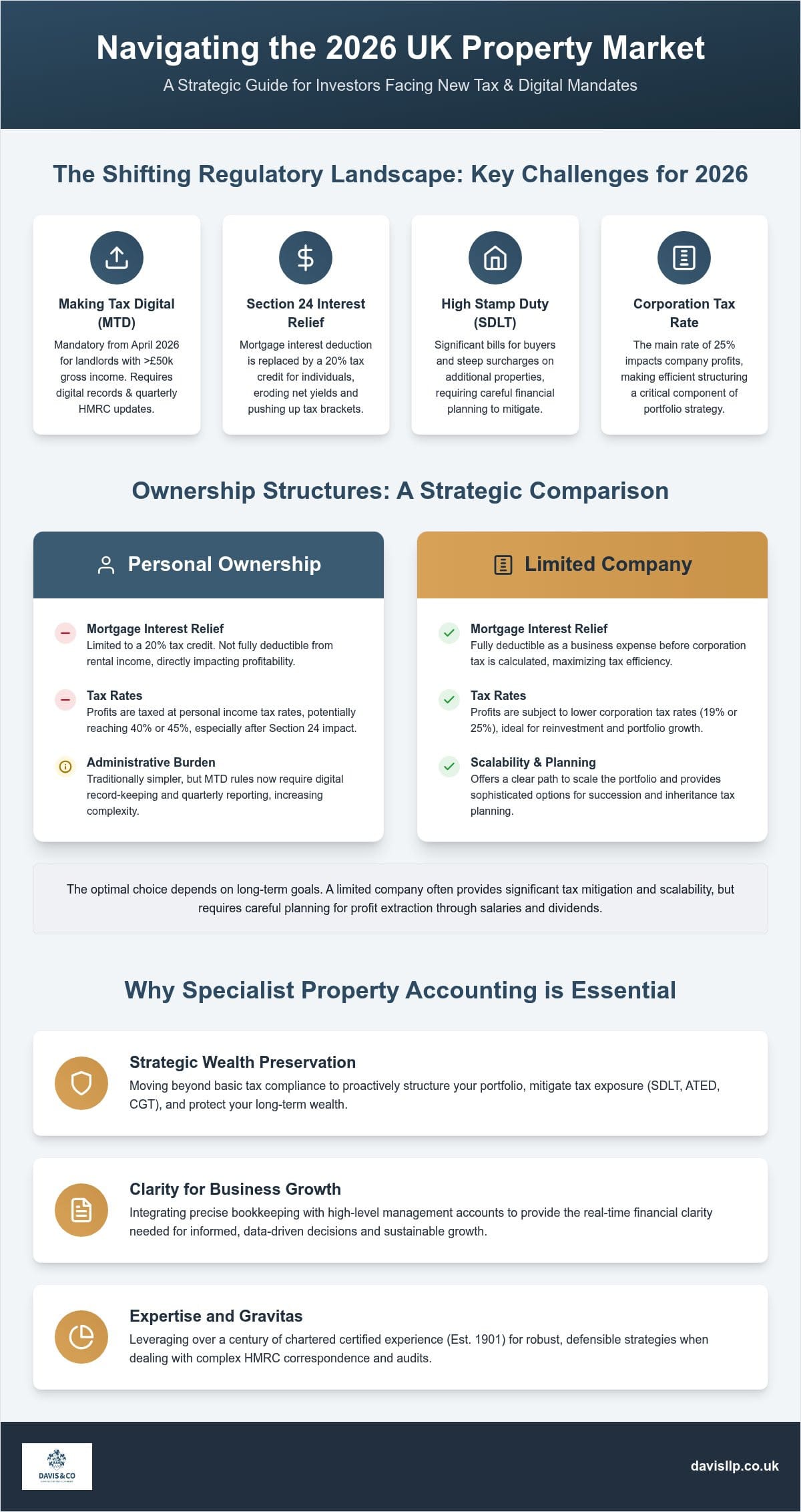
The shift toward total digital transparency reached a milestone on 6th April 2026 with the full implementation of Making Tax Digital for Income Tax Self-Assessment. Landlords with gross income exceeding £50,000 must now maintain digital records and provide quarterly updates to HMRC. This transition, combined with current economic volatility, makes accurate property valuations essential for tax efficiency. A national outlook is vital; regional variations in Stamp Duty Land Tax surcharges and the “mansion tax” thresholds for properties over £2 million mean that a localized approach is often insufficient for high-value portfolios. Our role as property accountants London involves synthesizing these complex variables into a coherent strategy that protects your yields.
The Value of Chartered Certified Expertise
Established in 1901, our firm brings over a century of reliability to every client engagement. This history of success provides the professional gravitas required when managing sensitive HMRC correspondence or complex audit and assurance requirements. Relying on expert tax advice in the UK ensures that your risk mitigation strategies are both robust and defensible. We prioritize a composed partnership, focusing on the human and organizational impact of fiscal changes. This approach allows us to deliver highly individualized service, positioning our practice as a dependable constant in a volatile market. By integrating precise bookkeeping with high-level strategic planning, we help you make informed decisions that drive business growth acceleration and secure your financial legacy.
Evaluating Property Ownership Structures: Limited Company vs. Personal Ownership
The choice between personal and corporate ownership is a defining strategic pivot for UK investors. Since the full implementation of Section 24 interest relief restrictions, individual landlords can’t deduct mortgage interest from rental income before calculating tax. Instead, they receive a 20% tax credit. This often pushes basic-rate taxpayers into higher brackets and erodes net yields. Professional property accountants London help investors quantify this impact, weighing the increased administrative costs of a company against the potential for significant tax mitigation.
The Corporate Route: Scalability and Tax Efficiency
For many, incorporation offers a path to scalability that personal ownership can’t match. Within a limited company, mortgage interest remains a fully deductible business expense. Profits are subject to corporation tax rates of 19% or 25% rather than personal income tax rates reaching 45%. This structure works well for those who reinvest profits into further acquisitions. Profit extraction requires careful planning, often balancing a mix of salary and dividends to remain tax-efficient. For high-net-worth individuals, the Family Investment Company (FIC) serves as a sophisticated vehicle for succession planning. It allows for the transfer of wealth to future generations while maintaining control over the assets. Utilizing specialized small business accountant services ensures these corporate portfolios remain compliant with both filing requirements and strategic growth objectives.
Personal Ownership: Flexibility and Capital Gains
Personal ownership remains a viable option for smaller portfolios or for investors who prioritize simplicity. If your total income stays within the basic rate band, the complexities of corporate filing might outweigh the tax benefits. Personal ownership also allows for certain reliefs on Capital Gains Tax that aren’t available to corporate entities. You should regularly review the UK government guidance on rental income tax to stay updated on how personal allowances affect your specific situation. Succession planning in personal ownership is more direct but can trigger immediate inheritance tax liabilities without careful trust-based structuring. Balancing these factors requires a composed, long-term view, which is why many investors partner with property accountants London to maintain fiscal clarity. Our team can help you determine the most effective path through a collaborative review of your property interests.
Mitigating Tax Liability: SDLT, ATED, and Capital Gains Strategies
Effective tax mitigation requires more than reactive filing; it demands a proactive assessment of how various levies intersect across a portfolio. For investors with significant holdings, property accountants London provide the technical oversight necessary to navigate the increasingly granular requirements of the UK tax regime. This involves balancing immediate acquisition costs against long-term disposal liabilities, particularly as the fiscal environment grows more transparent and digitalized. We focus on creating a cohesive strategy that accounts for every stage of the property lifecycle, ensuring that capital is preserved and reinvested efficiently.
Managing SDLT Surcharges and Reliefs
Acquisition remains a high-cost phase, with the 5% surcharge on additional properties creating a substantial entry barrier for buy-to-let investors and developers. While standard rates apply to primary residences, the additional surcharge is applied on top of each band for those expanding an existing portfolio. Precision in these calculations is vital to avoid overpayment, especially when assessing eligibility for specific reliefs on multiple dwellings or managing complex mixed-use transactions. We ensure that every acquisition is structured to account for these surcharges from the outset, protecting your initial capital outlay and ensuring cash flow remains stable throughout the purchasing process.
ATED Compliance for Corporate Owners
For residential properties held within corporate vehicles, the Annual Tax on Enveloped Dwellings (ATED) remains a critical compliance area. For the 2026/27 period, properties valued over £500,000 are subject to specific charges, starting at £4,600 for assets up to £1 million and rising to £9,450 for those valued between £1 million and £2 million. The filing deadline of 30th April 2026 is absolute, and errors in valuation can lead to significant penalties. We assist clients in navigating these thresholds, ensuring that genuine property development or rental businesses claim the reliefs they’re entitled to while maintaining the necessary documentation for HMRC scrutiny.
Disposals also require careful timing to manage Capital Gains Tax (CGT) exposure. The current CGT rate for residential property stands at 24% for higher-rate taxpayers, with a strictly enforced 60-day window for reporting and payment following the completion of a sale. This window is particularly challenging for those managing international tax planning requirements. As highlighted in recent industry analysis regarding Making Tax Digital for landlords, the move toward real-time reporting means that information silos are no longer viable. Property accountants London provide a strategic framework that integrates these various tax strands, ensuring your portfolio rebalancing is executed with both precision and discretion.
Beyond Compliance: Leveraging Management Accounts for Portfolio Growth
While basic bookkeeping satisfies statutory obligations, it rarely informs a sophisticated growth strategy. By partnering with property accountants London, you transform raw financial data into a strategic asset that guides your investment trajectory. We focus on moving beyond the limitations of annual snapshots, opting instead for a dynamic approach that mirrors the pace of the UK property market. Real-time visibility into your portfolio’s performance allows for immediate adjustments in response to market shifts, ensuring that your capital remains deployed in the most efficient manner possible.
Data-Driven Decision Making for Landlords
Transitioning from annual reporting to monthly management accounts provides a granular view of your operations that generalist firms often overlook. It’s easier to identify underperforming assets when you can see expense spikes or declining yields as they occur. For larger portfolios, integrating payroll services and VAT compliance into a single reporting framework reduces administrative friction and enhances accuracy. This level of detail ensures that every decision, from a minor refurbishment to a major divestment, is backed by empirical data rather than intuition. Accurate records are the lifeblood of a resilient business.
Strategic Cash Flow Management
Maintaining liquidity is paramount for long-term stability, particularly in a volatile economic environment where borrowing costs remain a primary concern. You need sufficient reserves to cover maintenance, upcoming tax liabilities, and potential interest rate volatility. Strategic cash flow management allows you to optimize the timing of capital expenditure, ensuring you maximize available tax reliefs without compromising your operational agility. Management accounts serve as the essential foundation for business growth acceleration by providing the financial clarity required to scale with confidence. This steady, measured approach to liquidity prevents the forced sale of assets during market downturns.
Beyond internal management, high-quality financial reporting builds essential external trust with financial institutions. Robust audit and assurance processes provide lenders with the security they need to offer more competitive financing terms for your next acquisition. When your records are precise and professionally verified by property accountants London, your ability to secure capital increases, allowing for a more aggressive yet secure growth trajectory. We act as a strategic partner, ensuring your financial infrastructure supports your long-term ambitions. If you are ready to enhance your portfolio’s performance, our team can provide the comprehensive property accounting support you require.
Selecting a Strategic Partner for Comprehensive Property Accounting
In the context of high-value residential and commercial assets, the choice of a professional advisor is a decision that carries significant long-term implications. You need more than a service provider; you require a partner whose professional gravitas and discretion match the sensitivity of your commercial interests. While many property accountants London offer basic compliance, a firm with a multi-disciplinary scope, spanning Audit, International Tax, and specialized sectors like dental tax, demonstrates a breadth of analytical capability that’s essential for complex portfolios. This versatility ensures that whether you’re navigating trust tax requirements or business growth acceleration, the advice you receive is integrated and comprehensive.
The selection process should prioritize firms that view accounting as a strategic function rather than a mere administrative chore. It’s often helpful to learn how to find a chartered accountant who understands the specific nuances of the property sector, as this ensures your advisor can anticipate legislative shifts before they impact your net yields. A partner with a history of stability provides a reassuring constant in an often volatile fiscal environment, allowing you to focus on acquisition and management with absolute confidence.
The Davis & Co LLP Approach to Property
Established in 1901, our firm maintains a tradition of excellence that combines historical reliability with modern technical expertise. We operate on a model of composed partnership, where our role is to make you feel secure and well-advised through every market cycle. Our approach is highly individualized; we recognize that a national portfolio requires a different strategic framework than a concentrated local holding. By managing the unique financial requirements of your assets with precision, we help you maintain the necessary distance of a professional expert while fostering a deeply collaborative relationship. We don’t just report on your past; we help you engineer your future.
Next Steps for Your Property Business
The first step toward optimizing your fiscal position is a comprehensive strategic review of your current ownership structure. With new, separate income tax rates for property income arriving on 6th April 2027, proactive planning today is essential to mitigate future exposure. We invite you to discuss tailored solutions for your national or international property interests, ensuring your portfolio is structured for both resilience and scalability. Our team of property accountants London is prepared to assist you in navigating these complexities with the intellectual rigour your assets deserve. We focus on the organizational impact of every decision, ensuring your legacy is protected through steady, measured advice.
Securing Your Property Legacy in a Digital Tax Era
The landscape of UK property investment is undeniably complex, yet it remains a robust vehicle for wealth preservation when managed with precision. We’ve explored how the transition to a corporate structure can mitigate the impact of Section 24 interest relief and how real-time management accounts provide the clarity needed for sustainable growth. Success in 2026 requires moving beyond simple compliance toward a model of strategic, multi-disciplinary planning that accounts for both national and international tax obligations. It’s no longer sufficient to look back at annual figures; you need a forward-looking strategy that anticipates change.
As Chartered Certified Accountants since 1901, we offer the professional gravitas and deep-seated expertise required to navigate these shifting regulations. Our national UK coverage ensures that your portfolio receives the same high-calibre, individualized service regardless of asset location. Partnering with experienced property accountants London allows you to focus on your commercial ambitions while we manage the intricacies of your fiscal obligations. We invite you to contact Davis & Co LLP for a strategic property tax consultation to review your current structure. We look forward to helping you build a resilient and scalable financial future.
Frequently Asked Questions
Do I need a specialist property accountant if I only have one rental property?
Engaging specialist property accountants London is advisable even for single-property landlords due to the mandatory implementation of Making Tax Digital for Income Tax Self-Assessment in April 2026. A specialist ensures you’re utilizing the 20% tax credit effectively under Section 24 interest relief rules. They also provide the strategic foresight needed to decide whether your next acquisition should remain personal or transition into a corporate structure. Early planning prevents costly re-structuring later.
What are the main tax advantages of holding property in a limited company in 2026?
Holding assets in a limited company allows for the full deduction of mortgage interest as a business expense, bypassing the Section 24 restrictions faced by individuals. Profits are subject to corporation tax rates of 19% or 25% rather than personal income tax rates of up to 45%. This structure is particularly beneficial for those reinvesting rental income into portfolio growth, though it requires careful management of dividend extraction and potential ATED liabilities.
How does ATED affect companies owning residential property?
The Annual Tax on Enveloped Dwellings (ATED) applies to companies owning residential properties valued over £500,000. For the 2026/27 tax year, charges start at £4,600 and must be reported by 30th April 2026. Reliefs are often available for genuine rental businesses or property developers, but these must be formally claimed through an ATED return. Precision in valuation is essential to avoid HMRC penalties for non-compliance or underpayment of the required levy.
Can property accountants help with international tax for overseas owners?
Specialized firms like Davis & Co LLP provide comprehensive international tax planning for non-resident owners. Managing UK property from abroad introduces complexities such as Non-Resident Capital Gains Tax and specific withholding tax requirements on rental income. We ensure your structure remains tax-efficient across multiple jurisdictions while maintaining full compliance with both UK and local reporting standards. This global perspective is essential for protecting yields in an increasingly transparent and digitalized regulatory environment.
What is the difference between a bookkeeper and a property accountant?
A bookkeeper focuses on the accurate daily recording of financial transactions and digital record-keeping. In contrast, property accountants London provide high-level strategic analysis, tax mitigation strategies, and formal audit and assurance services. While bookkeeping is the foundation of your data, the accountant interprets that data to accelerate business growth. They ensure your portfolio is structured to minimize overall tax exposure while meeting complex statutory requirements and long-term financial goals.
How often should I receive management accounts for my property business?
Receiving management accounts on a monthly or quarterly basis is recommended to maintain real-time visibility over your cash flow. Relying solely on year-end snapshots is often insufficient in a volatile market where interest rates and maintenance costs fluctuate. Regular reporting allows you to identify underperforming assets and optimize the timing of capital expenditure for maximum tax relief. This steady rhythm of information supports informed decision-making and builds lender confidence for future acquisitions.
Are there specific tax rules for dental professionals who invest in property?
Dental professionals often face unique financial structures that require integrated advice. As niche dental tax specialists, we understand how practice income and property investments interact within your broader tax profile. This expertise is vital for managing the tapered personal allowance for high earners and ensuring that property acquisitions don’t inadvertently increase your overall tax burden. We provide a cohesive strategy that balances your professional practice needs with long-term portfolio growth and wealth preservation.
What should I bring to my first meeting with a property accountant?
For an initial strategic review, you should prepare a comprehensive list of your property assets, including purchase dates and current valuations. Bring your most recent mortgage statements, two years of tax returns, and any existing tenancy agreements. If you already operate through a corporate vehicle, include your latest sets of accounts. This data allows property accountants London to conduct a thorough analysis of your current structure and identify immediate opportunities for tax optimization and risk mitigation.