What if your annual tax return was actually the least valuable insight your firm provided this year? For many directors, the relationship with their financial advisor has become a repetitive cycle of deadlines and HMRC filings. You may feel like just another entry in a high-volume firm’s ledger, left to manage shifting Corporation Tax rates or the April 2026 Making Tax Digital requirements without a clear roadmap. It’s a common frustration to feel that your professional advisors are looking in the rearview mirror rather than helping you steer the business forward.
This guide demonstrates how a strategic accountant for business growth moves beyond mere compliance to transform your financial obligations into a lever for sustainable expansion. We believe that professional gravitas should be matched by proactive tax efficiency and a deep understanding of your specific commercial objectives. We will explore how sophisticated international tax planning, precise cash flow management, and the latest 2026 regulatory changes can provide the clarity you need to scale. By the end of this article, you’ll understand how a composed partnership can turn complex reporting into a decisive advantage for your enterprise.
Key Takeaways
- Understand why a modern accountant for business growth acts as a financial architect rather than a mere bookkeeper, providing the strategic framework necessary for scaling in a volatile market.
- Learn how to navigate the 2026 VAT registration thresholds and audit requirements to ensure your business remains compliant while strengthening stakeholder confidence.
- Discover the advantages of sophisticated international tax planning for cross-border operations, ensuring tax efficiency across multiple jurisdictions and family office structures.
- Prepare for the April 2026 transition to Making Tax Digital for Income Tax Self-Assessment and shifting Corporation Tax rates with a roadmap designed to protect your firm’s profitability.
- Identify the essential criteria for selecting a high-calibre accounting partner who offers proactive, individualised communication over generic, high-volume service delivery.
Beyond Bookkeeping: The Evolving Role of a Small Business Accountant in 2026
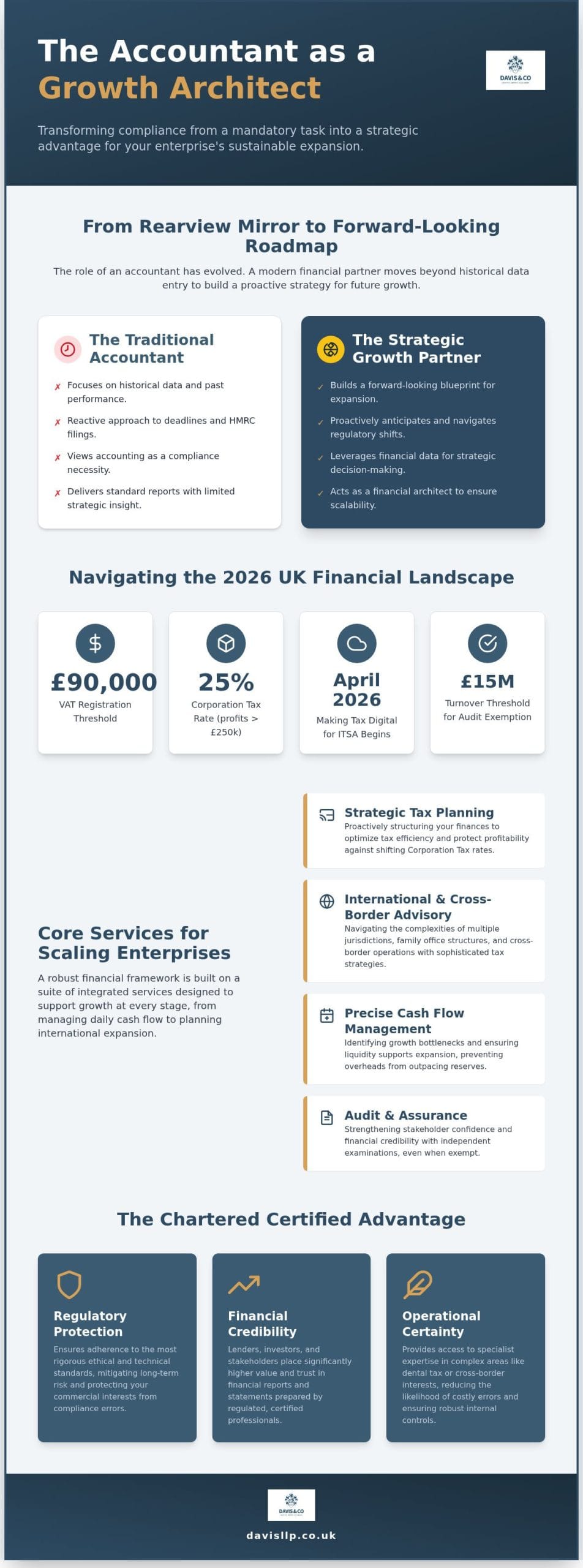
The role of the accounting professional has undergone a fundamental transformation. By 2026, the automation of routine ledger entries has rendered the traditional “bookkeeper” model obsolete for ambitious enterprises. Instead, a strategic accountant for business growth operates as a financial architect, designing systems that ensure both resilience and scalability. In a volatile economic climate where the main Corporation Tax rate stands at 25% for profits exceeding £250,000, passive compliance is no longer a viable strategy. You need a partner who anticipates regulatory shifts rather than merely reacting to them.
Traditional firms often focus on the historical recording of data, but this retrospective view offers little protection against modern market fluctuations. A high-calibre advisor brings professional gravitas and discretion to your operations, ensuring that sensitive commercial interests are shielded while you pursue expansion. This shift from data entry to financial architecture means your accounts become a tool for strategy, not just a requirement for HMRC.
The Shift from Compliance to Advisory
Modern businesses generate vast amounts of real-time data, yet data without expert interpretation is often just noise. Relying on fundamental financial accounting principles is the baseline, but the true value lies in the strategic analysis of management accounts. These reports allow us to identify specific growth bottlenecks, such as inefficient stock turnover or tightening margins, before they become critical issues. A strategic accountant acts as a proactive growth partner, translating historical figures into a forward-looking blueprint for commercial expansion. This transition allows directors to make decisions based on tomorrow’s potential rather than yesterday’s errors.
Why Credentials Matter: The Chartered Certified Advantage
The distinction between a standard service provider and a Chartered Certified advisor is found in the depth of professional standards and regulatory accountability. Engaging a firm with an established history, such as Davis & Co LLP’s legacy since 1901, provides a level of authority that protects your commercial interests. High-calibre advice from a dedicated accountant for business growth mitigates long-term risk by ensuring your internal controls are robust enough to withstand HMRC scrutiny. It’s about more than just numbers; it’s about the financial credibility your business projects to the wider world.
- Regulatory Protection: Chartered Certified status ensures adherence to rigorous ethical and technical standards.
- Financial Credibility: Lenders and investors place higher value on reports prepared by regulated professionals.
- Operational Certainty: Specialist expertise in areas like dental tax or cross-border interests reduces the likelihood of costly compliance errors.
This measured approach ensures that sensitive financial matters are handled with the discretion they deserve, fostering a composed partnership built on reliability and intellectual rigour.
Essential Accounting Services for Scaling UK Small Businesses
Scaling a UK enterprise demands a shift from reactive bookkeeping to a structured suite of professional services. As your turnover approaches the 2026 VAT registration threshold of £90,000, the complexity of your tax obligations increases significantly. Managing these requirements while overseeing payroll and maintaining UK company compliance requirements can quickly overwhelm internal resources. A dedicated accountant for business growth ensures that these administrative pillars remain robust, allowing you to focus on market expansion. Without this precision, growth can ironically lead to instability as overheads outpace cash reserves.
Audit and Assurance: Building Institutional Trust
While many small companies meet the exemption criteria, which include turnover up to £15 million and a balance sheet total up to £7.5 million, a voluntary audit often serves as a powerful strategic tool. It provides an independent examination of your financial health, which is vital when seeking external investment or negotiating high-value contracts. Specialist audit and assurance services demonstrate to stakeholders that your business is governed with intellectual rigour and transparency. This level of institutional trust is often the deciding factor in securing the capital necessary for the next stage of your journey. It moves your firm beyond the status of a small business in the eyes of institutional lenders and positions you as a serious market contender.
Management Accounts and Cash Flow Management
Static year-end accounts are insufficient for navigating a volatile economy. To maintain liquidity during rapid expansion, directors require the granular detail found in monthly management accounts. These reports highlight cash flow trends and identify potential capital shortfalls before they hinder operations. By partnering with the strategic small business accountant, you gain access to the sophisticated analysis needed to manage working capital effectively. This partnership ensures that every pound is allocated with purpose, transforming your balance sheet into a roadmap for future investment.
We provide the steady, deliberate financial oversight required to turn these insights into action. If you’re looking to strengthen your firm’s foundations, consider how our Business Growth Acceleration services can support your long-term objectives. Accurate bookkeeping serves as the bedrock here, providing the reliable data required for the complex financial forecasting that high-growth phases demand. An accountant for business growth doesn’t just record where your money went; they help you decide where it should go next.
Strategic Tax Planning and International Expansion for SMEs
Expanding beyond the UK market introduces a layer of fiscal complexity that generic accounting software cannot resolve. For a modern enterprise, an accountant for business growth must possess the intellectual rigour to navigate diverse tax jurisdictions. We focus on creating a cohesive strategy that aligns your global ambitions with UK compliance requirements, ensuring that expansion doesn’t lead to unforeseen liabilities. This level of strategic oversight is what distinguishes a high-calibre advisor from a standard service provider.
Cross-Border Tax Solutions for the Modern SME
When your business operates across borders, the risk of double taxation becomes a tangible threat to profitability. Effective international tax planning is essential to protect your margins and ensure that treaty reliefs are correctly applied. Whether you’re managing overseas subsidiaries or providing services to international clients, we provide the steady oversight needed to maintain tax efficiency. This includes advising on transfer pricing and the repatriation of profits, which are critical for the long-term health of family offices and global SMEs alike. Our approach ensures that your cross-border operations remain compliant with both local regulations and UK standards.
Specialist Industry Expertise: Dental and Property
Sector-specific nuances often dictate the success of a financial strategy. For instance, dental professionals face unique challenges regarding NHS contracts, associate agreements, and capital expenditure on specialist equipment. Working with a dental tax specialist ensures that your practice management is optimised for both current income and future sale value. We understand the professional realities of your day-to-day operations, allowing us to provide advice that is both technically precise and practically applicable. This niche expertise allows for a more nuanced interpretation of tax legislation as it applies to your specific profession.
Similarly, property accounting requires a sophisticated understanding of ownership structures and trust tax services. Whether you’re managing a growing portfolio of residential buy-to-lets or commercial business assets, the choice of vehicle has profound implications for your tax exposure. Your accountant for business growth must evaluate whether a limited company, personal ownership, or a trust structure best serves your long-term objectives. This individualised approach provides the security and discretion essential for high-net-worth directors and multi-generational family interests, ensuring that your wealth is protected as it grows.
How to Evaluate and Choose the Right Accounting Partner
Selecting a financial advisor is one of the most consequential decisions a director will make. It’s a choice that moves beyond simple bookkeeping software or the ease of switching providers. To secure a true accountant for business growth, you must look for a partner who offers intellectual rigour and a deep understanding of your long-term vision. A high-calibre firm doesn’t just manage your present; it architectures your future through a composed and reliable partnership.
The Professional Evaluation Framework
We recommend a structured approach when vetting a potential firm to ensure they meet the standards required for complex commercial operations. First, verify their professional body registrations and the depth of their history. A firm with a significant legacy, such as one established in 1901, offers a perspective on market cycles that newer, high-volume practices often lack. Second, scrutinise their specific approach to business growth acceleration. Ask how they’ve helped similar firms scale while maintaining tax efficiency. Finally, test their knowledge of complex tax jurisdictions and audit requirements. If your ambitions are international, your advisor must be as well.
Red Flags When Selecting an Accountant
Be wary of firms that offer only reactive compliance advice. If your primary contact is slow to respond or seems unaware of the 2026 regulatory shifts, such as the new UK GAAP changes for revenue recognition, they’re likely a “form-filler” rather than a strategic partner. There’s a significant danger in one-size-fits-all online accounting packages for scaling firms. These services often lack the nuanced interpretation required for complex commercial interests or niche sectors like dental tax. You can learn more in our how to find a chartered accountant guide.
Understanding the fee structure is equally vital. We believe that value-based pricing is superior to hourly rates for growing businesses. Value-based fees ensure that the focus remains on the quality of the strategic insight provided rather than the time spent on a task. This model encourages proactive communication, as you won’t feel penalised for seeking advice on a complex cross-border transaction or a sudden cash flow challenge. A dedicated accountant for business growth who understands your vision becomes a dependable constant in a volatile environment. If you’re ready to move beyond generic service delivery, we invite you to enquire about our strategic partnership model today. We focus on highly individualised service delivery, ensuring that your commercial and personal financial interests receive the sophisticated oversight they require.
Navigating Compliance: A Roadmap for Small Business Owners in 2026
The regulatory calendar for 2026 presents significant shifts that demand early preparation and intellectual rigour. From April 6, 2026, the mandate for Making Tax Digital (MTD) for Income Tax Self-Assessment applies to self-employed individuals and landlords with income exceeding £50,000. This transition isn’t merely a software update; it’s a fundamental change in how you interact with HMRC. An accountant for business growth ensures that your systems are not only compliant but also structured to provide the real-time data needed for informed scaling decisions.
Profitability is also directly impacted by the current Corporation Tax structure, where the main rate of 25% applies to profits over £250,000, while firms with profits of £50,000 or less may access the 19% small profits rate. Between these thresholds, Marginal Relief applies, creating a complex tapering effect that requires precise tax planning. Future-proofing your enterprise means understanding these nuances and the new UK GAAP changes for revenue recognition and lease accounting that came into force on January 1, 2026. We help you align your financial reporting with these standards to maintain institutional credibility.
Maintaining HMRC Compliance in 2026
HMRC compliance is a matter of risk management and strategic timing. Filing early for the 2024/25 tax year ahead of the January 31, 2026, deadline allows for better cash flow forecasting and prevents the stress of last-minute errors. A strategic advisor doesn’t just file your returns; we manage the risk of investigations by ensuring every claim is robust and defensible. This proactive stance is essential for businesses with complex interests or high-value cross-border transactions. You can find further details on managing these risks in our HMRC tax warning 2026 guide, which explores the intersection of savings, interest, and compliance.
Next Steps: Partnering for Success
Transitioning to a more strategic accounting partner is a deliberate step toward long-term stability. The process begins by identifying your financial KPIs for the next 12 months, whether that involves expanding your property portfolio or accelerating business growth through international trade. We believe in a composed partnership where our expertise acts as a dependable constant for your firm. To ensure your business is prepared for the regulatory shifts of the coming year, we invite you to contact Davis & Co LLP for a tailored strategic consultation. Our team provides the highly individualised oversight required to turn compliance into a lever for sustainable expansion.
- Review your MTD readiness: Ensure your income tracking meets the £50,000 threshold requirements before the April deadline.
- Assess Corporation Tax impact: Evaluate your profit forecasts against the 25% rate and Marginal Relief eligibility.
- Set growth-oriented KPIs: Work with your accountant for business growth to define clear financial milestones.
Securing Your Financial Future in a Shifting Regulatory Landscape
The transition into 2026 demands more than retrospective reporting; it requires a proactive approach to financial architecture. By moving beyond traditional compliance, you transform regulatory obligations into a strategic lever for expansion. Whether you’re navigating the complexities of international tax planning or preparing for the April 2026 MTD mandate, the right partner provides the clarity needed to scale with confidence.
As a firm of Chartered Certified Accountants established in 1901, we bring over a century of professional gravitas to your commercial interests. We specialise in highly individualised services, including specialist dental tax and international advisory, ensuring your specific sector needs are met with precision. Choosing a dedicated accountant for business growth is an investment in the stability and long-term vision of your enterprise.
We invite you to partner with Davis & Co LLP for strategic growth and professional accounting excellence. Our composed approach ensures you remain well-advised in an often volatile environment, allowing you to focus on your core objectives while we safeguard your financial health. Your journey toward sustainable growth is a shared endeavour, and we look forward to supporting your continued success.
Frequently Asked Questions
What should I look for in a small business accountant in 2026?
Prioritise a firm that offers strategic advisory rather than retrospective data entry. In 2026, your accountant should provide proactive insights into regulatory shifts, such as the new UK GAAP changes. Look for a partner with Chartered Certified status and a verifiable history of success. These credentials ensure a high level of technical precision and ethical accountability. A firm that understands your specific industry, such as dental practice management, offers significant competitive advantages.
How much does a small business accountant typically cost in the UK?
Fees for professional accounting services in the UK depend on the complexity of your commercial interests and the level of advisory required. While high-volume firms may offer flat rates for basic compliance, strategic partners often utilise value-based pricing models. This approach ensures that costs reflect the strategic insight provided rather than just hours logged. We recommend seeking a transparent fee structure that aligns with your long-term growth objectives and operational requirements.
Is it worth hiring a Chartered Certified Accountant for a small business?
Engaging a Chartered Certified Accountant provides your business with essential regulatory protection and enhanced financial credibility. These professionals are bound by rigorous ethical standards and continuous professional development requirements. For a small business seeking external investment or bank financing, reports prepared by a regulated firm carry significantly more weight. This professional gravitas helps mitigate long-term risks and ensures your internal controls are robust enough to withstand HMRC scrutiny during expansion.
When should a small business switch from basic bookkeeping to a full-service firm?
You should consider a full-service firm when your financial needs move beyond simple ledger entries. This transition is often critical when turnover nears the £90,000 VAT registration threshold or when managing international subsidiaries. If you lack clarity on your monthly cash flow or feel your current advisor is purely reactive, it’s time to switch. An accountant for business growth provides the management accounts and strategic oversight necessary to scale without compromising your liquidity.
How can an accountant help with business growth acceleration?
A strategic accountant for business growth accelerates expansion by transforming financial data into a forward-looking roadmap. They identify specific bottlenecks in your cash flow and implement tax-efficient structures to maximise reinvestment capital. By providing detailed management accounts, they allow directors to make informed decisions based on real-time performance rather than historical figures. This level of partnership ensures that your financial architecture is robust enough to support rapid scaling and international market entry.
What are the current VAT thresholds for small businesses in the UK for 2026?
As of 2026, the VAT registration threshold for UK businesses remains at £90,000 of taxable turnover on a rolling 12-month basis. If your turnover exceeds this limit, you must register with HMRC and comply with Making Tax Digital requirements. Conversely, the VAT deregistration threshold is set at £88,000. Monitoring these figures is vital to ensure your firm remains compliant while optimising its tax position. Specialist advisors can help manage these complexities during high-growth phases.
Can a small business accountant help with international tax planning?
Specialist firms provide essential international tax planning for SMEs with global ambitions. This includes mitigating the risks of double taxation and managing the repatriation of profits from overseas subsidiaries. By designing tax-efficient cross-border structures, an advisor ensures that your global operations remain compliant with both UK and local regulations. This level of sophisticated oversight is particularly important for family offices and businesses with complex international interests or diverse property portfolios.
What is the difference between a tax advisor and a Chartered Accountant?
While both professionals handle tax matters, a Chartered Accountant typically offers a broader scope of practice including audit, assurance, and strategic growth advisory. Tax advisors often focus exclusively on optimising tax liabilities and ensuring compliance with specific tax legislation. A Chartered firm provides a holistic view of your financial architecture, integrating personal and organisational service areas. This comprehensive approach is essential for directors who require a strategic partner to oversee their entire commercial and personal financial landscape.