A UK tax-residence decision is not simply a count of nights away. Under the UK tax residency rules for individuals, spending 183 or more days in the UK in a tax year is an automatic UK residence test, according to HM Revenue & Customs. But fewer days don’t necessarily mean non-residence: automatic overseas tests and, where relevant, the sufficient ties test also affect the outcome.
It’s understandable to focus on how many days you spend in the UK, particularly when your work, family or home spans more than one country. But the day count is only one part of the statutory residence test. How days are counted can matter as much as how many you spend here.
This guide explains how the residence tests, UK ties and day-counting rules work together, including when split-year treatment may apply. It covers why your recent residence history, work pattern and connections to the UK can affect the result, and what to consider when assessing your position for a tax year.
Key Takeaways
- Residence depends on more than your UK day total: your work, accommodation, family and previous residence can also affect the outcome.
- Keep a clear record of UK visits and workdays, as the midnight rule and specific exceptions can change how days are counted.
- Leaving or arriving part-way through a tax year may make split-year treatment relevant, but eligibility depends on the circumstances and applicable conditions.
- International tax planning can help you assess how your UK residence position fits with overseas income, work and personal arrangements.
The sufficient ties test
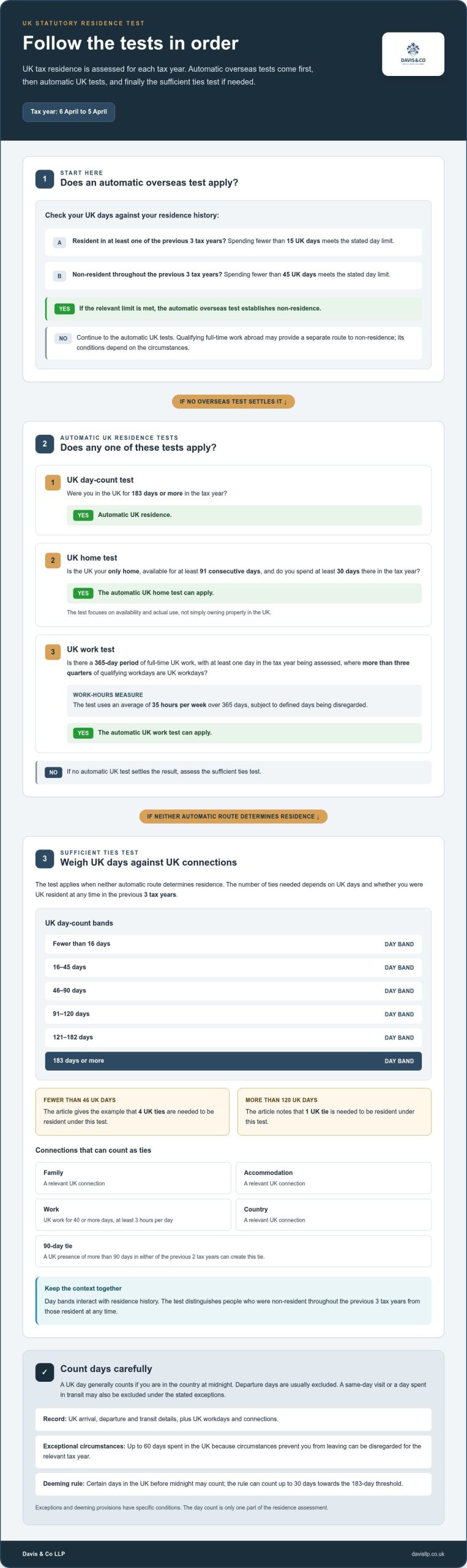
The statutory residence test determines an individual’s UK residence status for each tax year. It has three parts: automatic overseas tests, automatic UK tests, and the sufficient ties test. They are considered in that order, so meeting an automatic test can settle the result without relying on ties. Under the UK tax residency rules for individuals, the relevant tax year runs from 6 April to 5 April the following year.
The sufficient ties test applies when neither automatic route determines residence. It weighs UK connections alongside days spent here and residence history. Relevant ties include family, accommodation, work, and country ties, as well as a 90-day tie. According to HM Revenue & Customs, the UK work tie applies when a person works in the UK for 40 or more days in a tax year, for at least three hours per day. A person may have several ties, so work and a UK home can both affect the assessment.
The number of ties needed depends on UK days and whether the person was resident during the previous three tax years. For example, someone who spends fewer than 46 days in the UK needs four UK ties to be resident under this test. The residence table distinguishes people who were non-resident throughout those three prior tax years from those resident at any time. A 91-day presence in either of the previous two tax years can also create a tie. Understanding the UK tax residency rules for individuals therefore means considering both current connections and recent residence history.
Temporary non-residence rules can affect UK tax on some income and gains arising while a person is abroad, particularly when they return; the treatment depends on the income or asset and the circumstances. Scottish and other UK taxpayers use the same tax-year dates, 6 April to 5 April, and the statutory residence test assesses UK residence. HMRC’s residence status checker covers the current tax year and the previous six tax years. Tax residence can affect income tax, capital gains and inheritance tax, including under rules changed from April 2025.
Automatic UK residence tests
The automatic tests can establish UK residence or non-residence without weighing sufficient ties. Spending 183 or more days in the UK in a tax year is an automatic UK residence test, according to HM Revenue & Customs. The day threshold is one route, but the UK home and work tests can also determine status. An individual’s situation therefore depends on days, homes and work patterns, not domicile alone.
The automatic UK home test can apply if the UK is the individual’s only home, it is available for at least 91 consecutive days, and they spend at least 30 days there during the tax year. The stated home test also describes a home available for more than 90 days, with presence on at least 30 separate days. These conditions focus on access and actual use, not simply owning property in the country.
A UK work test can apply where someone works full-time in the UK over a 365-day period, with at least one day of that period falling in the tax year being assessed. More than three quarters of qualifying workdays in that period must be UK workdays. The work-hours test uses an average of 35 hours per week over 365 days, subject to defined days being disregarded. This makes work location and qualifying hours relevant even when UK visits are limited.
Automatic overseas tests can establish non-residence. A person resident in at least one of the preceding three tax years meets the stated day limit by spending fewer than 15 days in the UK; someone non-resident throughout those years meets it by spending fewer than 45 days. Qualifying full-time work abroad may provide a separate route to non-residence, depending on the circumstances. These tests can affect where income and gains are taxed. The applicable test depends on the facts and the person’s residence history.
Counting UK days and departure days
Under the statutory residence test, a UK day generally counts if you are in the country at midnight. Departure days are usually excluded, although specific exceptions apply. These details matter when applying the UK tax residency rules for individuals to visits close to a residence threshold.
Counting days spent in the UK
Under the midnight rule, a visit that begins and ends on the same day may not count as a UK day. A day spent in transit in the UK is also an exception to the usual rule. Departure days are generally excluded, but the statutory residence test’s deeming rule can treat certain days in the UK before midnight as UK days. Keep travel records showing arrival, departure and transit details, especially if you travel frequently between the UK and abroad. Clear records help you assess your day count.
Ties and day-count thresholds
The sufficient ties test assesses UK days alongside ties and residence history. Its day-count bands are fewer than 16, 16 to 45, 46 to 90, 91 to 120, 121 to 182, and 183 days or more. Someone who spends fewer than 46 days in the UK needs four ties to be resident under the test, while someone spending more than 120 days needs one tie. The UK tax residency rules for individuals therefore depend on how the day band interacts with personal connections.
The applicable threshold also depends on residence in the previous three tax years. The test distinguishes those who were non-resident throughout those years from people resident at any time. A 90-day tie applies if you were present in the UK for more than 90 days in either of the previous two tax years. Keep records of travel dates and UK connections together, so the day total and ties can be considered in context.
Exceptional circumstances can affect the calculation: up to 60 days spent in the UK because circumstances prevent you from leaving can be disregarded for the relevant tax year. A UK workday means working in the UK for more than three hours. The deeming rule can also count up to 30 days towards the 183-day threshold. These provisions have specific conditions, so they are not general exclusions for travel, work or time spent abroad.
Split-year treatment
If you move into or out of the UK part-way through a tax year, split-year treatment may be relevant. Rather than treating the whole tax year as one continuous period of residence, the rules may divide it into a UK-resident part and an overseas part. The move alone does not determine the outcome: the relevant conditions and your circumstances matter.
For someone leaving the UK, the overseas full-time work test describes working abroad for an average of at least 35 hours a week and spending fewer than 91 days in the UK during the tax year. These conditions illustrate why travel records and work arrangements matter alongside the departure date. A move abroad does not, by itself, establish that split-year treatment applies or determine how income and gains are treated.
If you arrive in the UK, the relevant question is how the Statutory Residence Test applies to your circumstances across the tax year. When a UK home becomes available, time spent in the country and work arrangements can all form part of the residence assessment. Keep travel, employment and move-date records together so each period can be assessed against the relevant tests. How income and gains are treated can depend on whether an item relates to the UK or overseas part.
A double tax treaty may also be relevant if both the UK and another country consider you resident. Treaty tie-breaker rules can determine which country treats you as resident for treaty purposes and help establish your tax exposure in each country. This is separate from split-year treatment, although both may apply to the same move. The relevant treaty and your circumstances shape the outcome, so assess residence under each country’s rules before considering treaty relief.
For a move involving overseas work or residence in two countries, discuss your cross-border tax position as part of reviewing the relevant tax-year facts.
Davis & Co LLP: International Tax Planning
Davis & Co LLP provides International Tax Planning for individuals whose work, income or personal arrangements span the UK and other countries. The service can help you consider how your residence position interacts with overseas income and cross-border tax obligations, particularly when moving to or from the UK or managing interests in more than one country.
Personal Tax Services may also be relevant when UK residence affects your wider tax affairs. The analysis depends on your travel, work, home and family circumstances, as well as the tax years involved. Bringing these details together can help clarify the practical implications of your residence position and support informed planning.
Contact Davis & Co LLP to discuss your international tax planning needs.
Make your next decision with clarity
Your residence position is most useful when it informs decisions about where you live, work and manage your financial affairs. Applying the UK tax residency rules for individuals carefully can help you plan for cross-border obligations and understand how a change in circumstances may affect your wider tax position.
Davis & Co LLP provides International Tax Planning for individuals with UK and overseas tax considerations. The firm also offers Business Growth Acceleration and Cash Flow Management to support broader financial and business planning where relevant. Each service meets different needs, so the next step should reflect your circumstances and priorities.
If you want to discuss how your residence position fits into your tax planning, contact Davis & Co LLP. A clear understanding of your position can help you move forward with greater confidence.
Davis & Co LLP can help with the tax decisions that follow
After assessing your UK tax residency position, Davis & Co LLP can help you understand the related tax considerations through International Tax Planning and Personal Tax Services.
Turn to Davis & Co LLP for support applying your residency position to your personal tax affairs or cross-border planning. If trusts, property or a business are also involved, the firm offers Trust Tax Services, Property Accounting and Business Growth Acceleration.
Frequently Asked Questions
What is tax residency?
Tax residency determines which country’s tax rules apply to a person. UK residents normally pay UK tax on income from the UK and abroad, while non-residents generally pay UK tax on UK income, not foreign income. Capital Gains Tax can involve separate considerations, including UK property or land. Residence status is distinct from nationality or citizenship.
How does the UK Statutory Residence Test determine tax residence?
The statutory residence test assesses each tax year using automatic overseas tests, automatic UK tests and, if needed, the sufficient ties test. The order matters: an automatic test can determine residence without assessing ties. For example, meeting an automatic overseas test means UK connections alone do not make someone UK-resident. Travel, work and residence history help establish which rules apply.
What are the automatic UK residence tests for individuals?
Spending 183 or more days in the UK in a tax year is an automatic UK residence test, according to HM Revenue & Customs. Other routes concern having a UK home that meets the availability and use conditions, or working full-time in the UK over a qualifying period. For the home test, the individual’s only home and actual presence there are relevant.
What are the automatic overseas tests under the UK Statutory Residence Test?
Automatic overseas tests can establish non-residence through limited UK presence or qualifying full-time work abroad. The day limit depends partly on residence during the preceding three tax years: fewer than 15 UK days applies to someone resident in at least one of them, while fewer than 45 applies to someone non-resident throughout. The overseas-work route also considers UK visits and UK workdays.
How does the sufficient ties test work, including day-count thresholds?
The sufficient ties test combines UK days with the individual’s ties and recent residence history. Its day bands range from fewer than 16 days through 183 days or more, and the required number of ties changes across those bands. The number of ties needed depends on how many days the person spends in the UK and their residence history. Previous residence can change which table applies.
What counts as a UK tie: family, accommodation, work, and 90-day ties?
Relevant ties can include a UK-resident spouse or minor child, qualifying UK accommodation, UK work, and substantial presence in earlier years. Accommodation may count when available for 91 consecutive days and used for at least one night; a close relative’s home has a 16-night minimum. According to HM Revenue & Customs, the work tie applies at 40 or more UK workdays, for at least three hours per day. The 90-day tie reflects presence in either of the previous two tax years.