In the UK, the practical difference between a chartered and certified accountant lies chiefly in the professional body behind the designation. An ACCA member is a Chartered Certified Accountant, while an ICAEW member is a Chartered Accountant. The chartered vs certified accountant UK difference is therefore not a simple measure of one being better qualified than the other. There are no special licence requirements to practise accountancy, but these professional designations are linked to membership of recognised bodies.
When choosing support for a small business, it is understandable to focus on the title, but the letters after an accountant’s name are only part of the decision. Their qualifications, relevant experience and fit with your business’s needs matter too.
This guide explains what ACCA qualification means, how it differs from ICAEW membership, and what to consider when choosing an accountant for a UK small business. It also looks at how professional status relates to practical needs such as tax, VAT, payroll and financial reporting, helping you make a more informed choice.
Key Takeaways
- Use the professional letters after an accountant’s name to identify the awarding body and qualification route.
- ACCA membership involves exams, an Ethics and Professional Skills module, and practical experience.
- Match an accountant’s experience and services to your business’s needs, not just the title they use.
- Understand which UK accountancy body awards the designation you’re considering before making your choice.
What’s the Difference Between a Chartered Accountant and a Certified Accountant?
In the UK, the distinction chiefly reflects the professional body awarding the qualification. ACCA members are Chartered Certified Accountants; ICAEW members use the Chartered Accountant designation.
Chartered Accountant Membership
ICAEW membership leads to the ACA designation, meaning Associate Chartered Accountant; eligible members may use FCA, Fellow Chartered Accountant. ICAEW training requires at least three years with an authorised employer. ICAS members use CA, and Chartered Accountants Ireland is another professional body. To check an accountant’s membership, use the relevant institute’s directory; ICAEW provides its Find a Chartered Accountant directory. Membership also involves ethical and continuing professional development obligations.
Certified Accountant Qualification
The Association of Chartered Certified Accountants (ACCA) awards the Chartered Certified Accountant qualification. Candidates complete exams, an Ethics and Professional Skills module, and the Practical Experience Requirement to become members. ACCA candidates must pass fourteen exams, although exemptions may apply for prior qualifications. They have ten years to complete the exams and need three years of relevant work experience. Members may use FCCA after five years.
Accountancy Body Differences
ICAEW ACA, ICAS CA, Chartered Accountants Ireland and ACCA are distinct professional routes, not interchangeable titles. ACA identifies an ICAEW Associate Chartered Accountant; CA is the ICAS designation; ACCA members are Chartered Certified Accountants. Chartered Accountants Ireland is a separate body. The main distinction is the awarding organisation and qualification, not a simple ranking of competence.
| Route | Body | Designation |
|---|---|---|
| Chartered | ICAEW | ACA or FCA |
| Chartered | ICAS | CA |
| Chartered | Chartered Accountants Ireland | Chartered Accountant |
| Chartered Certified | ACCA | ACCA or FCCA |
Choose based on the qualification and experience relevant to the work you need, not the title alone.
These designations do not, by themselves, determine a fixed salary difference. Salaries depend on factors such as role, experience, employer and responsibilities.
ACCA and Chartered Certified Accountants
The Association of Chartered Certified Accountants (ACCA) awards the Chartered Certified Accountant qualification. It supports accounting and finance work across sectors, and ACCA can award qualifications worldwide. This international reach distinguishes its route from designations awarded by UK institutes, while the letters still identify a specific professional membership.
ACCA membership requires three elements: examinations, the Ethics and Professional Skills module, and the Practical Experience Requirement. Together, they assess technical knowledge, professional judgement and practical application. Prior qualifications may lead to exam exemptions, so candidates’ routes can differ. Exemptions do not remove the need to complete the other membership requirements.
Members use ACCA after their names; eligible members may later use FCCA. These post-nominals identify professional status, not a separate type of firm or authority to perform every kind of work. The difference between ACCA and another association of chartered accountants lies partly in the awarding body and partly in its membership and practice rules.
Those rules matter when members serve the public. In the UK, ACCA members undertaking public practice engagements must hold a practising certificate, carry liability insurance and submit to inspections. These requirements apply to public practice, not every finance role held by an ACCA member. The work being undertaken, regardless of title, is central to which practice rules apply.
ACCA members may work in England and internationally, but location alone does not establish what work they may undertake. For example, audit work requires the necessary additional qualifications. The ACCA designation reflects a defined professional route; authority to undertake a particular engagement depends on relevant credentials and practice requirements.
For a business considering external scrutiny, understanding its reporting obligations alongside audit requirements can help clarify the support the engagement calls for.
Choosing an accountant for a UK small business
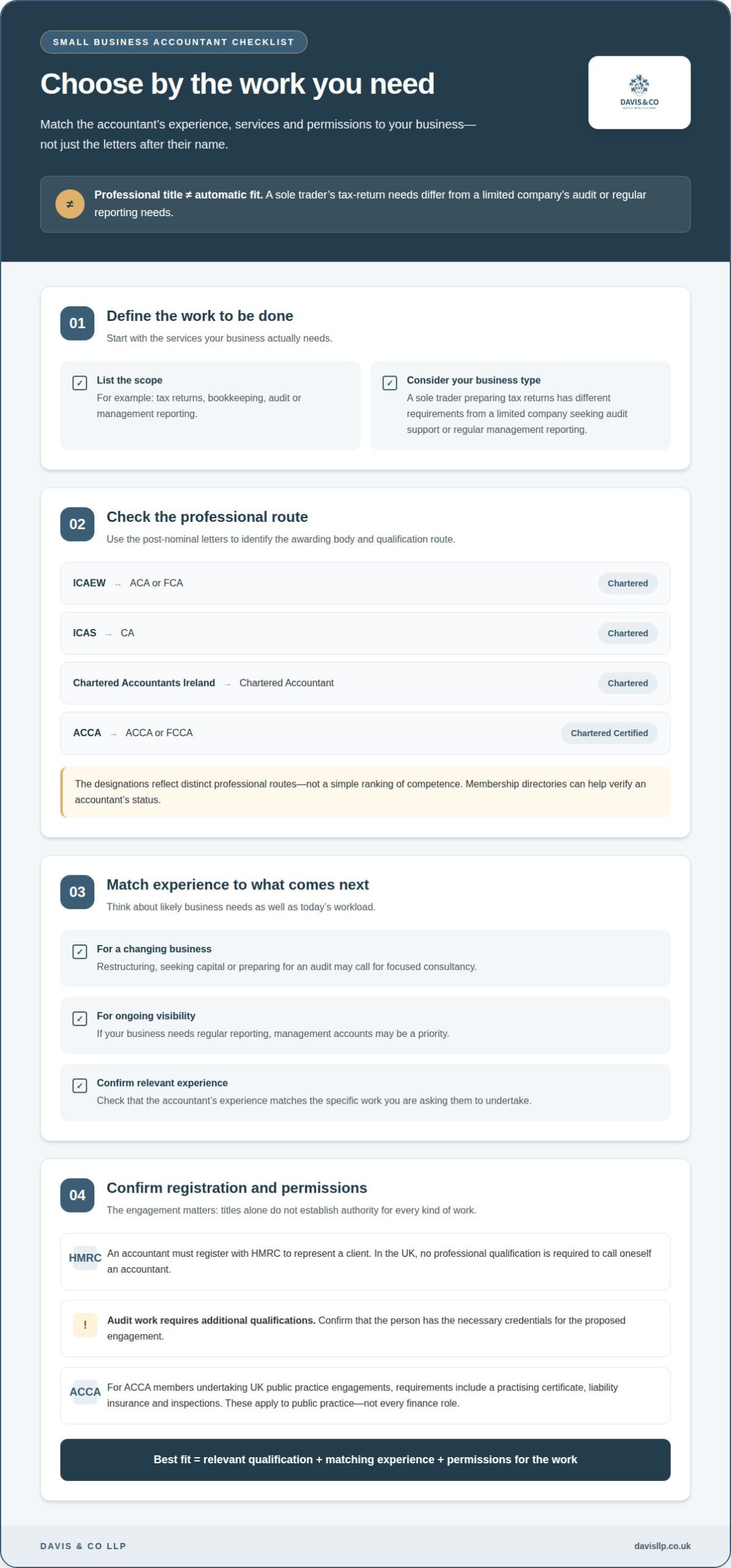
Start with the work your business needs, not the title alone. A sole trader preparing tax returns has different requirements from a limited company seeking audit support or regular management reporting. In the UK, no professional qualification is required to call oneself an accountant, but an accountant must register with HMRC to represent a client.
Next, match the accountant’s qualifications to the work. Membership of an institute such as ICAEW, ACCA or CIMA indicates a professional route; the letters after a name identify the relevant body. Chartered Accountant and Chartered Certified Accountant are protected designations, while the general word “accountant” is not. For accountants in England, that distinction helps separate professional membership from a general job title.
Consider the needs that may arise as the business develops. A company planning a restructuring, seeking capital or preparing for an audit may need focused consultancy. A business with regular reporting needs may instead prioritise management accounts. If an engagement involves audit, the accountant must have the necessary additional qualifications. Confirming that the proposed work matches their experience is more useful than choosing by title alone.
- Scope: Set out the work required, such as tax returns, bookkeeping, audit or management reporting.
- Membership: Use the ICAEW, ACCA or CIMA directory to check a named individual’s professional status.
- Representation: Establish whether the accountant can represent the business before HMRC.
These are practical checks, not a test of which designation sounds more senior. A qualified accountant may be better accepted by lenders and HMRC than an unqualified accountant, whose work may face limitations. Professional membership also brings ethical expectations and a route for complaints through the relevant body. Consider the business’s current needs, likely transactions and reporting responsibilities together before appointing an accountant.
Which UK accountancy body awards the certified accountant qualification?
The Association of Chartered Certified Accountants (ACCA) awards the Chartered Certified Accountant qualification. In the UK, “certified accountant” is not a separate designation awarded by ICAEW or ICAS. The protected title is “Chartered Certified Accountant”, and its use is tied to ACCA membership.
This distinction explains why the awarding body matters. A professional qualification identifies the route completed, while membership establishes the individual’s current relationship with that body. For example, an ACCA member uses the ACCA designation; an ICAEW member follows a different route and uses ICAEW designations. These titles are not interchangeable.
When choosing an accountant, consider the letters after the person’s name alongside the work required. ACCA’s qualification combines examinations, an Ethics and Professional Skills module, and practical experience. Prior qualifications may lead to exam exemptions. The route reflects both assessed knowledge and applied experience, rather than a title chosen by the individual.
Membership does not, by itself, mean an accountant can undertake every regulated engagement. ACCA members carrying out public practice engagements must meet additional requirements, including holding a practising certificate, carrying liability insurance and submitting to inspections. Audit work also requires the necessary additional qualifications. If commissioning an audit, distinguish general accountancy support from a specifically authorised audit engagement.
Use these practical steps to interpret a designation:
- Identify the awarding body named by the post-nominals.
- Match that body to the qualification, such as ACCA’s Chartered Certified Accountant title.
- Consider whether the proposed engagement involves public practice or audit requirements.
These distinctions clarify the chartered vs certified accountant UK difference: the awarding body and designation matter, but the engagement’s requirements matter too. If your organisation needs audit support, discuss audit and assurance in the context of its reporting needs.
Davis & Co LLP
Davis & Co LLP is a firm of Chartered Certified Accountants. We can help you connect your choice of accountant with the financial priorities of your business or personal affairs. The right support depends on the work involved, whether you are planning across borders, managing cash flow or assessing opportunities for business growth.
Our services include International Tax Planning, Business Growth Acceleration, Cash Flow Management and Personal Tax Services. Each addresses a different need, from considering international tax to improving visibility over business finances or handling personal tax matters. Start with the decision or challenge you need help with, rather than the title alone.
To discuss how our accountancy and tax services could fit your circumstances, contact Davis & Co LLP.
Make your next accounting decision with clarity
An accountant’s value lies in how well their work supports your next business decision. Before appointing someone, define the issue you need addressed, the information you can provide and the guidance that would help you act. This makes the chartered vs certified accountant UK difference part of a practical assessment, rather than the sole basis for your choice.
Your priorities may change as your business develops. A decision about expansion, cash reserves or tax planning can call for a different perspective from routine financial administration. Keep the conversation focused on your objectives, the advice you need and how it connects with your wider plans.
Davis & Co LLP can discuss the financial considerations relevant to your circumstances and help you identify an appropriate next step. Contact Davis & Co LLP today to begin that conversation and move forward with a clearer view of your options.
Frequently Asked Questions
How can I choose which type of accountant is right for me?
Choose based on the work you need completed, the accountant’s relevant experience and their professional membership. For example, a company preparing for an audit needs someone with the appropriate audit qualifications, while a business seeking routine financial oversight may prioritise management reporting. Identify your immediate requirements first, then consider whether the accountant’s background and professional status fit those responsibilities.
What does chartered accountant mean in the UK?
In the UK, “Chartered Accountant” describes a professional designation linked to membership of a recognised chartered accountancy body. The letters after a member’s name help identify their route, such as ACA or FCA for ICAEW members, or CA for ICAS members. The title signals professional membership, but the work an accountant can undertake may also depend on additional qualifications.
What does certified accountant mean in the UK?
In ordinary UK usage, “certified accountant” often refers to an ACCA-qualified member, whose formal designation is Chartered Certified Accountant. The distinction matters because “certified accountant” alone is not the protected title. ACCA after someone’s name identifies their professional body; FCCA is a fellowship designation available to eligible members after the required period.
Which UK accountancy bodies award chartered qualifications?
Chartered accountancy qualifications are associated with bodies including ICAEW, ICAS and Chartered Accountants Ireland. ACCA awards the distinct Chartered Certified Accountant qualification. These bodies use different post-nominals and qualification routes, so a designation such as ACA, CA or ACCA identifies the relevant professional organisation. For a specific engagement, the qualification must also match the work required.
What qualifications and exams are required to become a chartered accountant in the UK?
Requirements depend on the awarding body. For ICAEW’s ACA route, candidates complete professional examinations and at least three years of structured training with an authorised employer. The examinations cover areas including financial reporting, audit, tax, business strategy and ethics. ICAS and Chartered Accountants Ireland have their own qualification pathways, so candidates follow the requirements set by their chosen institute.
What qualifications and exams are required to become a certified accountant in the UK?
To become an ACCA member, candidates complete examinations, the Ethics and Professional Skills module, and the Practical Experience Requirement. The ACCA route includes fourteen exams, although prior qualifications may qualify candidates for exemptions. Practical experience is a separate membership requirement, so passing exams alone does not complete the qualification. The exact study route can therefore vary with a candidate’s earlier education.