The remittance basis is no longer available for current UK tax years: it was abolished from 6 April 2025. Before that change, eligible UK residents could use it to defer UK tax on foreign income and gains until they were brought to or used in the UK. The remittance basis of taxation, explained in that historical context, still matters when reviewing earlier tax years and funds brought to the UK now.
It’s understandable to focus on whether foreign income was transferred here, but eligibility, residence history and the way money was used could all affect the tax position. This guide explains who could claim the basis, how claims were made through Self Assessment, and how deemed UK domicile affected eligibility. It also sets out the broad treatment that replaced the remittance basis from 6 April 2025, so you can distinguish the rules for past years from those applying now.
Key Takeaways
- Assess deemed UK domicile using the relevant tax year and residence history, as it could prevent a claim under the former rules.
- Distinguish foreign income and gains kept overseas from amounts brought to or used in the UK when reviewing past tax exposure.
- For a historical claim, understand how the Self Assessment return recorded residence status, foreign income and remittances.
- International Tax Planning and Personal Tax Services can help clarify how past remittances and current cross-border income affect your UK tax position.
Deemed UK domicile
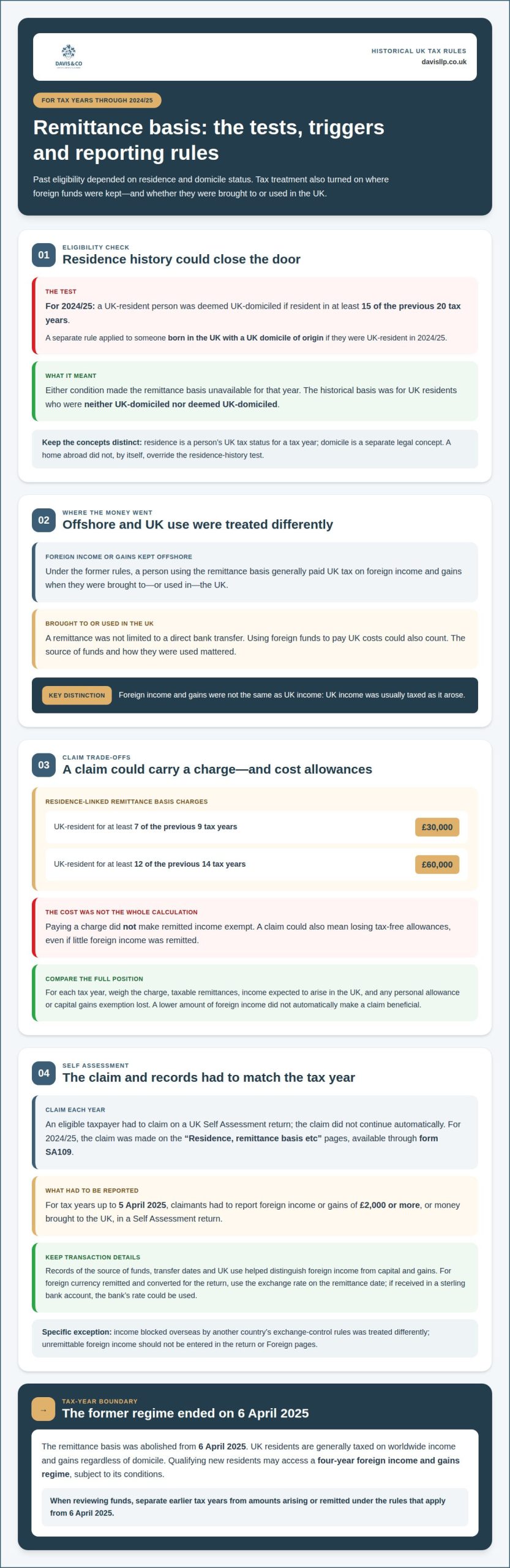
For the 2024 to 2025 tax year, deemed UK domicile could remove a person’s eligibility for the remittance basis. A person was deemed domiciled if UK-resident that year and resident in at least 15 of the previous 20 tax years. A separate rule applied to someone born in the UK with a UK domicile of origin, if they were UK-resident in 2024 to 2025. Either condition meant the remittance basis was unavailable.
These tests sat within a wider historical rule: for tax years up to and including 2024/25, the basis was available only to UK-resident people who were neither UK-domiciled nor deemed UK-domiciled. From 2017/18 to 2024/25, a UK-resident person who was not UK-domiciled could nevertheless become deemed domiciled when the applicable conditions were met. Residence history therefore mattered alongside a person’s domicile status, and the relevant assessment was tax-year specific.
Domicile and residence describe different connections. Residence concerns a person’s UK tax status for a particular tax year. Domicile is a separate legal concept, historically relevant to whether someone could access the remittance basis. A permanent home outside the UK did not, by itself, establish that a person was not UK-domiciled or deemed domiciled. For example, owning or occupying a home abroad would not displace the 15-of-20-year test.
This distinction matters when reviewing past income and capital gains. Someone may have considered themselves non-domiciled because their permanent home was overseas, yet still have met a deemed-domicile condition through UK residence. In that case, the arising basis applied instead of the remittance basis, subject to the rules for that tax year.
The remittance basis was abolished from 6 April 2025. The deemed-domicile tests above therefore concern historical claims through 2024/25; from 6 April 2025, the new residence-based regime applies regardless of domicile. Separating the tax years is a useful first step when assessing foreign income, gains, or a remittance made after the change.
What does Remittance basis mean?
Under the former UK rules, the remittance basis determined when foreign income and gains became taxable. A UK-resident person using it generally paid UK tax on foreign income or gains only when they were brought to, or used in, the UK. Income and gains kept offshore were treated differently from UK income, which was usually taxed as it arose. Bringing money into the UK was not the only possible trigger: using foreign funds to pay UK costs could also count as a remittance.
The charge was separate from tax due on remittances and UK income or gains. According to HM Revenue & Customs, a non-domiciled claimant who has been UK-resident for at least seven of the previous nine tax years must pay a minimum annual remittance basis charge of £30,000. HM Revenue & Customs states that a non-domiciled claimant who has been UK-resident for at least twelve of the previous fourteen tax years pays a £60,000 remittance basis charge. These thresholds measured residence history; paying a charge did not make remitted income exempt. The amount could affect whether claiming relief was worthwhile, especially when foreign income remained offshore.
For tax years up to and including 2024/25, an eligible person could choose between the arising basis and the remittance basis for each tax year. A claim could mean losing tax-free allowances, even if the person remitted little foreign income. The decision therefore involved weighing the charge, taxable remittances, income expected to arise in the UK, and any personal allowance or capital gains exemption lost. A lower amount of foreign income did not automatically make a claim beneficial.
The remittance basis of taxation explained in this historical context ended when the UK abolished the regime from 6 April 2025. UK residents are generally taxed on worldwide income and gains, regardless of domicile, but qualifying new residents may access a four-year foreign income and gains regime. This provides relief on eligible foreign income and gains during the qualifying period, subject to the regime’s conditions. The change means historic remittances and current foreign income may fall under different rules, so the tax year and the nature of each amount matter.
For anyone reviewing a past return, having the remittance basis of taxation explained alongside the relevant transactions can clarify how funds were treated. For example, a transfer from an overseas account needs to be considered in light of its source and how it was used in the UK.
Claiming the remittance basis through Self Assessment
Under the former rules, an eligible taxpayer had to claim the remittance basis on a UK Self Assessment return each year. It did not continue automatically from one tax year to the next. For 2024 to 2025, the claim was made on the ‘Residence, remittance basis etc’ pages, available through form SA109. That return connected residence status with the treatment of foreign income and gains.
Reporting also depended on what arose overseas and what came to the UK. For tax years up to 5 April 2025, UK residents claiming the basis had to report foreign income or gains of £2,000 or more, or money brought to the UK, in a Self Assessment return. A remittance could involve more than a direct bank transfer. Records showing the source of funds, transfer dates and UK use helped distinguish foreign income from capital and gains.
Currency conversion was another practical consideration. If foreign currency was remitted and converted for the return, the exchange rate on the remittance date was used. If the amount was received in a sterling bank account, the bank’s rate could be used. Income blocked overseas by another country’s exchange-control rules was treated differently: unremittable foreign income should not be entered in the return or Foreign pages.
An incorrect claim could lead to foreign income, capital gains or a remittance being reported inaccurately, affecting the income tax assessment. The practical risk is an incorrect return and tax calculation. A penalty cannot be determined from the claim alone, because the relevant circumstances matter.
When reviewing a historical return, check whether the person qualified for that tax year, made the claim correctly and reported the relevant overseas amounts. A transfer from a foreign bank account may need to be traced to its underlying source, particularly where income, capital and gains are mixed. Clear transaction records support the return’s treatment and make later amendments easier to assess.
Remittance basis eligibility and taxation
For tax years up to and including 2024/25, UK-resident individuals could use the remittance basis only if they were not UK-domiciled or deemed UK-domiciled. A person with unremitted foreign income and gains below £2,000 could qualify for automatic application, subject to the rules. Above that amount, a claim was generally needed unless another automatic condition applied. Eligibility therefore depended on residence, domicile status, the amount left overseas and the tax year concerned.
Choosing the basis affected allowances as well as foreign income or gains brought to the UK. For the tax year in which an individual claimed, the personal allowance was lost, as was the capital gains annual exempt amount. Under the figures applying at 17 March 2025, those allowances were £12,570 and £3,000 respectively. This could make the arising basis more favourable where a person had limited foreign income or expected to use those allowances.
The tax treatment of remitted foreign income depended on the taxpayer’s circumstances. The rate was 45% for taxpayers with taxable incomes exceeding £125,140. In 2024 to 2025, remitted foreign company dividends were taxed at the normal UK Income Tax rates of 20%, 40% and 45%, rather than special dividend rates. Foreign gains were subject to UK Capital Gains Tax when remitted; the applicable treatment depended on the type of gain and the person’s circumstances.
The remittance basis was abolished from 6 April 2025. UK residents are now generally taxed on worldwide income and gains, regardless of domicile, while qualifying new residents may claim relief under the four-year foreign income and gains regime. Past tax years still require separate analysis: income arising overseas, gains realised, amounts brought to the UK and any claim made can each affect the result.
A review of historic returns can clarify how eligibility, allowances and remittances interact. Arrange a review of your UK tax position before relying on a past-year treatment.
Davis & Co LLP
Davis & Co LLP helps individuals make sense of cross-border tax questions through International Tax Planning and Personal Tax Services. This support may be useful when reviewing historic remittance basis claims, assessing foreign income brought to the UK, or understanding how the rules changed from 6 April 2025.
Tax outcomes depend on the relevant tax year, residence history, income and gains, and how funds were used. A careful review can bring these factors together, clarify reporting implications and inform decisions about your current UK tax position.
For advice tailored to your circumstances, contact Davis & Co LLP.
Make your next tax decision with clarity
Having the remittance basis of taxation explained clearly can help distinguish historical reporting questions from decisions about your current financial arrangements. Consider how overseas income, assets and business plans fit together, rather than treating each tax return or transaction in isolation.
Davis & Co LLP’s International Tax Planning and Personal Tax Services can support individuals reviewing cross-border tax matters. For business owners, Business Growth Acceleration and Cash Flow Management can also connect tax considerations with wider commercial planning. The right focus depends on your circumstances and the decisions ahead.
If you would like to discuss your position and consider a practical way forward, contact Davis & Co LLP. A considered conversation can help you approach the next decision with greater confidence.
Davis & Co LLP and your international tax planning
Davis & Co LLP provides International Tax Planning and Personal Tax Services. If the remittance basis may affect your tax position, the firm can help you consider how it fits with your wider personal tax affairs.
For related needs, Davis & Co LLP also offers Trust Tax Services, Property Accounting and Business Growth Acceleration. The firm can help connect an international tax question with these services.
Frequently Asked Questions
What is the remittance basis of taxation in the UK?
The remittance basis was a former UK tax treatment for certain UK-resident individuals with foreign income or gains. Rather than taxing eligible overseas amounts as they arose, the rules generally linked UK tax to whether those amounts were brought to or used in the UK. For example, leaving foreign investment income offshore could produce a different UK tax result from using it to pay a UK expense.
Who could claim the UK remittance basis, and what were the eligibility rules?
For tax years up to and including 2024/25, a UK resident could use the basis only if not UK-domiciled or deemed UK-domiciled. Residence history and domicile status both mattered; a person’s overseas permanent home alone did not establish eligibility. Certain automatic rules also applied, including where unremitted foreign income and gains were below £2,000. A split-year assessment could affect which overseas amounts counted against that threshold.
How was the remittance basis claimed on a UK Self Assessment tax return?
An eligible individual claimed it through the relevant year’s Self Assessment return. For 2024 to 2025, the claim appeared on the ‘Residence, remittance basis etc’ pages, available through form SA109. The return needed to reflect the person’s residence and foreign income or gains position for that particular tax year. For example, foreign rental income and proceeds from an overseas asset sale may need separate treatment.
What counted as a remittance of foreign income or gains to the UK?
A remittance could arise when foreign income or gains reached the UK directly, or indirectly, so the taxpayer or a relevant person benefited here. Paying a UK bill with a foreign credit card could count, as could using overseas income to buy goods or services in the UK. A relevant person included the taxpayer’s children or grandchildren under 18, including those of a spouse or civil partner.
What was the remittance basis charge, and when did it apply?
It was a charge that could apply to certain non-domiciled claimants, in addition to tax on UK income and gains and taxable remittances. According to HM Revenue & Customs, a claimant resident for at least seven of the previous nine tax years faced a minimum annual charge of £30,000; at least twelve of the previous fourteen tax years brought a £60,000 charge. These rules concerned tax years up to and including 2024/25.
What were the rules for mixed funds, offshore accounts and bringing money to the UK?
A mixed fund combines different sources, such as foreign income, capital gains and clean capital, in one account. Keeping these categories in separate offshore bank accounts can make later transfers easier to trace. A recommended arrangement used three accounts, one for each category. The UK cleansing facility for separating mixed funds was available only from 6 April 2017 until 5 April 2019, so it cannot be used for later transfers.