The era of the “passive” UK landlord has effectively concluded, replaced by a mandate for rigorous, active tax management. As we enter 2026, the mandatory implementation of Making Tax Digital (MTD) for those with property income over £50,000 represents a fundamental shift in how your records must be maintained and reported. Securing specialist buy to let tax advice uk is no longer merely a recommendation; it’s a vital component of a resilient investment strategy in an increasingly scrutinized sector.
We recognize that the continued restriction of mortgage interest relief and the upcoming introduction of separate, higher tax rates on property income in 2027 have created significant pressure on portfolio profitability. This guide provides the expert insights you need to navigate these complexities, offering a structured approach to income tax, limited company transitions, and capital gains planning. We’ll examine the immediate implications of the 2026/27 tax year and provide a clear framework for choosing the ownership structure that best serves your long-term commercial objectives.
Key Takeaways
- Understand the mandatory Making Tax Digital (MTD) requirements taking effect in April 2026 for landlords with gross annual incomes exceeding £50,000.
- Evaluate the structural advantages of utilizing limited company SPVs to reclaim full relief on finance costs compared to personal ownership.
- Discover how bespoke buy to let tax advice uk helps you accurately distinguish between revenue expenses and capital improvements to optimize your tax position.
- Navigate the 60-day Capital Gains Tax reporting window and prepare for the upcoming transition to higher property income tax rates in 2027.
- Transition from reactive bookkeeping to a strategic financial framework that protects your property portfolio from increased HMRC scrutiny and regulatory shifts.
The Shifting Landscape of UK Buy to Let Taxation in 2026
The UK property market has entered a period of profound transition. For decades, buy-to-let was seen as a relatively straightforward path to wealth accumulation. That simplicity has vanished. Today, landlords face a dense thicket of regulations that demand a high level of technical proficiency and foresight. Understanding the broader UK tax system is the first step toward realizing that property investment is no longer a passive endeavour. It’s a sophisticated business that requires disciplined strategic oversight. Seeking tailored buy to let tax advice uk is the only way to ensure that compliance doesn’t come at the cost of your long-term yield. We believe that the distinction between simply filing a return and optimizing a tax position is where the future of your portfolio is decided.
The Impact of Section 24 and Finance Cost Restrictions
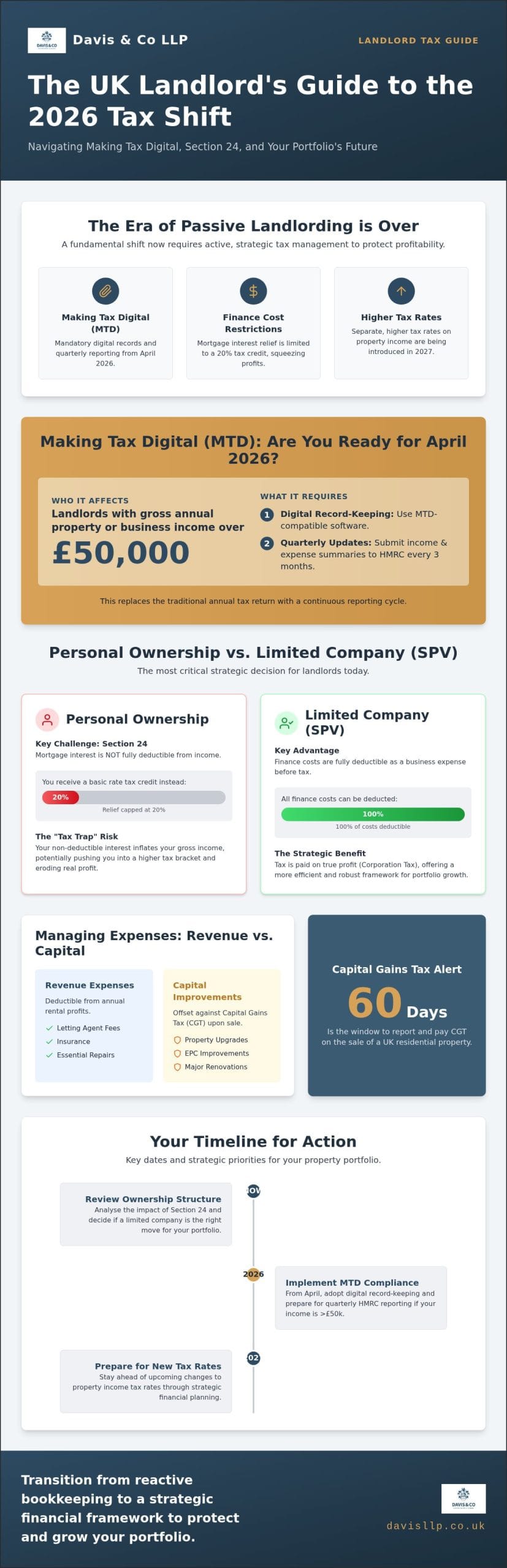
The restriction of finance cost relief remains the most significant hurdle for individual landlords. Instead of deducting mortgage interest from your rental income before tax is calculated, you receive a 20% tax credit. This change has a disproportionate effect on higher and additional rate taxpayers. If your financing costs are high, you might find yourself in a “tax trap.” Your gross income, inflated by the inability to deduct interest, can push you into a higher tax bracket even if your actual profit has remained static or decreased. We’ve seen many cases where this leads to an effective tax rate that consumes nearly all of the actual cash profit. It’s a mathematical reality that forces a total reassessment of personal ownership models.
Regulatory Hurdles: From EPC Standards to Tenant Rights
Non-tax regulations are increasingly bleeding into financial planning. Proposed upgrades to Energy Performance Certificate (EPC) standards represent significant capital expenditure. While some of these costs might be deductible, the timing and classification of these works are critical for tax efficiency. Simultaneously, the removal of fixed-term tenancies and changes to eviction processes introduce new operational risks. These shifts make 2026 a pivotal year for every serious investor. You must decide whether your current ownership structure can withstand these pressures or if a more robust corporate framework is required. Transitioning from basic compliance to strategic optimization is the only way to maintain a sustainable portfolio in this climate. Obtaining professional buy to let tax advice uk allows you to transform these regulatory hurdles into planned, tax-efficient capital investments.
Managing Rental Income: Allowable Expenses and MTD Compliance
Effective management of rental income requires a precise understanding of the boundary between revenue expenditure and capital improvements. While revenue expenses, such as letting agents’ fees, insurance, and essential repairs, are deductible from your annual rental profits, capital costs are treated differently. These costs, which involve improving a property beyond its original state, are generally preserved to offset your eventual liability for Capital Gains Tax on property. For landlords seeking expert buy to let tax advice uk, the strategic timing of these repairs is essential. Accelerating or deferring works can help manage your taxable income, potentially keeping you below the threshold for higher tax bands.
Meticulous record-keeping is the bedrock of this strategy. For those with modest rental activities, the £1,000 statutory property allowance offers a simplified alternative to claiming individual expenses. However, for most professional portfolios, the aggregate of actual allowable expenses far exceeds this figure, making detailed accounting the more tax-efficient choice. Maintaining a clear audit trail isn’t just about compliance; it’s about ensuring every pound of legitimate expenditure is working to reduce your tax liability.
Making Tax Digital for Income Tax (MTD ITSA) in 2026
From 6 April 2026, the administrative burden for landlords will increase significantly. Those with a gross annual property or business income over £50,000 must comply with MTD ITSA. This transition marks the end of the traditional annual tax return, replaced by a requirement for digital record-keeping and quarterly summary updates to HMRC. It’s a fundamental shift in how property businesses operate. At Davis & Co LLP, we provide bespoke property accounting services that ensure your digital systems are fully compliant; we don’t let administrative changes disrupt your focus on portfolio growth.
Optimizing the Property Allowance and Joint Ownership
Strategic ownership structures often provide the most effective route to tax efficiency. When a property is held jointly by spouses or civil partners, the default position is a 50/50 split of income. However, if the actual beneficial interest is different, filing a Form 17 with HMRC can align your tax liability with your actual ownership percentages. This is particularly useful when one partner resides in a lower tax bracket. Providing tailored buy to let tax advice uk allows us to identify these opportunities before they become missed savings, ensuring your household’s personal allowances are utilized to their fullest potential.
Personal Ownership vs. Limited Company SPVs: A Strategic Analysis
The structural decision between personal ownership and a limited company Special Purpose Vehicle (SPV) is perhaps the most critical choice a landlord faces in 2026. While personal ownership offers simplicity, the limited company structure provides a shield against the finance cost restrictions that currently erode individual margins. Within a company, you can deduct 100% of your mortgage interest as a business expense. This contrasts sharply with the 20% tax credit available to individuals. Seeking comprehensive buy to let tax advice uk is vital because the benefits of incorporation depend entirely on your individual tax bracket and long-term goals. It’s a complex shift. You’ll face corporation tax rates ranging from 19% to 25%, but for many, the ability to manage taxable profits more granularly outweighs the administrative burden.
The Mechanics of Incorporating an Existing Portfolio
Moving an established portfolio into a company isn’t as simple as changing a name on a deed. HMRC views this as a sale at market value, which can trigger significant Capital Gains Tax (CGT) and Stamp Duty Land Tax (SDLT) liabilities. However, Incorporation Relief under Section 162 can mitigate the CGT burden if the portfolio is managed as a substantive business. We’ve helped many clients navigate this transition, but we always emphasize that it’s not a one-size-fits-all solution. The upfront costs of refinancing and legal fees must be weighed against the multi-year tax savings. A limited company is a strategic tool, not a universal remedy.
Profit Extraction and Double Taxation Risks
The most common objection to incorporation is the perceived “double taxation” of profits. You pay corporation tax on company earnings, then personal tax on the money you take out. For 2026, dividend tax rates stand at 10.75% for basic rate taxpayers and rise to 39.35% for those in the additional rate band. The true power of a company lies in profit retention. By keeping funds within the SPV, you can reinvest in new properties using gross profits rather than income that has already been taxed at 40% or 45%. Furthermore, director loan accounts offer a strategic route to withdraw your original capital investment tax-free. This level of planning requires the kind of specialized buy to let tax advice uk that treats your portfolio as a dynamic commercial entity rather than a static asset.
Capital Gains and Inheritance Tax: Planning Your Exit Strategy
For many landlords, the final assessment of a portfolio’s success occurs at the point of divestment. In the 2026/27 tax year, Capital Gains Tax (CGT) on residential property stands at 18% for basic rate taxpayers and 24% for those in higher bands. With the annual exempt amount set at £3,000, the scope for tax-free gains is narrower than in previous decades. You must report and pay any CGT due within 60 days of completion. HMRC’s penalties for late filing are rigorous; we’ve seen how administrative oversights can quickly erode the net proceeds of a sale. Specialist buy to let tax advice uk ensures that every available loss is carried forward and every legitimate cost of acquisition and improvement is deducted to protect your capital.
Inheritance Tax and the Family Investment Company
Property remains a challenging asset for inheritance tax (IHT) due to its illiquid nature and the 40% tax rate on estates exceeding the nil-rate bands. Family Investment Companies (FICs) have emerged as a sophisticated alternative to traditional trusts for multi-generational planning. By using different share classes, you can transfer the value of future growth to your heirs while maintaining control over the assets. Our Trust Tax Services provide the structural precision required to protect family wealth from unnecessary exposure and ensure a seamless transition of property interests.
The International Landlord: Non-Resident CGT
Non-resident landlords face a distinct set of challenges that are often overlooked in generic financial guides. If you reside outside the UK, you’re still liable for CGT on the sale of UK residential interests, and you must report the disposal even if no tax is due. This requires careful navigation of Double Taxation Agreements (DTAs) to ensure you aren’t taxed twice on the same gain in different jurisdictions. Our expertise in International Tax Planning is essential for cross-border investors who need to reconcile UK obligations with their local tax residency. If you are considering a portfolio restructure or a full exit, consult with our senior tax partners to ensure your strategy is both compliant and commercially optimized.
Why Expert Buy to Let Tax Advice is Essential for Portfolio Growth
The transition from basic bookkeeping to strategic financial oversight is the defining characteristic of successful property investors in 2026. While some landlords still attempt a “DIY” approach to their filings, the increasing complexity of HMRC’s digital requirements and the shifting tax bands make this a high-risk strategy. Errors in reporting or missed opportunities for relief can lead to costly investigations and diminished yields. Professional buy to let tax advice uk provides more than just a shield against penalties; it offers a framework for sustainable growth. We believe that a property portfolio should be viewed as a central pillar of your broader financial identity, necessitating a partner who understands the intricate interplay between corporate structures and personal liabilities.
HMRC’s scrutiny of the private rental sector has never been more intense. With the implementation of Making Tax Digital, the window for correcting errors has narrowed, and the visibility of your financial data has increased. Relying on generic advice or outdated models often leads to the “tax traps” we’ve discussed in previous sections. A composed partnership with a dedicated specialist ensures that your portfolio remains a viable commercial entity rather than a mounting administrative burden. We provide the intellectual rigour required to transform compliance into a strategic advantage.
Bespoke Property Accounting and Advisory
Our approach to property accounting moves beyond the limitations of generic software. We provide bespoke management accounts that offer a clear, real-time view of your portfolio’s performance, allowing for informed decisions on acquisitions or disposals. This proactive oversight is essential when preparing for the legislative changes scheduled for 2027. By ensuring your Personal Tax Services are fully integrated with your property interests, we eliminate the friction often found between disparate financial records. This cohesion is the signature of a client-centric approach that prioritizes long-term stability over short-term compliance.
Securing Your Financial Future with Davis & Co LLP
Davis & Co LLP has served as a dependable constant for investors since 1901. In an environment defined by volatility and regulatory flux, our role as a trusted advisor is to provide the calm, reassuring authority needed to navigate complex restructures. We offer a level of intellectual rigour and discretion that is essential for managing sensitive commercial and personal matters. If you’re ready to move beyond reactive reporting toward a strategic partnership, we invite you to schedule a consultation. We’ll work together to ensure your portfolio is positioned for excellence, protecting both your current income and your future legacy. Securing high-calibre buy to let tax advice uk is the first step in ensuring your property business remains resilient for decades to come.
Securing Your Property Legacy in an Evolving Market
The UK’s property tax regime is no longer a landscape for the unassisted investor. With the arrival of Making Tax Digital in 2026 and the continued evolution of finance cost restrictions, the margin for error has narrowed significantly. We’ve explored how the strategic selection of an ownership structure and the meticulous management of allowable expenses can protect your yields. These technical adjustments are most effective when integrated into a comprehensive long-term plan that accounts for capital gains and inheritance tax obligations.
As Chartered Certified Accountants with over 120 years of expertise, Davis & Co LLP provides the composed, professional partnership required by high-net-worth investors. We specialize in complex property tax planning, ensuring your portfolio remains resilient against legislative shifts. Securing tailored buy to let tax advice uk is the most reliable way to transform these regulatory challenges into opportunities for structured growth. We invite you to Consult Davis & Co LLP for Strategic Property Tax Advice and begin a partnership defined by precision and discretion. Your portfolio deserves the clarity of expert oversight.
Frequently Asked Questions
Is buy to let still a tax-efficient investment in 2026?
Property investment remains viable but demands a shift toward corporate structures or lower-geared portfolios to maintain efficiency. With the introduction of higher property income tax rates in April 2027, the traditional individual model faces significant headwinds. Success now depends on seeking professional buy to let tax advice uk to align your holdings with these upcoming regulatory shifts. It’s about strategic positioning rather than passive holding.
Can I still claim mortgage interest as an expense on my buy to let?
Individual landlords cannot deduct mortgage interest from rental income before calculating tax. Instead, you receive a 20% tax credit on your finance costs. This often results in a higher effective tax rate for those in the 40% or 45% brackets. Conversely, properties held within a limited company allow for 100% of mortgage interest to be treated as a deductible business expense.
What are the benefits of setting up a limited company for my property portfolio?
Operating through a limited company SPV allows for the full deduction of mortgage interest and subjects profits to corporation tax rates of 19% to 25%. This is often more efficient than personal income tax rates. It also facilitates easier profit reinvestment and provides flexible options for succession planning. We find that for expanding portfolios, the corporate structure offers superior long-term stability and control.
How much Capital Gains Tax do I pay when I sell a buy to let property?
For the 2026/27 tax year, Capital Gains Tax on residential property is charged at 18% for basic rate taxpayers and 24% for higher or additional rate taxpayers. You can utilize an annual exempt amount of £3,000. It’s vital to remember that any tax due must be reported and paid to HMRC within 60 days of the sale’s completion to avoid penalties.
Do I need to register for Making Tax Digital (MTD) as a landlord?
You must comply with MTD for Income Tax from April 2026 if your gross annual income from property or self-employment exceeds £50,000. This requires you to keep digital records and submit quarterly updates to HMRC. The threshold will drop to £30,000 in April 2027. We assist our clients by implementing robust property accounting systems that ensure seamless compliance with these digital mandates.
How can I reduce Inheritance Tax on my property portfolio?
Reducing Inheritance Tax often involves utilizing Family Investment Companies (FICs) or specialized trust structures to move growth out of your personal estate. By gifting shares or using different share classes, you can retain control while gradually transferring value to the next generation. This area of buy to let tax advice uk is essential for protecting multi-generational wealth from the 40% IHT threshold.
What expenses are considered “allowable” for rental properties?
Allowable expenses include revenue costs necessary for the day-to-day running of the property, such as letting agent fees, buildings insurance, and essential repairs. You cannot claim for capital improvements that add value, like an extension. Distinguishing between a repair and an improvement is a common area of HMRC scrutiny; we ensure our clients’ records reflect this distinction accurately.
What are the tax implications for non-resident landlords in the UK?
Non-resident landlords are liable for UK tax on all rental income derived from UK properties, though you may apply to receive rent without tax deducted via the Non-resident Landlord Scheme. You’re also subject to UK Capital Gains Tax upon disposal. Navigating Double Taxation Agreements is critical to ensure you don’t pay tax twice on the same income in your country of residence.