Could your commitment to providing care inadvertently lead to an unforeseen tax liability or the loss of essential support due to the “overlapping benefits” rule? While the financial assistance provided by the state is vital, the intricate eligibility requirements often create more questions than they answer. We recognise that the pressure of meeting the strict earnings limit while providing at least 35 hours of care a week is a significant source of anxiety. This guide provides a definitive analysis of the carers allowance 2025 rates and criteria, ensuring you understand exactly how these payments integrate with your wider personal tax position.
You’ll gain a clear understanding of the 2025/2026 weekly rates and how the 35-hour rule applies to your specific circumstances. We also outline a pragmatic plan for managing your tax obligations if your total income exceeds the £12,570 Personal Allowance. From managing the earnings threshold to understanding statutory deductions, this overview ensures your financial arrangements are both compliant and secure.
Key Takeaways
- Understand the updated weekly payment rates for carers allowance 2025 and how this benefit serves as a foundational element of your financial support.
- Identify the core eligibility criteria, including the 35-hour care requirement and the specific qualifying benefits required for the person under your care.
- Navigate the complexities of the weekly earnings threshold and the ‘cliff edge’ implications to ensure your employment remains within statutory limits.
- Gain clarity on the ‘overlapping benefits’ rule and how it dictates your total income when receiving other state provisions or the State Pension.
- Learn how bespoke financial planning can help you manage multiple income streams and integrate your benefits into a broader, strategic tax position.
What is Carer’s Allowance and the 2025/2026 Landscape?
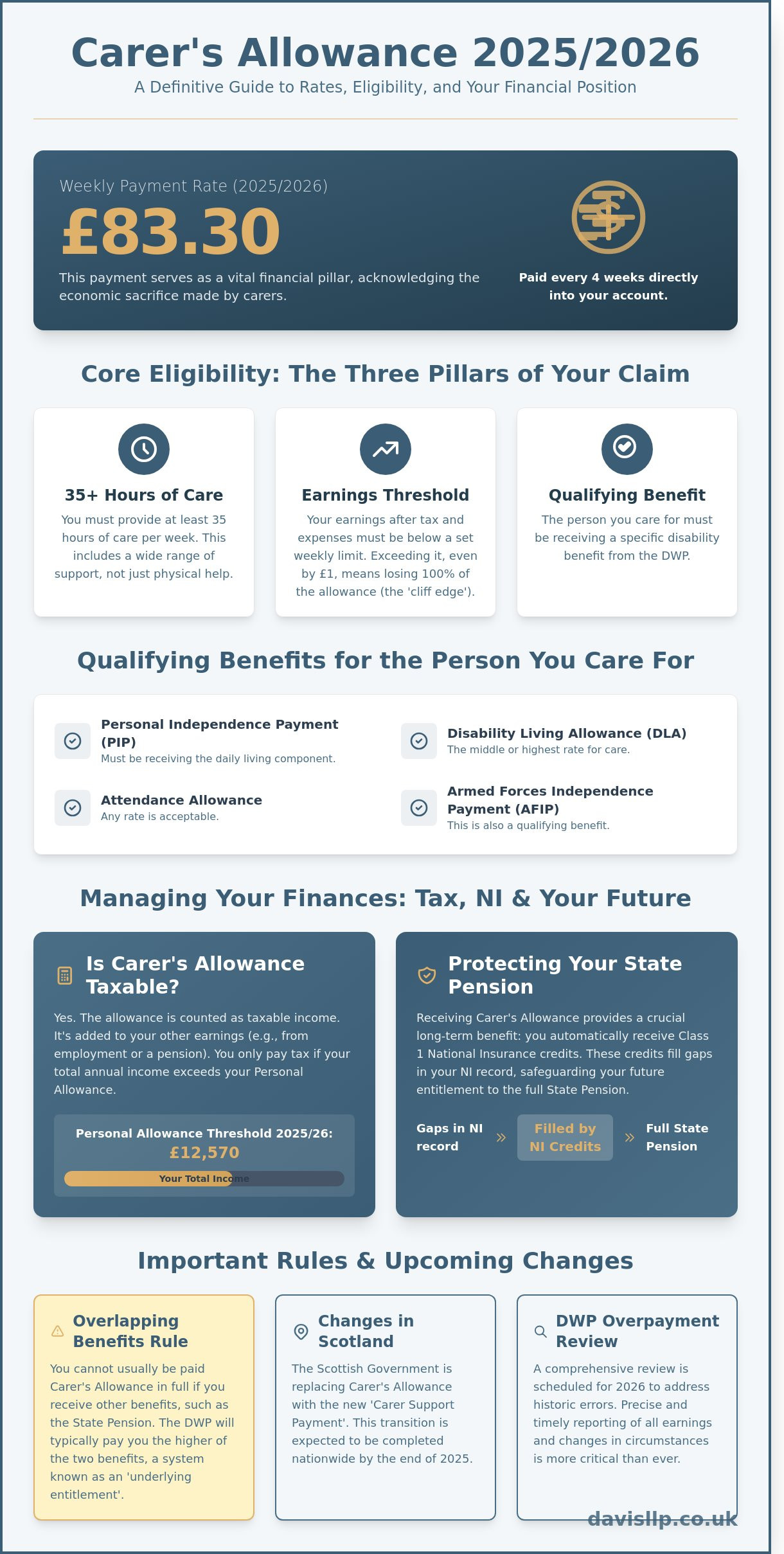
Carer’s Allowance stands as the principal statutory benefit for individuals providing substantial unpaid care within the United Kingdom. For the 2025/2026 tax year, the Department for Work and Pensions (DWP) has set the weekly rate at £83.30. This payment, typically transferred directly into a bank or building society account every four weeks, serves as a vital financial pillar. We recognise that while it isn’t a wage, it acknowledges the economic sacrifice made by those supporting vulnerable members of our society. Historically, Carer’s Allowance replaced the Invalid Care Allowance in 2003, evolving to meet the shifting demands of the British social security system.
Residents in Scotland should note that the Scottish Government is currently replacing this benefit with the Carer Support Payment. This transition is expected to complete nationwide by the end of 2025. Additionally, the DWP has announced a comprehensive overpayment review scheduled for 2026. This initiative aims to address historic administrative errors and ensure claimant compliance. Precise reporting of earnings is more critical than ever for the carers allowance 2025 cycle to avoid the risk of retrospective recovery actions.
The Core Purpose of the Benefit
Eligibility hinges on the provision of at least 35 hours of care per week. You don’t have to live with the person you care for, nor do you need to be a relative. However, the “one carer per person” rule is absolute. If two people care for the same individual, only one can claim the allowance. This prevents duplicate claims and ensures the allocation of funds remains sustainable. It’s a pragmatic framework designed to support those whose care duties limit their ability to maintain full-time employment.
National Insurance Credits and Future Security
Beyond the immediate cash injection, claiming the carers allowance 2025 provides essential long-term security. Recipients automatically receive Class 1 National Insurance credits. These credits are fundamental for those who’ve had to reduce their professional hours, as they protect your State Pension record. Without these contributions, carers might face a significant shortfall in their retirement income. We believe this dual benefit structure reflects a bespoke approach to safeguarding a carer’s financial future while they focus on their immediate responsibilities. This protection ensures that your commitment to care doesn’t result in personal financial detriment in later life.
Eligibility Criteria: Meeting the 35-Hour Requirement
To qualify for the carers allowance 2025, you must provide at least 35 hours of care per week to a person receiving specific disability benefits. This threshold is strict. We often find that clients underestimate the range of activities that constitute ‘care’ under Department for Work and Pensions (DWP) regulations. Meeting this requirement is the cornerstone of a successful claim; however, it’s only one part of a complex statutory framework.
Qualifying Benefits for the Cared-For Person
The individual you support must already be in receipt of certain state assistance. It’s not enough that they have a disability; they must have been formally assessed and awarded specific components of the following benefits:
- Personal Independence Payment (PIP): Specifically the daily living component.
- Disability Living Allowance (DLA): The middle or highest rate for care.
- Attendance Allowance: Any rate is acceptable.
- Armed Forces Independence Payment (AFIP): This is also a qualifying benefit.
If the person you care for is admitted to a hospital or a care home for more than 28 days, their benefit might be suspended. When their payments stop, your eligibility for the carers allowance 2025 also ceases. For the most current statutory details on these intersections, we recommend consulting the Official GOV.UK Carer’s Allowance guidance to ensure your specific circumstances align with the latest updates.
The 35-Hour Care Threshold in Practice
The 35-hour requirement doesn’t solely apply to direct physical assistance. It encompasses a broader spectrum of support. You can include time spent on household tasks such as laundry, cooking, and cleaning if they’re tailored to the person’s specific needs. Time spent managing their affairs or accompanying them to medical appointments also counts toward your weekly total.
The DWP doesn’t require a minute-by-minute diary as standard, but they may request evidence if they’ve reason to doubt your claim. We advise maintaining a simple log of activities. This creates a clear audit trail. It’s also vital to remember that you can’t “share” the 35 hours with another person. Only one individual can claim the allowance for caring for one person.
Age and residency rules also apply. You must be 16 or over and have lived in the UK for at least two of the last three years. Education presents a specific barrier. If you’re in full-time education for more than 21 hours a week, you aren’t eligible. This calculation includes both supervised study and individual research. For those balancing complex family duties with professional or academic aspirations, our team can provide bespoke advice on your legal standing regarding state support and private care arrangements.
The Earnings Limit and Taxation of Carer’s Allowance
The earnings limit represents a rigid boundary for claimants. For the 2025/26 tax year, the weekly earnings limit increases to £196, reflecting a sharp rise from the previous £151 threshold. This cap operates as a “cliff edge” rather than a sliding scale. If your net weekly earnings exceed this figure by as little as £1, you lose your entire entitlement to the benefit for that period. There’s no tapered withdrawal or partial payment. This binary structure demands precise financial monitoring to ensure you don’t inadvertently cross the line and forfeit your support. Understanding how the minimum wage 2025 thresholds interact with this earnings cap is particularly important for carers in part-time employment, as rising statutory pay rates can unexpectedly push net weekly earnings over the limit.
It’s vital to remember that Carer’s Allowance is a taxable benefit. While the Department for Work and Pensions (DWP) pays the benefit without deducting tax, the income is not exempt. It counts towards your total taxable income for the year. If your combined income from the allowance, part-time work, or private pensions exceeds the standard £12,570 Personal Allowance, you’ll owe tax on the excess. HMRC typically recovers this by adjusting your tax code, which reduces the take-home pay from your other employment. You can find the specific criteria and reporting requirements in the Carer’s Allowance official guidance.
Calculating ‘Net’ Earnings for the Limit
Determining your “net” earnings for the carers allowance 2025 threshold involves more than checking your gross pay. The DWP allows specific deductions that can help you stay below the £196 limit. You’re permitted to subtract:
- Income Tax and National Insurance contributions.
- Half of any contributions made into a workplace or personal pension scheme.
- Legitimate business expenses for those who are self-employed, such as equipment or travel costs.
- Care costs for the person you look after (or a child under 16) while you’re at work, up to a maximum of 50% of your net earnings.
Utilising these deductions is a pragmatic way to manage your income. For instance, increasing your pension contributions can effectively lower your “countable” income, keeping you eligible for the benefit while building your future security.
Tax Implications for High-Income Households
For households with diverse income streams, the interaction between the allowance and the £12,570 Personal Allowance requires a strategic approach. If you’re balancing professional work alongside your caring duties, the carers allowance 2025 payments might push you into a higher tax bracket or result in an unexpected year-end tax bill. We often advise clients that a bespoke review of their total income is the only way to ensure stability. A Chartered Accountant can help balance these streams, ensuring your commercial objectives don’t conflict with your statutory entitlements. They can provide the intellectual rigour needed to structure your earnings, perhaps through salary sacrifice or timed business expenses, to maintain your eligibility for the allowance while minimising your tax liability. Engaging professional tax planning services is particularly valuable for carers managing complex income structures who need to protect their wealth within an increasingly demanding regulatory environment.
Interactions with Other Benefits and Credits
The UK benefit system operates on a strict principle of non-duplication. This means you cannot usually receive two “maintenance” benefits at the same time. If you qualify for a benefit that pays more than carers allowance 2025, such as the State Pension or Contribution-based Employment and Support Allowance, the DWP applies the “overlapping benefits” rule. You won’t receive the physical cash for the carer’s benefit; however, you retain an “underlying entitlement.” This status is significant. It proves you’re a carer, which can unlock higher rates in other means-tested supports.
It’s vital to consider the person you’re supporting. Their own benefit income might drop if you claim. Specifically, they’ll lose the Severe Disability Premium, which is valued at £81.50 per week as of the 2024/2025 period. This loss often outweighs the gain from the allowance. We recommend a full benefit check before submitting an application to ensure the household is better off overall.
Universal Credit and the Carer Element
Universal Credit handles care through a specific mechanism. While the DWP deducts your Carer’s Allowance pound-for-pound from your UC payment, they add a “Carer Element.” You don’t need to receive the actual allowance to get this element. You only need to provide care for 35 hours a week for someone on a qualifying disability benefit. In many cases, opting for the UC Carer Element alone is simpler. It avoids the complexities of the £151 weekly earnings cap associated with the standalone carers allowance 2025.
Pension Credit and Older Carers
Older carers often miss out on support because their State Pension exceeds the allowance rate. By claiming the allowance and establishing an underlying entitlement, you may qualify for the “Carer Addition” in Pension Credit. This addition was £45.60 per week in 2024. It can move you above the standard Pension Credit threshold. This allows you to access secondary benefits like the £150 Warm Home Discount and full Council Tax Support. These “passported” benefits provide essential financial stability for those in retirement.
Bespoke Financial Planning for Carers with Davis & Co LLP
Managing the financial transition into full-time care requires more than a successful benefit application. At Davis & Co LLP, we move beyond the administrative task of claiming to provide strategic personal tax management. For those balancing multiple income streams alongside the carers allowance 2025, the risk of breaching the earnings limit is high. The Department for Work and Pensions (DWP) applies strict criteria; earning even £1 over the weekly limit, which stands at £151 for the 2024/25 period, can result in the total loss of the benefit and subsequent overpayment penalties.
Precision in reporting is vital. We assist clients with detailed self-assessment filings to ensure every source of revenue is accounted for correctly. Our role is to act as a strategic partner, ensuring you remain compliant while maximising your available relief. We focus on three primary areas of compliance:
- Accurate calculation of net earnings after allowable expenses, such as pension contributions.
- Timely reporting of income fluctuations to avoid the cliff edge of the earnings limit.
- Strategic use of tax-efficient savings to manage total taxable income levels.
Integrated Tax and Benefit Reviews
Our team analyses the net impact of the allowance on your total household income, recognising that Carer’s Allowance is a taxable benefit. If your combined income exceeds the £12,570 personal allowance, tax liabilities arise. We adjust your tax planning to account for these nuances, ensuring you aren’t surprised by a year-end bill. We handle sensitive family financial matters with the discretion you expect from a high-calibre practice, focusing on the practical realities of your situation.
Securing Your Financial Future
Protecting your State Pension is a priority. We monitor your National Insurance records to ensure the Class 1 credits provided by the carers allowance 2025 are correctly registered. Gaps in these records can reduce your future pension significantly; a single missing year can cost roughly £300 in annual pension income. Whether you’re transitioning from a senior corporate role to full-time care or managing private investments, our advisors provide the pragmatic support needed to protect your assets. Contact our team to arrange a tailored consultation regarding your specific tax position.
Securing Your Financial Position for the 2025/2026 Tax Year
Navigating the interaction between benefit entitlements and HMRC obligations requires a meticulous approach. It’s vital to recognise that carers allowance 2025 remains a taxable benefit, meaning it must be factored into your broader personal tax calculations to avoid unforeseen liabilities. With the weekly earnings limit set at £151 for the 2024/25 period, even a marginal increase in your income can result in a total loss of support. This cliff edge makes precise monitoring of your earnings essential for maintaining financial stability while fulfilling your caring responsibilities.
Since 1901, Davis & Co LLP has acted as a trusted advisor to families across London and Harpenden. Our Chartered Certified Accountants specialise in complex personal tax and trust services, providing the quiet excellence required to manage sensitive financial matters. We don’t believe in one-size-fits-all solutions; instead, we offer the intellectual rigour and discretion your situation deserves. You can contact Davis & Co LLP for bespoke personal tax advice to ensure your strategy is robust and tailored to the upcoming legislative changes. Proactive planning provides the reassurance you need to focus on what truly matters.
Frequently Asked Questions
How much is Carer’s Allowance for 2025/2026?
For the 2025/2026 tax year, the Carer’s Allowance rate is £83.30 per week. This figure follows the government’s decision to uprate disability and carer benefits by 1.7% in line with the September 2024 Consumer Price Index. You’ll receive this payment if you provide at least 35 hours of care weekly to someone receiving a qualifying disability benefit.
Is Carer’s Allowance taxable and do I need to tell HMRC?
Carer’s Allowance is a taxable benefit, though the Department for Work and Pensions doesn’t deduct tax at source. If your total annual income, including this allowance, exceeds the £12,570 Personal Allowance, you’ll owe Income Tax. You must inform HMRC of this income to ensure your tax code remains accurate and to avoid potential underpayments at the end of the financial year.
Can I claim Carer’s Allowance if I am self-employed?
You can claim Carer’s Allowance while self-employed, provided your net weekly earnings don’t exceed £196. This threshold, updated for the 2025/2026 period, applies after you’ve deducted allowable business expenses, tax, and National Insurance. It’s vital to keep precise records of your accounts; the DWP will require a profit and loss statement to verify your eligibility for **carers allowance 2025**.
What happens to my Carer’s Allowance when I reach State Pension age?
Your Carer’s Allowance payments will usually stop if your State Pension exceeds £83.30 per week due to overlapping benefit rules. However, you’ll retain an “underlying entitlement” if you continue to meet the caring criteria. This status is valuable because it often grants access to the Carer Addition within Pension Credit, currently worth £45.60 per week, or increases to your Housing Benefit.
Can two people claim Carer’s Allowance for the same person?
Only one individual can claim Carer’s Allowance for a specific person, even if multiple people share the caring responsibilities. If two people apply for the same individual, the DWP will decide who receives the payment based on their specific criteria. You should coordinate with other family members to determine who’s best positioned to claim this support for the upcoming year.
Does Carer’s Allowance affect the benefits of the person I care for?
Claiming Carer’s Allowance will cause the person you care for to lose their Severe Disability Premium, which is currently worth £81.50 per week. Their Council Tax reduction might also be affected depending on their local authority’s rules. We recommend calculating the total household income impact before applying, as the loss of these premiums often outweighs the value of the allowance itself.
What are the rules for Carer’s Allowance if I am a student?
You aren’t eligible for Carer’s Allowance if you’re in full-time education or studying for 21 hours or more each week. This 21-hour limit includes both supervised study and individual research time required by your curriculum. If your course falls below this threshold, you can still receive the allowance while maintaining your caring duties for at least 35 hours weekly.
How do I report a change in my earnings to the DWP?
You must report any changes in your earnings immediately through the official GOV.UK “Report a change” portal or by calling the Carer’s Allowance Unit on 0800 731 0297. Failing to notify the DWP of a salary increase that puts you over the £196 weekly limit for **carers allowance 2025** could result in a benefit overpayment. You’ll need to provide your National Insurance number and details of your new income.