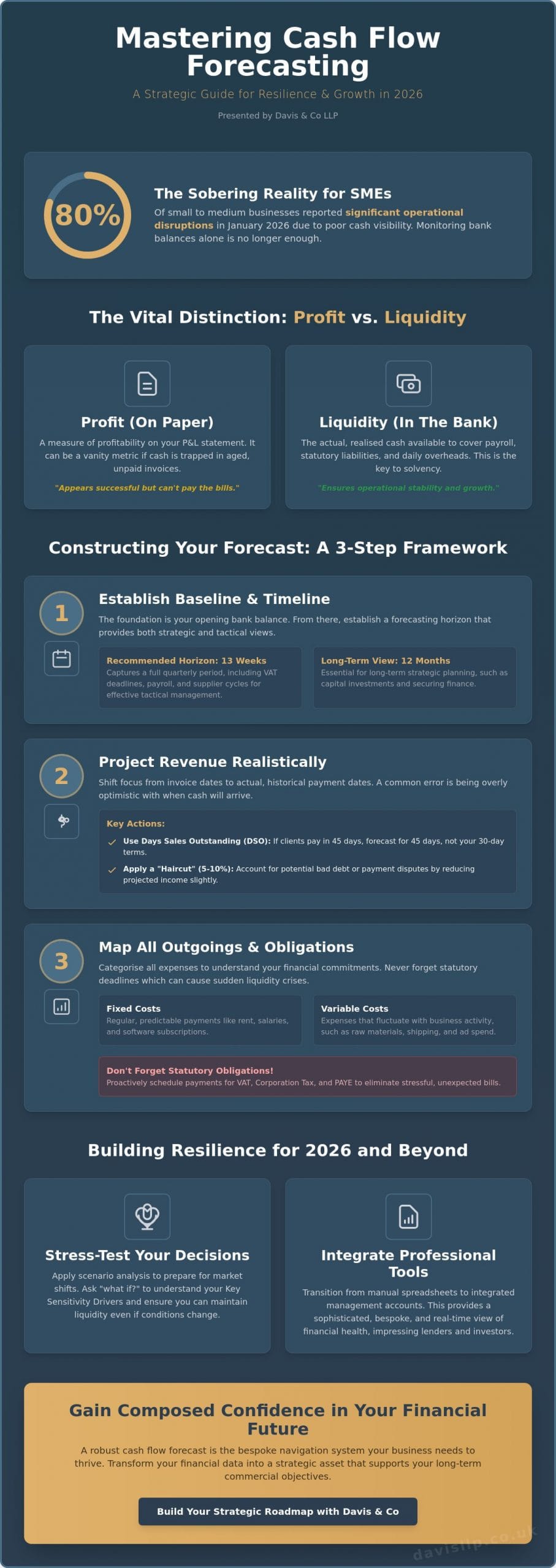
Nearly 80% of small to medium businesses reported significant operational disruptions in January 2026 due to poor cash visibility, according to research by Fathom. It’s a sobering statistic that confirms what many directors already feel: the traditional method of monitoring bank balances is no longer sufficient. Effective cash flow forecasting for small business acts as a strategic navigation system, bridging the gap between today’s ledger and tomorrow’s expansion.
We understand the pressure of a sudden Corporation Tax bill or the anxiety caused by unpredictable payment cycles from your primary clients. These challenges shouldn’t hinder your commercial objectives. This guide will help you master the art of forecasting to ensure your firm remains resilient, liquid, and prepared for growth in the current economic climate. We’ll explore how to stress-test your business decisions and gain a definitive view of your future liquidity, allowing you to approach tax deadlines and investment opportunities with composed confidence. By the end of this article, you’ll have a pragmatic framework to transform your financial data into a reliable roadmap for 2026.
Key Takeaways
- Understand why profitability isn’t a guarantee of solvency and how to prioritise liquidity as a core commercial objective.
- Learn to build a reliable model for cash flow forecasting for small business using historical payment trends rather than optimistic projections.
- Identify how to account for statutory obligations like VAT and Corporation Tax within your forecast to eliminate the stress of unexpected bills.
- Apply scenario analysis to stress-test your business decisions, ensuring you’re prepared for both expansion opportunities and sudden market shifts.
- Discover the benefits of transitioning from manual spreadsheets to integrated management accounts for a more sophisticated, bespoke view of your financial health.
The Strategic Role of Cash Flow Forecasting in 2026
A business can be technically profitable on its profit and loss statement while simultaneously being functionally insolvent. This paradox is the primary reason why sophisticated management requires more than just historical reporting. In its most pragmatic form, cash flow forecasting is a forward-looking exercise that models the timing and volume of cash movements. It’s the difference between seeing where you’ve been and knowing where you’re going.
For many directors, the objective isn’t merely survival but sustainable expansion. Effective cash flow forecasting for small business provides the necessary visibility to commit to new hires or capital investments without jeopardising operational stability. By moving away from static annual budgets toward a rolling forecast model, we help clients adapt to shifts in the UK economic environment with measured, intellectual rigour.
Profit vs. Liquidity: The Vital Distinction
Revenue is often a vanity metric if it’s trapped in aged receivables. We frequently see businesses that appear successful on paper yet struggle to meet payroll or VAT obligations because their working capital is tied up in unpaid invoices. Paper profit doesn’t pay the bills; realised liquidity does. A robust forecast accounts for the real-world delay between making a sale and receiving funds, ensuring that your cash reserves remain sufficient to cover statutory liabilities and daily overheads. This distinction is critical for maintaining a sense of composed partnership with your suppliers and employees.
Why 2026 Demands Greater Forecasting Accuracy
The financial environment of May 2026 presents unique challenges that demand precision. With the Bank of England maintaining a cautious stance on interest rates and commercial lending criteria remaining stringent, the cost of servicing debt has become a significant factor in liquidity management. Relying on overdrafts or short-term credit to cover cash shortfalls is an increasingly expensive and risky strategy. Accuracy in your projections is now a prerequisite for securing any form of external finance, whether through traditional term loans or private equity.
Lenders and investors require a bespoke navigation system that demonstrates you understand your “Key Sensitivity Drivers” and can maintain liquidity even if market conditions fluctuate. Implementing cash flow forecasting for small business provides this assurance, positioning your firm as a reliable and high-calibre partner in the eyes of financial institutions. It transforms your financial data into a strategic asset that supports long-term commercial objectives.
A Step-by-Step Guide to Constructing Your Forecast
Constructing a reliable model for cash flow forecasting for small business requires a methodical approach that prioritises empirical data over optimistic projections. It’s a process of translation, turning your commercial ambitions into a chronological map of liquid resources. To begin, we must move beyond the static figures of a balance sheet and focus on the timing of every pound that enters or exits your accounts.
Step 1: Establishing Your Baseline and Timeline
The foundation of any forecast is your opening balance, the total of all cleared funds across your current accounts and accessible reserves. Once this baseline is established, you must determine your forecasting horizon. For tactical liquidity management, we often recommend a 13-week cash flow forecast. This thirteen-week cycle is particularly effective because it captures a full quarterly period, encompassing standard payroll runs, supplier cycles, and VAT deadlines. While a 12-month view is essential for long-term strategic planning, the weekly cadence provides the granular detail needed for day-to-day operational stability.
Step 2: Realistic Revenue Projection
One of the most frequent errors in cash flow forecasting for small business is the reliance on invoice dates rather than actual receipt dates. Your forecast should reflect your “Days Sales Outstanding” (DSO). If your standard terms are 30 days but your historical data shows that clients typically pay at 45 days, you must project that income for the later date. In the 2026 economic landscape, where borrowing costs remain high, accounting for these delays is vital. We also suggest applying a “haircut” to your projected receipts, perhaps 5% to 10%, to account for potential bad debt or unforeseen disputes that might stall a payment.
Step 3: Mapping Outgoings and Obligations
Categorising your outgoings into fixed and variable costs allows for greater flexibility when “stress-testing” your position. Fixed costs, such as rent, salaries, and software subscriptions like QuickBooks or Xero, are predictable and non-negotiable. Variable costs, including raw materials and performance-based marketing, can often be adjusted if the forecast indicates a tightening of liquidity. It’s also prudent to build a contingency buffer for “unseen” operational costs, such as emergency repairs or sudden regulatory compliance shifts. Our specialists frequently provide bespoke cash flow management advice to help directors categorise these expenses with precision.
The final, and most critical, figure in this exercise is your “Closing Balance” for each period. This number doesn’t just represent cash on hand; it represents your margin for error and your capacity for growth. If the closing balance consistently trends toward a deficit, it’s an early warning signal to adjust your credit control or reconsider the timing of planned capital expenditures.
Navigating the Nuances: Accruals, Tax, and Timing
The most sophisticated models for cash flow forecasting for small business often falter not because of incorrect sales projections, but because they fail to account for the specific timing of statutory liabilities. Many directors view their bank balance as a reflection of available wealth, forgetting that a significant portion of those funds effectively belongs to HMRC. This “tax trap” is a primary driver of insolvency for otherwise profitable firms. To maintain liquidity, your forecast must treat tax as a non-negotiable cash outflow rather than a year-end accounting adjustment.
Effective Financial Forecasting requires a deep understanding of how UK legislative requirements impact your cash reserves. For instance, the 2026 fiscal year demands careful management of Corporation Tax, which for most companies is payable nine months and one day after the end of the accounting period. Integrating expert tax advice in the UK ensures that these significant, delayed payments are accurately reflected in your projections, preventing quarterly shocks that can stall growth acceleration.
Forecasting for HMRC Compliance
Aligning your forecast with Making Tax Digital (MTD) requirements is no longer optional; it’s a strategic necessity. We advise clients to set aside VAT receipts in real-time, treating them as held in trust rather than operating capital. It’s equally vital to estimate Corporation Tax payments well in advance, particularly as the main rate of 25% applies to profits over £250,000. Alongside these, your monthly cash model should account for employer National Insurance contributions and the specific timing of PAYE payments. This level of detail ensures you’re never surprised by a deadline.
Bridging the Gap Between Accounting Methods
There is a fundamental difference between an accrual-based budget and a cash-focused forecast. Your profit and loss statement includes non-cash items like depreciation, which are essential for accounting but irrelevant for immediate liquidity. Conversely, a cash forecast must include loan repayments and VAT payments that don’t appear on a P&L. Translating these complex financial statements into a pragmatic roadmap is where a small business accountant becomes an invaluable partner. We help you identify the timing difference between an expense being incurred and the actual cash leaving your account, providing a clear view of your true financial position. Implementing cash flow forecasting for small business in this way ensures your operational decisions are based on cleared funds rather than accounting abstractions.
Stress-Testing and Scenario Analysis for Resilience
Some directors dismiss cash flow forecasting for small business as a speculative exercise. This perspective overlooks the strategic value of stress-testing. A forecast isn’t a prediction of a single future; it’s a tool to prepare for multiple possibilities. By applying a “Best Case, Worst Case, Most Likely” framework, you transform raw data into a tactical navigation system. This intellectual rigour replaces anxiety with actionable intelligence, allowing you to govern your business with composed authority even when the UK economic outlook fluctuates.
Every industry has “Key Sensitivity Drivers” that disproportionately affect liquidity. For a manufacturer, it might be the fluctuating cost of imported raw materials. For a professional services firm, it’s often the timing of project milestones and the resulting impact on aged receivables. Identifying these drivers allows you to focus your analytical efforts where they matter most. This isn’t about predicting the future with absolute certainty. It’s about understanding the limits of your operational resilience before a crisis occurs.
Creating “What-If” Scenarios
We encourage clients to model three specific scenarios to ensure their strategy is robust. First, consider the impact if a major client delays payment by 60 days. If that client represents 25% of your monthly receipts, your model must show whether your current reserves can absorb the shock. Second, test how a 10% increase in supply chain costs in mid-2026 affects your gross margin and subsequent cash position. Finally, before committing to a new hire in Q3 2026, use your forecast to confirm you can sustain the additional payroll and employer National Insurance contributions without compromising your liquidity buffer.
Building Financial Buffers
Understanding your “Burn Rate” and “Runway” is essential for long-term survival. We recommend establishing a target reserve based on three to six months of essential outgoings. This isn’t a static figure; it must evolve as your business scales. Using a forecast to identify potential shortfalls months in advance allows for early, calm conversations with your bank regarding commercial credit facilities. This is far more effective than seeking emergency funding when cash has already depleted. If you require a bespoke approach to these calculations, our team provides expert cash flow management services to ensure your firm remains resilient.
Integrating Professional Advisory for Sustainable Growth
While approximately 80% of small businesses now utilise cloud-based accounting software like QuickBooks or Xero, the transition from raw data to strategic foresight requires more than a simple subscription. Moving from manual, static spreadsheets to integrated management accounts is a prerequisite for any firm seeking genuine growth. DIY models often fail to capture the nuanced interplay between domestic operations and global obligations. For those operating across borders, professional international tax planning isn’t a separate concern; it’s a fundamental driver of your domestic cash position.
The role of a trusted advisor is to provide “quiet excellence” through a partnership that prioritises your commercial objectives. We believe that cash flow forecasting for small business shouldn’t be a solitary task for the director. Instead, it serves as the foundation for a collaborative dialogue that ensures your business remains liquid and ready for the next stage of its evolution. This strategic oversight provides the distance necessary to see patterns that daily operations might obscure.
The Value of Management Accounting
A static forecast is only as good as its last update. Through regular management accounting reviews, we compare your “Actuals” against your “Forecasts” to identify why variances occur. Software can flag a deficit, but it can’t explain the underlying cause, whether it’s a shift in supplier pricing or a temporary inefficiency in your credit control. These sessions allow us to adjust your strategy in real-time. We move beyond simple bookkeeping to provide an intellectual rigour that ensures your business remains resilient against the volatility of the 2026 economic climate.
Bespoke Solutions for Complex Needs
As your business scales, your requirements will inevitably become more complex. You might need to integrate personal tax goals with business liquidity or tailor your projections for multi-jurisdictional expansion. A bespoke approach ensures that every statutory obligation, from VAT compliance to employer National Insurance, is woven into a single, coherent roadmap. When you decide to find a chartered accountant, you’re choosing a partner who provides the strategic gravitas required for high-stakes decision-making.
The ultimate aim of cash flow forecasting for small business is to replace uncertainty with a sense of composed control. We invite you to contact Davis & Co LLP to establish a bespoke forecasting review. Together, we’ll ensure your business isn’t just surviving the current landscape, but is actively prepared for sustainable, long-term growth.
Navigating the Path to Sustainable Liquidity
Transitioning from reactive monitoring to proactive strategy is the hallmark of a resilient director. Mastering cash flow forecasting for small business ensures you’re never caught off guard by quarterly VAT obligations or the 21% flat Corporation Tax rate. By moving beyond static spreadsheets and implementing a rolling 13-week model, you gain the clarity required to time investments and hire with confidence. This transformation from raw data to strategic foresight is what allows a business to thrive even in volatile markets.
Since 1901, Davis & Co LLP has served as a dependable constant for UK and international clients. As Chartered Certified Accountants specialising in business growth and management accounting, we provide the intellectual rigour and quiet excellence your commercial objectives require. We position ourselves as your strategic partner, ensuring your financial roadmap is as robust as your ambition. Secure your business future with bespoke cash flow management from Davis & Co LLP.
Your business deserves the stability and insight that only a legacy of success can provide. We look forward to helping you navigate your next stage of growth with composed authority and professional discretion.
Frequently Asked Questions
What is the difference between a cash flow forecast and a budget?
A budget represents your strategic intentions for the financial year, while a forecast is a pragmatic projection based on current performance. Think of the budget as the map and the forecast as the GPS that adjusts for real-world conditions. While the budget remains fixed to measure performance, cash flow forecasting for small business is a dynamic tool that evolves as invoices are settled and expenses are incurred.
How often should a small business update its cash flow forecast?
Updates should occur at least monthly to ensure your projections remain aligned with your bank balance. For businesses with high transaction volumes or tight margins, a weekly update is more appropriate to maintain visibility. Regular reviews allow you to identify liquidity trends early. This provides the necessary lead time to adjust your commercial objectives before a shortfall occurs.
Can I use Excel for my cash flow forecasting, or do I need software?
Excel is a viable starting point for very simple structures, but cloud-based software significantly reduces the risk of manual entry errors. In 2026, platforms like QuickBooks Online start at approximately $30 per month, while Zoho Books offers entry-level plans from $15. These tools integrate directly with your bank feeds, ensuring your cash flow forecasting for small business relies on cleared funds rather than optimistic estimates.
How do I forecast cash flow if my business is seasonal?
Seasonal businesses must rely on historical data from at least three previous cycles to model their trough periods accurately. You should identify the specific months where outgoings exceed receipts and build a cash reserve during peak trading. This bespoke approach ensures you have sufficient liquidity to cover fixed costs, such as rent and payroll, during the quieter months of the fiscal year.
What should I do if my forecast shows a significant cash shortfall?
Immediate action is required to preserve liquidity, starting with a rigorous review of your aged receivables. You might choose to delay non-essential capital expenditures or negotiate extended terms with key suppliers. It’s also the appropriate time to initiate a calm, professional dialogue with your bank or lenders. They’re more likely to support a business that demonstrates such forward-looking financial discipline.
Does a cash flow forecast include depreciation?
No, depreciation is a non-cash accounting entry and has no place in a liquidity-focused model. While it’s essential for your profit and loss statement to reflect the diminishing value of assets, it doesn’t represent money leaving your bank account. A forecast prioritises actual movements of cash, such as the initial purchase price of equipment or monthly loan repayments, rather than accounting adjustments.
How can an accountant help with my cash flow management?
An accountant provides the strategic gravitas needed to translate complex financial data into a clear operational roadmap. We identify looming tax liabilities and ensure your projections account for the 21% corporate tax rate and other statutory obligations. By acting as a high-calibre advisor, we help you stress-test your business decisions. This ensures that growth acceleration doesn’t come at the expense of your solvency.
What are the most common mistakes in small business forecasting?
The most frequent error is optimism bias; specifically, the assumption that clients will pay exactly on the invoice due date. Many businesses fail to account for their actual Days Sales Outstanding, which often lags behind terms by 15 or 30 days. Another fatal mistake is overlooking quarterly VAT or annual tax deadlines. These result in sudden, significant outflows that the business isn’t prepared to meet.