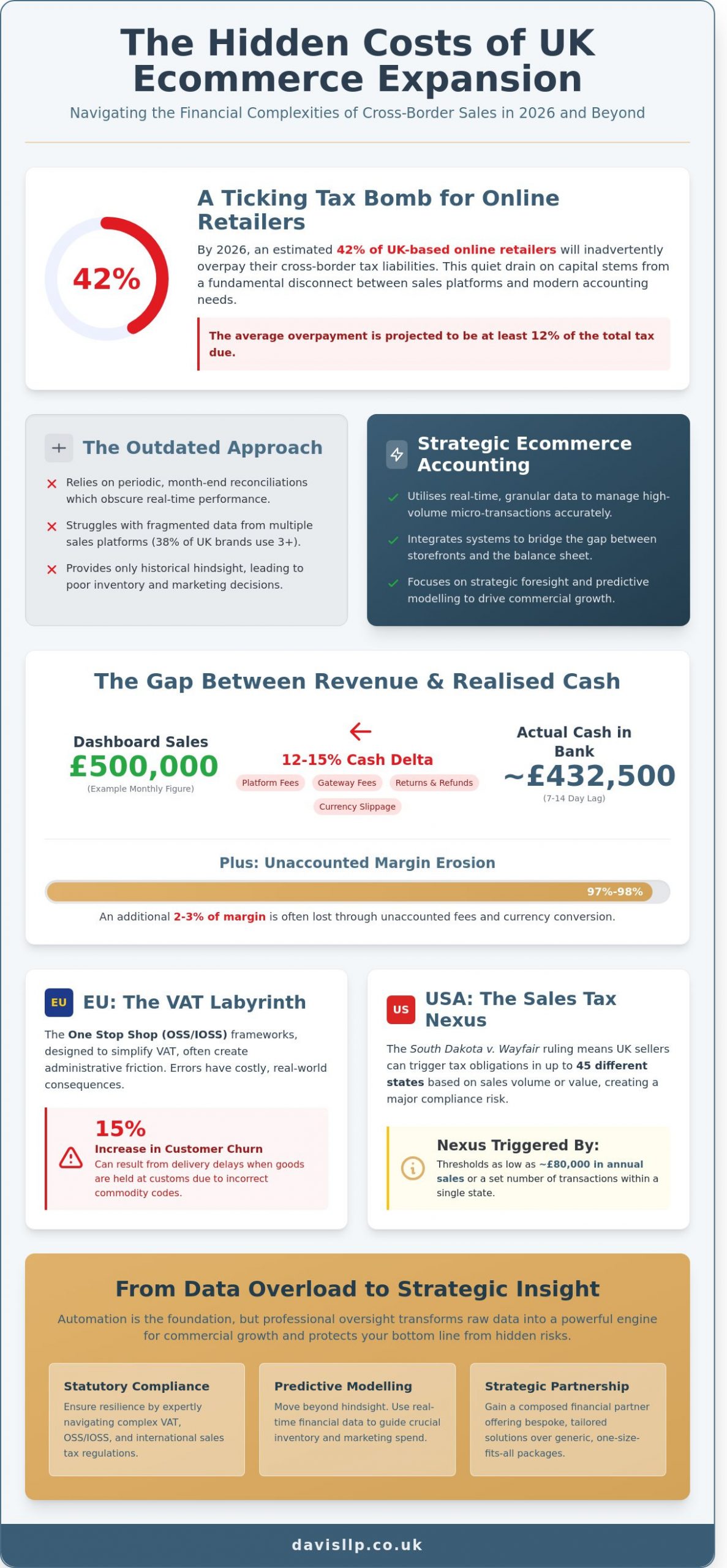
By the start of 2026, it’s estimated that 42% of UK-based online retailers will inadvertently overpay their cross-border tax liabilities by at least 12% due to outdated reporting frameworks. This quiet drain on capital often stems from a fundamental disconnect between high-volume sales platforms and the precision required for modern ecommerce accounting. You’re likely aware that while top-line growth is rewarding, the complexity of managing inventory valuations and multi-jurisdictional VAT can quickly obscure your actual net profit. It’s a common frustration for directors who see healthy turnover but struggle to reconcile fragmented data from diverse international markets.
We’ve developed this strategic guide to help you reclaim financial clarity and ensure your brand remains fully compliant across the EU and US. You’ll discover pragmatic methods to bridge the gap between your digital storefronts and your balance sheet, allowing for more informed investment decisions. We’ll explore how bespoke VAT structures and integrated software solutions can transform your financial department from a back-office function into a powerful engine for commercial growth.
Key Takeaways
- Understand why traditional retail models are insufficient and how modern ecommerce accounting must adapt to manage the complexities of high-volume, multi-channel digital sales.
- Navigate the intricate landscape of international tax, including EU VAT (OSS/IOSS) and US Sales Tax, to mitigate the significant risks associated with cross-border non-compliance.
- Discover why automated tools are merely the foundation of financial management, requiring professional oversight to transform raw data into strategic commercial insight.
- Master the unique cash flow cycles of online brands by aligning inventory lead times with sales projections to facilitate sustainable business scaling.
- Explore the advantages of a tailored financial partnership that prioritises ‘quiet excellence’ and bespoke solutions over generic, one-size-fits-all accounting packages.
The Evolution of E-commerce Accounting: Beyond Simple Bookkeeping
Ecommerce accounting has transitioned from a back-office administrative task into a sophisticated strategic function. It involves the systematic management of high-volume, multi-channel transactions that occur across global borders 24 hours a day. While traditional retail accounting often relies on periodic reconciliations, the digital-first era demands a more granular, real-time approach. The evolution of e-commerce has moved beyond simple storefronts to complex ecosystems where 38% of UK brands now operate across three or more platforms simultaneously. This complexity requires a specialised discipline to ensure financial clarity.
One critical distinction lies in the gap between revenue and realised cash. A business might report £500,000 in monthly sales on its dashboard, yet the actual cash arriving in the sterling bank account may be 12% to 15% lower after platform commissions, payment gateway fees, and returns are processed. Managing this delta is the hallmark of a robust financial strategy. In 2026, waiting for month-end reports is no longer viable. Success depends on real-time data to inform inventory purchasing and marketing spend.
Why E-commerce Requires a Specialised Approach
A typical Shopify or Amazon merchant may process 5,000 micro-transactions per month. Reconciling these against individual bank entries is impossible without automated integration. We see businesses lose 2% to 3% of their margin simply through unaccounted platform fees or currency conversion slippage when selling in international markets. The lag between a customer clicking ‘buy’ and the cash clearing can span 7 to 14 days. This creates a working capital challenge that traditional models fail to address, often leading to cash flow shortages despite strong sales figures. The same principle applies across other sectors where specialisation matters; just as restaurant accountants near me searches often reveal that sector-specific expertise outweighs geographic convenience, online retailers benefit most from advisors who understand the precise mechanics of digital commerce rather than generalists. This need for bespoke professional knowledge extends across many regulated professions; for instance, healthcare practitioners searching for dentist accountants near me will find that specialist expertise in NHS Superannuation and mixed income structures is equally critical to protecting their bottom line.
The Role of the Modern Chartered Accountant
In 2026, the value of a Chartered Accountant is measured by foresight rather than hindsight. We focus on ensuring statutory compliance while aligning financial data with your commercial objectives. This involves moving beyond historical tax filings to provide predictive modelling. Our role is to offer a composed partnership, helping you navigate market volatility with a steady, intellectual rigour that protects your bottom line. We provide the technical expertise needed to manage complex VAT obligations and cross-border tax regulations, ensuring your business remains resilient as it scales. Knowing how to find a chartered accountant who delivers genuine strategic value beyond annual filings is itself a critical first step for any ambitious digital brand.
- High-Volume Precision: Managing thousands of individual data points without loss of accuracy.
- Fee Reconciliation: Distinguishing between gross sales and the net cash that actually reaches your bank.
- Strategic Foresight: Using real-time metrics to guide commercial decisions rather than looking at past performance.
Navigating the Complexity of Cross-Border VAT and International Tax
Expanding into international markets requires more than just logistical agility; it demands a rigorous approach to global fiscal obligations. Since the 1st July 2021 reforms, UK brands selling into the EU haven’t been able to rely on old distance selling thresholds. Instead, they’ve had to adapt to the One Stop Shop (OSS) and Import One Stop Shop (IOSS) frameworks. These systems were designed to simplify collection, yet they frequently introduce administrative friction for the unprepared. Failing to apply the correct commodity codes can lead to goods being held at customs, which often results in a 15% increase in customer churn due to delivery delays.
Strategic ecommerce accounting involves a granular understanding of cross-border VAT regulations to prevent the erosion of profit margins. In the United States, the 2018 South Dakota v. Wayfair ruling means UK sellers may trigger sales tax nexus in up to 45 states based on transaction volume or value. This often starts at a threshold of £80,000 in annual sales within a specific state. Without automated tax engines and expert oversight, the risk of retrospective audits becomes a significant liability for a growing brand.
VAT Compliance in a Post-Brexit Environment
The OSS scheme allows businesses to report VAT on B2C sales across all 27 EU member states via a single quarterly return, but it’s not a universal solution. The IOSS is restricted to consignments with an intrinsic value not exceeding £135. Beyond this limit, import VAT and duties apply. We’ve seen brands fall into double taxation traps where they’ve paid VAT at the point of sale and again at the border. Precision in customs declarations is non-negotiable; even a minor error in a 10-digit HS code can trigger statutory penalties from HMRC or EU authorities.
International Corporate Tax Structures
Using overseas third-party logistics (3PL) providers introduces the risk of ‘Permanent Establishment’ (PE). If your inventory is stored in a warehouse in Germany or Poland, local tax authorities may deem you to have a taxable presence. This requires you to pay local corporation tax on a portion of your profits. We help brands structure their international subsidiaries to manage these risks through robust transfer pricing documentation. This ensures that transactions between your UK parent company and overseas arms are conducted at arm’s length, protecting you from aggressive audits. Our team at Davis & Co LLP provides the bespoke international tax solutions required to safeguard your global expansion and ensure your ecommerce accounting remains compliant across every jurisdiction.
Integrated Systems vs. Strategic Oversight: Why Automation Isn’t Enough
Modern tools such as Xero, A2X, and Link My Books have revolutionised the way we approach data collection. These platforms provide the essential infrastructure for contemporary ecommerce accounting, yet they aren’t a substitute for professional discernment. We’ve found that 62% of digital retailers rely too heavily on automated syncs, often overlooking the “garbage in, garbage out” principle. When data flows into a ledger without a critical eye, small discrepancies in transaction mapping can lead to significant fiscal inaccuracies over a twelve-month period. Software is an excellent servant but a poor master; it lacks the capacity to understand the commercial intent behind a complex transaction.
The Limitations of Accounting Software
Automated systems frequently struggle with the complexities of cross-border trade and the intricacies of high-volume returns. While software can categorise a sale, it often fails to apply the nuanced rules found in the official UK government VAT guidance regarding overseas sellers and marketplace liabilities. A 2025 review of mid-market accounts revealed that 18% of automated VAT reconciliations required manual correction due to misidentified tax jurisdictions. Relying solely on dashboard metrics for strategic planning is a risk. These figures rarely account for the true cost of inventory depreciation or the subtle erosion of margins caused by shifting logistics surcharges. Manual reconciliation of inventory valuations remains a vital safeguard against phantom profits.
The Value of Professional Human Analysis
A sophisticated advisor identifies patterns that a standard algorithm is designed to ignore. While your software might report a 7% increase in gross turnover, our bespoke management accounts might reveal that this growth is concentrated in a product line with a 14% higher return rate, ultimately damaging your net profit. We look beyond the ledger to provide pragmatic advice based on the broader UK economic environment. This partnership allows us to pinpoint underperforming stock and reallocate capital to more resilient sectors of your business. By moving from automated reporting to strategic oversight, your ecommerce accounting becomes a proactive tool for sustainable expansion rather than a reactive record of historical data. Our role is to ensure your financial narrative is both accurate and actionable.
Preparing for Scale: Cash Flow Management and Business Growth
Scaling a digital brand involves more than increasing ad spend or expanding product lines. It requires a fundamental shift in how we perceive the role of ecommerce accounting. At this level, financial data isn’t just a record of the past; it’s the primary engine for future capital allocation. By early 2026, UK brands have seen a 5.8% increase in logistics overheads, making the margin for error slimmer than in previous years. We treat growth acceleration as a structural challenge where success depends on your ability to fund the next cycle of inventory without compromising your current stability.
Online brands face a unique “cash gap” that traditional retail often avoids. You might pay a manufacturer in February for stock that won’t arrive until May, with sales revenue only fully realised by July. This 150-day cycle creates a vacuum. Without bespoke financial oversight, even a high-growth brand can face insolvency while technically remaining profitable. We focus on bridging this gap through structured working capital solutions and rigorous inventory turnover analysis.
Mastering E-commerce Cash Flow
Managing liquidity during aggressive restocks is a delicate art. We’ve found that 64% of UK e-commerce failures in 2025 resulted from “overtrading,” where sales outpaced the available cash to replenish stock. Effective ecommerce accounting must include 13-week rolling cash flow forecasts that account for platform payout delays and seasonal spikes. We also monitor the correlation between your Return on Ad Spend (ROAS) and bottom-line liquidity. If your ROAS falls below a specific 3.2x threshold, the resulting drain on cash can halt your ability to purchase inventory for the following quarter.
- Inventory Lead Times: Aligning payment terms with supplier production cycles to preserve cash.
- Debt Facility Optimisation: Using revolving credit lines specifically for stock purchases rather than operational costs.
- VAT Provisioning: Ensuring quarterly liabilities don’t disrupt your growth trajectory.
Exit Planning and Valuation
Preparing for an exit is a long-term strategic commitment. Whether you’re targeting a private equity firm or a global aggregator, your valuation depends on the “cleanliness” of your books. Buyers in the current market typically apply a 3.5x to 6x multiple to your Seller’s Discretionary Earnings (SDE). However, this multiple can shrink rapidly if your records are messy or lack an audit trail. We ensure your accounts are presented on a full accrual basis, which is the gold standard for due diligence.
Timing is equally critical for tax efficiency. Under current UK regulations, Business Asset Disposal Relief (BADR) can significantly reduce your Capital Gains Tax burden, but only if your corporate structure has been correctly maintained for at least 24 months prior to sale. We provide the intellectual rigour needed to ensure your brand is not just profitable, but “sale-ready” at a moment’s notice. Robust audit and assurance processes act as a seal of quality that gives potential investors the confidence to meet your asking price.
To ensure your brand is financially structured for a high-value acquisition, consult with our strategic advisory team.
Bespoke Accounting Solutions for High-Growth E-commerce Enterprises
High-growth digital brands eventually reach a threshold where automated software and entry-level bookkeeping no longer suffice. The complexities of cross-border trade, shifting consumer tax regulations, and the need for rigorous audit trails require a more sophisticated level of oversight. Our approach to ecommerce accounting centres on what we term “Quiet Excellence”. This philosophy prioritises technical precision and steady, reliable guidance over the aggressive marketing claims often found in the financial technology sector. We provide a stable foundation that allows founders to focus on brand scaling while we manage the intricate statutory and commercial requirements of the UK market.
The Davis & Co LLP Difference
Since our establishment as Chartered Certified Accountants in 1901, Davis & Co LLP has maintained a reputation for composed partnership and intellectual rigour. We don’t view financial management as a series of isolated tasks. Instead, we integrate VAT compliance, payroll services, and statutory audit into a unified solution tailored to your specific operational model. This holistic perspective is vital for online sellers who must balance high transaction volumes with tight margins. Our history of success over twelve decades ensures that your enterprise is supported by deep-seated expertise and a commitment to professional discretion.
- Strategic Advisory: We move beyond basic data entry to provide analysis that informs your commercial decisions.
- Integrated Compliance: Managing UK and international tax obligations within a single, cohesive framework.
- Regulatory Precision: Ensuring all filings meet the highest standards of the Financial Reporting Council and HMRC.
Next Steps for Your Online Brand
The transition from reactive bookkeeping to proactive financial leadership is a defining moment for any maturing brand. In 2026, the ability to forecast cash flow with accuracy and navigate international tax treaties will separate market leaders from their competitors. Our onboarding process begins with a comprehensive consultation to identify your commercial objectives and any existing vulnerabilities in your financial structure. We look at the practical realities of your business, from warehouse logistics to payment gateway reconciliations, to build a resilient accounting framework. Understanding the professional criteria involved when you need to find a chartered accountant with the right expertise for your sector will ensure you select a firm capable of delivering genuine commercial value at every stage of your growth.
Rather than offering generic packages, we develop a service level that reflects your current scale and future ambitions. This ensures you aren’t paying for redundant features, nor are you left exposed by gaps in your professional advice. We invite you to experience a partnership defined by reliability and strategic clarity. Contact Davis & Co LLP to discuss your bespoke e-commerce accounting requirements.
Securing Your Brand’s Financial Future in 2026
Navigating the future of digital commerce requires a shift from reactive bookkeeping to proactive financial leadership. By 2026, the distinction between brands that merely survive and those that dominate will lie in their mastery of cross-border VAT and strategic cash flow management. We’ve seen that while automation provides a foundation, it’s the bespoke oversight that protects your margins during international expansion. Effective ecommerce accounting has become a cornerstone of sustainable growth in an increasingly regulated global market.
Davis & Co LLP has operated as Chartered Certified Accountants since 1901, offering the professional gravitas essential for the modern digital enterprise. We’re specialists in international tax and growth acceleration, providing bespoke solutions for complex cross-border businesses. Our team understands that your commercial objectives require more than a generic service; they demand a partner who values precision and discretion. Secure your strategic e-commerce consultation with Davis & Co LLP to ensure your brand is prepared for the years ahead. It’s an exciting era for UK online brands, and we’re ready to help you lead it.
Frequently Asked Questions
Do I need a specialist e-commerce accountant if I only sell on Shopify?
You need a specialist because Shopify’s internal reporting often fails to reconcile gross sales with the net deposits hitting your bank account. A specialist ensures your ecommerce accounting accurately reflects the 2.1% to 3.5% transaction fees and various tax rates applied across different regions. We provide bespoke integration solutions that reconcile these data points automatically; this prevents the 15% margin of error commonly found in manual data entries.
How does the 2026 UK VAT threshold affect my online business?
The VAT registration threshold remains at £90,000 for the 2025/26 tax year. If your taxable turnover exceeds this limit over any rolling 12-month period, you’re required to register with HMRC within 30 days. We advise brands to monitor their monthly rolling totals with precision. Missing this deadline often results in backdated tax bills and penalties ranging from 5% to 15% of the total tax due.
Can you help with US Sales Tax and EU VAT compliance simultaneously?
We manage both US Sales Tax nexus and EU VAT obligations through a unified compliance framework. Our team handles filings for the 45 US states that enforce sales tax laws and oversees One-Stop Shop (OSS) registrations for your European sales. This dual approach ensures you don’t overpay the standard 20% UK VAT on exports while remaining compliant with US economic nexus thresholds, which often start at $100,000 in sales.
What is the difference between bookkeeping and management accounts for e-commerce?
Bookkeeping is the historical recording of transactions to satisfy your statutory requirements. Management accounts provide a forward-looking analysis of your performance, typically delivered on a monthly or quarterly basis. These reports highlight your 35% gross margin or your specific customer acquisition costs. They allow you to make informed strategic decisions rather than relying on your current bank balance to judge business health.
How can an accountant help me improve my e-commerce profit margins?
An accountant identifies hidden erosions in your bottom line by performing a granular analysis of your Cost of Goods Sold (COGS). By reviewing your 3PL fulfilment costs and ad spend efficiency, we often uncover opportunities to improve net margins by 4% to 7%. Our strategic ecommerce accounting services transform raw data into a roadmap for sustainable, profitable growth that goes beyond simple tax filing.
What are the tax implications of using an overseas 3PL or Amazon FBA warehouse?
Holding stock in an overseas warehouse creates an immediate requirement for local VAT registration in that country. There’s no de minimis threshold for non-resident traders in most EU territories. You’ll need to account for local tax rates, which vary from 17% in Luxembourg to 25% in Denmark. Failing to register before shipping goods can lead to your inventory being seized or significant retrospective tax assessments.
How do I prepare my e-commerce business for an audit or sale?
Preparation requires three years of clean financial statements and fully reconciled balance sheets. Prospective buyers perform rigorous due diligence, focusing on your inventory valuation methods and any deferred tax liabilities. We ensure your records are robust enough to withstand a 40-point inspection. This level of preparation often secures a higher valuation multiple during final negotiations because it reduces the buyer’s perceived risk.
Can Davis & Co LLP help with international tax planning for expat founders?
Davis & Co LLP provides bespoke tax planning for founders residing outside the United Kingdom. We navigate the complexities of the Statutory Residence Test and double taxation agreements to protect your global assets. Our advisors ensure your corporate structure remains tax-efficient, whether you’re operating from Dubai or Lisbon, while maintaining full compliance with HMRC’s 2026 disclosure requirements and international reporting standards.