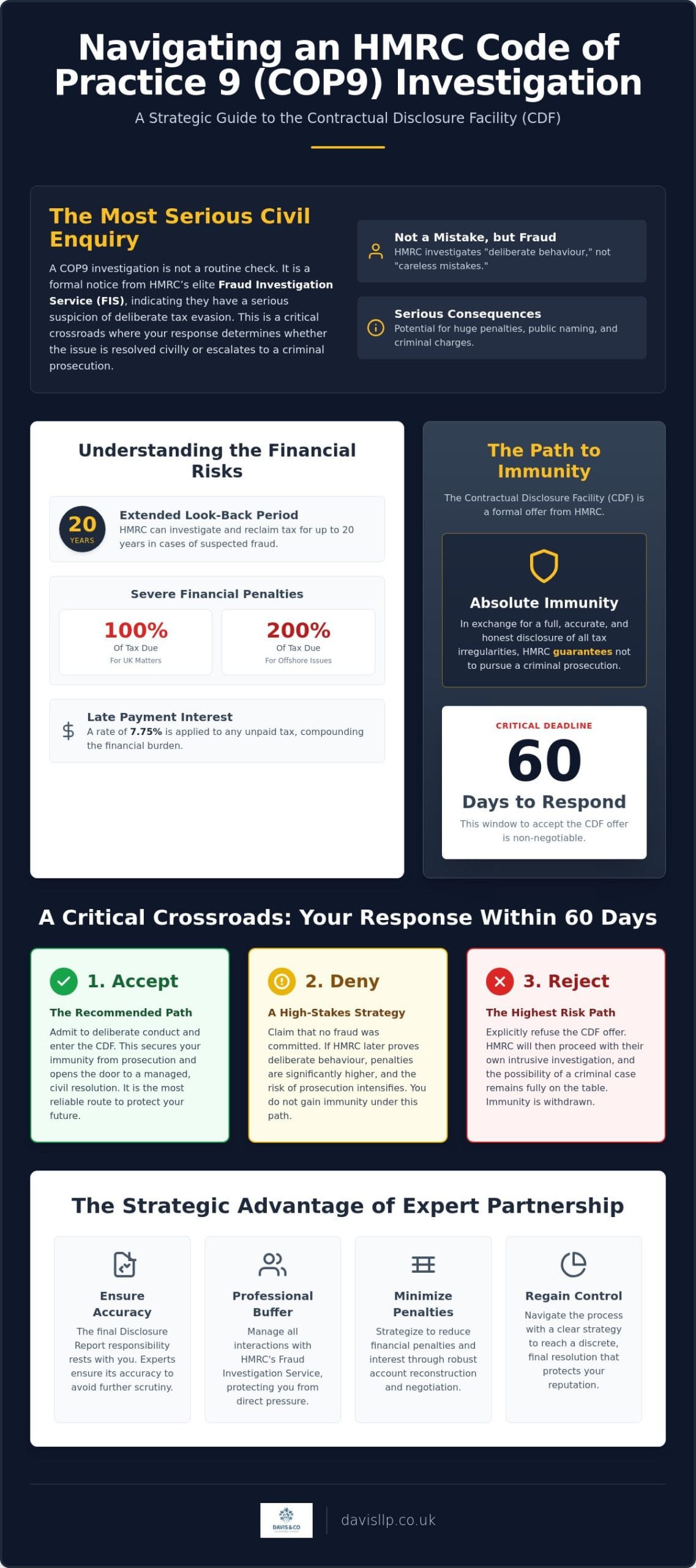
Receiving an hmrc code of practice 9 investigation notice is not a routine request for information; it is a formal notification that the Fraud Investigation Service suspects you of deliberate tax evasion. This moment represents a critical crossroads where your response dictates whether the matter remains a civil negotiation or escalates into a criminal prosecution. We understand the profound weight of this situation, particularly the fear of public naming and the anxiety surrounding HMRC’s 20-year look-back period for suspected fraud.
We believe that with the right strategic approach, you can regain control of your position. This guide provides the expert insight necessary to navigate the Contractual Disclosure Facility (CDF) with precision. You will learn how to secure absolute immunity from criminal prosecution and how to approach the disclosure process to minimize financial penalties. We will outline the essential steps to take within the strict 60-day deadline, the impact of the current 7.75% late payment interest rate, and how to reach a discrete, final resolution that protects your reputation and your future.
Key Takeaways
- Understand how to leverage the immunity clause within an hmrc code of practice 9 investigation to protect yourself from criminal prosecution.
- Identify the critical actions required within the 60-day window to validly accept the Contractual Disclosure Facility and secure your legal standing.
- Learn why the responsibility for the final Disclosure Report rests with the taxpayer and how to ensure its accuracy to avoid further scrutiny.
- Discover the strategic advantage of employing a professional buffer to manage interactions with HMRC’s Fraud Investigation Service.
- Gain insight into minimizing financial penalties and interest through proactive, voluntary disclosure and robust account reconstruction.
What is an HMRC Code of Practice 9 (COP9) Investigation?
An hmrc code of practice 9 investigation represents the most serious civil enquiry we see taxpayers face in the UK. It’s initiated when HMRC’s Fraud Investigation Service (FIS) has a “serious suspicion” that tax fraud has been committed. Unlike standard compliance checks conducted by local offices, this process is handled by specialist inspectors whose primary objective is to recover tax, interest, and substantial penalties through a formal disclosure. By 2026, the trigger for these investigations has become increasingly sophisticated. HMRC’s “Connect” system now cross-references billions of data points, from land registry records to offshore bank accounts, to identify discrepancies that suggest deliberate concealment rather than simple error.
The Seriousness of a COP9 Letter
Receiving a COP9 notice is a clear signal that HMRC believes they already possess evidence of deliberate wrongdoing. It marks a fundamental shift in the relationship between the taxpayer and the Crown. In these cases, the department is no longer looking for “careless mistakes” but is investigating “deliberate behaviour” that can span a 20-year look-back period. This distinction is vital because deliberate acts carry much higher financial penalties, often reaching 100% of the tax due for UK matters or up to 200% for offshore issues. Beyond the financial burden, there’s the looming risk of being “named and shamed” under the Publishing Details of Deliberate Defaulters programme, which can cause irreparable reputational damage to both individuals and businesses.
Civil vs. Criminal Investigations
We view an hmrc code of practice 9 investigation as a strategic bridge. It’s a formal offer by HMRC to deal with suspected Tax evasion in the United Kingdom through civil means rather than pursuing a criminal prosecution. HMRC generally reserves criminal routes for the most egregious cases or where they intend to send a strong public deterrent. The criteria for choosing the civil route often depend on the taxpayer’s perceived willingness to cooperate and the complexity of the financial reconstruction required. While a COP9 offers a path to immunity, it’s essential to understand the alternatives. For context on more aggressive enforcement measures, you may wish to read our guide on Understanding HMRC Dawn Raids and Tax Evasion. Choosing the right path early is the only way to secure a discrete and final resolution.
Understanding the Contractual Disclosure Facility (CDF)
The Contractual Disclosure Facility (CDF) is the operational heart of any hmrc code of practice 9 investigation. It isn’t merely a set of administrative forms; it’s a formal contract between the taxpayer and the Crown. Under the terms of this facility, HMRC makes a specific, time-limited offer. If you admit that your deliberate conduct led to a loss of tax and provide a full, accurate disclosure of all irregularities, they guarantee not to pursue a criminal prosecution for the conduct you disclose. This immunity is the primary reason the CDF exists. It provides a structured, albeit intense, pathway to resolve serious suspicions without the threat of imprisonment or a criminal record.
According to the official HMRC COP9 guidance, the window for accepting this offer is strictly limited to 60 days from the date the letter is issued. This deadline is non-negotiable. Missing it or failing to provide an adequate “Outline Disclosure” within this timeframe is often interpreted by the Fraud Investigation Service (FIS) as a refusal to cooperate. This can trigger a more intrusive investigation where the protection from prosecution is withdrawn.
The Three Options: Accept, Reject, or Deny
When you receive the notice, you’re presented with three distinct paths. Choosing Acceptance means you enter the CDF, admitting to deliberate conduct while securing your legal shield. This is the most reliable route for those seeking a managed resolution. Rejection occurs when you explicitly refuse the offer; in this scenario, HMRC will proceed with their investigation, and the possibility of a criminal case remains on the table. The third path, Denial, is where you claim no fraud was committed while acknowledging the investigation. This is a high-stakes strategy. If HMRC later proves deliberate behaviour that you denied, the penalties are significantly higher and the risk of prosecution intensifies. If you’re uncertain which path aligns with your circumstances, our personal tax services can provide the necessary clarity to protect your interests.
Strategic Implications of the “Deliberate” Admission
Entering the CDF requires a clear admission that the tax loss was “deliberate.” This is a legal prerequisite. Without this admission, the immunity shield cannot be activated. However, the phrasing of this admission requires professional precision. It shouldn’t be handled lightly; it will influence your tax compliance status for years to come. We focus on ensuring that the initial Outline Disclosure is robust enough to satisfy HMRC’s requirements while maintaining the professional gravitas needed to manage the inspector’s expectations. This admission is the foundation of your defence. It must be accurate and comprehensive to ensure the hmrc code of practice 9 investigation remains strictly within the civil arena.
The COP9 Process: From Letter to Resolution
The progression of an hmrc code of practice 9 investigation is a structured, multi-stage journey that demands meticulous attention to detail and a proactive stance. It begins the moment the notification arrives. This is a critical juncture where immediate evaluation with a specialist advisor is paramount. Unlike standard enquiries, the Fraud Investigation Service (FIS) operates with a high degree of autonomy and specific objectives. The process moves from the initial receipt through a series of formal milestones, including the Outline Disclosure, the Scope Meeting, and the eventual submission of a comprehensive Disclosure Report. Each stage is designed to test the taxpayer’s transparency and the accuracy of their financial reconstruction.
The Critical First 60 Days
While your regular accountant may be excellent at compliance and year-end filings, they’re often not equipped for the nuances of an hmrc code of practice 9 investigation. This phase requires a forensic mindset and an understanding of how FIS inspectors interpret data. During these first two months, we focus on gathering preliminary evidence and identifying potential irregularities without inadvertently alerting HMRC to further vulnerabilities. The Outline Disclosure is the foundational document that sets the scope of your immunity. It must be sufficiently detailed to demonstrate cooperation but carefully constructed to ensure it accurately reflects the deliberate conduct being admitted under the Contractual Disclosure Facility, as outlined in HMRC’s official Code of Practice 9.
Negotiating with the Fraud Investigation Service (FIS)
The Scope Meeting is perhaps the most high-pressure moment of the investigation. Here, HMRC FIS inspectors will outline what they expect the final Disclosure Report to cover. We act as a strategic buffer during these interactions, managing the flow of information to prevent “scope creep,” where the investigation unnecessarily expands into unrelated areas of your financial life. Given that HMRC’s FIS generated over £2,000 million in compliance yield in the 2025-2026 period, their focus is intense. We ensure that all cross-border interests and complex structures are accounted for, particularly where International Tax Planning has been a factor. This professional distance allows for a more objective negotiation of the final figures, covering the tax due, the 7.75% late payment interest, and the negotiated penalties, leading to a discrete and final resolution.
Preparing a Robust Disclosure Report
The Disclosure Report is the most intensive phase of an hmrc code of practice 9 investigation. It’s important to understand that the burden of production effectively shifts during this stage; HMRC expects you to provide the evidence of your own irregularities. This involves a meticulous reconstruction of financial records, often spanning several years where documentation might be sparse or non-existent. We use forensic accounting techniques to rebuild these accounts, ensuring that the final figures are defensible under scrutiny. A robust report doesn’t just list numbers; it provides a comprehensive narrative that explains the context of the deliberate conduct. This narrative is crucial for demonstrating the transparency that HMRC demands in exchange for immunity.
Quantifying the total liability requires more than just calculating unpaid tax. As of January 2026, the late payment interest rate stands at 7.75%, a figure that can significantly inflate the final settlement over a multi-year investigation. We also calculate the penalty percentage, which is heavily influenced by the quality and timing of the disclosure. If you’re facing the complexities of rebuilding years of financial history, our Personal Tax Services offer the strategic partnership needed to manage this burden with professional gravitas.
Penalty Mitigation Strategies
HMRC operates a specific framework for penalty reduction based on three pillars: Telling, Helping, and Giving access. By excelling in these areas, we can often negotiate penalties down from the maximum statutory levels. For UK-based deliberate errors, penalties can reach 100% of the tax due, while offshore matters can attract rates as high as 200%. Strategic mitigation involves more than just cooperation; it requires identifying any overpayments or legitimate business expenses that were previously unclaimed. These can serve to offset the overall fraud liability, ensuring the financial resolution is as fair as possible under the circumstances.
Finalising the Certificate of Full Disclosure
The process concludes with the signing of the Certificate of Full Disclosure. This is a document of immense legal weight. Any omission, whether intentional or accidental, can be viewed as a breach of the Contractual Disclosure Facility. If HMRC discovers undisclosed irregularities after this certificate is signed, your immunity from criminal prosecution may be voided. We ensure that the report includes a detailed Statement of Assets as of the report date, covering all worldwide holdings. It’s also vital to include non-tax irregularities that might affect HMRC’s view of your credibility, ensuring the resolution is truly final and your position remains secure.
Why Expert Partnership is Essential for COP9
Navigating an hmrc code of practice 9 investigation requires more than just technical knowledge; it demands a strategic buffer between you and the Fraud Investigation Service. FIS inspectors are specifically trained to identify inconsistencies in verbal testimony, often using formal meetings to probe for details that may not be immediately apparent in written records. Direct interaction without professional representation can lead to unintended disclosures that complicate the resolution. We provide that necessary layer of protection, ensuring all communication is measured, deliberate, and strategically aligned with your long-term interests.
Discretion and professional gravitas are the hallmarks of a successful resolution. We prioritize managing the investigation’s intensity so it doesn’t disrupt your daily operations or damage your professional reputation. Technical precision is equally vital. The Disclosure Report must meet exacting standards to satisfy HMRC’s requirements for closing the case. Any lack of clarity or forensic rigor can result in the rejection of the report, leading to further scrutiny or the withdrawal of criminal immunity. Our role is to ensure that every figure is defensible and every narrative is clear, providing the intellectual rigour needed to secure a final settlement.
The Role of Davis & Co LLP
Our firm has operated with a sense of quiet excellence since 1901, providing a calm and reassuring authority during high-stress fraud investigations. We understand that these matters are deeply personal and commercially sensitive. For clients with complex cross-border interests, our specialized expertise in International Tax Planning is particularly relevant. We don’t just act as service providers; we position ourselves as strategic partners. This approach of “composed partnership” means we work closely with you to rebuild financial records and draft the narrative accounts required for an hmrc code of practice 9 investigation, ensuring you feel secure and well-advised throughout the process.
Beyond the Investigation
A successful resolution is only the first step toward long-term security. Once the investigation is concluded, we focus on transitioning your affairs into a stable, compliant structure that withstands future scrutiny. This often involves implementing robust Small Business Accounting practices that provide clarity and oversight. As we move through 2026, staying ahead of changes to VAT and Corporation Tax is essential for maintaining this compliance. We ensure that the lessons learned during the investigation are translated into better governance and more efficient tax management. If you’ve received a COP9 letter, we invite you to contact us for a discrete consultation to discuss how we can secure your position and resolve the matter with the finality you require.
Securing Your Path to a Final Resolution
Successfully managing an hmrc code of practice 9 investigation requires a precise blend of transparency and strategic foresight. By accepting the Contractual Disclosure Facility, you secure a vital shield against criminal prosecution while establishing a structured path toward financial reconstruction. We’ve explored how a forensic Disclosure Report doesn’t just satisfy HMRC; it acts as your primary tool for penalty mitigation and reputational protection. It’s about moving from a position of uncertainty to one of controlled resolution.
Our firm, as Chartered Certified Accountants established in 1901, provides the professional gravitas and specialist expertise in high-stakes tax matters necessary for a discrete outcome. We operate as a composed partner, managing the technical complexities so you can focus on your future. You don’t have to navigate this high-pressure environment without a trusted advisor by your side. Our national reputation is built on delivering the intellectual rigour required for these sensitive commercial matters.
Secure your position with a discrete COP9 consultation today. With a clear strategy and expert partnership, a stable and compliant future is well within your reach.
Frequently Asked Questions
Can I go to prison if I receive a COP9 letter?
You won’t face imprisonment provided you validly accept the Contractual Disclosure Facility (CDF) and provide a full, accurate disclosure of all tax irregularities. The CDF is a formal contract where HMRC guarantees not to pursue a criminal prosecution for the conduct you disclose. However, if you reject the offer or provide a dishonest disclosure, HMRC reserves the right to initiate a criminal investigation that could lead to prosecution.
How long does an HMRC COP9 investigation typically take?
These investigations are complex and are rarely concluded within nine months. Because of the forensic nature of rebuilding financial records and the detailed negotiations with the Fraud Investigation Service, most cases take between 18 months and three years to reach a final resolution. The duration depends heavily on the volume of data and the complexity of your international or domestic financial structures.
What is the difference between COP9 and COP8?
The primary distinction is the suspicion of fraud. An hmrc code of practice 9 investigation is issued only when HMRC suspects deliberate tax evasion. In contrast, Code of Practice 8 (COP8) is used for cases involving large-scale tax avoidance or complex technical issues where HMRC doesn’t necessarily suspect fraud but believes a significant amount of tax is at stake.
Should I tell my regular accountant about a COP9 investigation?
It’s often prudent to consult a specialist advisor before discussing the matter with your regular accountant. Your current advisor’s previous work may be under scrutiny as part of the investigation, which can create a conflict of interest. A specialist firm acts as a strategic buffer, providing the forensic expertise and professional distance required to manage interactions with HMRC’s specialist inspectors effectively.
What happens if I forget to disclose something in my CDF report?
Omitting any tax irregularity can void your immunity from criminal prosecution. If HMRC discovers that your disclosure was incomplete or misleading, they can withdraw the CDF protection and move toward a criminal investigation. This is why the final Certificate of Full Disclosure and the Statement of Assets must be meticulously reviewed for absolute accuracy before they’re submitted.
How much are the penalties in a COP9 fraud investigation?
Penalties are determined by the amount of tax lost and the quality of your cooperation during the disclosure. For deliberate UK-based errors, penalties can reach 100% of the tax due, while offshore matters can attract penalties up to 200%. These costs are in addition to the tax itself and the late payment interest rate, which stands at 7.75% as of January 2026.
Can HMRC check my offshore bank accounts during COP9?
HMRC has extensive access to offshore financial data through the “Connect” system and international data-sharing agreements. During an hmrc code of practice 9 investigation, they’ll expect you to proactively disclose all worldwide assets. Since they receive automated information from over 100 jurisdictions, attempting to hide offshore interests often leads to the immediate withdrawal of the CDF offer.
What is the “60-day” rule in COP9?
The 60-day rule is a strict, non-negotiable deadline for responding to the initial HMRC letter. Within this period, you must decide whether to accept the CDF and submit an “Outline Disclosure” of the deliberate conduct. Failing to respond within this window is treated as a denial of any wrongdoing, which typically triggers a more aggressive and intrusive investigation by the Fraud Investigation Service.