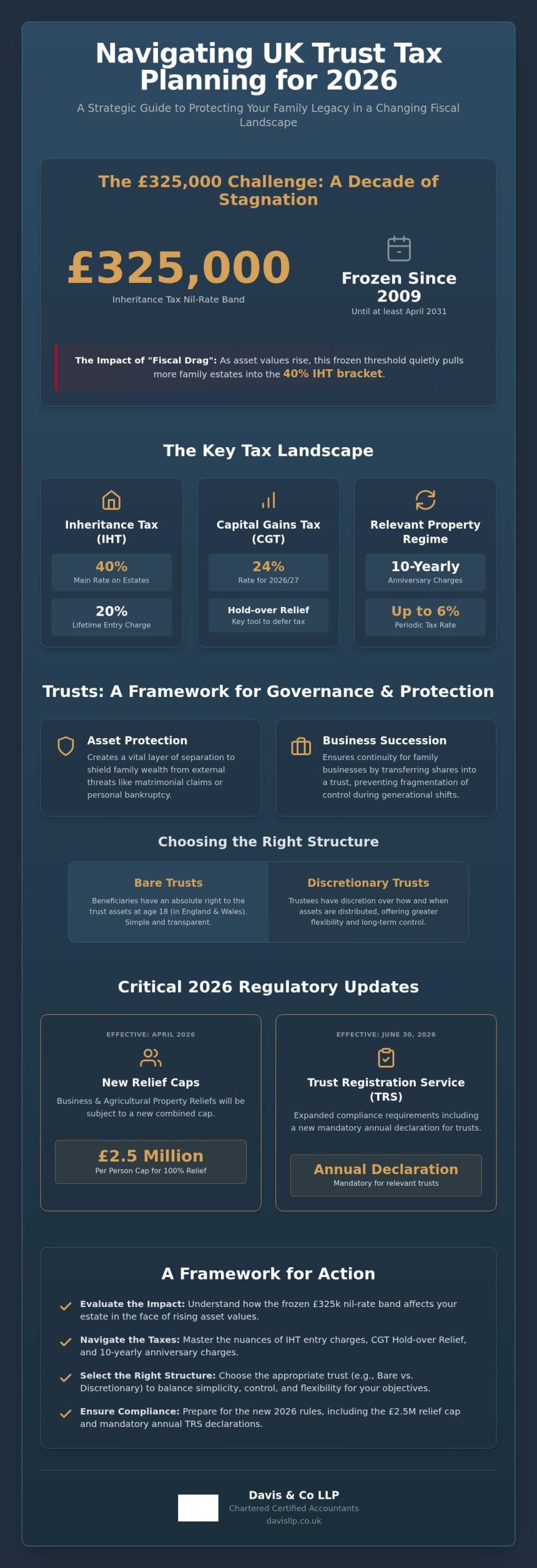
The inheritance tax nil-rate band has remained frozen at £325,000 since 2009, meaning that rising asset values are quietly pulling more family estates into the scope of the 40% tax bracket than ever before. In this environment, a trust is less a simple tax-efficiency tool and more a strategic governance framework that requires precise, active management to remain effective. We understand the weight of responsibility that comes with protecting family legacies, particularly when the complexity of the ‘Relevant Property’ regime and the fear of HMRC penalties can feel overwhelming. Effective trust tax planning uk isn’t just about reducing a bill; it’s about creating a stable, compliant foundation for the next generation.
Our guide provides a clear path through the 2026 regulatory landscape, ensuring you can balance asset control with the highest standards of professional compliance. We’ll explore the critical shifts in Agricultural and Business Property Relief caps and the expanded Trust Registration Service requirements effective from June 30, 2026. You’ll gain a comprehensive understanding of how IHT, CGT, and Income Tax interact within various trust structures. By the end, you’ll have a robust framework for selecting the right vehicle to protect your wealth with quiet, enduring confidence.
Key Takeaways
- Understand why the frozen £325,000 Nil-Rate Band makes trust tax planning uk essential for protecting family estates against fiscal drag in 2026.
- Learn to navigate the ‘Relevant Property’ regime, including the nuances of 10-yearly anniversary charges and the application of Hold-over Relief for Capital Gains Tax.
- Identify the most appropriate trust structure for your objectives, balancing the simplicity of Bare Trusts with the long-term flexibility of Discretionary arrangements.
- Ensure full compliance with the updated Trust Registration Service (TRS) requirements, including the new annual declaration mandates effective from June 30, 2026.
- Discover how a partnership with Davis & Co LLP integrates technical tax efficiency with a broader strategy for multi-generational wealth governance.
The Strategic Role of Trusts in 2026 Wealth Management
A trust is not merely a historical relic; it is a sophisticated legal instrument designed for the complexities of modern wealth governance. At its core, it represents a formal arrangement where legal ownership of assets is transferred to trustees, who manage them for the benefit of specific individuals or groups. This fundamental principle of English trust law provides a robust framework for long-term protection that remains highly relevant in 2026. By separating legal title from beneficial enjoyment, families can ensure that their wealth is managed with professional oversight and intellectual rigour.
While legislative shifts have altered the fiscal landscape, the strategic value of trust tax planning uk has evolved rather than diminished. With the Inheritance Tax nil-rate band frozen at £325,000 until at least April 2031, more estates are being drawn into the tax net through fiscal drag. Proactive trust tax planning uk allows families to navigate these thresholds while maintaining the integrity of their long-term objectives. The focus for many has shifted from aggressive tax mitigation toward a model of robust family governance, using trusts as a buffer against economic volatility and unforeseen legal claims.
Asset Protection vs. Tax Mitigation
Trusts provide a layer of separation that is essential for protecting family wealth from external threats. This includes potential matrimonial claims during a divorce or the risks associated with personal bankruptcy. For families with vulnerable beneficiaries or young adults who aren’t yet ready for the responsibility of significant capital, a trust ensures that assets are preserved and distributed according to a considered plan. In an era of increasing transparency, the confidentiality inherent in many express trusts also offers a level of discretion that remains a cornerstone of private wealth management.
Trusts as a Tool for Business Succession
Generational transitions can be precarious for family-owned businesses. By placing company shares into a trust, owners can ensure continuity of management while providing for multiple family members without fragmenting the business’s control. This approach often integrates with statutory reliefs to ensure the transition is as efficient as possible. Business Property Relief is a statutory mechanism that reduces the value of qualifying business interests for Inheritance Tax purposes, although as of April 2026, the 100% relief is subject to a combined £2.5 million cap per person. Success in this area requires expert tax advice to ensure that the trust structure aligns with both commercial realities and the latest regulatory requirements.
Navigating the UK Trust Tax Framework: IHT, CGT, and Income Tax
The fiscal environment for 2026 is defined by the continued freeze of the Inheritance Tax (IHT) Nil-Rate Band at £325,000. This threshold, which has remained unchanged since 2009, serves as the primary pivot point for trust tax planning uk. Most lifetime transfers into trusts that exceed this limit trigger an immediate 20% entry charge. For families with significant assets, this creates a requirement for precise valuation and timing to avoid unintended tax leakage. For a detailed breakdown of these classifications, the UK government guidance on trusts and taxes provides the statutory baseline for how different structures are treated.
Capital Gains Tax (CGT) also plays a pivotal role when settling assets into a trust. While a transfer is technically a disposal, the 24% CGT rate for the 2026/27 tax year can often be managed through ‘Hold-over Relief’. This mechanism allows the settlor to defer the gain, effectively passing the tax liability to the trustees. It’s a vital tool for preserving capital during the initial funding phase. Managing these cross-border complexities requires a partner who understands both local and international nuances. Our team at Davis & Co LLP specialises in aligning these tax obligations with your broader financial goals.
The Relevant Property Regime Explained
Most modern trusts fall under the ‘Relevant Property’ regime, which imposes a recurring tax charge every ten years. This periodic charge is capped at 6% of the trust’s value above the available Nil-Rate Band. Trustees must also account for ‘exit charges’ when capital is distributed to beneficiaries between these ten-year anniversaries. Calculating these figures is rarely straightforward; it involves a pro-rata assessment based on how many quarters have passed since the last anniversary. Proactive liquidity management is essential to ensure the trust has sufficient cash reserves to meet these liabilities without forced asset sales.
Income Tax for Trustees and Beneficiaries
The tax treatment of trust income depends heavily on the trust’s structure. Discretionary trusts face the highest burden, with income exceeding the £500 tax-free amount taxed at 45% for general income and 39.35% for dividends. Conversely, ‘Interest in Possession’ trusts generally see income taxed at the basic rate of 20%, or 10.75% for dividends. When beneficiaries receive distributions from a discretionary trust, they get a 45% tax credit, which they may be able to reclaim if they are lower-rate taxpayers. Optimising the timing of these payments can significantly improve the net outcome for the family.
Selecting the Right Trust Structure for Tax Efficiency
Choosing the appropriate vehicle is the cornerstone of effective trust tax planning uk. Each structure offers a different balance between control, flexibility, and fiscal obligation. Bare trusts are often the starting point for straightforward gifting. In these arrangements, the beneficiary has an immediate and absolute right to both the capital and the income. While they offer the least flexibility for the settlor, they’re highly efficient for Inheritance Tax (IHT) purposes. If the settlor survives for seven years after making a lifetime gift into a bare trust, the value of that gift falls entirely outside their estate for Inheritance Tax purposes.
Discretionary trusts offer a contrasting approach by granting trustees wide-ranging powers to decide how and when assets are distributed. This flexibility is invaluable for protecting wealth against spendthrift beneficiaries or uncertain future circumstances. However, this control comes with the added complexity of the Relevant Property regime discussed previously. For multi-jurisdictional families, this choice must be integrated with broader international tax planning to account for conflicting tax residencies and treaty protections. Understanding the nuances of Inheritance Tax on trusts is vital when selecting a structure that spans multiple borders.
Lifetime Settlements vs. Will Trusts
The timing of a trust’s creation significantly alters its tax profile. Lifetime settlements often involve Potentially Exempt Transfers (PETs) or Chargeable Lifetime Transfers (CLTs), depending on the trust type. PETs, typically used with bare trusts, require the settlor to survive seven years for the gift to become tax-free. Conversely, Will trusts only come into effect upon death. They provide a vital mechanism for post-death flexibility, allowing an estate to be managed according to the needs of survivors rather than being distributed in rigid, pre-determined portions. This is particularly useful for providing an income for a surviving spouse through an ‘Interest in Possession’ structure while ensuring the underlying capital eventually passes to children.
Specialist Trusts for Vulnerable Persons
Specific provisions within the UK tax code offer relief for trusts established for vulnerable beneficiaries. Trusts for disabled persons can benefit from special tax treatment that aligns their Income Tax and Capital Gains Tax liabilities more closely with those of an individual, rather than the higher trust rates. Similarly, trusts for bereaved minors provide a protective environment for children who have lost a parent, offering significant IHT advantages if specific conditions are met. In these sensitive cases, a ‘Letter of Wishes’ serves as a critical document. It provides trustees with non-binding yet essential guidance on how to exercise their discretion, ensuring the settlor’s original intentions are respected long after the trust is established.
Compliance and the Trust Registration Service (TRS) in 2026
The Trust Registration Service (TRS) has undergone a significant transformation, moving far beyond its initial role as a simple database. In 2026, trustees must view the TRS as a dynamic compliance obligation that requires regular, often annual, interaction. It’s no longer a ‘set and forget’ task. For those involved in trust tax planning uk, the risks of misclassifying a trust as ‘exempt’ are higher than ever. While new exemptions effective from June 30, 2026, exist for low-risk trusts with assets under £10,000 and annual income below £5,000, most express trusts remain firmly within the registration mandate. This includes non-UK trusts that acquired UK land before October 2020, which now face a transitional registration deadline of September 1, 2027.
HMRC has increased its scrutiny of trust data, with a focus on both late registrations and the accuracy of the information provided. Penalties for non-compliance are becoming more common, reflecting a broader government push for transparency in asset ownership. Maintaining a strategic compliance calendar is essential for avoiding HMRC warnings and ensuring that all filings are submitted within the required windows. This proactive approach is a hallmark of sophisticated wealth governance, ensuring that the legal structure remains a shield rather than a liability.
The Step-by-Step TRS Registration Process
The registration process requires a meticulous gathering of data for all relevant parties, including settlors, trustees, and ‘lead’ beneficiaries. Trustees must provide specific identifiers, such as National Insurance numbers or passport details, to satisfy HMRC’s requirements. When dealing with complex corporate trustees, defining ‘Beneficial Ownership’ becomes a more nuanced exercise, requiring a deep dive into the underlying control structures. Crucially, any changes in the trust’s circumstances, such as a change of address or the addition of a new beneficiary, must be updated on the TRS within 90 days to maintain trust tax planning uk compliance.
Anti-Money Laundering (AML) and Reporting Obligations
The Fifth Anti-Money Laundering Directive (5AMLD) continues to dictate the transparency standards for UK trusts. Trustees now hold significant duties regarding record-keeping and must be prepared to disclose beneficial ownership information to ‘obligated entities’ when entering into new business relationships. This administrative burden can be substantial. Partnering with a chartered accountant ensures that these professional reporting standards are met with precision. At Davis & Co LLP, we manage these complex disclosures to protect our clients’ reputations and financial interests. If you require assistance with your registration or ongoing maintenance, our team is available to provide bespoke trust tax services tailored to your specific family or commercial objectives.
How Davis & Co LLP Optimises Your Trust Strategy
At Davis & Co LLP, we view trust tax planning uk as a discipline that extends far beyond technical filing. Since 1901, our firm has acted as a dependable constant for families and businesses navigating the nuances of wealth preservation. We position ourselves as a strategic partner, ensuring that every decision is filtered through the dual lens of regulatory compliance and your specific family values. By integrating expert tax advice into your governance framework, we help you anticipate legislative shifts rather than merely reacting to them. This proactive approach is essential in a 2026 landscape where fiscal drag and increased transparency mandates can quickly erode capital if left unmanaged.
Our specialist expertise in cross-border trusts is particularly valuable for clients with multi-jurisdictional interests. We understand that international tax efficiency requires more than just local knowledge; it demands a composed partnership that can reconcile conflicting tax residencies and treaty obligations. We provide the intellectual rigour needed to manage these complex analytical challenges, making our clients feel secure and well-advised even as global regulations evolve.
Tailored Planning for Family Offices
Family offices face a unique set of tax risks when managing high-value assets across different borders. Our team provides the discretion and reliability required for these sensitive personal matters, acting as a bridge between your long-term objectives and the practical realities of the UK tax system. We coordinate closely with your legal advisors to ensure that the provisions within your trust deed are perfectly aligned with your tax strategy. This cohesion prevents the administrative friction that often arises when legal and financial advice are siloed, ensuring your trust tax planning uk remains robust under scrutiny.
Next Steps: Your Trust Tax Review
The first step toward a more efficient future is a comprehensive audit of your current arrangements. Many families hold ‘dormant’ trusts that, while no longer active in a commercial sense, still carry hidden tax liabilities or reporting requirements under the updated TRS rules. We conduct thorough feasibility studies for new settlements, assessing how they fit into the 2026/27 tax year landscape. If you’re considering a new trust or wish to optimise an existing portfolio, we invite you to contact our team for a bespoke consultation. Together, we’ll ensure your wealth is structured with the quiet excellence and precision it deserves.
Securing Your Legacy through Proactive Governance
Effective trust tax planning uk involves more than just understanding current rates; it requires a forward-looking strategy that anticipates regulatory shifts and economic volatility. We’ve explored how the right trust structure can balance asset control with tax efficiency while ensuring strict adherence to the latest TRS and AML mandates. By viewing your trust as a dynamic governance framework rather than a static document, you protect your family wealth from the silent erosion of fiscal drag.
As Chartered Certified Accountants since 1901, Davis & Co LLP brings a history of success and deep-seated expertise to every client engagement. We specialise in complex international tax planning, offering the discreet and reliable strategic partnership necessary for managing sensitive family matters across borders. We invite you to consult our trust tax specialists for a bespoke strategy review to ensure your arrangements remain resilient and compliant. Your financial legacy deserves the precision of professional oversight and a commitment to long-term stability.
Frequently Asked Questions
Do I still need to pay Inheritance Tax if I put my house in a trust?
Yes, you generally still face Inheritance Tax liabilities if you continue to reside in a property after transferring it to a trust. This is known as a ‘Gift with Reservation of Benefit’. Unless you pay a full market rent to the trustees, HMRC treats the house as part of your taxable estate upon death. Effective trust tax planning uk requires a clear separation of benefit to ensure the house successfully moves outside the IHT net.
How often does a trust need to pay the 10-year anniversary charge?
The periodic charge occurs exactly every ten years from the date the trust was originally established. Trustees must calculate the value of the ‘relevant property’ held within the trust on that specific anniversary date. If the value exceeds the available £325,000 Nil-Rate Band, a tax charge of up to 6% is applied. It’s a recurring obligation that requires precise valuation of all trust assets to ensure accurate reporting to HMRC.
What are the penalties for failing to register a trust with the TRS in 2026?
HMRC’s penalty regime for the Trust Registration Service is designed to enforce transparency. While initial failures may receive a warning letter, deliberate or repeated non-compliance can trigger financial penalties starting at £100 per instance. These fines can escalate based on the duration of the delay and the tax liability involved. Maintaining an accurate compliance calendar is the most reliable way to protect trustees from these avoidable administrative costs and professional reputational damage.
Can a non-UK resident be a trustee of a UK trust?
A non-UK resident can serve as a trustee, but this decision has significant implications for the trust’s tax residency. If a majority of trustees are non-resident, the trust itself may be classified as non-resident for tax purposes. This status changes how Capital Gains Tax and Income Tax are applied to trust assets. We recommend seeking specialist advice to ensure that the trustee’s residency doesn’t inadvertently create a complex cross-border tax burden.
Is it possible to close a trust without paying an exit charge?
You can only close a trust without an exit charge if the value of the assets being distributed is within the trust’s available Nil-Rate Band. Since the threshold is currently £325,000, many smaller trusts avoid these charges entirely. However, if the trust value has grown significantly or the Nil-Rate Band has been used by previous distributions, an exit charge will apply. This charge is calculated pro-rata based on the time elapsed since the last ten-year anniversary.
How does the ‘Hold-over Relief’ work for Capital Gains Tax in a trust?
Hold-over Relief allows the Capital Gains Tax liability to be deferred when assets are transferred into or out of certain trusts. Instead of the settlor paying 24% CGT on the gain at the time of transfer, the gain is ‘held over’ and attached to the asset. The tax only becomes payable when the trustees or the eventual beneficiary sell the asset in the future. It’s a vital tool for preserving capital during generational wealth transfers.
What is the difference between a settlor-interested trust and a standard discretionary trust?
A settlor-interested trust is one where the person who created the trust, or their spouse, can still benefit from the assets or income. For tax purposes, HMRC usually attributes the trust’s income directly to the settlor, regardless of whether it’s distributed. In contrast, a standard discretionary trust excludes the settlor from benefiting, allowing the trust to be taxed as a separate legal entity. This distinction is a fundamental pillar of strategic trust tax planning uk.
Can I use a trust to manage my dental practice’s succession planning?
Trusts are an excellent vehicle for managing the succession of a dental practice. By placing shares into a trust, you can ensure a smooth transition of ownership while utilising Business Property Relief (BPR) to mitigate Inheritance Tax. As dental tax specialists, we help practice owners structure these arrangements to protect the business’s valuation and ensure that the next generation of clinicians or family members are well-provided for without triggering immediate, heavy tax liabilities.