For many high-net-worth individuals and expanding businesses, the most significant threat to global wealth isn’t market volatility, but the complexity of cross-border tax regulations. While the UK personal allowance remains frozen at £12,570, the risk of fiscal drag and the intricacies of the Statutory Residence Test can lead to unexpected liabilities. Engaging a specialist international tax accountant ensures that your financial structure is robust enough to withstand HMRC scrutiny. We understand that the fear of double taxation is a heavy burden, especially when the 183-day rule and offshore disclosure requirements create a minefield for the unwary.
You deserve the peace of mind that comes from knowing your international interests are managed with discretion and professional gravitas. This guide offers a comprehensive strategy for 2026, focusing on minimising tax leakage and maintaining full compliance with both UK and global laws. We’ll explore the nuances of double taxation agreements and the latest HMRC thresholds to help you build a stable, long-term financial legacy. By the end of this article, you’ll have a clear understanding of how to protect your assets while meeting every regulatory obligation with confidence.
Key Takeaways
- Adapt your financial strategy to the 2026 regulatory environment, where increased global tax transparency and the automatic exchange of information necessitate a shift from traditional planning to a more dynamic approach.
- Navigate the nuances of the Statutory Residence Test to clearly define your residency and domicile status, ensuring a precise and compliant foundation for your UK tax liabilities.
- Discover how a specialist international tax accountant london can apply Double Taxation Agreements to protect your global income through various methods of relief, including credit and exemption strategies.
- Identify why Chartered Certified status and a history of managing complex family offices are essential benchmarks when selecting a strategic partner for cross-border financial interests.
- Understand the value of a partner-led approach that prioritises discretion and analytical rigour, drawing on over a century of expertise to secure your long-term global financial position.
The Complexity of Cross-Border Financial Interests in 2026
The management of financial affairs across multiple borders has reached a point of unprecedented intricacy. As governments worldwide intensify their efforts to close the tax gap, the intersection of UK domestic law and international treaties creates a dense, often opaque, regulatory environment. The Complexity of Cross-Border Financial Interests requires a sophisticated understanding of how different jurisdictions interact in real-time. Relying on a standard domestic firm often leaves high-net-worth individuals exposed to unforeseen risks and administrative scrutiny. In this context, an international tax accountant london provides the specialized oversight needed to manage these global variables with precision. HMRC has become remarkably adept at identifying discrepancies between reported domestic income and overseas asset growth, making professional discretion and analytical rigour essential assets for the modern taxpayer.
The Shift Towards Global Tax Transparency
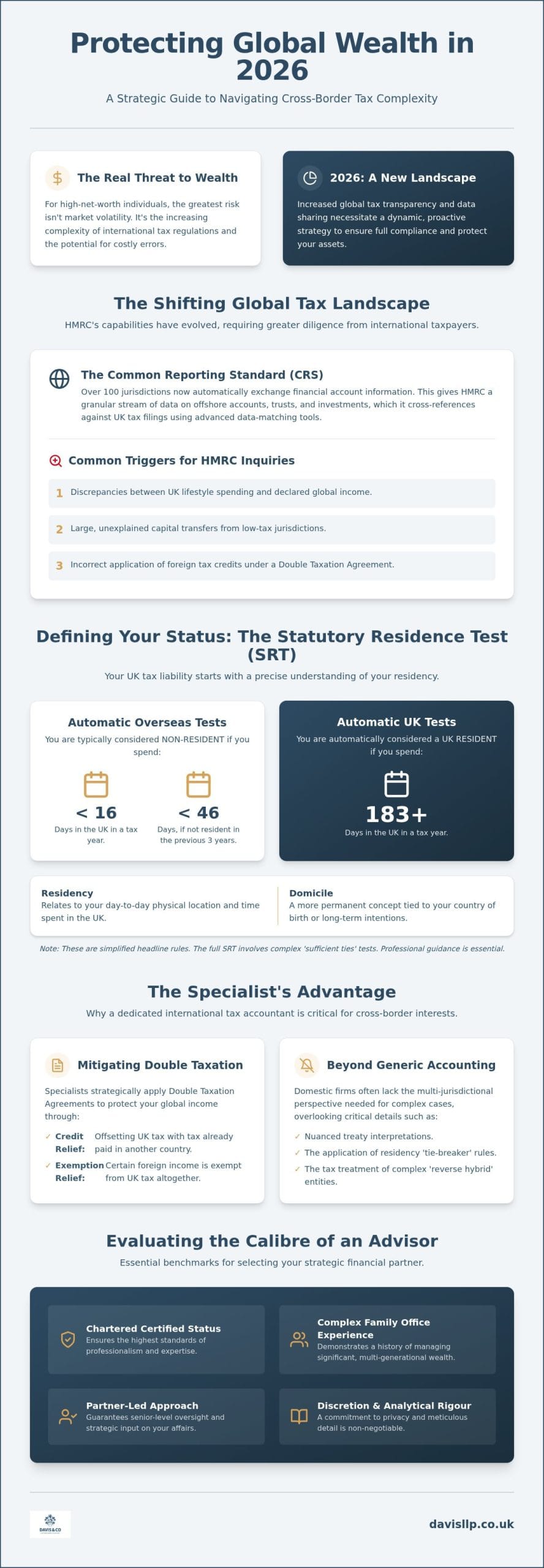
The 2026 landscape is defined by the maturity of the Common Reporting Standard (CRS). This framework facilitates the automatic exchange of information between over 100 jurisdictions, ensuring HMRC receives a granular stream of data regarding offshore accounts, trusts, and investments. We’ve seen that the Revenue now utilizes advanced data-matching tools to cross-reference this international intelligence against UK Self-Assessment filings. Proactive disclosure isn’t merely a recommendation; it’s a strategic necessity to avoid the punitive penalties associated with perceived non-disclosure. Common triggers for HMRC inquiries include:
- Discrepancies between UK-based lifestyle expenditures and declared global income streams.
- Large, unexplained capital transfers from jurisdictions historically characterized as low-tax.
- Incorrect application of foreign tax credits under the specific terms of a Double Taxation Agreement.
Why ‘Generic’ Accounting Fails International Clients
A domestic-only practice may excel at standard UK compliance, but they frequently lack the multi-jurisdictional perspective required for complex cross-border interests. Subtle differences in treaty interpretation can lead to significant tax leakage if not handled with expert care. For example, the treatment of ‘reverse hybrid’ entities or the application of ‘tie-breaker’ rules in residency disputes requires a level of detail that generic firms often overlook. We act as a strategic partner, ensuring that your financial structure is resilient against shifting global standards. An international tax accountant london understands that effective planning isn’t a static filing exercise; it’s a continuous process of risk mitigation in a volatile global environment. Without this level of professional gravitas, you risk liabilities that can significantly erode your international financial standing.
Navigating the Statutory Residence Test and Domicile Status
Determining your UK tax liability begins with a precise understanding of your legal standing within the British tax system. While many assume that residency is merely a matter of where one spends the majority of their time, the reality is governed by a rigorous set of criteria. The distinction between residency and domicile is particularly critical for those with interests spanning multiple continents. Residency relates to your day-to-day location, whereas domicile is a more permanent concept, often tied to your country of birth or long-term intentions. Misinterpreting these definitions can lead to significant financial exposure, making the guidance of an international tax accountant london indispensable for protecting your global wealth.
The Mechanics of the Statutory Residence Test
The Statutory Residence Test serves as the definitive measure of UK tax residency. It operates through a series of hierarchical checks, starting with the automatic overseas tests. If you spend fewer than 16 days in the UK, or fewer than 46 days if you haven’t been resident in the previous three years, you’re typically considered non-resident. Conversely, the automatic UK tests apply if you spend 183 days or more in the country during a single tax year. For borderline cases, HMRC applies the ‘sufficient ties’ test, which evaluates your connections through family, accommodation, and work. This nuanced approach ensures that residency isn’t easily manipulated, requiring careful record-keeping and professional oversight.
Domicile and the Remittance Basis in 2026
Domicile status offers a different layer of complexity, especially for long-term residents. Under current rules, individuals are ‘deemed domiciled’ for tax purposes once they’ve been resident in the UK for at least 15 of the previous 20 tax years. Before reaching this threshold, non-domiciled individuals can often elect to use the remittance basis of taxation. This allows you to pay UK tax only on UK-sourced income and any foreign income or gains brought into the country. However, this choice involves a strategic trade-off, as electing the remittance basis usually results in the loss of your £12,570 personal allowance. If you’re navigating these choices, our international tax accountant london can help you weigh the benefits of the remittance basis against the potential impact on Capital Gains Tax during global asset disposals. For a detailed review of your status, you may wish to consult our specialist tax partners.
Mitigating Double Taxation Through Strategic Treaty Relief
Protecting your global income from the erosion of double taxation requires more than a simple understanding of domestic law. It demands a strategic application of the UK’s extensive network of Double Taxation Agreements (DTAs). These treaties are designed to ensure that the same income isn’t taxed twice, but claiming these benefits isn’t automatic. As an international tax accountant london, we focus on identifying the specific treaty articles that apply to your unique circumstances. Whether you’re dealing with investment income, professional fees, or capital gains, the method of relief chosen can significantly impact your net returns. We ensure that your global financial interests are shielded from redundant liabilities through analytical rigour and precise filing.
There are three primary methods of relief: credit relief, where foreign tax paid offsets your UK liability; exemption relief, where income is excluded from taxation in one jurisdiction; and deduction relief, where foreign tax is treated as a business expense. In dual-residency scenarios, where two countries claim taxing rights, the ‘tie-breaker’ clauses within the DTA act as the final arbiter. These clauses often rely on the principles laid out in the Statutory Residence Test to determine where your ‘centre of vital interests’ truly lies. Navigating these requirements in 2026 necessitates a proactive approach to documentation, as HMRC has increased its scrutiny of treaty-based claims to prevent tax avoidance.
Understanding the UK’s Network of Tax Treaties
The UK maintains one of the most comprehensive DTA networks globally, with over 130 agreements in force for 2026. Identifying which jurisdiction holds the primary taxing right is essential for avoiding administrative friction. For instance, income from immovable property is almost always taxed in the country where the property is located, whereas business profits are generally taxed where the enterprise is resident. To claim these treaty benefits abroad, you’ll often need to obtain a Certificate of Residence from HMRC to prove your UK tax status to foreign authorities. We manage this process on your behalf, ensuring that your status is clearly established and recognized across all relevant jurisdictions.
Practical Methods for Avoiding Double Taxation
Effective management often involves applying for relief at source, which reduces the withholding tax applied to international dividends, interest, or royalties before the funds are even remitted. This is typically more cash-flow efficient than paying the full amount and claiming a tax credit after the fact. For example, managing withholding taxes on dividends, which carry UK rates up to 39.35% for additional rate taxpayers in 2026, requires precise coordination between jurisdictions. Integrating these considerations into your broader international tax planning allows for structure optimization that respects both UK and overseas regulations. By partnering with an international tax accountant london, you ensure that every cross-border transaction is handled with the precision and discretion your financial interests deserve.
Evaluating the Calibre of an International Tax Advisor
Selecting a strategic partner for your global financial interests is a decision that requires careful deliberation. While many firms offer basic compliance, the complexities of 2026 demand an international tax accountant london with a proven history of professional gravitas. ‘Chartered Certified’ status is a non-negotiable benchmark; it ensures your advisor adheres to the highest technical and ethical standards in the United Kingdom. We believe that for family offices and businesses pursuing cross-border growth, the quality of advice is directly linked to the experience of the individual partner leading the engagement. A partner-led approach avoids the pitfalls of high-volume compliance houses, where sensitive matters are often delegated to junior staff who may lack a holistic view of your financial landscape.
Discretion and reliability are the pillars upon which a successful tax partnership is built. When dealing with sensitive commercial data and personal wealth, you need the assurance that your advisor operates with the utmost confidentiality. An international tax accountant london should act as a composed advocate, providing clear, analytical thought rather than aggressive or unproven tax positions. This steady, measured approach builds a sense of stability, suggesting that your advisor is a dependable constant in an often volatile regulatory environment.
Key Criteria for Selection
A robust selection process focuses on a firm’s ability to manage complex, multi-jurisdictional challenges. You should look for a proven history in managing HMRC investigations and compliance, as this experience is vital for identifying potential risks before they escalate. The breadth of expertise is equally important; a firm must demonstrate deep-seated knowledge across property, trusts, and corporate tax to provide a comprehensive service. Longevity is perhaps the most telling indicator of quality. Firms like Davis & Co LLP, established in 1901, offer over a century of expertise, suggesting a level of reliability and success that newer practices cannot easily replicate.
The Strategic Advantage of a National Firm
Choosing a firm with a national scope provides a broader perspective on UK tax trends and HMRC’s shifting priorities. This allows for ‘London-standard’ expertise to be applied precisely to your specific financial context, regardless of where your primary operations are based. We understand that finding a chartered accountant for international needs requires looking beyond local high-street options to find a strategic partner with a global outlook. This multi-jurisdictional perspective ensures that your UK compliance is always aligned with your international goals. To discuss how our partner-led approach can secure your global financial interests, we invite you to speak with a specialist partner at our firm.
Davis & Co LLP: A Legacy of International Tax Excellence
Our firm’s history began in 1901. For over twelve decades, we’ve served as a dependable constant for individuals and businesses navigating the shifting tides of British and global tax law. This longevity isn’t merely a matter of survival; it’s a testament to a partner-led approach built on understated confidence and analytical rigour. As an international tax accountant london, we recognise that global wealth requires more than isolated compliance. It demands a cohesive strategy that integrates Personal Tax Services, Trust Tax Services, and Business Growth Acceleration. We don’t view ourselves as a mere service provider. Instead, we act as a strategic partner, ensuring your financial interests are protected with the professional gravitas they deserve.
The complexity of the 2026 regulatory environment, including the maturity of the Common Reporting Standard and the nuances of the Statutory Residence Test, requires a sophisticated level of oversight. We focus on the human and organisational impact of these complex issues. By providing a steady, measured rhythm of communication, we help our clients feel secure and well-advised. Our expertise allows us to move logically from identifying a potential cross-border challenge to implementing a customised, actionable solution that minimises tax leakage and ensures full HMRC compliance.
Our Partner-Led Strategic Advisory
When you engage our firm, you work directly with experienced partners who understand the high stakes of international tax planning. This direct involvement ensures that sensitive commercial and personal matters are handled with the discretion and reliability our reputation is built upon. We believe that complex tax matters cannot be delegated to high-volume compliance teams. Our partners provide the intellectual rigour necessary to navigate the expert tax advice in the UK that modern taxpayers require. This collaborative partnership fosters internal cohesion and ensures that every piece of advice is tailored to your specific multi-jurisdictional context.
Securing Your Financial Future
Proactive planning is the only way to safeguard a long-term financial legacy. We assist our clients in structuring their affairs to be tax-efficient across borders, focusing on critical areas such as inheritance tax and global asset protection. Whether you’re managing a family office or driving business growth acceleration, our role is to provide a stable foundation in an often volatile environment. We invite you to contact our team for a considered, professional consultation. Taking the first step towards a secure, compliant international tax strategy begins with a conversation rooted in expertise and mutual trust. Let us help you manage your global financial interests with the precision that has defined our practice since 1901.
Securing Your Global Financial Legacy for 2026 and Beyond
Managing international wealth in 2026 requires a transition from reactive compliance to a proactive, strategic partnership. We’ve explored how the interaction between the Statutory Residence Test and global transparency frameworks creates an intricate landscape for high-net-worth individuals. By leveraging the specific relief methods within Double Taxation Agreements and maintaining a multi-jurisdictional perspective, you can effectively shield your assets from redundant liabilities and administrative friction.
Choosing a reliable international tax accountant london is essential for establishing this long-term stability. As Chartered Certified Accountants established in 1901, we bring over a century of expertise to complex cross-border financial planning. Our partner-led approach ensures that your sensitive matters are handled with the discretion and analytical rigour they deserve. Discover how Davis & Co LLP can secure your international tax position. We look forward to helping you navigate these regulatory complexities with the confidence that comes from expert, tailored advisory.
Commonly Asked Questions on International Tax
What is the role of an international tax accountant in the UK?
An international tax accountant london acts as a strategic advisor for individuals and businesses with interests spanning multiple jurisdictions. Their primary function is to align your global financial activities with UK domestic law and international treaties. By overseeing complex filings and providing analytical rigour, they ensure you remain compliant with HMRC while minimising unnecessary tax exposure across your international asset portfolio. This partnership provides the stability needed to manage cross-border wealth effectively.
How do I know if I am considered a UK tax resident for the 2026 tax year?
Your residency status for the 2026 tax year is determined by the Statutory Residence Test. You’re typically considered a resident if you spend 183 or more days in the UK during the tax year. However, the test also evaluates automatic overseas and UK criteria, alongside the ‘sufficient ties’ test for borderline cases. Precise record-keeping of your travel and UK connections is essential to establish a clear position for HMRC.
Can I be taxed twice on the same income if I live abroad?
Double taxation occurs when two countries claim taxing rights on the same income. To prevent this, the UK has established a comprehensive network of agreements with over 130 jurisdictions. These treaties specify which country has the primary taxing right. You can often claim relief through credits, exemptions, or deductions, ensuring your total tax liability doesn’t exceed the higher of the two countries’ rates. Strategic planning helps identify the most efficient relief method.
What are the penalties for failing to disclose offshore assets to HMRC?
HMRC applies stringent penalties for the non-disclosure of offshore assets, which can reach up to 200% of the tax owed. These charges are often accompanied by ‘naming and shaming’ provisions and, in serious cases, criminal prosecution. Under the Common Reporting Standard, HMRC receives automatic data from over 100 countries. This makes the proactive disclosure of international interests a critical requirement for avoiding punitive measures and maintaining your professional reputation.
How does the Statutory Residence Test affect my international tax planning?
The Statutory Residence Test serves as the foundation of your international tax planning by defining the scope of your UK tax liability. If you’re deemed a resident, you’re generally taxed on your worldwide income and gains. Strategic planning involves carefully managing your time and ties in the UK to ensure your residency status aligns with your broader financial goals. This clarity allows for more precise management of international investment structures and income streams.
What is the difference between residency and domicile in UK tax law?
Residency is a measure of your physical presence and connections to the UK in a specific tax year. Domicile is a more permanent concept, usually relating to the country you consider your true home or where you intend to remain indefinitely. While residency determines your immediate tax status, your domicile status affects long-term liabilities. This includes inheritance tax and the ability to claim the remittance basis for foreign income and gains.
How do I claim relief under a Double Taxation Agreement?
You typically claim treaty relief through your annual UK Self-Assessment tax return. This process involves identifying the relevant article in the specific agreement between the UK and the foreign jurisdiction. In some instances, you’ll need to obtain a Certificate of Residence from HMRC to prove your status to overseas authorities. An international tax accountant london can manage these technical filings to ensure relief is applied correctly at the source or through subsequent tax credits.
Why should I choose a Chartered Certified Accountant for international tax?
Choosing a Chartered Certified Accountant ensures that your advisor meets the highest technical and ethical benchmarks in the United Kingdom. These professionals are required to maintain up-to-date knowledge of evolving tax laws and are subject to rigorous oversight. For complex international matters, this status provides the professional gravitas and analytical depth needed to manage sensitive financial interests. It suggests a level of reliability and discretion that is essential for a long-term strategic partnership.