The clearest signs you have outgrown your accountant are infrequent communication, support limited to compliance, and missed deadlines. If figures arrive only after the period they describe, or you lack clear answers about cash flow and profitability, your current arrangement may no longer suit your business.
It’s reasonable to expect your accountant to keep essential filings on track. But a growing business may also need timely financial information and advice to support decisions throughout the year. That doesn’t automatically mean you need to switch. A conversation about the support you need may be enough to improve the relationship.
This article explains how to recognise the signs, tell a service gap from a communication issue, and discuss practical changes with your current accountant before deciding what to do next. It also outlines the UK deadlines that matter, so you can assess whether your current support helps you meet them.
Key Takeaways
- Look beyond year-end accounts: consider whether you receive timely information that helps you understand cash flow, profitability and business performance.
- Separate a communication problem from a service gap by identifying what advice and reporting your business needs as it grows.
- Before switching, discuss specific changes with your accountant, such as more regular conversations or management accounts.
- Know which tax, payroll and filing deadlines apply to your business, and assess whether your current arrangements keep them on track.
1. What are the signs I could be outgrowing my accountant?
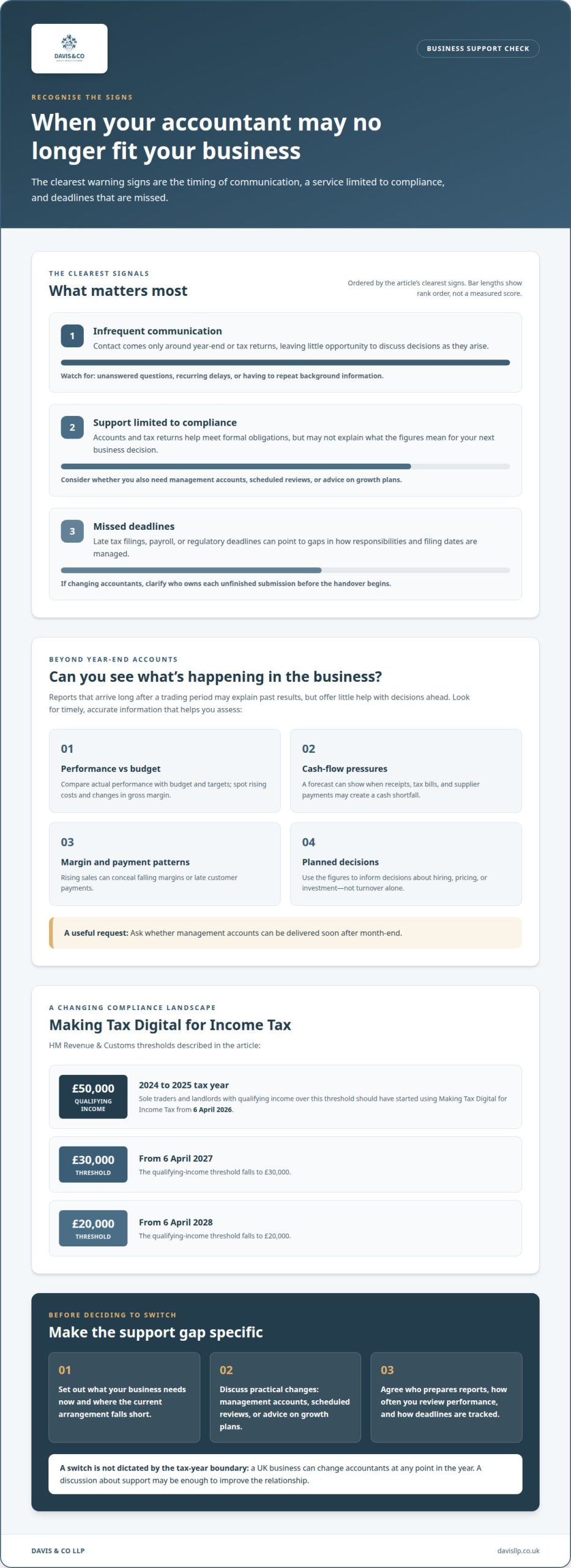
Several signs you have outgrown your accountant show up in the quality and timing of management information. Reports that arrive long after a trading period may explain past results but offer little help with decisions ahead. A growing business needs timely, accurate figures comparing actual performance with budget and highlighting cash-flow pressures and changes in gross margin. Rising sales, for example, can conceal falling margins or late customer payments.
Ask whether management accounts can be delivered soon after month-end. Regular reports can help you spot rising costs, compare results with targets, and assess whether planned spending is affordable. Cash-flow planning adds another perspective: a forecast can show when receipts, tax bills, and supplier payments may create a cash shortfall. Use these figures to inform decisions about hiring, pricing, or investment instead of relying on turnover alone.
Tax requirements can also change the information and support you need. According to HM Revenue & Customs, UK sole traders and landlords with qualifying income over £50,000 in the 2024 to 2025 tax year should have started using Making Tax Digital for Income Tax from 6 April 2026. The qualifying-income threshold falls to £30,000 from 6 April 2027 and £20,000 from 6 April 2028, according to HM Revenue & Customs. For a company director, section 455 tax may apply to an outstanding director’s loan, according to UK legislation portal.
If you decide to change accountants, request a complete handover of accounting records, filed accounts, tax returns, and relevant VAT and payroll records. Ask for the latest management reports and a clear list of upcoming filing dates, so the next adviser can take over with an accurate picture.
To check an accountant’s qualifications, ask which professional body they belong to and verify their membership in that body’s register. Confirm the named individual’s status rather than relying only on the firm’s description, and clarify who will handle your reports and advice.
2. Infrequent communication and compliance-only accounting
An accountant who contacts you only once a year may meet filing needs without supporting decisions between deadlines. If contact comes only around year-end or tax returns, advice can become reactive: you hear about an issue after it affects profit, rather than discussing options beforehand. Raise this pattern if your business has changed, taken on new work, or faces decisions that need current financial insight.
Compliance remains essential. Preparing accounts and submitting tax returns help meet formal obligations, but they don’t necessarily show what the figures mean for your next decision. A business owner considering a new project, for example, may need to understand likely costs, payment timing, and the effect on working capital. If your accountant mainly responds to documents or queries, ask whether the agreed service includes discussing business decisions as well as completing filings.
Continuity matters, too. If different team members handle each email, you may have to repeat background information or explain changes to your trading plans. Keep a simple record of unanswered questions, recurring delays, and information you’ve had to provide again. Share specific examples with your accountant and agree how updates, queries, and urgent issues will be handled. A clear contact process helps distinguish routine compliance from issues that need timely discussion.
Set expectations around the information you need and when you need it. For instance, agree a regular review of current performance, upcoming tax obligations and significant changes to your plans. A same-day reply may suit some arrangements, but the important point is a clear, workable response process. If you need support focused on VAT filings and related obligations, VAT compliance support may be relevant to your requirements.
3. Discussing needs with an existing accountant before switching
Before changing accountants, set out what your business needs now and where the current arrangement falls short. Give specific examples, such as needing a forecast before a hiring decision or clearer insight into project profitability. Ask whether the service can be adjusted to include management accounts, scheduled reviews, or advice on growth plans. The support should reflect your business’s structure and ambitions, not just its turnover.
Use the conversation to agree practical responsibilities. Clarify who will prepare reports, how often you’ll discuss performance, what information you need to provide, and how upcoming deadlines will be tracked. If you’re considering a new project, for example, agree what forecast would help assess its cash requirements and likely return. These details can show whether your accountant can adapt the support to your needs.
You can change accountants before the end of the tax year. A UK business can switch at any point in the year, so the tax-year boundary does not determine when a change is possible.
Changing accountants during a tax return or VAT filing deadline can create handover risks: missing records, uncertainty over who is responsible for an unfinished submission, or delays while the new accountant reviews previous work. Reduce disruption by identifying the status of each filing, gathering supporting documents, and agreeing who will complete outstanding work before the transfer begins.
After the discussion, compare the proposed arrangement with the outcomes you need. A written summary can record agreed reporting, forecasting, communication, and deadline processes, making it easier to assess whether the relationship is improving. If the revised scope still leaves you without timely insight, switching may be more practical. A clear record of the discussion and outstanding tasks also gives a successor accountant a useful starting point.
4. Late tax filings, payroll and regulatory deadlines
Missed deadlines can expose a growing business to penalties and signal weaknesses in its accounting process. In the UK, most small companies must pay Corporation Tax 9 months and 1 day after the end of their accounting period, according to HM Revenue & Customs. A limited company must file its annual accounts with Companies House within 9 months of its year end. The separate Company Tax Return is due within 12 months of the accounting period’s end, according to HM Revenue & Customs. Keep payment and filing dates distinct in your records.
Payroll and VAT involve recurring obligations that require dependable preparation. UK PAYE filings are made through RTI on or before payday, while a UK limited company must submit VAT returns every quarter. A payroll change, late timesheet, or missing sales record can disrupt the information needed for accurate submissions. Clarify who is responsible for collecting records, reviewing figures, and confirming each filing has been made.
Companies House deadlines go beyond annual accounts. Companies House can impose a financial penalty for a late confirmation statement, and late company accounts can result in automatic penalties in the UK. Create one calendar showing each deadline, the records needed, and the person responsible. For example, set a reminder ahead of a VAT return date to allow time to resolve missing invoices.
Growth can make deadline management more complex: new staff bring payroll information, while additional projects increase transaction volumes. Review your process whenever the business changes, and look for repeated late requests, unclear ownership, or missed submissions. A pattern across tax, payroll, and Companies House filings points to a process problem, not just one overlooked date. Keep filing confirmations with your accounts so you can quickly establish what has been submitted.
If payroll processing and payday submissions need more consistent handling, explore payroll services as part of a clearer compliance process. Agree responsibilities for gathering information and preparing submissions, then maintain a calendar that covers tax, payroll and Companies House obligations.
Davis & Co LLP: International Tax Planning
Davis & Co LLP provides International Tax Planning for individuals and businesses with cross-border tax considerations. This may be relevant if your business is expanding internationally, your income involves more than one country, or your current accountant’s support no longer reflects the complexity of your affairs.
For broader business needs, Davis & Co LLP also offers Business Growth Acceleration and Cash Flow Management. These services can support you in considering growth plans alongside your business’s financial position. Personal Tax Services are available for individual tax matters.
A conversation can help you explain your circumstances and identify the support that fits your needs. Contact Davis & Co LLP to discuss your requirements.
Choose accounting support that fits your next stage
Recognising the signs you have outgrown your accountant is a reason to review the relationship, not to rush a decision. Start by defining the insight and support your next stage requires, then consider whether your current arrangement can provide it. Knowing your priorities can make the next conversation more constructive.
Davis & Co LLP offers International Tax Planning, Business Growth Acceleration, and Cash Flow Management. These services may help businesses reviewing cross-border tax matters, growth plans, or cash-flow needs. The right starting point depends on the challenges you want your accounting support to address.
If you’re ready to discuss what would help your business move forward, contact Davis & Co LLP. A considered conversation can help you identify a practical next step with confidence.
Frequently Asked Questions
What are the signs I could be outgrowing my accountant?
You may be outgrowing your accountant if their advice no longer reflects your business goals, structure, or sector. A company expanding into a new market, for example, may need advice that accounts for its changing operations, not simply the processes used when it was smaller. Consider whether discussions help you assess opportunities and obstacles, or leave you relying on instinct for important decisions.
What should you expect from an accountant as your business grows?
As your business grows, expect advice to respond to its goals and changing financial needs. This might involve discussing how to fund expansion, whether pricing supports profitability, or how owners might approach profit extraction. The key measure is relevance: your accountant should understand the decision you face, explain the financial considerations clearly, and help you assess options in the context of your business.
What are the signs your accountant is no longer meeting your business needs?
A mismatch may become clear when advice remains generic despite changes to your business model, ownership, or industry. A construction firm, for instance, may need an accountant who understands project cash flow, subcontractor issues, and retention payments. If you repeatedly have to explain core aspects of your business, or your accountant cannot connect financial advice to your priorities, discuss whether the scope of the relationship needs to change.
How do you know when to change accountants in the UK?
Consider changing when you’ve clearly explained the support you need, discussed possible changes to the arrangement, and still don’t have a suitable fit. A UK business can switch accountants at any point in the year. Before deciding, weigh the value of the proposed service against the work involved in transferring records and responsibilities, especially if a filing is already underway.
What should a good UK accountant provide beyond annual accounts and tax returns?
Beyond compliance, an accountant can help you understand financial choices and plan for potential changes. They might discuss whether a proposed hire fits your forecasts or how a new pricing approach could affect margins. Advice should relate to your objectives and explain the financial implications clearly, giving you useful context rather than figures without interpretation.