With 62.6% of invoices in the UK currently paid late, the margin for error in your financial planning has never been slimmer. You likely understand the quiet frustration of balancing ambitious growth plans against the reality of unpredictable client payments and the constant pressure of maintaining VAT reserves. It’s a delicate equilibrium that can weigh heavily on a director’s mind, particularly as we approach the economic fluctuations and regulatory shifts scheduled for 2026. We recognise that for a professional practice, stability isn’t just a goal; it’s the foundation of every strategic move you make.
This guide provides a comprehensive framework for cash flow management for small business uk, moving your operations beyond passive monitoring toward active, strategic foresight. You’ll learn to master the principles of liquidity and accurate 12-month forecasting to ensure your business remains resilient. We’ll examine how to integrate tax compliance with your broader commercial objectives, providing the clarity needed for informed investment decisions. By the end of this article, you’ll have a clear roadmap to secure your firm’s financial future and move forward with the confidence that only deep financial insight can provide.
Key Takeaways
- Understand the critical distinction between business profitability and actual liquidity to ensure your firm remains solvent during periods of expansion.
- Implement a rolling 12-month forecast that integrates historical data with forward-looking assumptions to navigate the 2026 economic landscape.
- Master sophisticated techniques for cash flow management for small business uk to optimise your inflows and preserve vital supplier goodwill.
- Utilise surplus cash as a strategic lever for organic growth, reducing your reliance on external debt while enhancing your investment readiness.
- Transition from passive record-keeping to proactive strategy by leveraging professional management accounts for more precise commercial oversight.
The Fundamentals of Cash Flow Management for Small Business UK
At its core, The Fundamentals of Cash Flow describe the net amount of cash and cash equivalents being transferred in and out of a company. For a director, this isn’t merely an accounting metric; it’s a measure of your firm’s immediate vitality. Effective cash flow management for small business uk requires a shift in focus from historical reporting to real-time liquidity tracking. This process ensures that working capital remains sufficient to cover day-to-day operational costs, from payroll to supplier settlements, without necessitating urgent credit. Without a firm grasp of these movements, even a growing business can find itself in a position of technical insolvency.
Cash Flow vs. Profit: Why Both Matter
A common misconception in business management is that a healthy bottom line equates to financial security. It’s entirely possible for a firm to report substantial profits while simultaneously facing insolvency. This often occurs when capital is tied up in high inventory levels, work-in-progress, or extended payment terms with clients. While your profit and loss statement reflects your performance over a period, it doesn’t account for the timing of those funds. You might’ve secured a major contract that looks excellent on paper, but if the payment isn’t due for 90 days while your staff costs are due tomorrow, the gap can be fatal.
Profit is an opinion, but cash is a fact.
The 2026 UK Economic Landscape
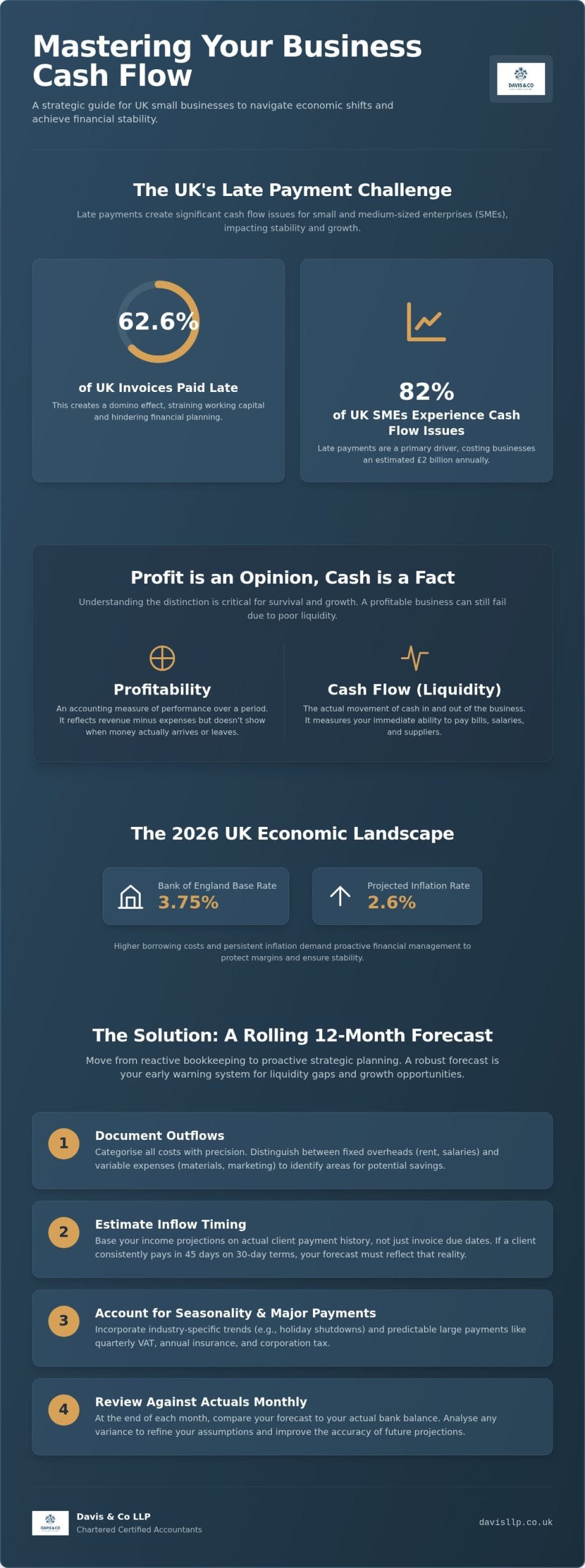
The current environment demands heightened vigilance. With the Bank of England base rate at 3.75% as of July 2026, the cost of servicing debt has become a significant factor in outflow predictability. Inflation, currently at 2.6%, continues to exert pressure on supply chain costs, making it harder to maintain stable margins. Research indicates that 82% of UK SMEs struggle with cash flow issues, often driven by the fact that 62.6% of invoices are paid late. This costs UK businesses approximately £2 billion annually, a figure that underscores why cash flow management for small business uk must be proactive rather than reactive.
We believe that resilience in the post-transition market depends on your ability to forecast these fluctuations before they impact your reserves. Managing these variables requires more than just a spreadsheet; it necessitates a strategic understanding of how external economic shifts influence your internal liquidity. By identifying potential shortfalls early, you can make informed decisions about scaling, hiring, and capital expenditure without jeopardising your firm’s stability.
Strategic Cash Flow Forecasting: Moving Beyond the Spreadsheet
While basic bookkeeping records what has already transpired, strategic cash flow management for small business uk requires a forward-looking lens. A rolling 12-month forecast serves as an early warning system, allowing you to anticipate liquidity gaps before they disrupt your operations. It transitions your finance function from simple record-keeping to a sophisticated tool for strategic management accounting. We believe this distinction is vital. Operational forecasting might tell you if you can meet next month’s payroll, but strategic forecasting tells you if you can afford to acquire a competitor or invest in new equipment in six months.
How to Build a Robust 12-Month Forecast
Building a reliable model involves more than just copying last year’s figures into a new sheet. We recommend a structured, four-step approach to ensure accuracy and commercial relevance:
- Document fixed and variable outflows: Categorise your costs with precision, distinguishing between non-negotiable overheads and discretionary spending. This allows you to see exactly where you can tighten the belt if needed.
- Estimate inflow timing: Base your projections on actual debtor history rather than optimistic invoice due dates. If a major client typically pays in 45 days despite 30-day terms, your forecast must reflect that reality.
- Account for seasonality: Incorporate industry-specific trends, such as holiday shutdowns or peak trading periods, that are unique to the UK market. Don’t forget to account for quarterly VAT payments and annual insurance renewals.
- Review against actuals: At the close of each month, compare your forecast to your bank balance. Use the variance to refine your assumptions for the remaining months.
Scenario Planning for Market Volatility
In an era defined by economic shifts, a single “expected” forecast is often insufficient. Strategic directors utilise scenario planning to model different outcomes. This involves creating “Best Case,” “Expected,” and “Worst Case” financial models to understand how your liquidity reacts to external pressures. For example, you might model how a 10% increase in raw material costs would affect your ability to service debt.
Stress-testing your cash flow against potential UK supply chain disruptions or sudden shifts in interest rates allows you to build a necessary buffer. This level of insight is only possible when you have access to high-quality Management Accounts that reflect the current reality of your business. By moving beyond static spreadsheets, you gain the agility to pivot your strategy when the market changes, ensuring that your firm remains ready for growth regardless of the economic climate.
Optimising Inflows and Outflows for Maximum Liquidity
Maximising liquidity requires a meticulous approach to the timing of every transaction. Effective cash flow management for small business uk isn’t just about the total volume of funds moving through your accounts; it’s about the velocity of that capital. When cash sits in unpaid invoices or excess stock, it’s essentially dead weight that cannot be deployed for growth. We advocate for a strategy that shortens the ‘cash conversion cycle’ by refining how you handle every pound that enters or leaves your business.
Accelerating accounts receivable is often the most immediate way to bolster liquidity. However, this must be handled with the discretion of a partner rather than the aggression of a debt collector. Clear communication and early intervention are key. On the other side of the ledger, managing accounts payable involves a strategic delay that preserves your cash without alienating essential suppliers. It’s a delicate balance that ensures you have the funds required for operational spending while keeping your long-term strategic investments on track. For retailers and wholesalers, this also means scrutinising inventory levels to ensure capital isn’t trapped in slow-moving stock.
Advanced Credit Control Techniques
Modern credit control relies on consistency. Implementing automated reminders at set intervals before and after the due date reduces the administrative burden and removes the emotional friction from chasing payments. For 2026, many firms are adopting tiered late payment penalties to incentivise promptness. We also suggest reviewing the benefits of early settlement discounts; while they reduce your margin slightly, the immediate boost to liquidity is often worth the cost. Accessing expert tax advice in the UK can be invaluable here, as it helps you structure client contracts that protect your cash flow from the outset.
Managing UK Tax Reserves and VAT
One of the most common pitfalls for small businesses is the ‘VAT shock’ at the end of a quarter. We recommend maintaining separate ‘tax pots’ or digital sub-accounts to hold VAT and Corporation Tax reserves as they’re collected. This ensures you aren’t inadvertently using HMRC’s funds to cover operational costs. By aligning your VAT payment cycles with your 12-month forecast, you can predict these outflows with certainty. Phased saving for Corporation Tax liabilities, based on your management accounts, prevents the need for sudden, large withdrawals that could otherwise stall your momentum.
Cash Flow as a Business Growth Accelerator
While many directors view liquidity through a defensive lens, high-performing firms treat surplus capital as a primary engine for expansion. Effective cash flow management for small business uk allows you to fund organic growth without the burden of expensive debt. By maintaining a robust liquid reserve, you gain the agility to seize market opportunities, such as acquiring a competitor or investing in a new product line, without waiting for external credit approval. This internal funding model is particularly valuable in the current climate, where the cost of capital remains a significant factor in strategic decision-making.
However, rapid expansion carries its own risks. We often see the phenomenon of overtrading, where a surge in sales leads to a critical cash shortfall because the business must pay for increased inventory and payroll before the new revenue arrives. A strong cash position acts as a buffer against this risk, ensuring that your growth is sustainable rather than a threat to your firm’s existence. Furthermore, a history of positive cash flow significantly improves your investment readiness, presenting a narrative of reliability to UK lenders should you eventually require larger-scale external finance.
Funding Growth: Internal vs. External Capital
Evaluating the cost of capital is essential when deciding how to fuel your next phase. Using internal reserves avoids interest payments and complex covenants, preserving your autonomy. With the Bank of England base rate at 3.75% as of mid-2026, the financial benefit of self-funding is clear. We suggest identifying a tipping point where the potential return on a new project exceeds the cost of a bank loan. By building a strong balance sheet now, you ensure that when you do approach a lender, you’re doing so from a position of strength, often securing more favourable terms and higher borrowing limits.
The Role of Management Accounting in Scaling
Safe expansion depends on the quality of your data. Strategic small business accountants provide the necessary oversight to monitor your cash conversion cycle efficiency. This involves tracking how quickly your investment in resources translates into cash inflows. By using precise KPIs, you can allocate capital expenditure or R&D budgets based on projected surpluses. This methodical approach replaces guesswork with analytical rigour, allowing you to scale your operations with confidence. If you’re planning to expand your footprint in 2026, our Business Growth Acceleration experts can help you design a financial framework that supports your ambitions without compromising your stability.
The Value of Professional Partnership in Cash Flow Management
Modern accounting software has undoubtedly simplified the recording of transactions, yet it’s a mistake to conflate data entry with strategic oversight. While an application can show you a bank balance, it cannot interpret the nuances of your specific market or provide the calm, expert counsel required during a period of rapid scaling. We believe that true cash flow management for small business uk is an intellectual exercise rather than a digital one. It requires the ability to look beyond the dashboard and understand the commercial implications of every figure.
By partnering with a firm like Davis & Co LLP, you gain access to over a century of heritage in professional practice. We don’t merely provide reports; we act as a strategic advisor, helping you move from reactive bookkeeping to a position of proactive financial leadership. This transition is vital for directors who wish to spend less time worrying about liquidity and more time focusing on the core growth of their organisation. Our role is to provide the clarity you need to make bold decisions with the security of knowing your financial foundation is sound.
Beyond Bookkeeping: Strategic Management Accounts
A professional management accounts pack is far more than a simple Profit and Loss statement. It should include a detailed balance sheet, a comparative cash flow statement, and a thorough analysis of your aged debtors and creditors. The most critical component, however, is the Director’s Review. This is a collaborative session where we sit down with you to interpret the numbers, identifying trends and potential risks before they manifest as crises. This regular oversight acts as a safeguard against compliance failures and ensures that tax liabilities never arrive as a surprise, providing a level of discretion and reliability that software alone cannot replicate.
Next Steps: Securing Your Business Future
Transitioning from DIY tracking to professional management begins with a shift in mindset. We suggest integrating your cash flow reports into your formal quarterly board meetings, ensuring that liquidity is given equal weight to sales and operations. This creates a culture of financial discipline that permeates the entire organisation. It moves the conversation from “what happened” to “what is possible.” If you’re ready to move beyond basic accounting and embrace a more sophisticated approach to your firm’s future, we invite you to Contact Davis & Co LLP for a bespoke cash flow and growth assessment. Our team is here to ensure that your business remains resilient, liquid, and prepared for the opportunities 2026 will bring.
Securing Your Firm’s Financial Future in 2026
Mastering the movement of capital within your organisation is the difference between merely surviving economic cycles and actively leading your industry. We’ve explored how transitioning to a rolling 12-month forecast and optimising your credit control can transform liquidity from a source of anxiety into a strategic advantage. It’s clear that cash flow management for small business uk is no longer a back-office administrative function; it’s a primary lever for sustainable growth and long-term resilience.
As Chartered Certified Accountants since 1901, we bring over a century of heritage to every client relationship. Our team specialises in growth acceleration, management accounting, and complex international tax planning, ensuring your financial strategy remains as ambitious as your commercial goals. We invite you to Partner with Davis & Co LLP for Strategic Cash Flow and Growth Advice to secure the expert oversight your firm deserves. With the right analytical framework and a dedicated strategic partner, you can move forward with the confidence that your business is both stable and ready to capture the opportunities that lie ahead.
Frequently Asked Questions
What is the most common cause of cash flow problems for UK small businesses?
Late payments from clients remain the primary driver of liquidity issues. According to current research, 62.6% of UK invoices are settled after their due date, which places immense pressure on working capital. This delay often forces directors to rely on overdrafts or credit, increasing the cost of operations. By implementing rigorous credit control and automated reminders, you can mitigate this risk and ensure that your firm’s cash cycle remains predictable and stable.
How much cash reserve should a small business ideally hold in 2026?
While requirements vary by sector, we typically recommend maintaining a reserve equivalent to three to six months of essential operating expenses. In the 2026 economic environment, with inflation at 2.6% and interest rates at 3.75%, this buffer protects against supply chain volatility and sudden shifts in borrowing costs. Holding these funds in a high-yield liquid account ensures you can meet payroll and tax obligations even during a temporary downturn in client receipts.
Can I use my accounting software for cash flow forecasting?
Most modern platforms offer basic forecasting modules, but they often lack the nuance required for complex cash flow management for small business uk. Software typically relies on historical data and doesn’t account for future market assumptions or strategic shifts in your business model. For a truly robust 12-month outlook, you need to supplement these digital tools with professional analysis that considers external economic variables and your specific commercial objectives for the year ahead.
How does the 2026 VAT threshold affect my cash flow planning?
The VAT registration threshold is currently £90,000. If your turnover approaches this level, your cash flow planning must account for the 20% standard rate you’ll need to collect and remit to HMRC. This transition can significantly impact your pricing strategy and net margins. We advise creating a dedicated VAT reserve account early to ensure that these funds are never mistakenly used for operational expenses, preventing a liquidity crisis when your quarterly return is due.
What is the difference between cash flow management and bookkeeping?
Bookkeeping is the process of recording historical financial transactions to ensure accuracy and compliance. In contrast, cash flow management for small business uk is a strategic discipline focused on the timing and availability of funds for future operations. While bookkeeping tells you what has happened, cash flow management uses that data to predict what will happen. It allows you to make informed decisions about hiring, investment, and expansion based on projected liquidity levels.
Is it better to pay suppliers early or wait until the due date?
Generally, it’s more beneficial to retain cash within your business until the invoice due date to maximise your liquidity. However, you should evaluate this against any early settlement discounts offered by your suppliers. If the discount exceeds the interest you’d earn by holding the cash, paying early may be the more efficient choice. Maintaining clear communication with suppliers is essential to ensure that delaying payment doesn’t damage your reputation or future credit terms.
How can a chartered accountant help with business growth acceleration?
A chartered accountant provides the analytical rigour needed to scale safely. At Davis & Co LLP, we use management accounts to track key performance indicators that reveal the efficiency of your cash conversion cycle. By identifying where capital is trapped, we help you reinvest surpluses into high-growth areas. Our centennial heritage allows us to offer a perspective that combines traditional reliability with contemporary strategies for business growth acceleration and long-term commercial success.
What happens if my business has a temporary cash flow shortfall?
If a shortfall occurs, immediate communication with creditors is the most effective first step. Many suppliers and HMRC offer payment plans if they’re notified before a deadline is missed. You should also review your aged debtors to see if any outstanding invoices can be accelerated through proactive chasing. If the gap is structural rather than temporary, we can help you explore short-term financing options or adjust your operational spending to restore a healthy balance.