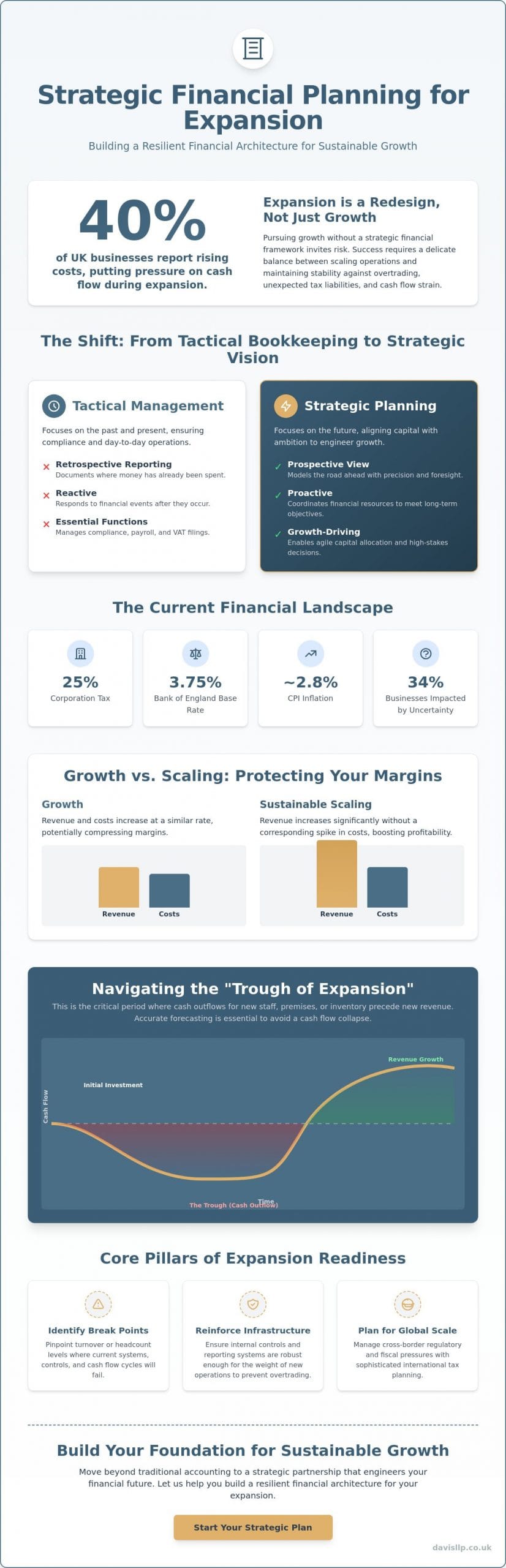
Expansion is not a matter of increasing volume; it’s a fundamental redesign of your financial architecture. We recognise the common concern that rapid scaling can often lead to cash flow strain, particularly as 40% of UK businesses reported rising costs in April 2026. It’s a delicate balance to pursue growth without inviting the risks of overtrading or unexpected tax liabilities. To succeed, your organisation requires strategic financial planning for expansion that prioritises stability as much as it does reach.
In this guide, we will help you master the financial architecture required to scale sustainably while maintaining rigorous tax efficiency and cash flow stability. We’ll provide a clear overview of the essential steps, from navigating the 25% corporation tax rate to implementing international tax planning for new jurisdictions. This approach ensures your expansion is built on a foundation of professional precision and long term resilience.
Key Takeaways
- Identify the shift from tactical bookkeeping to a sophisticated financial architecture that accommodates rising operational complexity.
- Implement strategic financial planning for expansion to stress-test your growth assumptions against volatile market conditions.
- Evaluate the optimal capital structure to ensure working capital remains resilient as your business scales.
- Navigate international tax planning and VAT compliance with precision to mitigate the risk of unforeseen liabilities in new markets.
- Recognise why sustainable growth requires a multidisciplinary approach that moves beyond traditional accounting into a strategic partnership.
The Architecture of Growth: Defining Strategic Financial Planning
Growth is frequently mistaken for a simple increase in volume, yet for the established UK business, it represents a fundamental shift in operational complexity. In the current economic climate of 2026, where the Bank of England base rate remains at 3.75% and CPI inflation has settled near 2.8%, the cost of capital and the price of miscalculation have both risen. Relying on strategic financial planning for expansion allows a leadership team to move beyond reactive management. It’s the process of building a fiscal framework capable of supporting a larger, more intricate version of your organisation without compromising its core stability.
Most businesses possess a functional accounting department that excels at retrospective reporting. They can tell you exactly where your money went last quarter. However, expansion demands a prospective view. It requires an analytical shift from documenting history to engineering the future. We believe that true resilience is found when a company stops looking in the rearview mirror and begins to model the road ahead with precision and foresight.
Tactical vs. Strategic Financial Management
The distinction between tactical bookkeeping and strategic planning is often the difference between surviving and thriving. Tactical management focuses on compliance, payroll, and VAT filings; these are essential but do not drive growth. In contrast, understanding what is strategic planning involves the high level coordination of financial resources to meet long term objectives. It’s about ensuring that every pound of capital is working toward a specific, measurable milestone within your corporate vision. Strategic financial planning is the alignment of capital with ambition.
In 2026, capital allocation requires more agility than in previous decades. With 34% of businesses reporting that economic uncertainty continues to impact turnover, the ability to pivot funding from underperforming divisions to high growth opportunities is vital. We work with our clients to establish management accounts that serve as a compass, providing the real time data necessary to make these high stakes decisions with composed confidence.
The Core Pillars of Expansion Readiness
Before an organisation can scale, it must identify its “break points.” These are the specific levels of turnover or headcount where current internal controls, reporting systems, and cash flow cycles will begin to fail. Without strategic financial planning for expansion, the risk of overtrading becomes a statistical probability rather than a remote concern. We focus on reinforcing these pillars to ensure the infrastructure is robust enough for the weight of new operations.
For many UK firms, growth in 2026 involves looking beyond domestic borders. This transition introduces a new layer of regulatory and fiscal pressure. It’s at this stage that the necessity of international tax planning becomes clear. Managing cross border growth requires a sophisticated understanding of different jurisdictions to maintain tax efficiency and protect your margins. By assessing your readiness now, we ensure that your financial architecture is a facilitator of growth, not a barrier to it.
Building Scalable Financial Models for Sustainable Expansion
Scaling a business is often conflated with simple growth, yet the two are distinct. Growth refers to increasing revenue, while scaling is the ability to increase that revenue without a corresponding spike in costs. Without a dynamic financial model, many UK firms find that their margins actually compress as they expand. In 2026, where 40% of businesses are already reporting increased costs for goods and services, the margin for error is slim. Effective strategic financial planning for expansion relies on models that don’t just predict success, but also account for the friction of change.
A static spreadsheet is insufficient for a modern enterprise. Your financial architecture must be dynamic, allowing you to adjust variables such as the 3.75% base rate or shifting labour costs in real time. We focus on identifying the “trough of expansion.” This is the critical period where cash outflows for new staff, premises, or inventory precede the arrival of new revenue. If this trough isn’t accurately forecasted, even a successful sales strategy can lead to a cash flow collapse.
Scenario Planning and Risk Mitigation
Resilience is built through stress-testing. We advocate for a three-tier approach to scenario planning: best, base, and worst-case. In the current landscape, this means quantifying the impact of potential supply chain disruptions or regulatory shifts. For instance, with inflation sitting at 2.8%, a sudden spike in operational overheads could derail a project if it hasn’t been modelled as a “worst-case” possibility. It’s often helpful to explore government-backed financial support for UK businesses to bridge these gaps, provided they align with your long term debt strategy.
This level of analysis is where the role of a small business accountant evolves. They move beyond the role of a compliance officer to become a growth advisor, ensuring that your expansion assumptions are grounded in fiscal reality rather than optimism. We believe this transition is essential for any leadership team that values long term stability over short term gains.
Utilising Management Accounts for Real-Time Scaling
Waiting for year-end figures to assess performance is a luxury that scaling businesses cannot afford. Real-time feedback is the only way to catch leading indicators of financial strain before they become systemic failures. By integrating professional management accounts into your monthly workflow, you gain the visibility needed to pivot when a growth initiative isn’t yielding the expected ROI. These reports do more than just track spending; they provide the intellectual rigour required to secure external investment or bank funding.
If you’re preparing for your next phase of growth, our team can help you build the robust models necessary to scale with confidence. We invite you to examine our management accounting services to see how we can support your strategic objectives.
Capital Structure and Cash Flow Management During Growth
Funding an expansion represents one of the most significant financial hurdles a leadership team will face. It’s not merely a question of how much capital is required, but rather how that capital is structured to preserve the long term health of the organisation. In a climate where the Bank of England base rate is held at 3.75%, the cost of debt remains a primary consideration. Relying too heavily on borrowing can lead to restrictive covenants, while over-reliance on equity may unnecessarily dilute ownership. Effective strategic financial planning for expansion seeks the optimal equilibrium between debt, equity, and retained earnings to fuel growth without compromising autonomy.
The danger of “overtrading” is a very real threat during high-growth phases. This occurs when a business expands its sales volume more rapidly than its working capital can support. You might see record-breaking orders on the books, yet find your bank balance depleted as you struggle to pay suppliers and staff before customers settle their invoices. We focus on refining the Cash Conversion Cycle (CCC) to mitigate this risk. By shortening the duration between the initial outlay of cash and its eventual recovery from sales, you reduce your reliance on expensive external borrowing and improve your internal liquidity.
Securing Expansion Funding in 2026
The UK lending landscape in 2026 requires a high degree of transparency and preparation. With 34% of trading businesses reporting that economic uncertainty is still a factor in their decision-making, lenders have become more discerning. To secure favourable terms, your financial dossier must be beyond reproach. This is where the value of professional audit and assurance becomes evident. A robust audit doesn’t just satisfy regulatory requirements; it builds the necessary confidence for banks and investors by providing an independent verification of your financial position. It’s a signal of professional gravitas that can significantly lower your perceived risk profile.
Preserving Liquidity Amidst Capital Expenditure
Expansion often involves significant capital expenditure, whether in technology, premises, or human capital. The challenge lies in funding these long term investments without draining the liquidity needed for day-to-day operations. We advise our clients to maintain a disciplined approach to working capital, specifically by managing creditor and debtor terms with precision. Extending your payables where possible and incentivising earlier receivables can provide a vital cash buffer during the volatile early stages of a new project.
Cash flow is the primary cause of expansion failure. It’s often the silent killer of otherwise brilliant commercial strategies. By integrating strategic financial planning for expansion into your core operations, you ensure that your growth is funded sustainably. We work as your strategic partner to monitor these metrics, providing the steady, measured guidance needed to navigate the complexities of capital management in a scaling environment.
Tax Optimisation and Compliance in a Scaling Environment
Taxation is frequently viewed as a secondary compliance concern, but for an expanding enterprise, it’s a primary determinant of net profitability. As your business grows, the fiscal landscape shifts significantly. For companies with profits exceeding £250,000, the 25% main rate of Corporation Tax applies, while those between £50,000 and £250,000 must navigate the complexities of marginal relief. Incorporating strategic financial planning for expansion ensures that your tax strategy evolves alongside your turnover, preventing a scenario where growth is eroded by inefficient fiscal structuring.
Compliance in 2026 also requires a rigorous approach to digital reporting. HMRC’s evolving requirements demand real-time accuracy, particularly as you cross the £90,000 VAT registration threshold. We help our clients leverage these digital mandates as an opportunity for better data visibility, using the required reporting frameworks to sharpen internal insights. Beyond basic compliance, we look for incentives such as R&D tax credits to reclaim costs associated with innovation, effectively using the tax system to fund your next phase of development.
International Tax and Jurisdictional Complexity
Entering new international markets is a milestone that introduces the risk of permanent establishment. Simply having a fixed place of business or a dependent agent in another country can create a taxable presence, often leading to unforeseen liabilities. We focus on managing these risks through precise transfer pricing documentation for intra-group transactions. This ensures that profits are allocated correctly across jurisdictions, reflecting the economic reality of where value is created. Seeking expert tax advice in the UK is a vital safeguard against double taxation and ensures your global footprint remains tax-efficient.
Structuring for Long-Term Tax Efficiency
The choice between establishing a foreign branch or a subsidiary is a foundational decision with long-term consequences for profit repatriation and dividend strategies. A subsidiary offers a clear legal separation, whereas a branch is an extension of the UK entity; each has distinct implications for how losses are offset and how profits are taxed. It’s also essential to remain mindful of HMRC tax warnings regarding aggressive or artificial structures. We prioritise transparency and intellectual rigour, ensuring that your corporate architecture is both robust and fully compliant with current regulations.
If your growth plans involve cross-border operations, our specialists can provide the clarity you need to navigate these complexities. We invite you to explore our International Tax Planning services to ensure your expansion is built on a secure and efficient fiscal foundation.
The Strategic Partnership: Beyond Traditional Accounting
Expansion is more than a fiscal exercise; it’s a profound organisational transformation that requires a shift in how you view professional counsel. While a traditional accountant might focus on the accuracy of your past, a strategic partner focuses on the viability of your future. As we’ve explored, strategic financial planning for expansion involves complex layers of tax optimisation and capital management. Navigating these requires more than technical skill. It demands a partner who understands the human and organisational impact of every decision made at the board level.
Our firm’s founding in 1901 serves as a testament to our enduring stability and discretion. In a 2026 economy where 73% of SMEs still expect to grow despite fragile confidence, having a partner with a century-long perspective provides a unique sense of security. This history enables us to provide a multi-disciplinary approach. We blend tax, audit, and growth advisory into a cohesive strategy that mitigates both financial and emotional risks, ensuring your leadership remains focused on commercial execution.
Selecting the Right Growth Advisor
Choosing an advisor for expansion requires a careful assessment of their scope and specialisation. You need a firm that can manage local payroll and VAT compliance while simultaneously offering the sophisticated international tax planning required for cross-border reach. Specific sector expertise is also invaluable. For instance, our specialist dental tax services provide the nuanced understanding required for clinical practices to scale effectively without compromising their professional standards.
When you seek to find a Chartered Accountant, prioritise those who demonstrate intellectual rigour and a history of successful partnerships. A true growth advisor doesn’t just provide a service; they integrate themselves into your strategic vision. They should be capable of identifying the “break points” in your financial structure before they manifest as operational crises. This foresight is the hallmark of a high-calibre advisor.
The Davis & Co Approach to Expansion
We approach every client relationship as a composed partnership. Our method involves integrating essential functions like payroll, VAT, and company secretarial services directly into your broader growth objectives. This ensures that the administrative foundation of your business is as robust as its commercial ambitions. By centralising these services, we provide a steady, measured rhythm of support that helps maintain stability during the most volatile phases of scaling. It’s a style of quiet excellence that doesn’t need to shout to be effective.
Successful strategic financial planning for expansion is built on trust, precision, and a shared commitment to long-term resilience. We invite you to Partner with Davis & Co LLP for your expansion journey and experience the benefits of a truly strategic alliance. Together, we can ensure your organisation’s growth is both sustainable and secure in an ever-changing market.
Securing the Foundation for Sustainable Growth
Sustainable scaling requires a transition from reactive management to a sophisticated financial architecture. By prioritising prospective modelling and rigorous tax efficiency, your organisation can avoid the common pitfalls of overtrading and unforeseen liabilities. It’s about ensuring that every commercial ambition is backed by the necessary capital and structural integrity. Our history suggests that those who plan with precision are best equipped to navigate the complexities of 2026 and beyond.
Implementing strategic financial planning for expansion is the defining factor between a company that merely grows and one that scales with resilience. As Chartered Certified Accountants since 1901, we bring over a century of stability to our partnerships. We specialise in international tax and business growth acceleration, providing tailored advisory for both UK and international SMEs that seek to expand with composed confidence.
Secure your business expansion with strategic financial planning from Davis & Co LLP. We look forward to supporting your organisation as it reaches its full potential in an evolving global market.
Frequently Asked Questions
What is the difference between growth and scaling in financial planning?
Growth refers to increasing revenue through a proportional increase in resources and costs. Scaling is the ability to increase revenue without a corresponding spike in operational overheads. This requires a fundamental redesign of your financial architecture to ensure that your margins don’t compress as volume rises. Distinguishing between the two is vital for long term profitability and organisational resilience.
How much working capital should I retain during an expansion phase?
The amount of working capital required depends on your specific cash conversion cycle and the depth of your forecasted expansion trough. We typically advise maintaining a liquidity buffer that covers at least three to six months of operating expenses. This ensures you can meet payroll and supplier obligations during the period before new revenue matures. It’s a necessary safeguard against the volatility of rapid scaling.
What are the primary tax risks when expanding a UK business internationally?
The primary risks involve creating a permanent establishment in a foreign jurisdiction, which triggers local tax liabilities and reporting requirements. Without proper international tax planning, you may also face double taxation on the same profits. Transfer pricing for intra-group transactions is another critical area; tax authorities require these to be conducted at arm’s length. Managing these complexities requires technical precision to protect your global margins.
Can my current accounting software handle the complexities of business expansion?
Standard accounting software is often sufficient for domestic compliance but may lack the multi-entity and multi-currency capabilities required for international growth. As complexity increases, you need systems that integrate with management accounts to provide real-time data visibility. If your current tools don’t support automated consolidation or complex tax reporting, they may become a bottleneck. We help clients evaluate systems that scale alongside their ambitions.
How does strategic financial planning impact my business valuation?
Strategic financial planning for expansion significantly enhances business valuation by demonstrating a track record of predictable cash flow and robust internal controls. Investors and acquirers look for organisations that have de-risked their growth through disciplined capital allocation. A well-structured financial model provides the evidence of stability and future profitability that justifies a higher multiple. It transforms your finance function into a primary value-driver.
Should I use debt or equity to fund my business expansion in 2026?
The choice depends on your current capital structure and the cost of capital in 2026. With the Bank of England base rate at 3.75%, debt remains a viable option for those with strong balance sheets; however, it introduces repayment obligations and restrictive covenants. Equity funding avoids debt service but results in ownership dilution. We analyse your specific circumstances to determine the optimal mix that preserves both liquidity and control.
How often should I update my financial forecasts during rapid growth?
During phases of rapid growth, we recommend updating your financial forecasts on a monthly basis. This frequency allows you to react to the real-time feedback provided by your management accounts. A static annual budget is insufficient when market conditions or operational costs shift quickly. Monthly reviews ensure that your strategic financial planning for expansion remains aligned with actual performance, allowing for timely and informed pivots.
What role does a Chartered Accountant play in the expansion process?
A Chartered Accountant serves as a strategic partner, moving beyond basic bookkeeping to provide high-level growth advisory and audit services. We ensure your organisational structure is tax-efficient and compliant with both UK and international regulations. By providing an independent verification of your financial health, we also build the necessary confidence for lenders and investors. Our role is to provide the steady, measured guidance required for secure scaling.