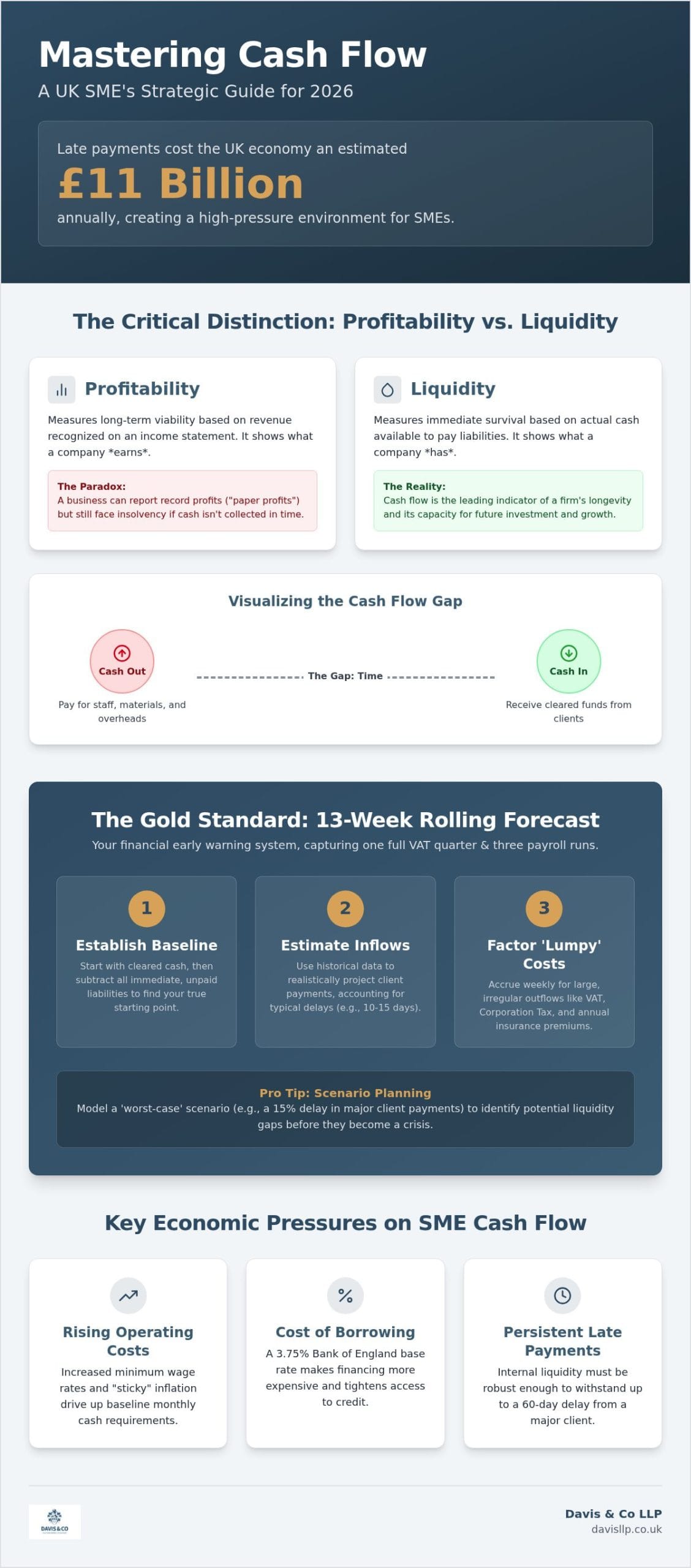
Late payments cost the UK economy an estimated £11 billion annually. For many directors, this isn’t just a distant statistic; it’s the primary reason for a restless night before a quarterly VAT deadline or a Corporation Tax payment. We understand that the “cliff-edge” of tax season, combined with a 3.75% Bank of England base rate and persistent operating costs, can make forecasting feel more like guesswork than governance. Strategic cash flow management for small business uk has become the defining discipline that separates resilient enterprises from those merely surviving in 2026.
We agree that the constant pressure of balancing working capital against growth ambitions is exhausting. This guide will help you master the principles of liquidity to ensure your business remains tax-compliant and ready for investment. We’ll explore how to build a predictable financial buffer, navigate the latest marginal relief thresholds, and leverage new late payment protections to secure your firm’s future.
Key Takeaways
- Master the 13-week rolling forecast to transition from retrospective reporting to proactive financial foresight and visibility.
- Identify and mitigate the risks of overtrading, ensuring that your expansion plans are always supported by sufficient working capital.
- Learn to integrate tax liabilities into your cash flow management for small business uk to prevent quarterly VAT and Corporation Tax payments from disrupting operations.
- Distinguish between accounting profit and available liquidity to maintain a resilient financial buffer in an inflationary environment.
- Understand how strategic management accounting serves as an early warning system, allowing for better-informed investment and hiring decisions.
Understanding Cash Flow as a Strategic Asset in 2026
In the current UK fiscal landscape, viewing financial statements as mere historical records is a significant strategic oversight. For a director, understanding What is Cash Flow within their specific operational cycle is the difference between strategic agility and forced stagnation. While profit demonstrates the long-term viability of a business model, cash flow measures its immediate survival. In 2026, cash flow management for small business uk isn’t just an administrative task; it’s a strategic asset that dictates how quickly you can pivot when market conditions shift.
Liquidity vs. Profitability: The Crucial Difference
It’s entirely possible for a UK company to report record profits while simultaneously facing insolvency. This paradox often stems from “paper profits” where revenue is recognised upon invoicing, yet the actual currency remains locked in the debtor ledger. High-growth firms are particularly vulnerable, as they often spend cash to fulfill new orders long before the resulting revenue arrives. For modern service-based businesses, the Cash Flow Gap represents the critical duration between paying for delivery costs, such as specialist staff and infrastructure, and the eventual receipt of cleared funds from the client. Relying on an Income Statement alone provides a distorted view of your ability to meet immediate liabilities like payroll or HMRC payments.
The 2026 Economic Context for UK SMEs
The current year has introduced unique pressures on working capital that require a more nuanced approach to cash flow management for small business uk. Recent adjustments to the minimum wage 2025 rates have increased the baseline monthly cash requirement for many sectors, especially those with significant headcount. When combined with “sticky” inflation and a Bank of England base rate of 3.75% as of July 2026, the cost of operational overheads has become far less predictable than in previous cycles.
We advise our clients to maintain a robust “cash cushion” to absorb these fluctuations without disrupting growth plans. With late payments still costing the UK economy an estimated £11 billion annually, your internal liquidity must be sufficient to withstand a 60-day delay from a major client without compromising your own supplier terms. In this environment, cash isn’t just a resource; it’s the primary leading indicator of your firm’s longevity and its capacity for future investment.
The Architecture of Effective Cash Flow Forecasting
Static bank balances only tell you where you were yesterday. To maintain effective cash flow management for small business uk, you must shift your gaze forward. We view the 13-week rolling forecast as the gold standard for SME governance. This specific window is long enough to capture a full quarterly VAT cycle and three payroll runs, yet short enough to maintain high levels of data accuracy. While many entrepreneurs rely on an ultimate guide to cash flow management for the basics, true resilience comes from categorising every outflow with precision.
Proactive forecasting requires a clear distinction between fixed and variable outflows. Fixed costs like rent and core salaries are predictable; variable costs, such as raw materials or performance-based marketing, fluctuate with business activity. We also advocate for scenario planning. By modelling a ‘Worst Case’ scenario, such as a 15% delay in client payments, you can identify potential liquidity gaps before they become crises. This analytical rigour ensures you’re never surprised by your own bank balance.
Building Your Rolling Forecast Model
Constructing a reliable model begins with three fundamental steps:
- Step 1: Establishing the Baseline. Start with your current cleared cash balance. Subtract any immediate, known liabilities that haven’t yet left the account to find your true starting point.
- Step 2: Estimating Realistic Inflows. Don’t just list your total accounts receivable. Use historical data to adjust for clients who typically pay 10 or 15 days late. In 2026, where the median turnover for a UK SME is £300,000, even minor delays can have outsized impacts.
- Step 3: Factoring in ‘Lumpy’ Costs. These are the irregular but significant outflows. Quarterly VAT payments, annual insurance premiums, and Corporation Tax must be accrued for weekly to avoid a sudden cash drain.
Leveraging Technology and Management Accounts
While basic bookkeeping software provides a helpful starting point, it often lacks the strategic depth required for complex decision-making. High-quality management accounts provide the granular data foundation needed for accurate forecasting. They allow us to see the “why” behind the numbers, identifying trends in supplier pricing or customer behaviour that software alone might miss. Real-time data accuracy is paramount; a forecast built on month-old data is a liability, not an asset. If you’re seeking a more robust framework, our team can help you design a bespoke system for cash flow management that aligns with your specific growth objectives.
Navigating the Growth Trap: Balancing Expansion with Liquidity
Expansion is often the most dangerous phase in a company’s lifecycle. While rising sales figures suggest success, they frequently mask a deepening liquidity crisis known as overtrading. This occurs when a business expands its operations too rapidly without sufficient working capital to support the increased demand for resources. Overtrading remains the primary reason why otherwise viable UK SMEs fail during their growth phase. Effective cash flow management for small business uk requires a disciplined approach to scaling, ensuring that every new contract is backed by a realistic funding plan before commitments are made.
The relationship between increased sales and the demand for capital is often non-linear. A 20% increase in turnover might require a 40% increase in available liquidity to cover upfront costs like additional headcount, inventory, or software licences. We advise directors to view growth as a series of controlled steps rather than a continuous sprint. Strategic timing is paramount; investing in new staff or technology should only occur when your 13-week forecast confirms a sustainable cash buffer. Rushing these decisions can lead to a “cash crunch” where you’re unable to meet payroll despite having a healthy order book.
The Cost of Scaling: A UK Perspective
Calculating your working capital cycle is essential before committing to significant expansion. This cycle measures the time elapsed between paying for raw materials or staff and receiving payment from your customers. If your industry typically operates on 60-day payment terms, a sudden influx of orders can deplete your reserves before the first invoice is settled. In 2026, with the Bank of England base rate at 3.75%, the cost of debt finance must be carefully weighed against the benefits of rapid growth. Organic growth, while slower, often provides a more stable foundation for long-term resilience, though many firms utilise the Growth Guarantee Scheme to bridge specific liquidity gaps during expansion.
Optimising Accounts Receivable and Payable
Optimising your ledger is a non-negotiable component of a growth strategy. Reducing your Days Sales Outstanding (DSO) involves more than just sending reminders; it requires robust credit control procedures and clear communication from the outset. We suggest referring to this Small Business Cash Flow Guide to establish these foundational habits within your team. Conversely, managing Days Payable Outstanding (DPO) requires a delicate balance. While extending supplier terms can preserve cash, it must be done ethically to maintain vital partnerships. Negotiating longer terms with key suppliers during a growth spurt is a strategic move, provided it’s handled with transparency and professional discretion. A collaborative approach with your supply chain often yields better credit terms than simply delaying payments without notice.
Implementing these procedures ensures that cash flow management for small business uk becomes a proactive tool for growth rather than a reactive response to crisis. By tightening your credit control and being selective about which customers you offer credit to, you protect the business from the volatility of the current economic environment.
Integrating Tax Planning with Working Capital Management
Tax obligations often represent the single largest cash outflow for a UK SME. We’ve seen many directors treat tax as an isolated year-end event, which inevitably creates a “Tax Cliff” where quarterly VAT and annual Corporation Tax payments destabilise operations. In 2026, with the Small Profits Rate at 19% and the Main Rate at 25%, the difference in cash impact is substantial. Integrating professional tax advice uk into your cash flow management for small business uk ensures these liabilities are predicted months in advance, rather than discovered days before the deadline.
We believe that tax planning and cash management are two sides of the same coin. By aligning your financial forecast with your tax cycle, you can transform a passive liability into a manageable operational expense. This approach is particularly beneficial for directors and shareholders who wish to extract value from the business without compromising the firm’s liquidity or triggering unforeseen personal tax burdens.
VAT and Corporation Tax: Timing is Everything
Strategic timing of capital expenditure can significantly influence your tax position and immediate cash reserves. For example, coordinating large equipment purchases or technology investments with your tax year-end can accelerate relief, provided your cash flow forecast supports the initial spend. We often recommend the use of “Sinking Funds” to remove the sting of major HMRC payments. By setting aside a calculated percentage of every invoice into a ring-fenced tax reserve, you ensure the funds are available when needed. For businesses pursuing global markets, international tax planning is vital to manage cash repatriation. Navigating different jurisdictions requires a sophisticated understanding of how global outflows affect your domestic UK cash position.
HMRC Compliance and Cash Flow Resilience
Compliance is a fundamental pillar of financial resilience. Late payment penalties and interest charges are an unnecessary drain on working capital that can be easily avoided with professional oversight. Following an hmrc tax warning regarding new interest rates or reporting requirements allows you to adjust your reserves before a penalty is triggered. Accurate, real-time bookkeeping ensures your cash flow management for small business uk is based on verified data, reducing the risk of being caught off-guard by a discovery assessment. If your current tax strategy feels reactive, our specialists can help you design a proactive cash flow management framework that prioritises both compliance and growth.
Professional Oversight: Enhancing Resilience with Davis & Co LLP
While modern software can flag a declining bank balance, it cannot interpret the strategic nuances behind the numbers. Effective cash flow management for small business uk requires a human element; a partner who understands your operational goals and the external fiscal environment. Expertise makes the difference. Engaging a chartered accountant ensures that your financial data is transformed into actionable intelligence. At Davis & Co LLP, we move beyond basic compliance to act as a strategic growth partner, providing the professional gravitas necessary to navigate complex commercial challenges.
Our approach is rooted in management accounting, which serves as a vital early warning system for your business. Rather than looking back at historical performance, we provide customised reporting tailored to your specific Key Performance Indicators (KPIs). This disciplined financial planning allows you to see exactly when you can afford to hire, when to invest in capital assets, and how much liquidity you need to maintain to remain resilient against market volatility.
Bespoke Advisory for Specialist Sectors
We recognise that a one-size-fits-all approach is insufficient for businesses with unique capital structures. For dental practices and healthcare professionals, we offer specialist tax and cash flow advisory that accounts for NHS vs. private income streams and high equipment overheads. Our property accounting strategies focus on maintaining portfolio liquidity, ensuring that rental yields are managed alongside maintenance costs and financing obligations. For UK-based global businesses, we provide the sophisticated oversight required for international tax planning, managing the complexities of cross-border cash repatriation and varied regulatory landscapes.
Next Steps: Securing Your 2026 Financial Position
Transitioning from reactive bookkeeping to proactive cash flow management for small business uk is a significant step toward long-term stability. We invite you to take the next step in securing your firm’s future. Our team provides the steady, deliberate guidance needed to build a dependable financial constant in a volatile environment.
- Request a comprehensive cash flow audit and strategic review of your current position.
- Transition to proactive management accounting to gain real-time visibility into your working capital.
- Engage our Harpenden or London teams to support your national operations with polished, intellectual oversight.
We are committed to ensuring your firm is not just surviving the current economic cycle, but is actively prepared for the opportunities 2026 will bring. Clarity is our priority. By partnering with us, you gain a strategic ally dedicated to your long-term commercial success.
Securing Your Financial Future in 2026
Mastering the principles of liquidity is no longer an optional exercise for the modern director. We’ve explored how transitioning from retrospective reporting to a disciplined 13-week rolling forecast provides the visibility necessary to avoid the pitfalls of overtrading. By aligning your tax planning with your operational cycle, you ensure that HMRC obligations don’t disrupt your momentum. Effective cash flow management for small business uk remains the cornerstone of a resilient and growth-ready enterprise.
As Chartered Certified Accountants founded in 1901, we provide the deep-seated expertise required to navigate these complex financial waters. Whether you require specialist management accounts or strategic international tax planning, our role is to act as your composed partner in commercial success. We invite you to consult with Davis & Co LLP to develop a strategic cash flow management plan for your business. Together, we can build a stable financial foundation that allows you to invest with confidence and pursue your long-term ambitions with clarity. We look forward to supporting your journey toward sustained prosperity.
Frequently Asked Questions
What is the most common cause of cash flow problems for UK small businesses?
Late payments from clients remain the primary cause of liquidity issues, costing the UK economy an estimated £11 billion annually as of July 2026. This delay creates a timing gap between fulfilling orders and receiving cleared funds. Overtrading, where a firm expands beyond its available working capital, is another frequent catalyst for failure among growing enterprises.
How much cash reserve should a small business ideally hold in 2026?
A resilient business should ideally maintain a cash reserve equivalent to three to six months of essential operating expenses. In the current environment of 3.75% interest rates and persistent inflation, this buffer protects against unforeseen cost spikes or prolonged payment delays. This reserve ensures you can meet payroll and tax obligations without relying on expensive short-term lending.
Can I use accounting software alone to manage my cash flow?
While software is excellent for data entry and basic tracking, it can’t provide the high-level strategy required for effective cash flow management for small business uk. Software identifies that a problem exists; it doesn’t offer the strategic solution or the nuanced foresight of a professional advisor. Professional oversight is necessary to interpret trends and align your financial position with your long-term growth objectives.
What is the difference between cash accounting and accrual accounting for VAT?
Cash accounting allows you to pay VAT to HMRC only once your customer has paid you, which significantly aids liquidity if you face late payments. Under standard accrual accounting, VAT is due based on the invoice date, regardless of whether the funds have cleared your bank account. Choosing the right method is a critical decision in cash flow management for small business uk, especially for firms with long payment cycles.
How does inflation affect my cash flow forecast calculations?
Inflation increases the nominal cost of future outflows, meaning a forecast that doesn’t account for rising supplier prices or wage growth will be inaccurate. We advise directors to include a percentage-based contingency in their variable cost projections to absorb these inflationary pressures. Failing to adjust for these real-world increases can lead to a significant shortfall in your projected working capital.
Should I pay my suppliers early to get a discount if I have the cash?
You should only take early payment discounts if the saving is greater than the cost of your capital or the interest you could earn by holding that cash. With the Bank of England base rate at 3.75%, the “cost” of parting with liquidity is higher than in previous years. We suggest prioritising your cash cushion unless the discount offers a substantial and immediate improvement to your margins.
What are the first signs that a business is entering a cash flow crisis?
The earliest indicators include a consistent reliance on a bank overdraft to meet payroll or a growing trend of stretching supplier payments beyond agreed terms. You might also notice a widening gap between your reported profits and the actual cash available in your account. If you find yourself delaying tax payments to fund daily operations, it’s a clear signal that your liquidity structure requires urgent professional review.
How often should a small business owner review their cash flow forecast?
We recommend a weekly review of your 13-week rolling forecast to manage immediate operational liquidity and identify short-term gaps. A more comprehensive strategic review should take place monthly alongside your management accounts to ensure your growth plans remain on track. This dual-layered approach provides the steady, deliberate oversight needed to maintain financial stability in a volatile market.