Could the statutory exemption designed to reduce your administrative burden actually be the primary obstacle to securing more favourable commercial lending terms? Many directors feel a natural sense of relief when their turnover falls below the £10.2 million threshold; yet, this transition often leads to a subtle erosion of internal financial discipline. We understand that while the immediate cost saving is apparent, the long-term benefits of a voluntary audit for small business often far outweigh the initial fee.
It’s common to view an audit as a reactive necessity rather than a proactive tool. However, by treating financial scrutiny as a strategic asset, you can effectively mitigate the risk of internal errors. According to the ACFE 2024 Report to the Nations, organisations that implement proactive audits see a 50% reduction in the duration of fraud schemes. We’ll demonstrate how this robust governance lowers corporate debt interest rates and enhances your business valuation for a future exit. This article outlines a bespoke approach to transforming your accounts into a hallmark of credibility for 2026.
Key Takeaways
- Understand how to navigate the 2026 UK statutory thresholds and why opting for voluntary assurance provides a robust foundation for your firm’s financial integrity.
- Discover how the benefits of a voluntary audit for small business extend beyond compliance, serving as a powerful deterrent against fraud while identifying systemic reporting weaknesses.
- Learn how audited accounts enhance your standing with lenders and international partners, potentially securing more favourable interest rates and elevated credit limits.
- Position your business for a successful exit by shortening the due diligence window and reducing the risk discounts often applied to unaudited financial statements.
- Explore why a bespoke audit approach, tailored to your specific sector, delivers significantly more commercial value than a standard, commoditised service.
Navigating UK Audit Thresholds: The Case for Voluntary Assurance
For many UK enterprises, the decision to undergo an audit is dictated by the Companies Act 2006. However, a growing number of directors are looking beyond mere compliance. A voluntary audit is an independent examination of a company’s financial statements conducted by choice rather than statutory mandate. To understand why this shift is occurring, we must first look at the current regulatory environment. Understanding what is a financial audit helps clarify that while the law might excuse a business, the market often does not. We find that the most resilient firms are those that treat financial transparency as a core value rather than a legal hurdle.
The 2026 Statutory Thresholds Explained
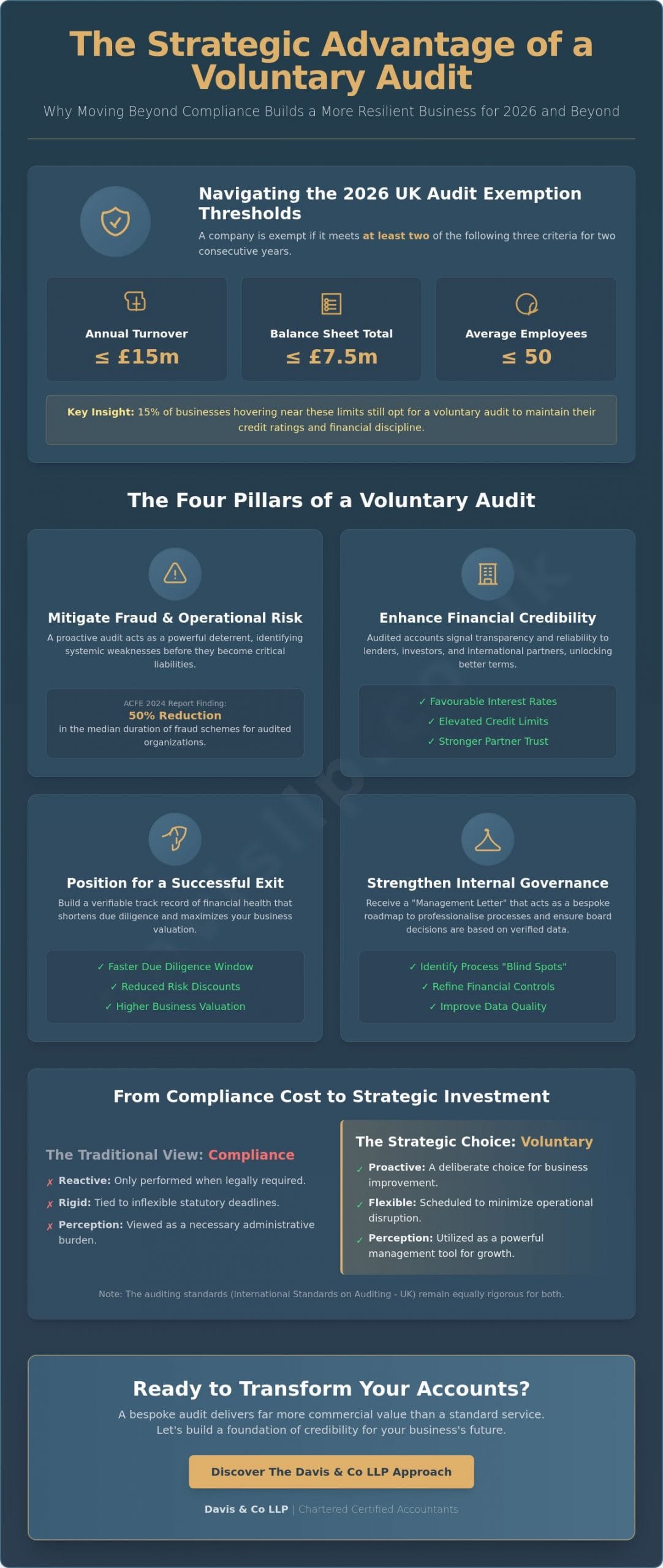
In 2026, a UK company is generally exempt from a statutory audit if it qualifies as “small.” To meet this definition, a business must satisfy at least two of the following three criteria: an annual turnover of no more than £15 million, a balance sheet total of no more than £7.5 million, and an average of 50 or fewer employees. It’s not a one-time snapshot. The “two-year rule” dictates that a company must exceed these limits for two consecutive financial years before the audit becomes a legal requirement. This creates a grey zone for businesses hovering near these limits. In this space, firms are technically exempt but often carry high-risk profiles that demand closer scrutiny. We’ve observed that 15% of businesses in this bracket choose to audit regardless of the exemption to maintain their credit ratings.
Voluntary vs. Statutory: What Changes?
A voluntary audit is a rigorous, independent verification of financial truth. While the catalyst for the work differs, the standards do not. Every engagement follows the International Standards on Auditing (UK), ensuring the same level of scrutiny as a mandatory filing. One significant advantage is timing. Statutory audits are bound by rigid filing deadlines at Companies House. A voluntary approach allows the board to schedule the process during quieter periods of the business cycle. This flexibility is one of the key benefits of a voluntary audit for small business, as it minimizes operational disruption while maximizing the depth of the findings.
The transition from a compliance mindset to a strategic one is essential. We view this shift as a move from seeing an audit as a cost of doing business to recognizing it as a management tool. It provides a level of assurance that’s pivotal when negotiating with lenders or preparing for a future exit. By adopting this practice early, small businesses build a track record of reliability that pays dividends during due diligence. It’s about professional gravitas and the quiet confidence that comes from knowing your figures are beyond reproach.
Strengthening Internal Governance and Mitigating Operational Risk
Reliable governance serves as the foundation for any resilient enterprise. One of the primary benefits of a voluntary audit for small business is the rigorous examination of internal structures that typically escape daily notice. By inviting an independent review, we help directors identify systemic weaknesses in their financial reporting frameworks before these flaws crystallise into significant liabilities. This proactive stance ensures that the benefits of a voluntary audit for small business extend far beyond simple compliance, touching every corner of the operation.
Internal Control Assessments
The audit process focuses on evaluating the “tone at the top” and the efficacy of existing financial authorisations. Auditors often discover “blind spots” where automated accounting software has been bypassed by manual workarounds; these gaps create unnecessary risk. The resulting “Management Letter” acts as a bespoke roadmap for operational refinement. It provides clear, actionable feedback to professionalise internal accounting processes and ensures that the Board makes decisions based on verified, high-quality data rather than optimistic projections.
Mitigating Fraud and Financial Misstatement
The “expectation of audit” creates a powerful deterrent effect within any organisation. According to the 2024 ACFE Report to the Nations, organisations that implement regular audits reduce the median duration of fraud schemes by 50% and significantly lower the total loss per instance. While an audit can’t guarantee the detection of every sophisticated instance of collusion, it narrows the “expectation gap” by testing the robustness of existing controls. Maintaining this day-to-day integrity is often a collaborative effort between the firm and a small business accountant who manages the underlying ledger.
For many UK entities, staying below the UK audit thresholds, currently defined by a turnover of £10.2 million or gross assets of £5.1 million, means they aren’t legally required to undergo this scrutiny. However, choosing to do so voluntarily signals a commitment to transparency that lenders and investors value. It ensures that the finance function isn’t just recording history but is actively protecting the company’s future. If you’re looking to refine your internal controls, we invite you to consult our advisory team for a tailored review of your current governance standing.
Enhancing Financial Credibility for Lenders and International Partners
External stakeholders typically view internal financial statements with a degree of healthy scepticism. While your management accounts serve internal decision-making well, they lack the independent verification that provides “absolute” rather than “reasonable” assurance to the outside world. One of the most significant benefits of a voluntary audit for small business is the immediate elevation of the firm’s financial standing in the eyes of commercial lenders and institutional partners. By 2026, as credit conditions remain disciplined, this distinction between certified and audited figures will likely dictate the terms of your next growth phase.
The Lender’s Perspective on Risk
Commercial banks assess risk through the lens of certainty. When a business presents audited accounts, it provides a verified data set for calculating debt-service coverage ratios (DSCR). This transparency reduces the lender’s risk premium; it’s the difference between a high-interest unsecured loan and a structured facility with favourable rates. We’ve observed that businesses with audited financials often secure credit limits 20% to 30% higher than those relying solely on statutory accounts. These audits also allow directors to renegotiate existing covenants, providing the flexibility needed to deploy capital into new markets without breaching bank terms.
Cross-Border Credibility
For SMEs eyeing global expansion, an audit serves as a universal financial passport. This is especially vital for firms engaged in international tax planning where multi-jurisdictional transparency is a prerequisite for compliance. Overseas joint venture partners or parent companies rely on the UK’s rigorous audit standards to feel secure in their capital allocations. It standardises reporting across borders, ensuring that your financial health is understood with the same level of confidence in Dubai or New York as it is in London. This level of assurance is often the deciding factor when a foreign entity chooses between two potential UK partners.
The benefits of a voluntary audit for small business also extend into the supply chain. Large corporate entities and government bodies now mandate rigorous “Know Your Vendor” (KYC) checks. To win a contract worth £500,000 or more, you must prove long-term solvency. An audit provides this proof, acting as a badge of corporate maturity. It also serves your internal stakeholders by:
- Protecting Minority Shareholders: Providing an objective view of the company’s performance to those not involved in daily operations.
- Attracting Venture Capital: Ensuring that potential investors see a “clean” set of books, which simplifies the due diligence process and can accelerate a funding round by several weeks.
- Securing Government Tenders: Meeting the strict financial stability thresholds required for public sector work in the UK.
We provide bespoke audit strategies that go beyond simple compliance. Our approach ensures your business projects the “quiet excellence” necessary to secure high-value partnerships. By opting for a voluntary audit, you aren’t just checking a box; you’re building a foundation of trust that supports your commercial objectives for 2026 and beyond.
Strategic Preparation for Business Scaling and Future Exit
Voluntary audits serve as a rigorous stress test for a company’s financial infrastructure. One of the primary benefits of a voluntary audit for small business is the immediate acceleration of the sale process. A 2024 analysis of UK mid-market transactions indicated that businesses presenting three years of audited accounts can reduce the due diligence phase by approximately 25%. This efficiency prevents “deal fatigue” and maintains momentum during sensitive negotiations.
By identifying “deal breakers” early, we allow owners to rectify accounting issues long before a sale process begins. Common hurdles, such as the incorrect treatment of Research and Development (R&D) tax credits or complex VAT liabilities, can be resolved quietly. This proactive approach ensures that when a buyer arrives, the narrative remains focused on growth rather than historical corrections.
Audit as Exit Readiness
Buyers often apply a “risk discount” to companies with unaudited financials, sometimes reducing the final valuation by 10% to 15% to account for potential undisclosed liabilities. We ensure your revenue recognition policies and asset valuations remain defensible under the scrutiny of a buyer’s forensic accountants. Integrating expert tax advice uk ensures that audit findings align with your long-term tax efficiency, preventing costly surprises during the disclosure process. It’s about creating a “no surprises” environment that protects your hard-earned equity.
Scaling with Confidence
Rapid growth introduces complexities that founder-led accounting systems often struggle to absorb. When turnover nears the £10.2 million statutory threshold or headcount doubles within a single fiscal year, internal controls can fracture. A voluntary audit identifies these weaknesses before they manifest as financial losses.
- Institutional-grade management: Transitioning from simple bookkeeping to robust financial reporting.
- Director recruitment: Building a legacy of transparency that attracts high-calibre non-executive directors.
- Future-proofing: Developing the reporting muscles required for mid-cap status or a 2026 IPO.
This disciplined framework provides the benefits of a voluntary audit for small business by shifting the focus from day-to-day survival to long-term strategic value. It signals to the market that your business is managed with the precision of a much larger institution.
Preparing your business for its next chapter requires more than just balanced ledgers; it demands a strategic partner who understands the nuances of the UK corporate landscape. Consult with Davis LLP to refine your financial reporting for a successful future exit.
Selecting a Bespoke Audit Partner: The Davis & Co LLP Approach
A commoditised audit often yields little more than a signature on a page. For a small business, this approach misses the point entirely. The true benefits of a voluntary audit for small business lie in the depth of the inquiry, not the speed of the tick-box exercise. When an audit is tailored to your specific sector, whether that’s property development or international trade, it uncovers operational efficiencies that a generic service ignores. We believe that an audit should act as a diagnostic tool, providing a clear-eyed view of your firm’s financial health as you move through 2026.
Transitioning to a voluntary audit doesn’t have to disrupt your daily operations. We focus on a philosophy of “quiet excellence,” where our team integrates with your finance department without causing friction. This ensures that the professional gravitas of an independent review is maintained while respecting the pragmatic realities of running an SME. Our objective perspective provides the assurance your stakeholders require, delivered with the discretion your business deserves.
What to Look for in an Audit Firm
The “Chartered Certified” designation is the essential benchmark. It represents a commitment to technical proficiency and ethical standards that are non-negotiable in the UK. A firm should demonstrate a track record of handling complex structures, especially if your growth strategy involves international tax planning alongside assurance. You need a partner who understands that your 2026 objectives require a balance of statutory rigour and commercial insight. The audit team must be able to speak the language of business, not just the language of accounting standards. Statistics from the mid-2020s indicate that businesses with voluntary audits are up to 30% more likely to secure favourable lending terms because of this increased transparency.
The Davis & Co Difference
We don’t believe in one-size-fits-all solutions. Our approach respects the unique DNA of your business, ensuring that every recommendation is relevant to your specific goals. We provide an objective perspective that adds value to your board meetings and strengthens your position with external lenders. If you’re unsure where to start your search, our guide on how to find a chartered accountant outlines the qualities of a true strategic partner.
We treat every engagement as a composed partnership. This ensures your business feels secure, well-advised, and prepared for the evolving regulatory landscape of the UK. Our goal is to provide clarity, not just compliance. By choosing a bespoke approach, you’re investing in a relationship that understands the human and business impact of every financial decision. We remain a dependable constant in an often volatile business environment, helping you turn an audit from a requirement into a strategic asset.
Securing Your Commercial Legacy for 2026
Choosing to undergo an audit before reaching the statutory threshold positions your company as a transparent, low-risk entity. It provides the rigorous internal governance needed to mitigate operational risks and builds the credibility required by international partners and UK lenders. Understanding the benefits of a voluntary audit for small business is essential for directors who are aiming for a successful exit or significant scale-up. This proactive step ensures your financial records withstand the most intense scrutiny from stakeholders.
Davis & Co LLP has operated as Chartered Certified Accountants since 1901; we bring over a century of expertise to every engagement. As specialists in international and complex tax assurance, we provide a bespoke, partner-led service that addresses the unique challenges of your sector. We don’t believe in a one-size-fits-all approach. Instead, we offer the quiet excellence and technical precision your business deserves.
Request a bespoke consultation for your voluntary audit with Davis & Co LLP to begin your journey toward greater financial clarity. We look forward to supporting your long-term commercial objectives.
Frequently Asked Questions
Is a voluntary audit worth the cost for a small business?
Yes, the benefits of a voluntary audit for small business often outweigh the initial outlay by identifying operational inefficiencies and enhancing market valuation. In 2026, many UK SMEs view this as a strategic investment rather than a mere compliance cost. It provides internal peace of mind and external credibility. This rigorous scrutiny can uncover cost-saving opportunities that might otherwise remain hidden within complex ledgers.
Can a voluntary audit help my business secure a bank loan?
A voluntary audit significantly improves your chances of securing a bank loan by providing lenders with high-level assurance regarding your financial health. Banks typically view audited accounts as more reliable than unaudited ones. This professional validation reduces the perceived risk for the lender. Consequently, businesses with audited accounts may access more competitive interest rates or higher credit limits during the 2026 fiscal year.
How long does a voluntary audit typically take to complete?
A typical voluntary audit for a UK SME takes between two and four weeks of fieldwork to complete. This timeline depends on the complexity of your transactions and the quality of your existing records. We recommend preparing documentation well in advance to ensure a smooth process. Clear communication between your internal finance team and the auditors helps maintain this schedule and avoids unnecessary delays.
What is the difference between an independent examination and a voluntary audit?
An independent examination is a less rigorous review that provides limited assurance, whereas a voluntary audit offers a comprehensive, high-level opinion on the truth and fairness of financial statements. While an examination checks for obvious errors, an audit involves detailed testing of transactions and internal controls. This distinction is vital for businesses seeking to demonstrate the highest standards of transparency to potential investors or stakeholders.
Does a voluntary audit prevent all instances of internal fraud?
No audit can guarantee the detection of all fraud, but it serves as a powerful deterrent and identifies weaknesses in your internal control systems. Auditors look for material misstatements and evaluate the risk of fraudulent activity. By implementing the bespoke recommendations provided after the audit, you can strengthen your firm’s resilience. This proactive approach helps protect your assets and maintains the integrity of your commercial operations.
Can I choose which parts of my business are audited in a voluntary engagement?
You can’t choose specific areas to include if you want a full audit opinion, as the auditor must follow International Standards on Auditing (UK). The entire financial statement must be subject to scrutiny to ensure a true and fair view. However, we can perform agreed-upon procedures for specific departments if you require a more tailored, narrow focus. This provides a flexible solution for businesses with specific concerns.
How much does a voluntary audit cost for a UK SME?
According to recent industry benchmarks, the cost of a voluntary audit for a UK SME typically starts around £5,000 and can exceed £20,000 for more complex entities. These figures vary based on the size of the business and the volume of transactions. It’s a professional fee that reflects the depth of expertise and the level of risk the auditing firm assumes. We provide bespoke quotes tailored to each client’s specific requirements.
What happens if the auditor finds an error in my previous year’s accounts?
If an auditor identifies a material error in previous accounts, it’s usually corrected as a prior-period adjustment in the current year’s financial statements. This ensures your records remain accurate and compliant with UK GAAP. While it might seem concerning, addressing these discrepancies early prevents larger regulatory issues later. We guide our clients through this process to ensure full transparency and professional resolution of any historical inaccuracies.