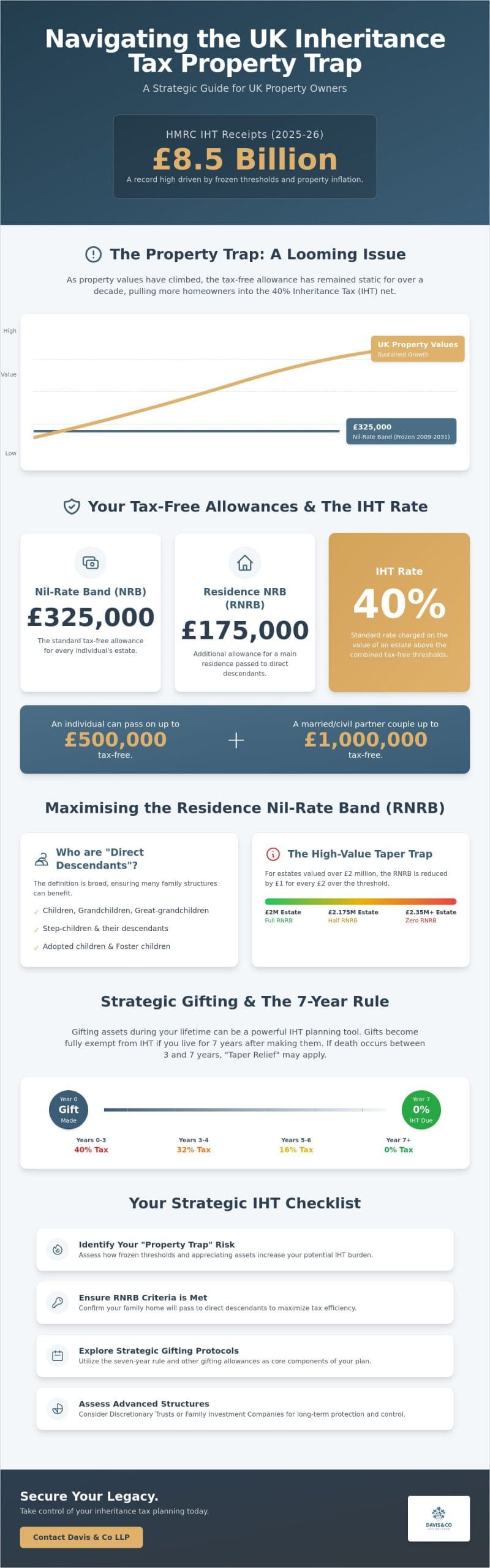
HMRC collected a record £8.5 billion in inheritance tax receipts during the 2025-2026 tax year. This surge isn’t just a reflection of extreme wealth; it’s the direct result of stagnant tax thresholds failing to keep pace with sustained property inflation. For many UK homeowners, the freeze on the £325,000 nil-rate band until 2031 means that a larger portion of their estate is now vulnerable to a 40% tax charge. Effective inheritance tax planning for property owners has transitioned from a niche concern for the elite to a vital necessity for anyone wishing to preserve their family’s financial legacy.
We recognize the frustration of seeing your hard-earned assets potentially diminished by complex regulations like the Residence Nil Rate Band tapering or the 2026 reforms to Agricultural and Business Property Relief. You’ve spent years building your wealth, and you deserve a clear strategy to protect it. This guide provides a sophisticated framework to help you navigate these shifting HMRC rules with confidence. We’ll outline how to maximize your available allowances, provide a legal roadmap for gifting property, and explain how trusts can offer a robust layer of protection for your portfolio.
Key Takeaways
- Identify how the “Property Trap” of frozen thresholds affects your estate and learn the mechanisms to prevent appreciating assets from increasing your tax burden.
- Understand the specific criteria for the Residence Nil Rate Band to ensure your family home passes to direct descendants with maximum tax efficiency.
- Explore the strategic application of the seven-year rule and gifting protocols as core components of inheritance tax planning for property owners.
- Assess the role of discretionary trusts and Family Investment Companies in providing long-term protection and control for complex property portfolios.
- Determine why a multi-disciplinary approach is required to balance inheritance tax objectives with capital gains and income tax obligations.
Understanding the Property Trap: Inheritance Tax Thresholds in 2026
Inheritance Tax is a 40% levy on the value of an estate that exceeds specific, government-mandated thresholds. While it was once perceived as a tax solely for the ultra-wealthy, the “Property Trap” has fundamentally changed this dynamic for UK families. As property values have climbed, the thresholds have remained static, pulling more homeowners into the tax net every year. In the 2025-2026 tax year alone, HMRC collected a record £8.5 billion in receipts. This isn’t just a number; it represents thousands of families facing significant financial pressure. The primary issue for property owners is illiquidity. Unlike cash or liquid investments, you can’t sell a single room to settle a tax bill. This creates a unique crisis for heirs who may be forced to sell a family home simply to meet HMRC’s requirements.
The Frozen Nil-Rate Band and Property Inflation
The Nil-Rate Band is the tax-free allowance available to every individual estate. Currently fixed at £325,000, this baseline hasn’t moved since 2009 and will remain frozen until 2031. This prolonged freeze means that property inflation acts as a stealth tax. Over the last decade, house prices have outpaced these allowances by a significant margin. When we look at the history of UK Inheritance Tax, it’s clear that the current environment is particularly challenging for those with property-heavy portfolios. Strategic inheritance tax planning for property owners is now a requirement to ensure that the growth in your home’s value doesn’t simply result in a larger bill for your children.
Calculating the Potential Liability for Property-Rich Estates
HMRC values property based on the open market value at the time of death. This calculation must be precise. To find the net taxable value, we deduct any outstanding mortgages or qualifying liabilities from the gross value. However, HMRC often challenges valuations that seem low, especially in a volatile market. We always advise our clients to seek professional, RICS-qualified valuations for their property assets. This proactive step helps avoid the stress of a formal investigation or dispute with the Revenue later on. Because the stakes involve a 40% tax rate, getting these numbers right is the first step in any robust inheritance tax planning for property owners. It’s about shifting the focus from simple ownership to long-term stewardship of your wealth.
Maximising the Residence Nil Rate Band (RNRB) for Family Homes
While the standard nil-rate band provides a foundational tax-free allowance, the Residence Nil Rate Band (RNRB) offers an additional £175,000 of protection specifically for the family home. When combined with the basic allowance, an individual can potentially pass on £500,000 tax-free. For married couples and civil partners, these allowances are fully transferable. This creates a combined tax-free threshold of £1 million, provided the main residence is bequeathed to direct descendants. In the context of inheritance tax planning for property owners, understanding the nuances of this relief is often the difference between a manageable tax position and a significant liability.
The definition of “direct descendants” is broader than many realize. It encompasses children, grandchildren, and great-grandchildren, but also extends to step-children, adopted children, and foster children. However, a critical limitation exists for high-value estates. For estates valued above £2 million, the RNRB is subject to a taper. The allowance reduces by £1 for every £2 the estate exceeds this threshold. Consequently, an individual estate valued at £2.35 million or more will lose the RNRB entirely. This tapering effect makes proactive planning essential for those whose property values have surged toward the £2 million mark.
Qualifying for the Main Residence Allowance
To claim the RNRB, the deceased must leave a “qualifying residential interest” to their descendants. This typically means a property that was their residence at some point during their ownership. It doesn’t necessarily have to be their home at the time of death. For instance, a property you once lived in but later let out could still qualify under specific conditions. Because HMRC’s criteria for residency are stringent, securing expert tax advice in the UK is vital to ensure your documentation supports your claim and protects your family’s interests.
Downsizing and the RNRB: Protecting the Allowance
Many homeowners worry that moving to a smaller property or into residential care will forfeit their RNRB. Fortunately, “downsizing additions” allow you to preserve the higher allowance even if you’ve sold a more valuable home. If you sold a qualifying residence after 8 July 2015, the value of that former home can be used to calculate the relief. You must maintain clear records of the previous property’s sale price and the date of disposal. Strategic timing of these transactions is a core element of inheritance tax planning for property owners, ensuring that a move in later life doesn’t inadvertently increase the tax burden on your heirs. If you are considering a change in your living arrangements, consulting with a specialist can help you structure the sale to retain your full tax-free bands.
Strategic Gifting: Transferring Property Interest and the Seven-Year Rule
Gifting property during your lifetime is one of the most effective methods of inheritance tax planning for property owners, yet it requires meticulous adherence to HMRC’s timeline and benefit rules. Most lifetime gifts to individuals are classified as Potentially Exempt Transfers (PETs). These gifts only become fully exempt from inheritance tax if the donor survives for seven years after the transfer. If death occurs within this period, the value of the gift is brought back into the estate for tax purposes, though the rate may be mitigated by taper relief.
Taper relief begins to reduce the 40% tax charge if the donor survives at least three years after the gift. Between years three and four, the tax rate on the gift drops to 32%, eventually reaching 8% in the sixth year before becoming tax-free at year seven. It’s vital to recognize that gifting a property is also a disposal for Capital Gains Tax (CGT) purposes. Unless the property is your primary residence and qualifies for full Private Residence Relief, you may face an immediate CGT bill based on the market value at the time of the gift, even if no money changes hands.
The Risks of Gifting a Main Residence
The “Gift with Reservation of Benefit” (GWR) rules are a significant hurdle for those wishing to transfer their home to their children while remaining in situ. If you gift your property but continue to live there without paying a full market-rate rent to the new owners, HMRC will treat the asset as if it were still part of your estate. This renders the seven-year clock irrelevant and keeps the property’s full value subject to the 40% charge upon death. A gift is only valid for IHT if the donor ceases to benefit from the asset. Breaching these rules can lead to a double taxation scenario where the recipient faces both IHT and potential CGT issues on a subsequent sale.
Gifting Share of Property and Joint Ownership
For many, a more balanced approach involves gifting a fractional share of a property. This is typically achieved by holding the property as “Tenants in Common” rather than “Joint Tenants”, allowing each owner to bequeath or gift their specific share independently. This strategy can be particularly effective for investment portfolios where you wish to gradually reduce the value of your estate over several years. For clients with assets across borders, these transfers must be integrated into a broader international tax planning strategy to ensure compliance with both UK and foreign jurisdictions. Careful documentation of these transfers is essential to prove to HMRC that a genuine change of ownership has occurred.
Advanced Protection: Using Trusts and Corporate Structures for Portfolios
For investors with extensive buy-to-let portfolios, simple gifting often falls short of providing the necessary control and long-term security. Advanced inheritance tax planning for property owners often involves the use of discretionary trusts to ring-fence assets for future generations. By placing a property into a trust, you effectively remove it from your personal estate while maintaining a degree of influence over how the asset is managed and when beneficiaries receive income. However, trusts are subject to the “Relevant Property Regime”, which includes an immediate 20% entry charge on values exceeding the £325,000 nil-rate band, along with periodic ten-year anniversary charges and exit charges. To mitigate the eventual tax burden on heirs, many owners utilize life assurance policies written in trust, providing the liquidity needed to settle IHT bills without forced property sales.
Trusts for Property: Control vs Tax Efficiency
The primary appeal of a trust lies in the separation of legal ownership from beneficial enjoyment. Trustees hold the property, protecting it from a beneficiary’s potential creditors, bankruptcy, or divorce settlements. This level of protection is a cornerstone of sophisticated inheritance tax planning for property owners who prioritize legacy over immediate asset transfer. Managing these structures requires technical precision to avoid unnecessary penalties. Our trust tax services ensure that all HMRC reporting requirements, including the Trust Registration Service (TRS), are met with absolute accuracy. If you’re unsure which trust structure suits your portfolio, contact our specialist team for a tailored evaluation.
Family Investment Companies (FICs) for Portfolio Landlords
Family Investment Companies have become a preferred alternative to traditional trusts for large-scale portfolios. An FIC is a private limited company where the directors are usually the parents and the shareholders are family members. This structure allows you to gift different classes of shares to your children, effectively transferring the future capital growth of the property portfolio out of your estate while you retain voting control. From a tax perspective, rental income within an FIC is subject to corporation tax, which is often more efficient than personal income tax rates for high-earners. This corporate approach provides a flexible, scalable solution for managing property wealth across multiple generations.
International Property and Cross-Border IHT
Owning a holiday home in Europe or a rental property overseas introduces significant complexity to your estate. If you’re domiciled in the UK, HMRC claims the right to tax your worldwide assets, regardless of where they’re located. This often leads to the threat of double taxation. Fortunately, the UK has established double taxation treaties with many countries to provide relief for foreign taxes paid. We analyze these treaties to ensure you don’t pay more than is legally required. Strategic planning for international assets involves balancing UK domicile rules with local succession laws, ensuring your holiday home remains a benefit rather than a tax liability for your heirs.
Securing Your Legacy: Bespoke Inheritance Tax Planning with Davis & Co LLP
Effective inheritance tax planning for property owners demands a strategy that is as dynamic as the market itself. It’s not enough to implement a single trust or make a one-time gift; true wealth preservation requires a holistic view that balances IHT mitigation against Capital Gains Tax and Income Tax. We often see “off-the-shelf” tax products fail because they don’t account for the unique liquidity constraints of property-rich estates. A plan that looks good on paper can quickly become a burden if it doesn’t align with your long-term cash flow requirements or your family’s specific needs.
The legislative landscape is shifting rapidly. With major reforms to Agricultural and Business Property Relief arriving in April 2026 and the inclusion of pensions in the taxable estate from 2027, static plans are a significant risk. Regular reviews are no longer optional; they’re a fundamental part of responsible stewardship. We provide the professional gravitas and intellectual rigour required to handle these sensitive matters, acting as a strategic partner to ensure your legacy remains intact regardless of political or economic volatility. Our approach is built on discretion and a deep understanding of the human impact behind complex financial decisions.
Our Integrated Property Accounting and Tax Approach
We believe that technical accounting precision and strategic tax foresight are inseparable. When managing a property portfolio, every entry in the ledger has a potential tax consequence. Working with a chartered accountant who possesses a granular understanding of the UK property market ensures that your records are robust enough to withstand HMRC scrutiny. This is particularly vital for those involved in active development or commercial letting. We also provide specialist support as a small business accountant for property developers, helping to structure ventures in a way that facilitates growth while simultaneously preparing for a tax-efficient transition to the next generation.
Next Steps: Developing Your Personalised Tax Roadmap
The journey toward a secure legacy begins with a thorough assessment of your current estate and your long-term objectives. Our initial consultation process is designed to identify potential vulnerabilities in your current arrangements and explore the most appropriate reliefs for your specific situation. We don’t just provide a report; we build a personalized tax roadmap that evolves with you. Ongoing compliance and proactive advice are the hallmarks of our partnership, providing you with the peace of mind that your family’s future is well-protected. If you’re ready to take a proactive step in protecting your property wealth, contact Davis & Co LLP to begin your inheritance tax planning and ensure your estate is prepared for the challenges of 2026 and beyond.
Protecting Your Property Wealth for the Next Generation
Preserving your estate in the face of rising valuations and frozen thresholds requires more than just a passing acquaintance with HMRC rules. We’ve explored how maximizing the Residence Nil Rate Band and navigating the seven-year gifting rule can significantly reduce potential liability. For those with larger portfolios, the strategic application of trusts and corporate structures offers a level of control that standard estate planning cannot match. Effective inheritance tax planning for property owners is ultimately about proactive stewardship rather than reactive compliance. It’s the only way to ensure your hard-earned assets aren’t unnecessarily diminished by the 40% levy.
As Chartered Certified Accountants since 1901, Davis & Co LLP brings over a century of professional gravitas to your personal affairs. Our specialists in international and property tax, combined with our deep expertise in trust and estate planning, ensure your legacy is managed with discretion and precision. We invite you to consult our experts for a bespoke inheritance tax review. Securing your family’s future is a deliberate choice, and we’re here to help you make it with confidence.
Frequently Asked Questions
What is the current inheritance tax threshold for property in 2026?
The baseline tax-free allowance for an individual in 2026 is £325,000, known as the Nil-Rate Band. If you’re passing a main residence to direct descendants, you may also utilize the Residence Nil-Rate Band of £175,000. These thresholds are currently frozen until April 2031. This means a single person can potentially pass on £500,000 tax-free, while a married couple can transfer up to £1 million between them.
Can I give my house to my children to avoid inheritance tax?
You can gift a property, but you must survive seven years for it to fall entirely outside your estate. If you continue to live in the house, you must pay a full market-rate rent to avoid the Gift with Reservation of Benefit rules. Failing to do so means HMRC will still treat the property as part of your taxable estate. This is a critical area where inheritance tax planning for property owners requires precise execution to be effective.
Do I have to pay inheritance tax on property located outside the UK?
HMRC will assess inheritance tax on your worldwide assets, including property located abroad, if you’re domiciled in the UK. While this often raises the risk of double taxation, the UK has established treaties with many nations to provide relief for taxes paid in foreign jurisdictions. We analyze these treaties to ensure our clients don’t pay more than is legally required on their international holiday homes or rental investments.
What is the seven-year rule for property gifts?
The seven-year rule dictates that most gifts, including property interests, are considered Potentially Exempt Transfers. If the donor survives for seven years after the gift, no inheritance tax is due on that asset. If death occurs between three and seven years, taper relief applies, gradually reducing the tax rate from 40% on a sliding scale. This rule is a cornerstone of inheritance tax planning for property owners looking to reduce their taxable estate early.
How does a trust help with inheritance tax on a buy-to-let portfolio?
Trusts allow you to move property assets out of your personal name while maintaining control over how they’re managed. By placing a buy-to-let portfolio into a discretionary trust, you can cap the value of your personal estate and protect the assets from beneficiaries’ potential creditors. It’s vital to account for the 20% entry charge on values above the nil-rate band and the subsequent ten-year anniversary charges that apply to trust assets.
Is it possible to reduce the 40% inheritance tax rate?
The standard 40% rate can be reduced to 36% if you leave at least 10% of your net estate to a registered charity. Taper relief can also reduce the effective tax rate on lifetime gifts that become chargeable if the donor survives at least three years. Strategic use of Business Property Relief or Agricultural Property Relief can exempt qualifying assets, though new caps of £2.5 million apply from April 2026.
What happens if my estate is worth more than £2 million?
Estates exceeding £2 million trigger a tapering of the Residence Nil-Rate Band. For every £2 your estate’s total value is over this threshold, the £175,000 allowance is reduced by £1. Once an individual estate reaches £2.35 million, the additional property allowance is lost completely. This makes it essential for high-value homeowners to consider lifetime gifting or corporate structures to bring their net estate back below this threshold.
Does a spouse have to pay inheritance tax on the family home?
Transfers of property between spouses or civil partners are generally exempt from inheritance tax regardless of the value. This spousal exemption allows the surviving partner to inherit the family home without an immediate tax bill. Any unused portion of the deceased partner’s nil-rate bands can also be transferred to the survivor. This doubling of allowances provides a robust shield for the family estate until the second partner passes away.