Did you know that as of April 2026, the Capital Gains Tax rate for Business Asset Disposal Relief has climbed to 18%? For many clinicians, this shift represents a significant departure from previous years, making meticulous tax planning for dentists selling a practice more critical than ever. You’ve likely dedicated your career to patient care and the steady growth of your clinical reputation, and it’s only natural to feel concerned about protecting the equity you’ve worked so hard to build.
We understand that the transition from practice owner to retiree or associate requires more than just a willing buyer; it demands a sophisticated approach to wealth preservation. In this guide, we’ll provide the strategic counsel necessary to navigate the complexities of the 2026 tax landscape. We’ll explore how to optimise your £1 million lifetime limit, manage the separation of personal and business assets, and ensure your exit remains compliant with the latest Making Tax Digital requirements. By the end of this article, you’ll have a clear roadmap for a discrete, tax-efficient transition that honours your professional legacy.
Key Takeaways
- Proactive tax planning should commence at least 24 months prior to a sale to ensure all assets and structures are fully eligible for available reliefs.
- Effective tax planning for dentists selling a practice is essential to navigate the 2026 Business Asset Disposal Relief rate of 18% while protecting your £1 million lifetime limit.
- Strategic deal structuring, including the precise allocation between goodwill and freehold property, can significantly reduce your overall Capital Gains Tax burden.
- Wealth preservation extends beyond the transaction; learn how to utilise trusts and inheritance tax strategies to protect your proceeds for future generations.
- Determining whether a share sale or an asset sale is more beneficial requires a nuanced analysis of your specific business structure and personal financial goals.
The Strategic Importance of Tax Planning for Dentists Selling a Practice
Tax planning for dentists selling a practice in 2026 is far more than a simple accounting exercise. It is a multi-year strategic undertaking designed to protect the clinical and commercial value you’ve spent decades building. In the current fiscal environment, a successful exit requires a precise alignment of your business disposal strategy with your long-term personal wealth goals. This ensures that the transition doesn’t just result in a sale, but in the maximum possible preservation of capital.
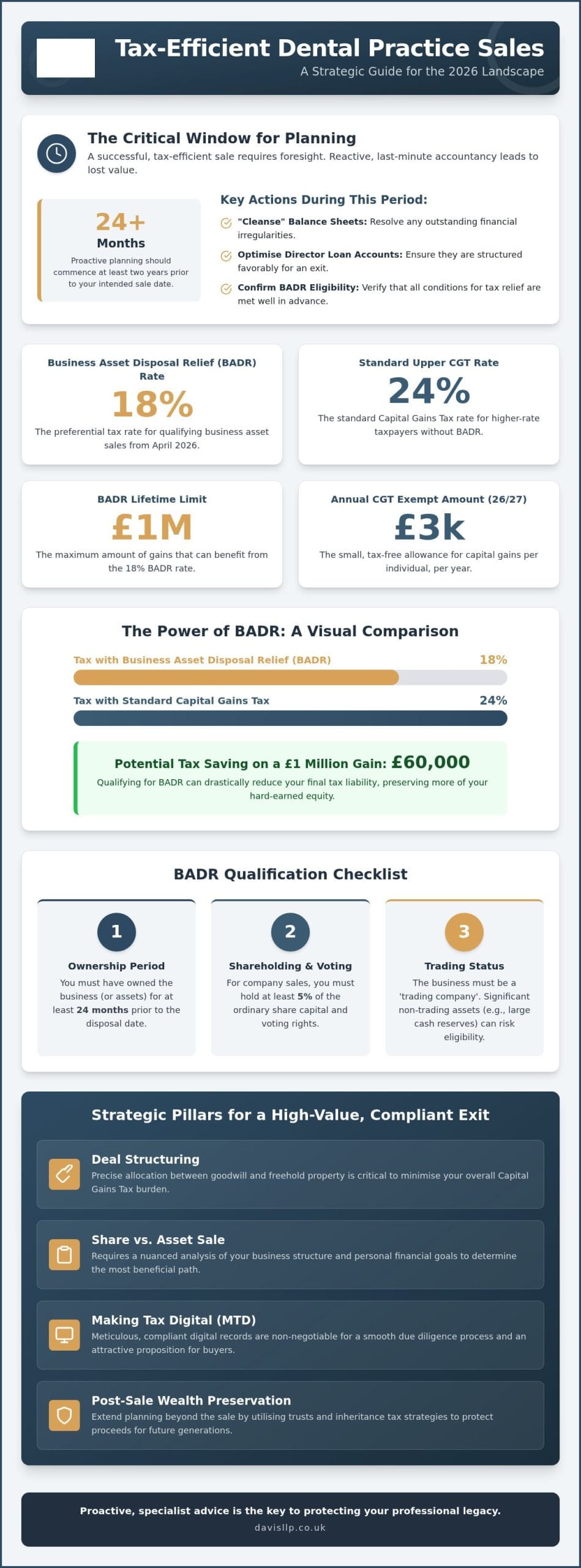
We advise that proactive planning should ideally begin at least 24 months before you intend to bring your practice to market. This lead time is vital for several reasons. It allows for the “cleansing” of balance sheets, the optimisation of director loan accounts, and the ensuring of full eligibility for Business Asset Disposal Relief. Without this window, clinicians often find themselves trapped by technicalities that could have been easily resolved with foresight. Waiting until a buyer is found is often too late to implement the most effective mitigation structures.
The Limitations of Reactive Accountancy
Many generalist accounting firms approach a practice sale as a standard business transaction. However, the dental sector has unique nuances, from the treatment of NHS contracts to the specific way goodwill is valued and taxed. Relying on reactive, year-end accounting often leads to “tax leakage,” where significant portions of your sale proceeds are lost to avoidable liabilities because the deal structure wasn’t optimised from the outset. A specialist dental tax advisor provides the strategic value of ensuring your clinical legacy is not eroded by avoidable tax burdens through precise, sector-specific deal structuring.
2026 Compliance and MTD for Dentists
The 2026 tax year introduces specific challenges, particularly with the full implementation of Making Tax Digital (MTD) for Income Tax. When selling your practice, your final period accounts must be meticulously prepared to meet these digital requirements. This isn’t just about compliance; it’s about making your practice attractive to buyers who will demand seamless, digital records during due diligence. Managing the transition of these digital assets to a new owner or a corporate group requires careful handling to avoid mid-sale reporting errors. For those seeking Expert tax advice in the UK, ensuring your digital record-keeping is robust well before the sale is a non-negotiable step for a smooth transition.
Navigating Capital Gains Tax and Business Asset Disposal Relief
Capital Gains Tax (CGT) represents the single largest fiscal hurdle for most clinicians during an exit. Effective tax planning for dentists selling a practice focuses heavily on the distinction between goodwill, which is an intangible asset, and the physical surgery premises. For the 2026/27 tax year, the annual exempt amount has been set at £3,000. Given this relatively low threshold, the strategic identification and offsetting of previous capital losses becomes a priority to reduce your overall taxable base before the sale completes.
Business Asset Disposal Relief (BADR) remains the most effective tool for tax mitigation in the UK. You should be aware that for the 2026/27 tax year, the BADR rate is 18%. While this is an increase from previous years, it remains significantly more favourable than the standard 24% upper rate of CGT. The technicalities of asset basis and the distinction between capital and ordinary gains are universal hurdles in commercial disposals. Resources like IRS Publication 544 provide a comprehensive look at how tax authorities generally classify business assets, illustrating the global rigour applied to distinguishing between business and personal capital gains.
Qualifying for Business Asset Disposal Relief
Qualifying for BADR requires meeting strict criteria over a sustained period. The primary hurdle is the two-year rule; you must’ve owned the business or held at least 5% of the shares and voting rights for at least 24 months prior to the disposal. Additionally, the entity must be a “trading company” in the eyes of HMRC. If your practice has accumulated significant non-trading assets, such as investment portfolios or excessive cash reserves not intended for business use, you risk “tainting” your status and losing the relief entirely. We help our clients “purify” their balance sheets well in advance to protect their £1 million lifetime limit from such pitfalls.
CGT Planning for Dental Premises
The treatment of dental premises often creates the most complex CGT scenarios. Retaining the freehold while selling the clinical goodwill is a popular strategy for generating post-retirement rental income, yet it can be a tax trap. If the property isn’t sold as part of a “material withdrawal” from the business, it may not qualify for the 18% BADR rate, leaving the gain exposed to higher standard CGT rates. Alternatively, if you’re selling to move to a larger site or reinvesting in another practice, Roll-over Relief can be utilised to defer the tax liability. Understanding these trade-offs is why knowing how to find a chartered accountant with specific clinical property expertise is a vital step in your journey toward a bespoke advisory partnership.
Beyond the Sale: Wealth Preservation and International Considerations
The successful completion of a practice sale is a significant milestone, yet it marks the beginning of a new phase in financial stewardship. Converting a trading asset into liquid capital fundamentally alters your tax profile, particularly regarding Inheritance Tax (IHT). Strategic tax planning for dentists selling a practice must account for this shift well before the final contracts are signed. Without a structured approach to wealth preservation, a substantial portion of your legacy could be exposed to significant IHT liabilities. It’s also essential to manage the resulting cash flow to ensure your post-retirement lifestyle remains sustainable and your capital is preserved for the long term.
Trusts and Inheritance Tax (IHT) Strategy
While you own your practice, it likely qualifies for Business Relief, which can reduce its value for IHT purposes to zero. However, the moment you receive cash proceeds, this protection is lost. We often recommend utilising trusts or family investment companies to house these proceeds, allowing for long-term capital growth while providing a structured framework for succession. By integrating these vehicles into your exit strategy, you can maintain control over the assets while effectively removing them from your personal estate. This ensures that the wealth you’ve built serves your family’s future rather than being depleted by avoidable fiscal burdens.
Cross-Border Financial Interests
For clinicians with global footprints, the transition requires even more nuanced oversight. Whether you hold property in the Mediterranean or manage a family office with interests in multiple jurisdictions, International tax planning is an essential component of a modern practice exit. Disposing of a UK-based business while holding multi-jurisdictional assets can trigger complex double taxation issues that require expert resolution. We provide the discrete, high-calibre advisory needed to navigate these treaties, ensuring you don’t pay more than necessary in any territory.
If you’re considering retiring abroad, your tax residency status becomes a pivotal factor. Moving from the UK requires careful timing to ensure that the disposal of your practice and the subsequent management of your cash flow remain tax-efficient under both UK and foreign regulations. Comprehensive tax planning for dentists selling a practice ensures your global interests are protected, allowing for a seamless transition between jurisdictions without compromising your wealth. This level of detail is necessary to avoid the unforeseen liabilities that often arise when UK assets are liquidated by individuals with international ties.
Structuring the Deal for Maximum Efficiency
The architecture of your deal is where strategic tax planning for dentists selling a practice transitions from theory into tangible financial outcomes. A high-value offer is only as good as the structure supporting it. We recommend a five-step approach to ensure the final agreement serves your long-term interests:
- Step 1: Asset Allocation. You must determine the optimal split between clinical goodwill, equipment, and freehold property. While goodwill typically attracts the 18% Business Asset Disposal Relief rate, the sale of equipment may trigger balancing charges that are taxed as trading income.
- Step 2: Sale Type Evaluation. You need to decide between a share sale and an asset sale. This choice significantly impacts your final net proceeds and your exposure to historical liabilities.
- Step 3: Earn-out Negotiation. Many corporate buyers insist on earn-outs. It’s vital to structure these so they’re treated as capital gains rather than employment income, which could be taxed at rates up to 45%.
- Step 4: Financial Due Diligence. Corporate groups and private equity buyers will perform rigorous audits. Having clean, transparent digital records ready for inspection prevents price chipping during the final stages.
- Step 5: Completion Accounts. Finalise the accounts to reflect the exact position of net debt and working capital on the day of the sale. This prevents unexpected post-sale tax surprises or clawbacks.
Asset Sale vs. Share Sale: The Tax Divide
There is often a natural tension between buyer and seller regarding the sale structure. Buyers generally prefer asset sales because they can “step up” the tax basis of the assets and avoid inheriting the company’s past liabilities. Conversely, as a seller, you likely prefer a share sale. If your practice is held within a limited company, an asset sale can trigger “double taxation”; the company pays Corporation Tax on the gain, and you pay personal tax when extracting the cash. Engaging The strategic small business accountant early in the negotiation phase allows for a robust defence of your preferred structure, often finding middle ground through price adjustments or specific indemnities.
Managing Post-Sale Obligations
The transition doesn’t end when the keys are handed over. If you receive deferred consideration or loan notes, the tax treatment depends on whether these are “ascertainable” at the time of completion. You must ensure your 2026 personal tax returns accurately reflect the disposal to avoid HMRC inquiries. For a discrete evaluation of your specific deal structure, we invite you to consult with a dental tax specialist at our firm. We ensure that every nuance of your deferred payment is optimised for capital treatment, protecting your wealth from being reclassified as high-rate income tax.
The Davis & Co LLP Approach: Discrete, High-Calibre Dental Advisory
With a legacy spanning 125 years, our firm has established a reputation for providing reliable, strategic financial counsel to clinical professionals. We operate on a “composed partnership” model, which offers a calm, reassuring authority during what is often the most complex transition of a dentist’s career. We believe that a practice exit shouldn’t be a source of stress, but a well-orchestrated culmination of years of professional dedication. By integrating our niche expertise as a dental tax specialist with sophisticated international tax planning, we ensure that every facet of your disposal is handled with the highest degree of intellectual rigour.
Our approach is defined by a commitment to discretion and highly individualised service delivery. While we maintain a national reach across the UK, we intentionally avoid the impersonal, corporate messaging of larger firms. Instead, we focus on the human and organisational impact of your transition. We understand that tax planning for dentists selling a practice requires a steady, deliberate rhythm, reflecting a thorough thought process that prioritises your long-term stability over mere transactional speed.
Your Strategic Partner in Practice Disposals
We position ourselves as more than mere service providers; we are strategic partners for the entire lifecycle of your sale. This means moving beyond the immediate mechanics of the transaction to address the vital intersection of corporate disposal and personal wealth preservation. We’ve seen how easily sale proceeds can be eroded by poor post-sale planning. Our role is to act as a dependable constant, ensuring that the capital you realise is protected through bespoke structures that align with your family’s future. We apply the same level of precision to your personal inheritance tax strategy as we do to the initial deal structuring, providing a holistic solution that few generalist firms can match.
Next Steps for a Seamless Exit
Initiating a successful transition begins with a confidential consultation to review your current practice structure and personal objectives. We recommend transitioning your accounting to a specialist firm well before you intend to go to market. This allows us to cleanse your balance sheets and implement the necessary tax mitigation strategies mentioned in previous sections. Our process is steady and measured, designed to make you feel secure and well-advised at every stage. By securing your financial future through bespoke wealth preservation today, you ensure that your clinical legacy remains a source of enduring prosperity.
Securing Your Clinical Legacy and Financial Future
Exiting your practice is a complex journey that demands more than just a valuation; it requires a multi-year strategy to protect your hard-earned equity. We’ve explored how proactive tax planning for dentists selling a practice can mitigate the impact of the 18% Business Asset Disposal Relief rate and ensure your wealth is preserved through sophisticated trust structures. By addressing deal architecture and compliance early, you transform a standard transaction into a secure foundation for your retirement.
As Chartered Certified Accountants since 1901, we provide the boutique, partner-led advisory necessary for such sensitive transitions. Our specialist dental and international tax experts are here to guide you with intellectual rigour and discretion. We invite you to request a confidential consultation with our specialist dental team to review your specific requirements. Your professional legacy deserves the protection of a strategic partner who understands the nuances of the 2026 fiscal landscape. We look forward to helping you realise the full value of your life’s work.
Frequently Asked Questions
How far in advance should I start tax planning for selling my dental practice?
You should ideally begin the process at least 24 months before your target exit date. This timeframe allows us to implement effective tax planning for dentists selling a practice by restructuring assets and clearing director loan accounts. Early intervention prevents “tax leakage” and ensures your business meets the strict “trading company” definition for tax reliefs. Waiting until you have a firm offer often limits your mitigation options significantly.
What is Business Asset Disposal Relief and how does it apply to dentists in 2026?
Business Asset Disposal Relief (BADR) is a tax relief that reduces the Capital Gains Tax rate on qualifying business disposals. For the 2026/27 tax year, the BADR rate is 18% on gains up to a lifetime limit of £1 million. Dentists can apply this to the sale of clinical goodwill and qualifying business assets. It remains a cornerstone of wealth preservation despite the recent rate increases.
Is it better to sell the shares of my dental company or just the assets?
Sellers generally prefer share sales because they often qualify for BADR and avoid the “double taxation” of extracting cash from a company after an asset sale. In a share sale, you dispose of the entire legal entity, including its history and liabilities. Buyers often lean toward asset sales to cherry-pick equipment while avoiding past risks. We help negotiate structures that bridge this gap while protecting your net proceeds.
How is goodwill taxed when selling a dental practice?
Goodwill is treated as an intangible asset and is subject to Capital Gains Tax upon disposal. If you meet the qualifying criteria for BADR, the gain on goodwill is taxed at 18% for the 2026/27 tax year. This relief is a vital component of tax planning for dentists selling a practice, as it protects your hard-earned equity from the higher standard CGT rate of 24%. Precise valuation is essential here.
Can I still claim BADR if I remain as an associate after the sale?
You can typically claim BADR if you dispose of your entire interest in the business but continue to work as an associate. The relief requires a “material disposal” of your business assets or shares. Remaining as a clinician doesn’t automatically disqualify you, provided you no longer hold the requisite ownership and voting rights. We ensure your post-sale contract is structured to satisfy HMRC’s requirements for a clean break.
What are the tax implications of selling my dental practice to a corporate group?
Selling to a corporate often involves “earn-outs” or deferred consideration, where part of the price is paid later based on performance. These payments can be taxed as capital gains or reclassified as high-rate employment income if not structured correctly. Corporates also demand rigorous financial transparency. We specialise in managing these complex deal structures to ensure your deferred payments remain tax-efficient and your final settlement isn’t eroded.
How does Making Tax Digital (MTD) affect the sale of my practice in 2026?
Making Tax Digital for Income Tax requires you to maintain digital records and provide quarterly updates to HMRC. During a sale in 2026, your final period accounts must be fully compliant with these digital standards to ensure a smooth transition. Buyers view robust, MTD-compliant records as a sign of a well-managed practice. Failure to maintain these can complicate the due diligence process and lead to avoidable reporting errors.
Do I need a specialist dental accountant if I have international investments?
A specialist firm is essential when your clinical disposal intersects with global wealth. Generalist accountants often overlook the nuances of double taxation treaties or the specific impact of UK practice sales on overseas tax residency. We integrate specialist dental tax knowledge with sophisticated international planning. This ensures your UK exit doesn’t trigger unforeseen liabilities on your Mediterranean property or family office holdings, providing a truly holistic wealth strategy.