The £60,000 pension annual allowance uk is often perceived as a fixed ceiling, yet for the high-net-worth individual, it’s merely the starting point of a far more intricate fiscal architecture. We understand that the transition from a straightforward contribution limit to the complexities of tapered allowances and adjusted income thresholds often brings a justified sense of unease regarding HMRC compliance. You’ve worked diligently to build your wealth, and the prospect of an unforeseen tax charge due to a technical oversight is a risk that requires precise, professional mitigation.
We’ll provide you with the clarity needed to master these regulations, ensuring your retirement strategy remains both compliant and highly efficient. This guide explores the professional strategies used to maximise your savings, including a detailed analysis of the carry-forward rules that could potentially unlock up to £240,000 in contributions for the 2026/27 tax year. We will examine the nuances of the £260,000 adjusted income threshold and how the Pension Schemes Act 2026 reshapes your long-term planning, positioning you to navigate these changes with absolute confidence and quiet excellence.
Key Takeaways
- Confirm your eligibility for the standard £60,000 pension annual allowance uk and understand how this limit applies across all your retirement schemes for the 2026/27 tax year.
- Identify if your income exceeds the £200,000 threshold or £260,000 adjusted limit, which may trigger a tapered reduction of your allowance to a minimum of £10,000.
- Utilise carry-forward rules to access unused allowances from the three previous tax years, providing a strategic window to make significant, tax-efficient contributions.
- Prepare for the long-term implications of the Pension Schemes Act 2026 and the inclusion of pension assets within your estate for inheritance tax purposes from April 2027.
- Move beyond generic digital tools by employing bespoke tax planning to manage complex cross-border interests and ensure precise compliance with evolving HMRC regulations.
Understanding the Pension Annual Allowance in 2026
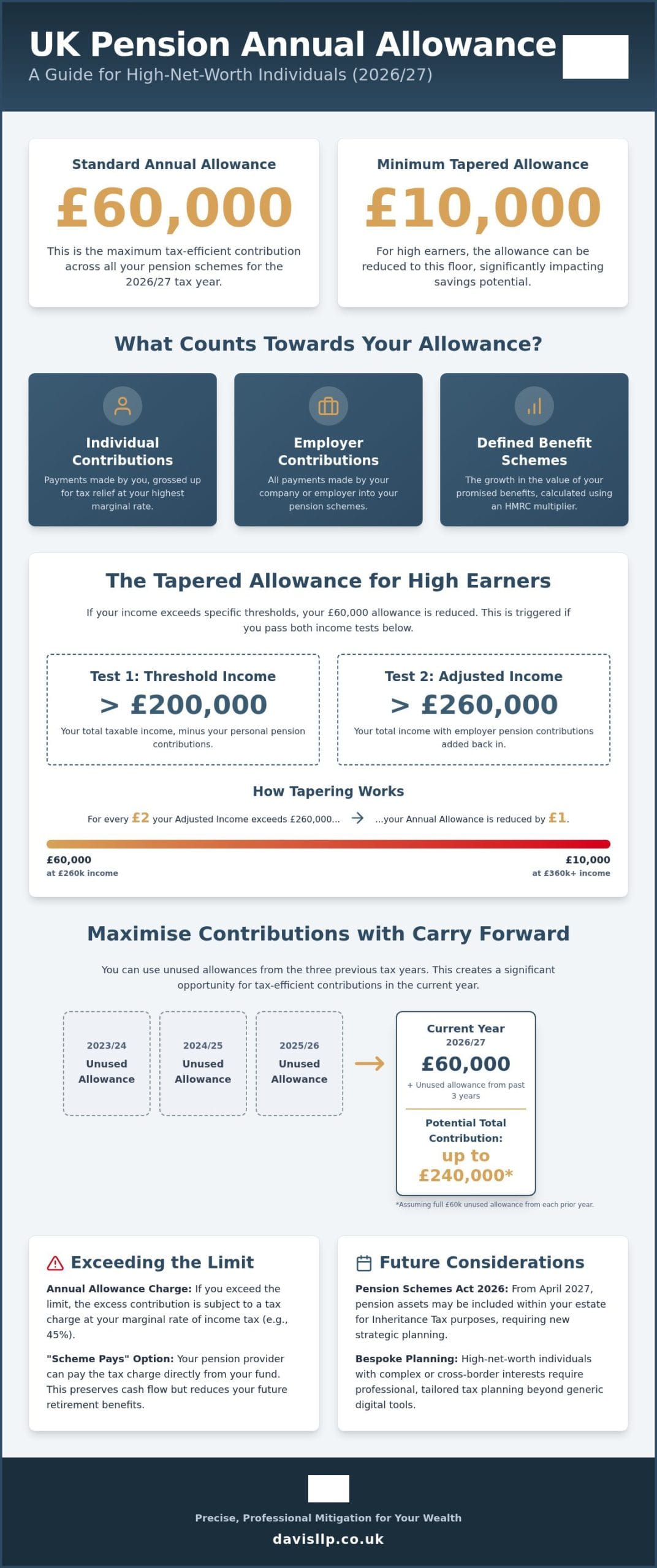
The pension annual allowance uk represents the maximum amount you can contribute to your pension schemes each tax year while still qualifying for tax relief. For the 2026/27 tax year, this standard limit is set at £60,000. This figure isn’t just a personal contribution cap. It encompasses the aggregate of all payments made into your various schemes, whether by you personally or by your employer. We view this allowance as a critical component of your broader fiscal strategy, requiring proactive management to avoid unnecessary tax exposure.
The UK operates under an “Exempt, Exempt, Taxed” (EET) model. This framework allows for tax-free contributions and tax-free investment growth within the fund, with taxation only occurring at the point of withdrawal. It’s a structure designed to incentivise long-term saving, yet it requires careful monitoring to ensure you don’t inadvertently breach the thresholds that trigger immediate tax liabilities. This balance is essential for maintaining the integrity of your retirement savings while ensuring full compliance with HMRC standards.
What Counts Towards Your Allowance?
Calculating your total contribution requires a nuanced approach, especially when balancing different types of pension structures. For Defined Contribution (DC) schemes, the calculation is straightforward. It’s the total cash value of all personal and employer contributions made during the tax year. Defined Benefit (DB) schemes are more complex. The allowance is measured against the increase in the value of your promised retirement benefits rather than the cash paid in. This increase is typically calculated using a multiplier set by HMRC.
- Individual Contributions: Includes payments made by you, grossed up for tax relief at your highest marginal rate.
- Employer Contributions: Any payments made by your company or employer into your pension, which are often a significant part of a professional’s total accrual.
- Tax Relief Arrangements: Whether through “relief at source” or “net pay,” the total gross value is what matters for the limit.
The Consequences of Exceeding the Limit
Exceeding the allowance doesn’t result in a legal penalty, but it does trigger an annual allowance charge. This charge effectively “claws back” the tax relief you received on the excess amount. HMRC calculates this based on your highest marginal rate of income tax. If you’re a high earner paying 45% tax, the charge on your excess contributions will reflect that rate. You’ll usually report this through your Self Assessment tax return by the standard deadlines.
In certain circumstances, you can utilise the “Scheme Pays” mechanism. This allows your pension provider to pay the tax charge directly from your pension fund. While this preserves your current cash flow, it will ultimately reduce the value of your retirement benefits. We suggest reviewing your contribution levels mid-year to identify potential breaches before they become a fiscal burden. This foresight is a hallmark of the disciplined approach we maintain for our clients.
Tapered Annual Allowance and MPAA: Limits for High Earners
For many high-income professionals, the standard £60,000 pension annual allowance uk is subject to a complex tapering mechanism. This reduction applies once your earnings cross specific fiscal boundaries, potentially lowering your allowance to a minimum of £10,000. Understanding where you stand requires passing two distinct income tests: the Threshold Income test and the Adjusted Income test. If you exceed both, the taper begins to erode your capacity for tax-relieved savings.
The tapering process operates on a precise ratio. For every £2 your adjusted income exceeds £260,000, your annual allowance is reduced by £1. This sliding scale continues until you reach the floor of £10,000, which applies to anyone with an adjusted income of £360,000 or more. Because these calculations rely on specific definitions of income that include employer contributions, it’s vital to assess your position before the tax year concludes to avoid a retrospective tax bill.
Navigating the Taper Trap
The distinction between Threshold and Adjusted income is where many professionals encounter difficulties. Threshold Income, currently set at £200,000, generally refers to your total taxable income minus your personal pension contributions. Adjusted Income, set at £260,000, is more inclusive. It adds the value of all employer pension contributions back into your total income. This reflects the total economic benefit you receive toward your retirement.
Salary sacrifice arrangements deserve particular scrutiny. While these are often efficient, they can inadvertently push your income over the threshold and trigger the taper. To calculate adjusted income for a high-earning director, start with your total taxable income, add the value of all employer pension contributions, and subtract certain allowable reliefs. Managing these variables effectively is a core part of our personal tax services, as we help clients maintain their savings velocity without triggering unexpected charges.
The Money Purchase Annual Allowance (MPAA)
The Money Purchase Annual Allowance (MPAA) introduces a different set of restrictions that don’t depend on your income level. This limit is triggered the moment you flexibly access your defined contribution pension, such as by taking an uncrystallised funds pension lump sum (UFPLS) or starting a flexi-access drawdown. Once activated, your allowance for money purchase schemes drops permanently to £10,000 for the 2026/27 tax year.
This trigger has significant long-term consequences. Not only is the limit reduced, but you also lose the ability to use carry-forward rules for money purchase contributions. We often advise semi-retired individuals to exercise caution here. If you plan to continue working and contributing significantly to your pension while drawing a small income, triggering the MPAA could severely hamper your ability to build your pot further. It’s a permanent shift in your tax status that requires careful timing.
Maximising Contributions with Carry Forward Rules
The pension annual allowance uk is not merely a static annual limit; it’s a rolling three-year opportunity for strategic wealth accumulation. Carry-forward rules allow you to utilise unused allowances from the previous three tax years, provided you were a member of a registered pension scheme during those periods. This mechanism is particularly valuable for high earners who may have seen their current year’s allowance restricted by tapering, as it provides a legitimate route to make substantial contributions without triggering an immediate tax charge.
To employ this strategy, you must first exhaust your full allowance for the current 2026/27 tax year. Only then can you look back to previous years, beginning with the earliest of the three. For the current cycle, this includes the 2023/24, 2024/25, and 2025/26 tax years. We find that precise record-keeping is vital here, especially for those with Defined Benefit accruals, where the “unused” portion isn’t a simple cash figure but a calculation of benefit growth against historical limits.
A Step-by-Step Carry Forward Calculation
Quantifying your available headroom requires a methodical, chronological approach to avoid miscalculations that could lead to HMRC enquiries. We recommend following these three steps:
- Step 1: Identify the unused allowance from the tax year three years prior (2023/24). If this isn’t utilised in the current year, it’s lost forever.
- Step 2: Assess the intervening years (2024/25 and 2025/26) in strict chronological order, ensuring any contributions made in those years are subtracted from the limits applicable at that time.
- Step 3: Factor in any tapering that applied in those historical years. If your income was high enough to trigger a reduction in 2024, your “starting” allowance for that year might have been significantly lower than the standard headline rate.
Common Pitfalls in Carry Forward Planning
A frequent oversight involves the “relevant UK earnings” restriction. While carry-forward allows you to use old allowances, your personal contributions in the current year are still limited to 100% of your current relevant UK earnings. If you have a low-income year but significant carry-forward capacity, you cannot personally contribute more than you earned that year. Employer contributions, however, don’t face this specific “earnings” cap, though they must still meet the “wholly and exclusively” test for corporation tax purposes.
The abolition of the Lifetime Allowance (LTA) has removed the previous “ceiling” on total pension size, making carry-forward an even more attractive tool for aggressive fund building. For business owners managing fluctuating annual profits, carry-forward serves as a vital fiscal safety valve, allowing for significant pension injections during high-liquidity years to offset previous periods of lower contribution. This flexibility ensures that your long-term retirement goals aren’t penalised by the natural ebbs and flows of commercial life.
Strategic Considerations for International and High-Net-Worth Clients
While the UK pension landscape is inherently domestic, the fiscal reality for high-net-worth individuals is frequently international. Managing the pension annual allowance uk becomes significantly more complex when wealth is distributed across multiple jurisdictions. For non-domiciled individuals, the interaction between UK tax relief and overseas pension schemes requires a high level of technical precision. International tax treaties often dictate how “relevant UK earnings” are calculated, especially for those with split-year residency or income sourced from several countries.
We often see clients with interests in Qualifying Recognised Overseas Pension Schemes (QROPS). While these offer flexibility, they don’t exist in a vacuum. Transfers and contributions must be mapped against the UK’s annual limits to avoid double taxation or unexpected charges. Our expertise in international tax planning ensures that your global retirement strategy remains cohesive and tax-efficient, regardless of where your career has taken you. This bespoke oversight is essential for maintaining compliance while maximising your global wealth potential.
Pensions and Inheritance Tax (IHT) Synergy
In 2026, pensions remain a powerful tool for estate planning as they’re typically outside the estate for IHT purposes. However, the legislation scheduled for April 2027 will bring most unused pension funds into the taxable estate, representing a significant shift in how we approach long-term wealth transfer. Strategic contributions made now can still serve as a method of reducing your current taxable estate, provided you stay within the annual allowance. We provide expert tax advice to help you balance immediate income needs with long-term legacy preservation before these rules shift.
Planning for Dental Professionals and Partners
As specialist dental tax advisors, we understand the unique pressures on NHS pension scheme members. The “Scheme Pays” election is a vital mechanism for managing high accrual values in the NHS scheme without depleting personal cash flow. However, transitioning between NHS and private practice requires careful timing to avoid breaching the allowance. For partners in a practice, profit shares directly impact the threshold income calculation, potentially triggering the taper even if your base salary seems modest. We ensure that every pound of your partnership income is accounted for when determining your available allowance.
Our team provides the bespoke oversight necessary to manage these sensitive matters with discretion. We recommend contacting us for bespoke tax planning to ensure your contributions are optimised for both current relief and future security.
The Value of Professional Tax Planning
The complexities surrounding the pension annual allowance uk are rarely solved by generic digital calculators. While basic tools can provide a headline figure, they often fail to account for the nuanced interplay between adjusted income, carry-forward headroom, and specific business structures. At Davis & Co LLP, we believe that managing significant wealth requires more than just arithmetic; it demands a collaborative partnership built on a foundation of reliability and discretion. Since our firm’s establishment in 1901, we’ve served as a trusted constant for high-net-worth individuals, providing the intellectual rigour necessary to navigate even the most volatile fiscal environments.
We provide a sense of order and security that automated services simply cannot replicate. Our role is to act as a strategic partner, ensuring that your retirement planning is as sophisticated as the wealth you’ve worked to build. This involves a logical progression from identifying your current challenges to providing actionable, bespoke solutions that reflect your individual circumstances. By maintaining this level of quiet excellence, we help you avoid the pitfalls of unexpected HMRC charges while ensuring your contributions are perfectly aligned with current regulations.
How We Support Your Financial Objectives
Effective pension planning shouldn’t exist in isolation. It’s most powerful when integrated with your broader strategy for business growth and personal tax efficiency. We utilise real-time data from management accounts to inform contribution decisions, ensuring that your pension injections are timed to coincide with peak liquidity and maximum tax relief. This proactive approach allows us to adjust strategies mid-year rather than reacting after the 5th April deadline has passed. If you’re seeking a long-term strategic partner, understanding how to find a chartered accountant who aligns with your professional values is a vital first step.
Next Steps: Securing Your Retirement Position
The window for identifying and utilising carry-forward opportunities is finite. A comprehensive tax review is the only definitive way to ensure that historical allowances aren’t lost to time, particularly as we approach the end of the 2026/27 tax year. We invite you to engage with our specialist tax planning services to secure a position of compliance and maximum efficiency. Our team of Chartered Certified Accountants is prepared to conduct a thorough analysis of your current standing, providing a clear path forward that respects both the human and organisational impact of your financial decisions.
For a discreet, professional consultation regarding your pension annual allowance uk, we encourage you to reach out to our practice. Early planning is the cornerstone of quiet excellence, allowing you to move from uncertainty to a state of well-advised security. Let us help you master these complexities with the composed partnership your financial future deserves.
Securing Your Fiscal Future Through Strategic Oversight
Mastering the pension annual allowance uk requires a shift from reactive compliance to proactive strategic planning. We’ve explored how the standard £60,000 limit interacts with intricate tapering rules and the vital role of carry-forward in protecting your wealth. These variables demand a high level of technical precision to ensure your contributions remain tax-efficient while satisfying HMRC’s rigorous standards. Generic calculators simply cannot replace the nuanced perspective of a seasoned advisor.
As an independent partnership of Chartered Certified Accountants established in 1901, we provide the discretion and expertise necessary to manage these sensitive matters. Whether you’re navigating cross-border interests or specific dental pension accruals, our focus remains on delivering highly individualised solutions. We invite you to consult with our personal tax experts for bespoke pension planning to identify missed opportunities before the tax year concludes. Taking these steps now ensures the stability needed for long-term retirement security. We look forward to acting as your strategic partner in maintaining the quiet excellence of your financial legacy.
Frequently Asked Questions
What is the pension annual allowance for the 2026/27 tax year?
The standard pension annual allowance uk for the 2026/27 tax year is £60,000. This figure represents the total gross amount you can contribute to all your pension schemes while benefiting from tax relief. We often remind clients that this limit includes personal payments, employer contributions, and any tax relief added by the government. It’s a foundational threshold that applies to most UK residents, though high earners may face significant reductions.
Can I carry forward unused pension allowance from previous years?
You can indeed carry forward unused allowances from the three previous tax years to increase your capacity in the current year. For the 2026/27 cycle, this includes the 2023/24, 2024/25, and 2025/26 periods. You must’ve been a member of a registered pension scheme during those years to qualify. This strategy is an essential tool for managing fluctuating income or making large contributions while maintaining full compliance with HMRC regulations.
How does the tapered annual allowance work for high earners?
The tapered annual allowance reduces your £60,000 limit if your threshold income exceeds £200,000 and your adjusted income is over £260,000. For every £2 your adjusted income rises above this £260,000 mark, your allowance drops by £1. This sliding scale continues until it reaches a minimum floor of £10,000. We find that precise income forecasting is necessary to avoid breaching these limits and triggering unexpected tax liabilities at year-end.
What happens if I contribute more than £60,000 to my pension?
Contributing beyond your available limit results in an annual allowance tax charge on the excess amount. HMRC calculates this charge by adding the excess contribution to your taxable income, effectively taxing it at your highest marginal rate. It’s designed to recoup the tax relief you received on the overpayment. While “Scheme Pays” is sometimes an option for settling the bill, we suggest a proactive review of your total accruals to prevent this.
Does the annual allowance include employer contributions?
Yes, the pension annual allowance uk is an aggregate limit that accounts for all contributions made on your behalf. This includes your personal net payments, the tax relief added by the provider, and any contributions made by your employer. Many professionals overlook the impact of company-funded payments, yet these are often the primary driver of an allowance breach. We help you monitor these combined figures to ensure your total funding remains within boundaries.
What is the Money Purchase Annual Allowance (MPAA)?
The Money Purchase Annual Allowance (MPAA) is a restricted limit of £10,000 that applies once you flexibly access your defined contribution pension. This trigger occurs if you take an uncrystallised funds pension lump sum or start a flexi-access drawdown. Once activated, it’s a permanent change that limits your future tax-relieved savings. It also removes your ability to use carry-forward for money purchase schemes, which is a significant factor for those planning to work.
Are there different rules for Defined Benefit (final salary) pensions?
Defined Benefit schemes follow different valuation rules because they aren’t based on cash contributions. Instead, the allowance is measured against the increase in the value of your promised retirement benefits over the tax year. HMRC uses a specific multiplier to calculate this growth, which often results in high notional contributions. We provide specialist oversight for members of these schemes, including dental professionals, to accurately quantify their annual benefit accrual and avoid unforeseen charges.
How do I report an annual allowance tax charge to HMRC?
You must report any annual allowance tax charge through your Self Assessment tax return. There is a specific section for pension savings where you disclose the amount by which you’ve exceeded your limit. If you’re using “Scheme Pays,” you’ll also need to indicate that your pension provider is settling some or all of the charge. We ensure these details are handled with the necessary precision to maintain your standing as a compliant taxpayer.