If tax has already been deducted overseas, should you seek repayment there, arrange relief at source or claim UK foreign tax credit relief? The answer depends on where you’re resident, where the income arises and what the relevant treaty says. Claiming double taxation treaty relief can feel uncertain because a treaty may limit taxing rights, but relief isn’t automatic. The appropriate route varies by income type and country.
Before making a claim, it helps to establish the relevant tax year, identify the treaty article that covers the income and check which authority should receive your claim. The wrong form or incomplete evidence can delay the process. This guide explains how to distinguish relief at source from a repayment claim and UK foreign tax credit relief, and how to organise supporting documents. It also covers common checks that can help you avoid claiming the same relief twice or relying on a treaty provision that doesn’t apply. Where residence, source-country tax and treaty wording interact, tailored international tax planning can help clarify the position.
Key Takeaways
- Start with the relevant tax year, your residence position and where the income arises before deciding which countries’ rules to examine.
- Claiming double taxation treaty relief may involve relief at source, a repayment claim or UK foreign tax credit relief. The right route depends on the treaty and tax already paid.
- Check the applicable treaty and current HMRC requirements, then gather relevant income records, tax statements and evidence of residence.
- Track the claim and any response. Missing evidence, conflicting residence positions or multiple income types may require further review.
- Where treaty wording and cross-border tax positions interact, professional international tax planning can help you assess the available route without assuming relief is guaranteed.
Claiming double taxation treaty relief: what it can and cannot do
Treaty relief is relief available under a particular agreement between countries, subject to that agreement’s wording and the procedures of the countries involved. It can address situations where both countries’ domestic tax rules apply to the same income. Avoiding double taxation is the broader aim of treaties. It doesn’t mean every cross-border taxpayer will pay tax in only one country.
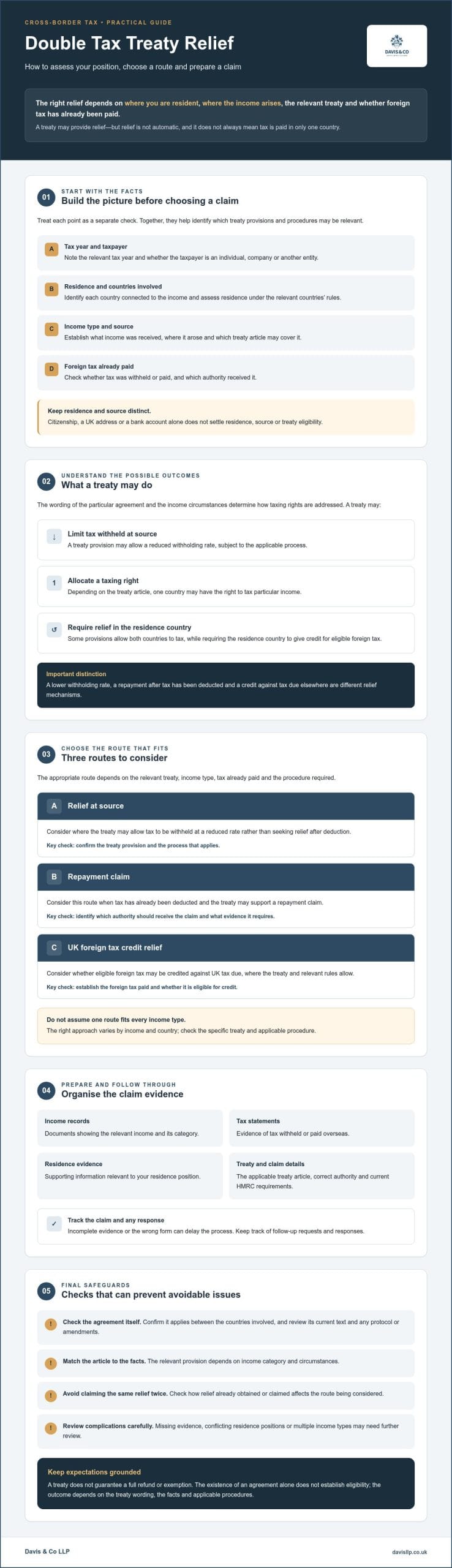
A treaty may allocate taxing rights between the country where a person is resident and the country where income arises. Depending on the income and treaty article, it may limit tax withheld at source, give one country the right to tax, or require the residence country to give credit for eligible foreign tax. The mechanism matters: a reduced withholding rate is different from a repayment after tax has been deducted, and both differ from a credit claimed against tax due elsewhere.
For a high-level introduction to what a double tax agreement is, see the general overview. It can explain the purpose and common models of treaties, but it isn’t a substitute for checking the agreement that applies to your circumstances.
What does double taxation mean in a cross-border case?
Two countries may seek to tax the same income under their own rules. The outcome can depend on the taxpayer’s residence, where the income arises, its category and the relevant tax year. Residence and source are separate questions. Living in one country does not, by itself, determine how another country taxes income arising there.
Hypothetical example: A UK tax resident receives interest from an overseas account. The country where the account is held may withhold tax, while the UK may also include the interest in its tax calculation. Whether a treaty reduces the withholding or the UK allows relief depends on the particular agreement and the facts.
Does a double taxation treaty always mean you pay tax only once?
No. A treaty may limit one country’s taxing rights without removing tax in the other. Some provisions allow both countries to tax while requiring a form of relief. The result depends on the treaty article, the type of income and relevant domestic rules, including the process for claiming relief.
Claiming double taxation treaty relief isn’t a guarantee of a full refund or exemption. Check the specific treaty and your circumstances before deciding what relief to seek. The existence of an agreement alone does not establish eligibility.
Check residence, income source and treaty eligibility before claiming
Before choosing a form or asking for relief, define the case you’re assessing. Note the relevant tax year, whether the taxpayer is an individual, company or other entity, and every country connected to the income. Then establish what income was received, where it arose and whether tax has already been deducted or paid. These details help identify which treaty provisions may apply and which authority or procedure to consider.
Start by checking residence, source, income type and tax already paid. Treat each as a separate question. Residence may affect which country can tax a person’s worldwide income, while the source country may have taxing rights over particular income arising there. The country that withheld tax may be the source country, but withholding itself doesn’t establish residence or settle what relief is available.
How do tax residence and source of income affect a claim?
Countries apply their own rules to determine tax residence, and those rules may not produce the same answer. Residence isn’t synonymous with citizenship, domicile or simply where someone happens to be on a particular day. Time spent in a country may be relevant, but no single fact establishes a person’s status in every case. Consider each country’s rules and any relevant treaty tie-breaker provisions against the full facts.
Source is also specific to the type of income. Employment income, for example, may require you to examine where duties were performed, while investment income may be connected to a payer or asset in another country. Don’t assume that a UK address, passport or bank account alone decides where income arises or which country may tax it.
How can you identify the relevant treaty article?
Confirm that an agreement applies between the countries concerned, then check its current text and any protocol or amendments. Match the provision to the income category and circumstances. Dividends, interest, employment income and pensions may be covered by different articles, each with distinct conditions and relief methods. Once you’ve identified the relevant provision, check the domestic procedure and claim route.
For broader context on cross-border considerations, read our international tax planning guide. If residence, income source and treaty wording interact in a complex case, a tailored review through international tax planning may help clarify which issues to examine before proceeding.
Choose the right route for claiming double taxation treaty relief
The route depends on where you’re resident, the type of income, the relevant treaty and which country has deducted or charged tax. Relief at source, a foreign tax repayment and UK foreign tax credit relief are different mechanisms, not interchangeable options. Before proceeding, check the current instructions from HMRC and the tax authority in the country that imposed the tax. Forms, certification requirements and submission methods vary by country and may change.
| Situation | Possible route | Authority to check | Evidence to confirm |
|---|---|---|---|
| Treaty eligibility is established before a payment is made | Relief at source, if the treaty and local procedure allow a reduced withholding rate | The paying country’s tax authority and payer; HMRC where UK clearance or residence certification is relevant | Residence evidence, income type, treaty conditions and any required certification |
| Foreign tax was withheld, potentially above the treaty rate | A repayment claim to the country that withheld the tax | That country’s tax authority | Payment and withholding statements, applicable treaty rate and claim requirements |
| Foreign tax was paid on income also subject to UK tax | UK foreign tax credit relief, if the conditions are met | HMRC and the relevant treaty | Foreign tax paid, income reported in the UK and any supporting tax documents |
When might relief at source or a repayment claim apply?
Some treaties allow eligible taxpayers to receive payments with reduced withholding, but the required claim or clearance may need to be completed in advance. If tax has already been withheld at a rate higher than the treaty permits, a repayment claim to the source country may be relevant. The route, form name, residence certification and deadline depend on that country’s current process. Check each requirement before submitting. Don’t assume a UK form will be accepted overseas.
When might UK foreign tax credit relief be relevant?
Where foreign tax has been paid on income that is also taxable in the UK, foreign tax credit relief may reduce the UK tax attributable to that income, subject to eligibility and limits. For individuals completing Self Assessment, the SA106 supplementary pages are used to report foreign income and claim relief where appropriate. Check the current HMRC instructions for the relevant tax year and circumstances. The credit isn’t automatically equal to all foreign tax paid: UK law, the treaty and the facts determine the amount that may be credited.
Keep records for each route distinct and make sure the same foreign tax isn’t used to claim relief twice. If the interaction between residence, source-country tax and treaty terms is unclear, international tax planning advice may help you assess the position before making a claim.
Prepare your treaty relief claim: documents, checks and follow-up
A well-organised claim makes it easier for the relevant authority to understand the income, tax and treaty provision involved. Before preparing paperwork, confirm the applicable agreement and article, identify whether you’re applying for relief at source, a repayment or UK foreign tax credit relief, then check the current requirements of the authority receiving the claim.
Consistent residence and tax records can help an authority assess a claim. The exact evidence depends on the treaty, income and procedure. Treat the records below as examples to check against the authority’s current list, not as universal requirements.
What evidence may a claim require?
Depending on the route, useful records may include payment or income statements, evidence of tax withheld or paid, and documents showing the source and nature of the income. A Certificate of Residence may be relevant if the other country requires confirmation of UK tax residence. Check HMRC’s current application process and the foreign authority’s instructions before requesting or submitting one.
Some authorities may also ask for certification, translations or country-specific documents. Verify whether these are required and whether original documents or copies are accepted. Keep a record of what you provide.
- Income statements and records identifying the payer and income type.
- Withholding certificates or other evidence of foreign tax paid.
- Residence evidence or a Certificate of Residence, if requested.
- A copy of the claim, proof of submission and related correspondence.
What should you check before submitting and after filing?
Use this sequence to keep the claim organised:
- Confirm the treaty and article. Check that the agreement covers the countries, tax year and income in question.
- Verify the route and evidence list. Follow current official guidance from HMRC or the foreign tax authority receiving the claim.
- Reconcile the figures. Check that income amounts, tax withheld, dates and currency conversions agree across forms and supporting records. Explain any differences clearly.
- Check submission details. Confirm the recipient, filing method, required signatures and applicable deadline using official instructions.
- Retain and track the claim. Keep a complete copy and proof of submission, note any reference number, and respond promptly if the authority requests more information.
These checks are particularly useful when claiming double taxation treaty relief across more than one income type or country, where records and filing procedures may differ. If residence evidence and tax documentation are difficult to reconcile, discuss your cross-border tax position with an adviser experienced in international tax planning.
Resolve complications and decide when to seek international tax advice
Even a carefully prepared treaty claim can become complicated. The countries involved may reach different conclusions about residence, a required Certificate of Residence may be missing, or the tax withheld may be disputed. Claims involving several income types can add another layer because each category may be governed by a different treaty article and evidence requirement.
If a claim is delayed, refused or only partly accepted, start with the authority’s notice. Identify the reason given, the evidence it considered and any documents or explanations it says are missing. Check the notice for response, review or appeal deadlines, then confirm the available procedure with the authority that issued it. Options vary by country and claim type. A treaty’s existence alone does not require an authority to accept a claim.
What if a treaty claim is delayed, refused or only partly accepted?
Compare the decision with the claim you submitted. Check the income and tax figures, treaty article relied on, residence evidence and withholding records. If the authority appears to have misunderstood a document or overlooked information, follow its stated process for providing clarification or requesting a review. Keep copies of correspondence and act within any applicable deadline. If the notice is unclear, ask the authority to explain the next procedural step.
When can an international tax adviser add value?
Professional review may be useful if two countries treat you as resident, your residence position is uncertain, withholding is challenged or different income categories are involved. An adviser can assess the relevant treaty provisions alongside your records and domestic tax rules, helping you understand where positions may conflict and what questions need to be resolved. This is particularly relevant when claiming double taxation treaty relief involves several jurisdictions or tax periods.
For wider context, see our UK tax advice guidance. Davis & Co LLP provides tailored international tax planning for individuals and businesses with cross-border tax considerations. Discuss your cross-border tax position with Davis & Co LLP if you would like professional input on the issues involved. Advice can help clarify the analysis, but it cannot guarantee that a tax authority will grant relief or repayment.
Take a considered approach to your treaty claim
Before claiming double taxation treaty relief, establish which countries and tax year are involved, confirm the applicable treaty article and identify the appropriate route. Relief at source, a repayment from the country that withheld tax and UK foreign tax credit relief follow different procedures. The right choice depends on your residence, income and the tax already paid.
Keep your evidence consistent, check current instructions from the relevant tax authorities and retain a record of your submission. A treaty doesn’t guarantee a full exemption or repayment. Complex residence questions, multiple income types or disputed withholding may benefit from individual review.
Davis & Co LLP is an independent partnership of Chartered Certified Accountants, founded in 1901, providing tailored international tax planning for individuals and businesses. If your tax obligations span jurisdictions, contact Davis & Co LLP to discuss your international tax position.
Frequently Asked Questions
How do I claim double taxation treaty relief in the UK?
Start by confirming your tax residence, where the income arises, the relevant tax year and the treaty article that covers it. Then identify whether you need relief at source, a repayment from the country that withheld tax or UK foreign tax credit relief. Check current HMRC and overseas authority guidance for the correct form, evidence and submission method. Some individual claims may use form DT-Individual, depending on the circumstances.
Can I claim foreign tax credit relief and treaty relief on the same income?
Potentially, but you must not claim relief twice for the same foreign tax. A treaty may limit the amount of tax the source country can charge, while UK foreign tax credit relief may address eligible foreign tax on income also taxed in the UK. The amount that can be credited depends on UK rules, the treaty and your circumstances. Check whether excess foreign tax should instead be reclaimed from the source country.
What documents do I need to claim double taxation treaty relief?
Requirements vary by country, treaty and claim route, so check the receiving authority’s current evidence list. Depending on the case, you may need income statements, evidence of foreign tax withheld or paid, proof of residence or a Certificate of Residence, and documents identifying the income source. Keep copies of your claim, submission confirmation and correspondence. Some authorities may require certification, translations or specific local documents.
Do double taxation treaties mean I will not pay tax twice?
No. A treaty can allocate or limit taxing rights, reduce withholding or provide for relief in the country where you’re resident, but it doesn’t always exempt income or remove all tax. The outcome depends on the specific treaty article, income type, residence position and domestic procedures. In some cases both countries may tax the income initially, with relief available through a credit or repayment if the relevant conditions are met.
How do I claim relief on foreign tax paid as a UK resident?
If foreign tax has been paid on income also taxable in the UK, you may be able to claim UK foreign tax credit relief, subject to the applicable rules and treaty. Individuals commonly report foreign income and claim relevant relief through Self Assessment, using the SA106 supplementary pages where instructed by current HMRC guidance. If foreign tax exceeded the treaty limit, check whether a repayment claim should be made to the overseas authority.
Is there a deadline for claiming double taxation treaty relief?
Deadlines depend on the type of claim, the country involved and the applicable treaty or domestic rules. HMRC generally allows claims for tax refunds up to four tax years after the end of the tax year in which the overpayment occurred. For example, a refund claim for 2022/23 is generally due by 5 April 2027. Don’t assume this UK time limit applies to a claim overseas. Verify the relevant authority’s deadline.
What should I do if HMRC or another tax authority rejects my claim?
Read the decision carefully and identify the reason, evidence considered and any missing information. Check the notice for the process and deadline to provide further details, request a review or pursue another available remedy. Procedures differ between countries and claim types, so confirm the next step with the authority that issued the decision. If residence, treaty interpretation or several income types are in dispute, consider tailored international tax advice.