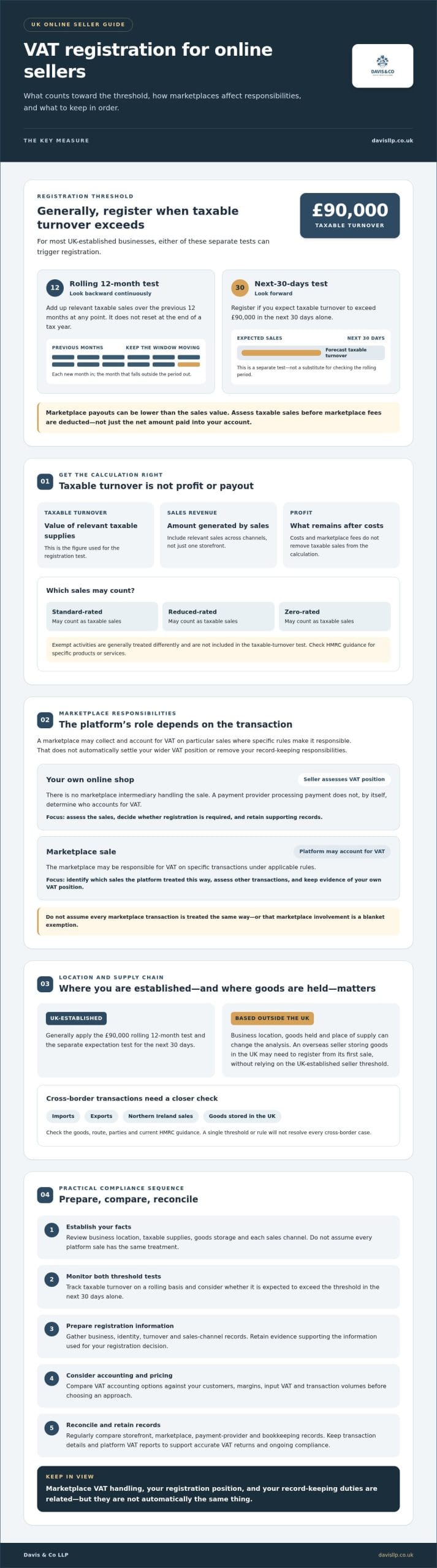
Could your online shop be approaching the VAT threshold even if your marketplace payout suggests otherwise? For vat registration for online sellers, the key figure is generally taxable turnover from sales before marketplace fees are deducted, not the net amount paid into your account. Most UK-established businesses must register when taxable turnover exceeds £90,000 over a rolling 12-month period, or when they expect it to exceed that amount in the next 30 days alone.
Selling through a marketplace does not automatically change who is responsible for VAT. The answer depends on factors such as where you’re established, where your goods are stored and how each sale is made. Marketplace VAT rules may apply to particular transactions, but they do not necessarily remove your own registration or record-keeping responsibilities.
This guide explains how to assess taxable turnover, when marketplace-facilitated sales may affect the rules, and what information to prepare if registration is required. It also covers practical next steps, including charging VAT correctly and keeping records for ongoing compliance. Reviewing your sales and supply chain can help you decide what to do and whether to seek tailored VAT compliance support.
Key Takeaways
- Assess vat registration for online sellers by considering your business location, taxable supplies and sales channels. Do not assume every marketplace transaction is treated the same way.
- Prepare business, identity, turnover and channel records before applying, and retain evidence of the information used to make your registration decision.
- Compare VAT accounting options against your customers, margins, input VAT and transaction volumes before choosing an approach.
- Reconcile storefront, marketplace, payment-provider and bookkeeping records regularly to support accurate VAT returns and ongoing compliance.
- Check how VAT is handled for each type of marketplace sale and keep clear records of your own responsibilities.
When does an online seller need VAT registration in the UK?
VAT registration notifies HMRC that a business is accountable for VAT on its taxable sales and must meet related reporting and payment obligations. Whether registration is required depends on the supplies the seller makes, where the business is established and its taxable turnover. Incorporating a company, for example, does not by itself determine whether VAT registration is required.
A UK-established seller generally needs to register if taxable turnover exceeds £90,000 in a rolling 12-month period, or if the seller expects to exceed £90,000 in the next 30 days alone. These are separate tests, so monitor both. The threshold is current as of October 2026. Check the latest HMRC guidance if your circumstances or the rules change.
Which sales count towards the VAT registration test?
Taxable turnover is the value of sales that count as taxable supplies for VAT purposes. It can include standard-rated, reduced-rated and zero-rated sales. Exempt activities are generally treated differently and are not included in the taxable-turnover test. The UK’s UK Value-Added Tax (VAT) system provides general background on these categories. For specific products or services, check HMRC guidance.
The rolling test looks back over the previous 12 months at any point, rather than resetting at the end of a tax year. Review your total regularly: add each new month’s taxable sales and remove the month that has fallen outside the period. The separate 30-day test applies if you expect taxable turnover to exceed the threshold in that period alone.
Keep sales revenue, profit and taxable turnover distinct. Sales revenue is the amount generated by sales; profit is what remains after costs; taxable turnover is the value of relevant taxable supplies. Costs and marketplace fees do not remove taxable sales from the calculation. Include sales from all relevant channels, such as your own website, marketplaces and other platforms, rather than checking one storefront in isolation.
What changes for overseas sellers and cross-border sales?
For sellers based outside the UK, the location of the business, where goods are held and the place of supply can change the registration analysis. An overseas seller storing goods in the UK may need to register from its first sale, without relying on the UK-established seller threshold. Do not assume this treatment applies to every non-UK business or transaction. Establish the relevant facts first.
Imports, exports and sales involving Northern Ireland can also affect how a transaction is treated. Check current HMRC guidance for the goods, route and parties involved. A single threshold or rule will not resolve every cross-border case. Where the supply chain is complex, tailored VAT compliance advice can help clarify the registration position and set up a reliable way to track turnover.
How do online marketplaces affect VAT registration and seller responsibilities?
A marketplace may handle VAT for certain transactions, but that does not automatically settle the seller’s overall VAT position. The platform’s role depends on the transaction and the rules that apply. Sellers still need to understand their own registration and record-keeping responsibilities.
Selling through a marketplace versus your own online shop
Compare responsibilities transaction by transaction:
| Sales channel | Platform role | Seller’s continuing focus |
|---|---|---|
| Own online shop | There is no marketplace intermediary handling the sale. A payment provider may process payment, but that alone does not establish who accounts for VAT. | Assess the VAT treatment of sales, determine whether registration is required and keep supporting records. |
| Online marketplace | The marketplace may collect and account for VAT where specific rules make it responsible for that transaction. | Check which sales the platform has treated this way, assess other transactions and maintain records that support your VAT position. |
For vat registration for online sellers, marketplace involvement is one part of the analysis, not a blanket exemption. Compare transaction records with the platform’s terms and VAT reports, then check current HMRC guidance. Keep enough detail to identify the goods, buyer, destination, seller location and VAT treatment for each relevant sale.
Does a marketplace collect VAT on every sale?
No single answer applies to every order. The treatment can depend on where the seller is established, where the goods are located, who the buyer is and how the transaction is structured. For example, GOV.UK explains that an online marketplace is responsible for VAT on certain sales of overseas goods to UK customers when the consignment is valued at £135 or less. Its guidance on VAT on overseas goods explains the scope of that rule.
A marketplace’s responsibility to account for VAT on a particular sale does not, by itself, remove the seller’s responsibility to assess registration, account for other sales correctly or retain adequate records. Reconcile platform reports against your own order and bookkeeping data. Investigate differences rather than assuming a platform summary covers every obligation.
If cross-border sales, overseas stock or marketplace VAT reports leave your position unclear, transaction-level advice can help establish what applies. Davis & Co LLP provides VAT compliance and bookkeeping support tailored to a business’s circumstances.
How to register for VAT as an online seller: a practical sequence
Once you’ve established that registration may be required, a clear process can prevent gaps between your sales records, application and subsequent VAT reporting. Use the steps below to prepare for vat registration for online sellers. Confirm current requirements directly with HMRC, particularly if your business sells across borders or through a marketplace.
- 1. Confirm the registration trigger. Review your taxable turnover and business circumstances, including where you’re established and where goods are held. If the position is unclear, resolve it before submitting an application.
- 2. Assemble relevant records. Bring together business and identity details, trading information, turnover calculations, sales records and a list of sales channels. Reconcile marketplace reports with your bookkeeping so you can explain the figures.
- 3. Apply through HMRC’s current process. Most businesses can register online, but check GOV.UK for the applicable process and the information required for your business structure and circumstances.
- 4. Keep the application evidence. Save your calculations, supporting records, submission confirmation and HMRC correspondence together. These documents create an audit trail for your decision and the details you supplied.
What information should sellers prepare before applying?
Organise records under practical headings: business structure and identifying details; trading activity and start dates; sales and taxable-turnover records; and channel information for your own website, marketplaces and other routes to customers. These are preparation categories, not a definitive HMRC document checklist. Check HMRC’s application guidance for current identity checks and document requirements. For marketplace transactions involving overseas goods, compare your records with the official government guidance on VAT for online marketplaces.
Check that sales reports, refunds and bookkeeping entries reconcile, and note any differences before applying. A consistent record of how you calculated turnover makes it easier to support the application and maintain accurate records afterwards.
What happens after submitting a VAT registration application?
Monitor HMRC correspondence and respond to any instructions or requests for further information. Processing times and outcomes can vary, so follow the latest guidance and keep a copy of what you submitted.
Pay close attention to the effective date HMRC confirms. It can affect when VAT obligations begin, so establish the date before issuing VAT invoices or changing how sales are recorded. Check HMRC guidance for any applicable notification deadlines and what to do while an application is being considered. If your registration position or records need review, tailored VAT compliance and bookkeeping support can help you prepare a clear process.
Which VAT scheme and pricing approach should an online seller consider?
Registration is only part of the decision. Your VAT accounting approach can affect cash flow, administration and how much VAT you can recover on purchases. The right comparison depends on your customer mix, product margins, input VAT, transaction volume and the quality of your marketplace reporting. Check current HMRC scheme rules and eligibility before choosing.
How should sellers compare VAT accounting options?
| Approach | Cash flow and input VAT | Records and eligibility |
|---|---|---|
| Standard VAT accounting | VAT is accounted for under the usual rules for sales and purchases. The timing of returns and payments can affect cash flow. | Requires records that support VAT charged on sales and VAT claimed on eligible purchases. Check current requirements for your business. |
| Cash Accounting Scheme | VAT is generally accounted for as customers pay and suppliers are paid, which may help with timing where sales are paid for later. | Eligibility conditions apply. Review how payment timing and transaction records work for your channels before selecting it. |
| Flat Rate Scheme | VAT is calculated using a sector-based percentage of VAT-inclusive turnover. Input VAT recovery is restricted under the scheme, subject to specific rules. | Businesses generally need taxable turnover of £150,000 or less to join. A limited cost trader rate of 16.5% may apply, so the scheme may not suit sellers with low goods-related costs. |
These options are starting points, not recommendations. Check scheme names, eligibility and detailed treatment against current HMRC guidance. Model your actual sales and costs, including marketplace fees and the way platforms report VAT, before comparing the likely outcome.
How might registration affect product pricing and margins?
For consumer sales, you might absorb some or all of the VAT within the existing price, raise the VAT-inclusive price, or use a combination across products. The choice depends on margins, customer expectations and competitors’ prices. Business-to-business customers who can recover VAT may assess the net cost differently, but do not assume every business customer can reclaim it.
Illustration: If a standard-rated product is sold for £120 including VAT at the 20% standard rate, the VAT element is £20 and the sale before VAT is £100. This example assumes the product is standard-rated and the price remains unchanged; other VAT treatments produce different results. Use product-level figures to see how a price change or absorbed VAT affects your margin.
Modelling your actual transaction data can help compare scheme and pricing choices. To discuss tailored VAT compliance support for your online business, speak with Davis & Co LLP.
What should online sellers do after VAT registration?
Registration starts an ongoing process. Sellers need a reliable routine for applying the correct VAT treatment, supporting figures with records and meeting return and payment obligations. For vat registration for online sellers, a common practical challenge is bringing data from several sales systems into one consistent picture.
What records and reporting routines should sellers maintain?
Reconcile orders from your storefront and marketplaces with payment-provider statements and bookkeeping records. Track refunds, discounts, fees, VAT charged and settlement amounts separately so a net payout does not obscure the underlying sales. Investigate differences promptly and keep evidence explaining adjustments or unusual transactions.
Issue VAT invoices where required and make sure they contain the information prescribed for the transaction. Record the basis for VAT treatment, particularly for unusual products or cross-border sales. Check current HMRC rules for invoice requirements, record-retention periods and any special treatment relevant to your business.
HMRC requires VAT-registered businesses to keep digital records and submit VAT returns using Making Tax Digital-compatible software. Confirm current requirements and choose a process that preserves a clear connection between source transactions, bookkeeping entries and submitted figures. If you file quarterly, the general deadline to submit the return and pay is one month and seven days after the accounting period ends. Check your accounting period and current HMRC instructions rather than assuming every seller has the same dates.
When can an accountant help with online-seller VAT?
Professional review can be useful if you sell through several channels, have international customers, hold goods in different locations, or are uncertain about registration status or the treatment of particular transactions. It can also help when turnover changes, platform reports do not reconcile with your books, or a new sales route changes how orders are fulfilled.
Davis & Co LLP provides VAT compliance and bookkeeping services. Tailored support can help sellers review their records, establish practical reporting routines and consider the VAT implications of their circumstances. No single approach suits every business. For broader context, consult the firm’s UK tax advice guide and consider how its guidance applies to your transactions.
If you’d like to discuss your online business’s VAT records or ongoing compliance, contact Davis & Co LLP to explore support suited to your circumstances.
Put a clear VAT plan in place
For online sellers, VAT decisions depend on more than headline sales. Taxable turnover, business location, stock movements and the structure of marketplace transactions can all affect the answer. Review sales across every channel, confirm how VAT is handled for each type of transaction, and keep reliable records to support registration decisions and ongoing returns.
Choosing an accounting approach and setting customer prices also calls for a clear view of margins, input VAT and the customers you serve. A consistent process makes these decisions easier to revisit as your business grows. The rules around vat registration for online sellers can be specific to each business, particularly where cross-border sales are involved.
Davis & Co LLP is an independent partnership of Chartered Certified Accountants with a history dating to 1901. Its services include VAT compliance, bookkeeping and business advisory, helping businesses assess their circumstances and maintain orderly records. Discuss VAT compliance for your online business with the firm to consider practical next steps. With clear information and a sound routine, you can manage VAT with greater confidence.
Frequently Asked Questions
Is VAT registration compulsory for every online seller?
No. VAT registration for online sellers is not automatic. The obligation depends on taxable turnover, the supplies made, the seller’s location and the rules applying to the transactions. A UK-established business generally assesses the £90,000 threshold using the rolling 12-month test or the separate expectation test for the next 30 days. Overseas sellers and particular cross-border arrangements may be treated differently, so check current HMRC guidance before deciding.
How much can I sell online before I need to register for VAT?
For most UK-established businesses, the current threshold is £90,000 of taxable turnover. The usual test looks at taxable sales over any rolling 12-month period, not profit or sales in one calendar month. There is also a separate test if you expect taxable turnover to exceed £90,000 in the next 30 days alone. Check current HMRC guidance, as the relevant treatment can depend on your location and supplies.
Do I need VAT registration if I sell only through an online marketplace?
Possibly. Selling only through a marketplace does not automatically remove your own VAT responsibilities. Whether the platform accounts for VAT can depend on your location, the goods, the customer and how the sale is structured. Review transaction-level reports and platform terms to identify which sales the marketplace has handled, then assess your remaining taxable turnover and obligations. Check current HMRC guidance for your specific arrangement, particularly for cross-border transactions.
Can an overseas seller register for VAT in the UK?
Yes. An overseas seller may need to register for UK VAT, but the usual threshold assessment for a UK-established business may not apply in the same way. The analysis depends on where the seller is established, where goods are stored and how sales are made. For example, storing goods in the UK can change the position. Verify current HMRC rules for your circumstances before relying on a threshold or deadline.
How do I register for VAT as an online seller?
First, confirm that a registration trigger applies, then gather your business details, identity information, turnover calculations and sales-channel records. Apply using HMRC’s current registration process and retain your submission and supporting evidence. Check HMRC guidance for current document requirements, deadlines and the effective date of registration. If you sell across borders or use several platforms, tailored advice can help clarify what information you need and how to present your transactions.
Should an online seller use the Flat Rate Scheme?
Not necessarily. The Flat Rate Scheme has eligibility conditions, including a current taxable-turnover limit for joining, and its suitability depends on your business type, costs, input VAT and sales model. Compare its cash-flow effects and administrative requirements with other accounting approaches using your actual transactions. For example, sellers with substantial eligible purchase VAT should consider how input VAT treatment affects the comparison. Check current HMRC guidance before choosing a scheme.
What records must an online seller keep after registering for VAT?
Keep records that support sales, VAT invoices, refunds, fees, VAT calculations and marketplace reports, and reconcile them with payment-provider statements and bookkeeping entries. A regular reconciliation can help identify differences between gross orders and net payouts. Record the reasoning and evidence for unusual or cross-border transactions. HMRC’s retention, digital record-keeping and filing requirements can depend on circumstances, so check current guidance and use a process that supports accurate returns.