Doing your own accounts can give you control, but it doesn’t always give you confidence that every obligation has been handled correctly. The choice in diy accounting vs chartered accountant is less about software versus paperwork and more about the time you can commit, the complexity of your finances and when specialist judgement could help.
Accounting software can organise transactions and keep records in one place, but it still depends on accurate information and the right choices when transactions are categorised. You remain responsible for keeping records and meeting the tax and reporting requirements that apply to you. As a business grows, or personal and business finances become more involved, interpreting the figures and making sound decisions can take more than keeping the books up to date.
This guide compares the practical trade-offs between managing accounts yourself and working with a chartered accountant. It covers time, control, compliance responsibilities and decision-making support, including where bookkeeping, tax compliance and management accounts can help. Use it to identify which tasks you can manage consistently and where additional support could be useful.
Key Takeaways
- Use the diy accounting vs chartered accountant comparison to weigh your available time, confidence and financial complexity, rather than assuming one approach suits everyone.
- Look for practical warning signs, such as transaction backlogs, multiple income sources or changing circumstances that make records harder to maintain.
- Consider a blended approach: handle familiar tasks yourself and seek professional review or advice where you need it.
- Match support to the task, from bookkeeping and personal tax to management accounts that help you understand business performance.
- Davis & Co LLP is an independent partnership of Chartered Certified Accountants, supporting individuals and businesses with accounting and tax needs.
DIY accounting vs a chartered accountant: what are you actually choosing?
Accounting software makes it easier to organise financial records, but it doesn’t remove your responsibility for keeping them accurate or meeting relevant reporting obligations. The choice in diy accounting vs chartered accountant is about more than who enters the numbers. It’s also about who interprets them and where you can turn when you need advice.
DIY accounting means managing your own records and accounting tasks, often with software. Software-assisted bookkeeping can help you record transactions, organise receipts and produce summaries. A chartered accountant can work with those records to prepare accounts, support tax compliance and explain what the figures mean for your circumstances. A Chartered accountant is a qualified accounting professional whose work may span areas such as taxation, auditing and business finance. Davis & Co LLP is an independent partnership of Chartered Certified Accountants.
| Area | DIY accounting | Working with an accountant |
|---|---|---|
| Responsibilities | You organise and maintain records, and handle relevant submissions. | Support can cover agreed accounting and tax tasks. You still provide accurate information and understand your responsibilities. |
| Time | You set aside time to record and check transactions and prepare information. | You may delegate agreed tasks, while still supplying records and reviewing information. |
| Expertise and advice | Software can process information, but it doesn’t replace professional judgement. | You can draw on accounting knowledge and discuss how the figures relate to your circumstances. |
What DIY accounting includes, and what it doesn’t
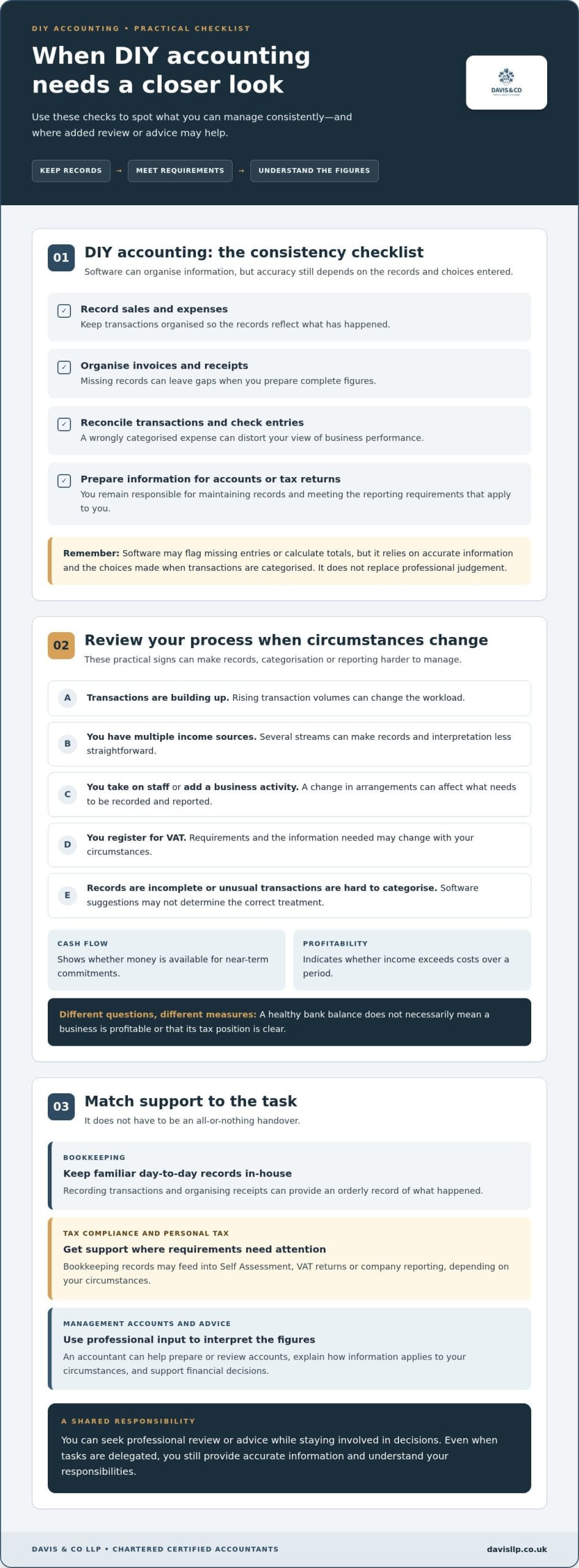
Typical DIY tasks include recording sales and expenses, organising invoices and receipts, reconciling transactions and preparing information for accounts or tax returns. These bookkeeping activities create an organised record of what has happened. They don’t, by themselves, determine how a transaction should be treated for tax or what the figures indicate about financial performance.
Software can flag missing entries or calculate totals, but it relies on the information entered and the choices made when transactions are categorised. Using software doesn’t transfer responsibility for your records or submissions.
What a chartered accountant can contribute
An accountant can help prepare or review accounts, support tax compliance and explain how financial information applies to your situation. You might keep day-to-day bookkeeping in-house while seeking help with tax matters or management accounts. It doesn’t have to be an all-or-nothing handover: professional input can add interpretation and advice while you remain involved in financial decisions.
Where DIY accounting becomes difficult: compliance, accuracy and judgement
DIY accounting can be manageable when transactions are straightforward and records are updated consistently. The workload can change as transaction volumes rise, income comes from several sources, or circumstances shift, such as taking on staff, registering for VAT or adding a business activity. Each change can affect what information you need to record and how it should be reported.
A missed receipt or incorrectly categorised expense can leave gaps in your records and make it harder to prepare complete figures. It can also distort the information you use to make decisions. For example, recording a personal expense as a business cost could affect your view of business performance. Software may flag missing data or suggest categories, but it can’t always determine the correct treatment of an unusual transaction.
Compliance tasks that need more than data entry
Bookkeeping records may feed into Self Assessment, VAT returns or company reporting, depending on your circumstances. Requirements, eligibility and deadlines can vary, so a process that worked last year may need to change if your income sources or business arrangements change. Check current HMRC guidance for the rules and deadlines that apply to you. Don’t rely solely on an old checklist or a software reminder.
The ICAEW Chartered Accountant guidance offers a UK reference point when considering the value of working with a qualified accountant. Professional review can help clarify how a requirement applies to your situation, rather than simply confirm that a form has been completed.
When accounting figures need interpretation
Accurate records are a starting point, not the whole analysis. Cash flow shows whether money is available to meet near-term commitments; profitability indicates whether income exceeds costs over a period; and a tax position concerns how relevant rules apply to taxable income or profits. These measures answer different questions. A healthy bank balance doesn’t necessarily mean a business is profitable or that its tax position is clear.
Unusual transactions, several income streams or a material change in trading can make categorisation and interpretation less straightforward. An accountant can review the underlying information and explain what the figures may mean for reporting and decisions. Accurate bookkeeping records what happened; informed financial interpretation helps you understand what it means.
The practical question in diy accounting vs chartered accountant is not only whether you can enter transactions, but whether you can confidently judge their treatment and implications. Davis & Co LLP provides bookkeeping and tax support shaped around your circumstances.
DIY accounting vs a chartered accountant: compare the real trade-offs
The balance between doing the work yourself and engaging an accountant depends on more than software features. DIY can give you direct control over day-to-day records, while professional support can bring consistency and a route to advice when entries raise questions. Neither approach removes your involvement. Consider your available time, confidence and financial complexity, as well as the workload and agreed scope of any support.
A practical comparison by task and responsibility
| Task or responsibility | DIY | Professional support | Shared approach |
|---|---|---|---|
| Maintaining records | You enter transactions and organise supporting information. | An accountant may handle agreed bookkeeping tasks using information you provide. | You keep records up to date; the accountant reviews or helps organise them. |
| Checking accuracy | You review entries and investigate discrepancies. | An accountant can examine records within the agreed scope and raise queries. | You resolve missing information, with professional input on issues that need attention. |
| Preparing submissions | You prepare and submit relevant information yourself. | An accountant may prepare or assist with agreed accounts or tax work. | You supply and approve information, while the accountant supports the specified tasks. |
| Technical questions | You research the issue and decide how to proceed. | You can draw on an accountant’s expertise for relevant interpretation and advice. | You manage routine entries and seek guidance where a transaction or decision is less clear. |
The division of work is not automatic. The agreed scope determines which tasks the accountant undertakes and which remain with you, so clarify responsibilities at the outset.
The hybrid option: software with professional oversight
A hybrid arrangement can preserve your control of routine bookkeeping while adding professional review where it’s useful. You might record transactions and organise documents, then use an accountant to review the records, support tax or reporting work, or discuss figures that need interpretation. The right frequency and scope depend on your circumstances.
Software can speed up data entry and organise figures, but it can’t always judge whether an entry has been treated correctly or identify the question behind an unusual result. For example, a system may categorise a payment, but you or your accountant may still need to establish whether that category fits the transaction and its reporting context.
For wider context on how accounting support can relate to business planning, explore small business accounting and growth guidance, including bookkeeping support for UK businesses. The central question in diy accounting vs chartered accountant is which tasks you can manage confidently and where additional oversight would help you make informed decisions.
How to decide whether DIY accounting is still right for you
The choice doesn’t need to be permanent or all-or-nothing. To assess diy accounting vs chartered accountant, identify what your finances require, what you can manage reliably and where the consequences of an error are harder to assess.
A four-step check before you choose
- Map the work. List the records you need to maintain and any relevant submissions or reporting, such as Self Assessment, VAT or company accounts. Requirements depend on your circumstances, so consult current HMRC guidance for tax obligations and deadlines.
- Assess your capacity. Can you update records consistently alongside your other responsibilities, or do transactions build up until a deadline is close? Check whether your records are complete and easy to explain.
- Mark the uncertain areas. Note transactions, reporting questions or financial decisions you don’t feel equipped to handle. Uncertainty about one area may call for targeted advice, rather than a complete handover.
- Choose the level of support. Keep managing tasks you understand and can stay on top of. If you need more input, consider support for specific work or a shared arrangement that adds review or advice while keeping you involved.
When comparing professional support, consider the accountant’s qualifications, the tasks included in the agreed scope and how you’ll share information and queries. This helps you assess whether the arrangement fits your needs.
Signals that your current approach needs to change
Repeatedly updating records late, leaving accounting questions unresolved or feeling unsure whether information is complete are useful prompts to review your approach. Changes in your circumstances can also create new record-keeping and reporting needs. Business growth, new income sources, employing staff or a shift in personal finances may all make a previously straightforward system harder to manage.
The right level of accounting support follows complexity, not a fixed business size. Match support to the work and decisions in front of you, while retaining tasks you can manage confidently. For a wider view of how accounting can support business planning, read our small business accounting and growth guidance.
Learn more about accounting support tailored to your circumstances.
Working with Davis & Co LLP: turn accounting records into informed decisions
Choosing professional support doesn’t mean stepping away from your finances. Davis & Co LLP is an independent partnership of Chartered Certified Accountants. We work with individuals and businesses, tailoring accounting and tax support to their circumstances, whether they need help with a defined task or broader oversight.
Support for individuals and businesses with different needs
For individuals, personal tax support can help manage tax affairs that involve more than routine record-keeping. For businesses, bookkeeping helps maintain organised records, while VAT compliance and payroll address other recurring areas of financial administration. The right mix depends on what you manage in-house and where you need additional expertise.
Management accounts help business owners use financial information to understand performance and inform decisions. Rather than simply recording transactions, they put figures into the context of business activity and plans. This can be useful when reviewing costs, considering a change or seeking a clearer view of performance.
The diy accounting vs chartered accountant decision doesn’t have to mean choosing between complete independence and handing over every task. You can continue maintaining day-to-day records while engaging support for personal tax, bookkeeping, VAT compliance, payroll or management accounts. Our involvement is tailored to your needs and defined by the agreed scope.
A considered next step, whether you need full or targeted support
Before discussing support, note how you currently manage your accounts: which records you maintain, which tasks recur, where deadlines or updates become difficult, and what questions remain unresolved. This gives you a practical starting point for deciding whether you need help with a particular responsibility, regular accounting input or broader support.
Tailored accounting support can add expertise where it’s needed while keeping you informed and involved in your financial decisions. The right arrangement should reflect your circumstances, rather than assume every individual or business needs the same service.
To discuss an appropriate level of support, discuss accounting support with Davis & Co LLP.
Choose the level of accounting support that fits your next step
The decision between diy accounting vs chartered accountant depends on the complexity of your finances, the time you can give to maintaining records and how confident you feel about handling reporting questions. Software can support routine bookkeeping, but it doesn’t replace the judgement needed to interpret figures or assess unfamiliar issues.
You don’t have to choose between doing everything yourself and handing over complete control. Keep managing tasks you can handle consistently, and consider professional input where you need review, advice or greater confidence. As your personal or business circumstances change, the level of support that works for you may change too.
Our support includes personal tax, bookkeeping and business management accounting, with the scope shaped around individual circumstances. Discuss tailored accounting support with Davis & Co LLP and take a considered next step in managing your finances.
Frequently Asked Questions
Can I do my own accounting in the UK?
Yes. You can manage your own accounting as long as you keep appropriate records and meet the obligations that apply to your circumstances. Accounting software can help record transactions, organise documents and prepare financial information, but it doesn’t remove your responsibility for accurate records or relevant submissions. If you have several income sources, complex transactions or uncertainty about reporting, professional advice may help.
Is a chartered accountant better than accounting software?
Neither is automatically better because they serve different purposes. Software helps record, organise and process financial information. A chartered accountant can interpret that information, discuss its implications and provide professional input on accounting or tax questions. When weighing diy accounting vs chartered accountant, consider the complexity of your finances, the time you can commit and whether you need judgement beyond the software’s functions. You can use both together.
When should a small business hire a chartered accountant?
Consider professional support when your records become difficult to maintain, you’re unsure about reporting or tax treatment, or business changes create new accounting questions. Growth, additional income sources, employing staff or VAT-related responsibilities may increase the work involved. You don’t necessarily need to hand over every task: you can continue routine bookkeeping and seek support with accounts, tax compliance or management information, according to your circumstances and agreed scope.
Can I use accounting software and still work with an accountant?
Yes. You can use software to record transactions and organise documents while an accountant supports other parts of the process. For example, you might maintain day-to-day bookkeeping and seek help reviewing records, preparing agreed accounts or considering tax matters. The division of work depends on the scope you agree. Keeping records current and sharing complete information can make the arrangement more effective.
What happens if I make a mistake in my accounts?
First, identify what is incorrect and how it affects your records or any information already submitted. Correct the underlying entry and check whether the error affects other figures or reporting. If a submission may need correcting, consult current HMRC guidance or seek professional advice about the appropriate process. The right response depends on the nature of the mistake and your circumstances, so don’t assume every error is handled in the same way.
How much time does DIY accounting take?
There’s no single time estimate that applies to every person or business. The workload depends on transaction volume, the number of income sources, record-keeping habits and reporting tasks. Regularly recording transactions and organising supporting documents can help prevent work from accumulating, but reviewing figures and resolving queries also takes time. Consider how much time you can reliably set aside alongside your other responsibilities and deadlines.
Do I still have tax responsibilities if an accountant prepares my accounts?
Yes. An accountant can prepare or support agreed accounting and tax work, but you still need to provide complete, accurate information and understand which responsibilities remain yours. Review the agreed scope so it’s clear who handles each task, including relevant submissions and approvals. Keep supporting records and tell your accountant about changes that could affect your tax position. Check current HMRC guidance for requirements that apply to you.