Working Abroad for a UK Company: 2026 Tax Guide
Could an employee working overseas for a few weeks create tax or payroll questions for a UK company? The tax implications of working abroad for a uk company depend on more than the length of the stay. The employee’s residence, duties and destination all matter, and the company must assess its own obligations separately.
It may seem reasonable to assume that UK PAYE and National Insurance can continue unchanged, or that a short visit will have no consequences overseas. Neither is safe to assume without checking the arrangement. The destination country’s rules, any relevant tax treaty or social security agreement, and the employee’s wider circumstances can all affect the outcome.
This guide explains which facts help determine an employee’s tax position and what a UK employer should review before approving overseas work. It covers potential tax in the host country, UK PAYE and National Insurance, social security coordination, and possible corporate tax exposure. It also explains why a short assignment may need a different assessment from a longer arrangement, and when coordinated personal and business tax advice can help clarify the position.
Key Takeaways
- The tax implications of working abroad for a uk company depend on the employee’s destination, residence, duties and working pattern, not simply the length of the stay.
- Assess the employee’s income tax position separately from the company’s PAYE, National Insurance and potential overseas corporate tax exposure.
- Don’t rely on a universal day-count rule. The relevant tax treaty and the employee’s circumstances can affect whether income may be taxed in more than one country.
- Before approving a request, record where and when the employee will work, what duties they’ll perform, how they’ll be paid and when they expect to return.
- Where the arrangement involves multiple countries, a longer stay or significant duties, coordinated personal and business tax advice can help clarify the separate obligations.
Tax implications of working abroad for a UK company: what changes?
When an employee performs their duties in another country, the arrangement may raise tax and compliance questions there as well as in the UK. The employee’s exposure concerns how and where their earnings are taxed; the employer’s exposure concerns payroll withholding, social security and whether its activities create a corporate tax presence. These issues are connected, but an answer to one does not automatically settle the others.
A UK employment contract, UK-based employer or UK bank account won’t, on its own, determine the tax outcome. Start with the destination and the employee’s circumstances, then consider the length and pattern of the stay, the duties performed and how the role is managed. A few overseas workdays and a regular or extended arrangement may call for different assessments, but duration alone does not guarantee a particular result.
Why the employee’s work location matters
The country where the employee physically performs their duties may have rules affecting how their employment income is taxed. This is separate from where the employee lives, where the employer is based and whether the individual remains UK tax resident. Each location can be relevant, so assess the facts together rather than treating a UK contract as decisive.
Where both countries may have a claim, review the applicable treaty carefully. Double taxation agreements can provide a framework for allocating taxing rights or relieving double taxation, but the terms and their application depend on the countries and circumstances involved. There is no universal day-count shortcut that resolves every case.
Which obligations may affect the UK company?
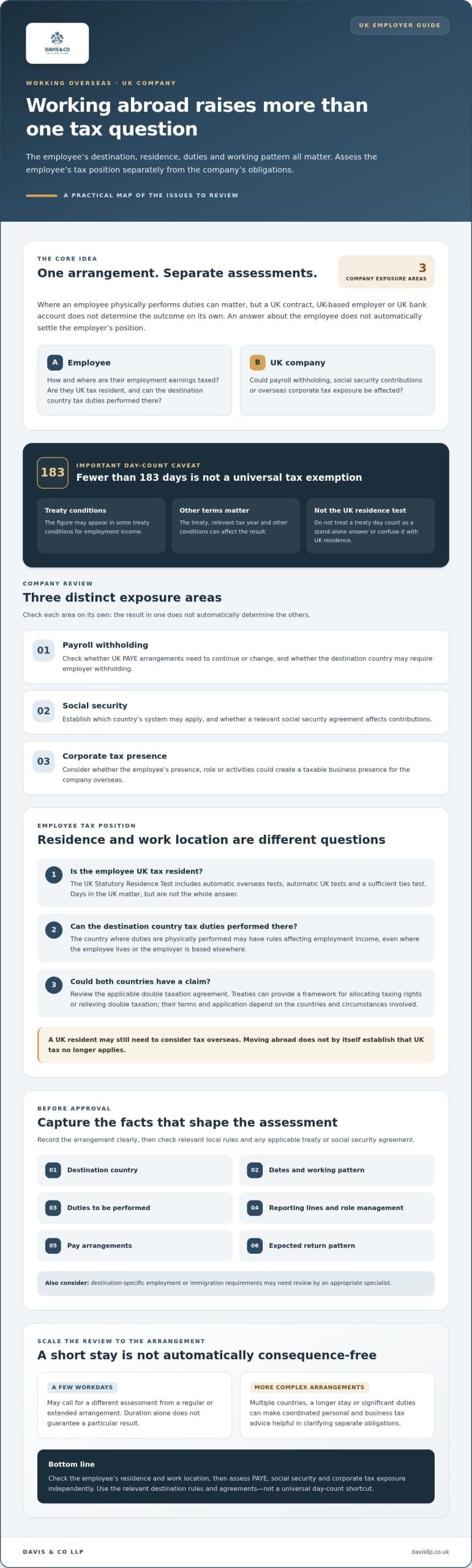
Assess the company’s position separately from the employee’s personal tax position. A practical first review should distinguish three areas:
- Payroll withholding: Check whether UK PAYE arrangements need to continue or change, and whether the destination country may require employer withholding.
- Social security: Establish which country’s system may apply and whether a relevant agreement affects contributions.
- Corporate tax: Consider whether the employee’s presence, role or activities could create a taxable business presence for the company overseas.
The outcome in one area does not automatically decide another. For example, the employee’s income tax treatment will not, by itself, establish the company’s payroll or corporate tax position. Before approval, record the destination, dates, duties, reporting lines, pay arrangements and expected return pattern. Then check the relevant local rules and any applicable treaty or social security agreement. Destination-specific employment or immigration requirements may also need review by an appropriate specialist.
How tax residence and double taxation agreements affect overseas work
Two questions need separate answers: is the employee UK tax resident, and can the destination country tax earnings for duties performed there? The answers may overlap. A UK resident may still need to consider tax overseas, while moving abroad does not by itself establish that UK tax no longer applies.
Spending fewer than 183 days in a country is not a universal exemption from tax there. The figure may appear in some treaty conditions for employment income, but it is not a stand-alone rule. The treaty, relevant tax year and other conditions all matter. Nor should it be confused with the UK’s residence test.
Is the employee still UK tax resident?
The UK Statutory Residence Test (SRT) determines whether an individual is UK resident for a tax year. It includes automatic overseas tests, automatic UK tests and a sufficient ties test. Days in the UK matter, but they do not provide the whole answer. The employee’s home, UK and overseas work pattern, and personal ties may also need consideration.
For example, two employees spending similar periods abroad could have different outcomes if their homes, work arrangements or connections to the UK differ. Check the rules and HMRC guidance for the relevant tax year rather than relying on a day count alone. The UK government guidance on foreign income explains how UK residence can affect tax on foreign income and how relief may be claimed where income is taxed twice.
What a double taxation agreement can and cannot do
The UK’s agreement with one country may have different terms from its agreement with another. Where an agreement includes a short-term employment condition, its application may depend on more than the number of workdays. Review the specific treaty article and facts such as the employee’s workdays, who the employer is for the relevant provisions, and how the remuneration is borne or paid.
Relief under an agreement or domestic rules may reduce or resolve overlapping tax, but it does not necessarily remove the need to file a return, make a claim or keep supporting records. Confirm the destination’s domestic rules and treaty position before deciding how to report the income.
For the company, this review helps distinguish the employee’s residence and income tax position from the employer’s own obligations. The tax implications of working abroad for a uk company are best assessed by considering the employee’s location, dates, duties and personal circumstances together. Where the position remains uncertain, tailored international tax planning can help assess the employee and business implications before the arrangement proceeds.
Compare the company’s overseas tax, payroll and social security exposures
Review these obligations separately. An employee’s income tax position does not determine which payroll system applies, and neither answer settles whether the company could have corporate tax exposure overseas. The rules depend on the destination and arrangement. Use the comparison below to structure the review, not to assume one outcome applies in every country.
| Issue | Whose exposure? | Key facts to examine | Action to verify |
|---|---|---|---|
| Income tax | Employee | Where duties are performed, residence, workdays and treaty terms. | Check the destination’s domestic rules and the relevant treaty. |
| PAYE or overseas payroll withholding | UK company and employee | Work location, duration, pay arrangements and local employer obligations. | Confirm whether UK PAYE continues and whether overseas withholding or registration needs review. |
| National Insurance or overseas social security | Company and employee | Destination, assignment pattern and any applicable social security agreement. | Verify which system applies and whether a certificate, such as an A1, is relevant. Check eligibility and process for the specific arrangement. |
| Corporate tax or permanent establishment | UK company | Employee’s duties, authority, workplace arrangements and duration. | Assess the company’s activities against destination-specific rules and treaty terms. |
| Employment and immigration requirements | Company and employee | Destination, length and nature of the work. | Identify any local requirements and seek appropriate specialist advice. |
PAYE, National Insurance and overseas social security
Working abroad does not automatically end a UK employer’s PAYE responsibilities. The company should check current HMRC guidance for the employee’s circumstances and establish whether the destination requires withholding or local payroll steps. These obligations can overlap, so addressing one does not remove the need to assess the other.
Social security is separate from income tax. The applicable country arrangement may affect whether UK National Insurance or contributions in another country are due. A certificate may help evidence the applicable position where the relevant rules provide for one, but availability and procedure must be checked for the destination and assignment.
Could the employee’s presence affect company tax?
A permanent establishment is a separate corporate tax issue. Remote work abroad does not automatically create one, and a home office or overseas presence alone does not determine the result. The employee’s role, authority to act for the business, work location and duration may all warrant review under local rules and any relevant treaty.
For the tax implications of working abroad for a uk company, assess the exposures in sequence: employee income tax, payroll withholding, social security and then corporate tax, alongside any employment or immigration questions. This gives the company a clearer basis for deciding whether the arrangement can proceed and what further destination-specific advice may be needed.
A practical checklist before approving work abroad for a UK company
A consistent approval process helps a company identify unanswered questions before an employee starts working overseas. The tax implications of working abroad for a uk company depend on the individual arrangement. Collect the facts first, assign the right reviews and make approval conditional on resolving material uncertainties.
What information should the company collect?
Ask the employee for the proposed destination and dates, expected work location, role and duties, reporting lines, decision-making authority, pay arrangements and anticipated return pattern. With appropriate consent, record relevant residence history and any existing overseas workdays. Collect only information needed for the review, and identify who will have access to it.
How should an employer manage an approved arrangement?
Use a written policy to explain how requests are considered, what employees must report and how changes are handled. For uncertain cases, coordinate HR, payroll, finance and relevant tax advisers before work begins. Reassess the same employee if their role or circumstances change. Another employee’s outcome is not a reliable substitute.
- Log the request. Record the country, proposed dates, work location, duties, reporting line, authority and expected return pattern.
- Clarify the employee’s circumstances. Gather relevant residence and travel information with appropriate consent, including any other overseas workdays that could affect the assessment.
- Identify the questions to resolve. Check the employee’s potential tax position, the applicable social security arrangement, UK PAYE and any possible overseas payroll or company tax exposure. Confirm destination-specific employment and immigration requirements with suitable specialists.
- Assign and document reviews. Name the responsible HR, payroll, finance or tax contact for each issue. Confirm which destination rules and agreements have been checked, and record any advice or steps still required.
- Approve with clear conditions. Set permitted locations and dates, reporting expectations and a process for seeking approval before changing the arrangement. Agree payroll actions before the employee starts work abroad.
- Monitor and reassess. Track actual workdays and review the arrangement if the destination, duration, duties, authority or working pattern changes, or the expected return date shifts.
For broader context on assessing cross-border arrangements, read our international tax planning guide. If the employee’s location, duties or duration leave the company uncertain, discuss an international tax planning review before confirming approval.
When tailored international tax advice can help a UK company
A focused review is particularly useful if an employee may work in more than one country, their UK residence position is uncertain, the stay is expected to be longer, or their duties are commercially significant. These factors can make it harder to assess the employee’s tax position alongside the company’s payroll and potential corporate exposure. The tax implications of working abroad for a uk company depend on the facts and destination rules, so advice should clarify the issues and actions to check, not promise a particular tax result.
What to prepare for an adviser review
A clear picture of the proposed arrangement helps make the review practical. Gather:
- The destination country or countries, proposed dates and expected work schedule.
- The employee’s role, duties, reporting lines, employment terms and any decision-making authority.
- Current payroll arrangements, including how salary and any relevant payments are handled.
- Relevant residence information, together with details of previous or planned overseas work, where appropriate and with the employee’s involvement.
Ask the adviser to distinguish what may need attention before the employee leaves from what requires ongoing monitoring. For example, confirm whether payroll or social security arrangements need review before work begins, and what changes in location, duties or duration should trigger a fresh assessment. The advice should consider the destination’s domestic rules and any applicable treaty or social security agreement.
For broader context, see our UK tax advice guidance. It can help frame the questions to raise, although the employee’s circumstances and overseas destination still need individual consideration.
A considered next step for employers and employees
Early discussion is valuable when one overseas arrangement could affect both the employee and the company in different ways. Davis & Co LLP provides international tax planning for individuals and businesses with cross-border interests. A tailored review can help identify which personal tax, payroll and business tax questions need further checking, without assuming the same outcome applies to every employee or country.
Before confirming the arrangement, bring together the proposed schedule, duties, employment and payroll details, and relevant residence information. Discuss your proposed overseas work arrangement with Davis & Co LLP to consider the specific facts and appropriate next steps.
Make overseas work a considered business decision
The tax implications of working abroad for a uk company depend on the employee’s residence and work pattern, the destination’s rules, and the company’s own payroll, social security and potential corporate tax position. These are separate questions, so a sound decision starts with the facts rather than assumptions about the length of the stay or the employee’s UK contract.
Before approving an arrangement, confirm where and when the employee will work, what duties they’ll perform, and how the relevant tax and payroll questions will be checked. Keep the position under review if the destination, duration or role changes. This helps both the employee and the company understand what may require action.
Davis & Co LLP provides tailored international tax planning for individuals and businesses. As an independent partnership of Chartered Certified Accountants founded in 1901, the firm can help assess specific cross-border circumstances. Discuss your international tax position with Davis & Co LLP before confirming an overseas arrangement, to consider the issues that need attention.
Frequently Asked Questions
Does a UK company have to pay tax when an employee works abroad?
Not automatically. The employee’s income tax position is separate from the company’s obligations, which may include UK PAYE, overseas payroll withholding, social security contributions or corporate tax. Whether an overseas obligation arises depends on the destination’s rules and the employee’s duties, working pattern and duration. Assess each exposure separately rather than treating overseas work itself as proof that a tax liability exists.
Will I still pay UK tax if I work abroad for a UK employer?
You may still be liable to UK tax, depending partly on your UK residence position for the relevant tax year. The country where you perform your duties may also have a right to tax some employment income under its domestic rules. A treaty may provide relief, but only if its conditions are met. Check your residence, workdays and destination rules before deciding how to report your income.
Does the 183-day rule mean I will not pay tax abroad?
No. Spending fewer than 183 days abroad is not a universal exemption from tax in that country. Where a treaty includes a day-count condition, it may also impose other requirements concerning residence, the employer or who bears the remuneration. The wording differs between agreements, and domestic rules may still matter. Check the specific UK agreement and destination law before relying on a day count to determine your tax position.
Does my UK employer have to keep deducting PAYE while I work abroad?
PAYE may continue to apply while you work overseas, but the employer’s responsibilities depend on your circumstances and current HMRC procedures. PAYE withholding is not necessarily the same as your final income tax liability, which may depend on residence, work location and any relevant treaty. Employers should review the arrangement, including dates and duties, and check current HMRC guidance before changing payroll treatment.
Do I pay National Insurance if I work remotely abroad for a UK company?
Possibly, but the answer depends on the destination, duration and any applicable social security agreement. National Insurance is separate from income tax, so the tax treatment of your salary does not determine which country’s social security system applies. Check current HMRC guidance and the relevant country arrangement. If a certificate may be needed to confirm the applicable system, verify its eligibility requirements and process for your circumstances.
Can my company create a permanent establishment if I work abroad?
It’s possible, but remote work abroad does not automatically create a permanent establishment, a corporate tax consideration linked to a company’s presence or activities in another country. The employee’s duties, authority, workplace arrangements and length of presence may all be relevant, as may the destination’s rules and any treaty. The company should obtain a fact-specific review rather than treating a home office or overseas work alone as decisive.
What should a UK company check before allowing an employee to work abroad?
Record the destination, proposed dates, duties, reporting lines, decision-making authority, pay arrangements and expected return pattern. Then review the employee’s residence and potential income tax position separately from UK PAYE, overseas payroll, National Insurance or social security, and possible corporate tax exposure. Document the approval and monitor changes to location, duration or duties. If the position is unclear, seek destination-specific advice before work begins.