Why do 39% of UK exporters report rising operational costs in 2026 while their top-line revenue remains deceptively stable? For many directors, the distinction between high-volume activity and genuine fiscal health has become increasingly blurred under the weight of a 25% Corporation Tax rate and a 15% Employer National Insurance contribution. You likely feel the pressure of these shifting margins and the frustration of opaque overheads that seem to erode your hard-earned gains. We understand that a business profitability analysis shouldn’t just be a retrospective reporting exercise; it’s a vital diagnostic tool for strategic survival. Data alone isn’t enough.
We’ll help you master the frameworks and specific metrics required to transform your raw financial data into a bespoke roadmap for sustainable growth. By the end of this guide, you’ll know how to isolate the most profitable 20% of your client base and reduce waste in your overhead allocations. We’ll also examine how to optimise your tax efficiency alongside profit to ensure your firm remains resilient despite the current 3.3% inflation rate and the 3.75% Bank of England base rate.
Key Takeaways
- Distinguish between high-volume activity and genuine fiscal health by moving beyond vanity metrics toward a sanity-focused financial perspective.
- Utilise the “Big Three” profit margins and Return on Capital Employed (ROCE) to evaluate the true efficiency of your corporate investments.
- Learn to conduct a rigorous business profitability analysis by segmenting revenue streams and implementing a fair method for overhead distribution.
- Avoid the “Overhead Trap” and data integrity issues that frequently compromise the accuracy of financial modelling and strategic decision-making.
- Discover how bespoke management accounts can bridge the gap between compliance-driven reporting and actionable business growth acceleration.
What is Business Profitability Analysis in a Strategic Context?
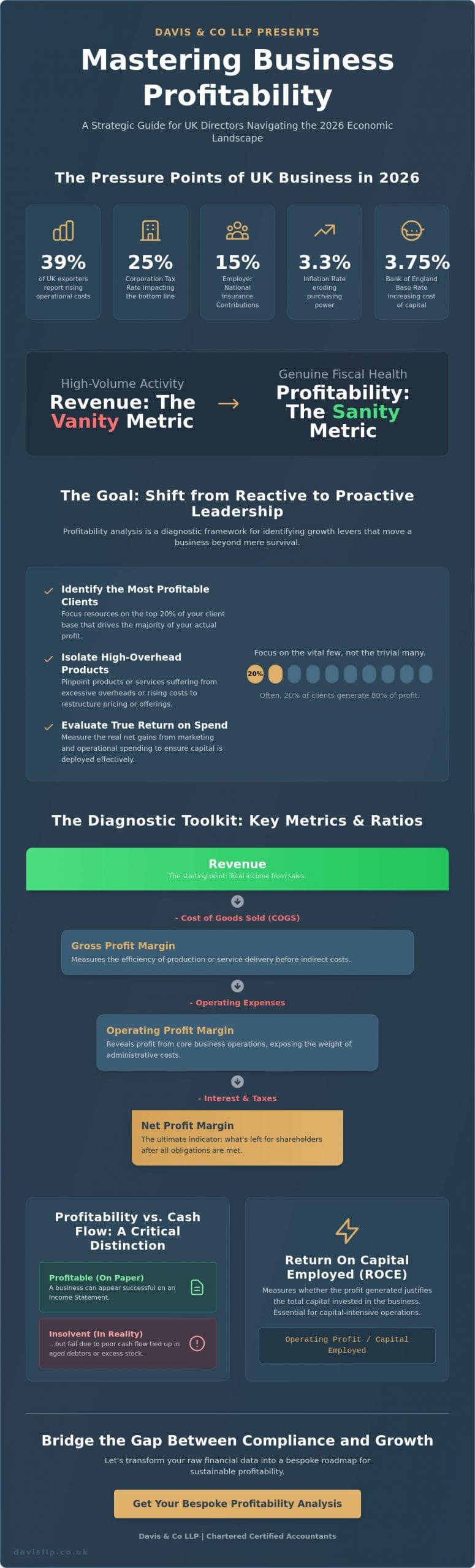
At its foundation, a business profitability analysis is the systematic evaluation of a company’s capacity to generate earnings relative to its operational expenses. While many directors focus on top-line growth, true commercial resilience in 2026 requires a deeper interrogation of the bottom line. In an economy where 39% of UK exporters are reporting increased costs and inflation sits at 3.3%, revenue has transitioned into a vanity metric. Profitability, by contrast, serves as the ultimate sanity metric. It provides the clarity needed to determine if a firm’s activity is actually creating value or merely consuming resources under the weight of a 25% Corporation Tax rate.
Traditional accounting often relies on backward-looking reporting to satisfy statutory requirements. However, strategic analysis looks forward. It transforms historical data into a predictive tool. Fundamentally, profitability analysis is a diagnostic framework for identifying growth levers that move a business beyond mere survival. Understanding What is Profitability Analysis in this broader context allows directors to shift from reactive management to proactive leadership. This shift is essential when the Bank of England base rate remains at 3.75%, making the cost of capital a significant factor in any strategic expansion.
The Core Objectives of Profitability Analysis
The primary aim of this analysis is to distinguish between high-margin and low-margin revenue streams. It isn’t uncommon for a single product line or client to account for a disproportionate share of the workload while contributing negligible profit. By assessing the efficiency of resource allocation across different departments, we can identify where capital is best deployed. Key focus areas include:
- Identifying the most profitable 20% of your client base to prioritise service delivery.
- Isolating products that suffer from excessive overhead allocations or rising import costs.
- Evaluating the true return on marketing and operational spend relative to net gains.
Benchmarking these results against 2026 UK industry standards, where average small business margins hover between 7% and 10%, ensures your firm remains competitive in a tightening market. This process allows for a more pragmatic approach to hiring and investment decisions.
Profitability vs. Cash Flow: A Critical Distinction
A critical distinction must be made between being profitable and being liquid. A business can appear successful on an Income Statement while failing due to poor cash flow management. This often occurs when “paper profits” are tied up in aged debtors or excess stock. Analysis helps directors identify these bottlenecks before they become terminal. Integrating this financial rigour with broader cash flow oversight ensures that the business remains solvent and capable of meeting its obligations, such as the 15% Employer National Insurance contributions or VAT liabilities. It bridges the gap between accounting theory and the practical realities of UK commerce.
Key Metrics and Ratios for a Comprehensive Analysis
Executing a rigorous business profitability analysis requires more than a cursory glance at the year-end surplus. It demands an interrogation of specific ratios that reveal how effectively a firm converts its resources into value. We prioritise the “Big Three” margins: Gross, Operating, and Net Profit. These key profitability ratios act as a tiered diagnostic tool. While the Gross Margin highlights the direct efficiency of your production or service delivery, the Operating Margin exposes the weight of your administrative and indirect costs. The Net Profit Margin remains the ultimate indicator of what’s left for the shareholders after all obligations, including the 2026 tax liabilities, are met.
Beyond these margins, we often look to EBITDA (Earnings Before Interest, Taxes, Depreciation, and Amortisation) as a primary metric for business valuation. It strips away non-operational accounting variables to show the raw cash-generating power of the enterprise. For directors managing capital-intensive operations, Return on Capital Employed (ROCE) is equally vital. It measures whether the profit generated justifies the capital invested in the business. Tracking these figures shouldn’t be an annual event. Implementing bespoke management accounts allows for real-time monitoring, ensuring that deviations from your strategic plan are identified and corrected before they impact your annual returns.
Efficiency Ratios You Cannot Ignore
Profitability is inextricably linked to operational velocity. Asset Turnover reveals how hard your physical and intellectual assets are working to generate revenue. In sectors dealing with tangible goods, Inventory Turnover is a critical metric; capital trapped in slow-moving stock is capital that isn’t earning a return. Similarly, Debtor Days measure the speed at which your sales convert into actual liquidity. If your debtor days are rising despite healthy sales, your “profitable” business may face a technical insolvency risk. Tightening these cycles is a pragmatic way to boost margins without increasing prices.
The Impact of UK Corporation Tax on Net Profit
The 2026 fiscal environment presents unique challenges for UK directors. With the main Corporation Tax rate at 25% for profits exceeding £250,000, the gap between operating profit and net profit has widened significantly. Even smaller firms at the 19% Small Profits Rate must account for the 15% Employer National Insurance contributions when calculating true departmental profitability. This makes seeking expert tax advice an essential component of your growth strategy. By utilising R&D tax credits or capital allowances, you can protect your hard-earned margins from unnecessary erosion. If you’re concerned about how these rates impact your dividend capacity, our team can provide a tailored assessment of your current tax position to ensure your corporate structure remains efficient.
A Step-by-Step Guide to Conducting Your Analysis
A methodical approach to business profitability analysis ensures that your strategic decisions are based on empirical evidence rather than intuition. While modern accounting software can automate data collection, the value lies in the interpretation of that data. Knowing how to measure business profitability effectively allows you to build a framework that identifies specific commercial advantages. We suggest following these five structured steps to gain a clear view of your firm’s performance:
- Step 1: Revenue Segmentation. Break down your total turnover by product line, service category, or customer group. This reveals which areas of the business are actually driving growth.
- Step 2: Cost Allocation. Distinguish between direct costs and indirect overheads. You’ll need a fair method for distributing shared costs, such as rent or administrative salaries, to each segment.
- Step 3: Contribution Margin Calculation. Determine what remains after variable costs are deducted from revenue. This figure tells you how much each segment contributes toward covering your fixed costs.
- Step 4: Sensitivity Analysis. Conduct “What-If” scenarios for 2026 variables. Consider how a sustained 3.3% inflation rate or a shift in the 3.75% Bank of England base rate would impact your margins.
- Step 5: Professional Validation. Review your findings with a Chartered Accountant. This step is vital to validate your assumptions and ensure no technical errors have skewed the results.
Advanced Techniques: ABC vs. Marginal Costing
Choosing the right costing method is essential for accuracy. Activity-Based Costing (ABC) assigns overheads based on actual resource consumption, making it ideal for complex service industries like healthcare or legal practices. It provides a granular view of the “cost to serve” each client. Conversely, Marginal Costing focuses on the cost of producing one additional unit. This is particularly useful for scaling decisions in manufacturing or digital sectors. Your choice should reflect the practical realities of your specific industry and operational structure.
Segmenting for Success
Analysis often reveals that a small percentage of clients generate the majority of your profit. Customer Profitability Analysis helps identify high-maintenance clients whose demands may actually be eroding your margins. Similarly, a Product Life Cycle Analysis can signal when it’s time to retire a declining service line that no longer justifies its resource consumption. For firms with a global footprint, assessing geographic profitability is a prerequisite for effective international tax planning. It ensures that overseas branches are contributing to the group’s health after accounting for local compliance and transfer pricing.
Overcoming Common Profitability Analysis Challenges
Even the most sophisticated business profitability analysis will falter if the foundational data is compromised. The principle of “garbage in, garbage out” remains a stark reality for many UK firms. When financial modelling relies on incomplete bookkeeping or inconsistent data entry, the resulting strategy is inevitably flawed. Another frequent pitfall is the “Overhead Trap.” This occurs when directors apply arbitrary, flat-rate allocations for shared costs rather than using precise methodologies like Activity-Based Costing. Such inaccuracies can make a resource-heavy department appear falsely profitable, leading to misguided investment decisions.
Directors must also guard against analysis paralysis. In an era of big data, it’s tempting to monitor dozens of performance indicators simultaneously. However, focusing on a multitude of metrics often obscures the “vital few” that actually dictate commercial success. Implementing a schedule of regular internal audits is the only reliable method to ensure that the baseline figures used for your financial modelling remain beyond reproach.
Addressing the “Busy-ness” Illusion
In the current 2026 climate, where 44% of importing businesses report rising costs, distinguishing between activity and achievement is paramount. It’s common to find “vanity projects” that bolster top-line revenue but offer zero contribution to the bottom line. Pruning these projects requires a cold, data-driven approach. Similarly, the psychological challenge of resigning an unprofitable client can’t be understated. Yet, when a business profitability analysis reveals that a client’s “cost to serve” exceeds their revenue, maintaining the relationship is a dereliction of fiduciary duty. Data provides the necessary leverage to justify price increases to your remaining base, ensuring margins remain resilient against the 3.3% CPI rate.
Ensuring Compliance and Accuracy
Strategic growth must never come at the expense of statutory obligations. As profit margins fluctuate due to internal restructuring or external market shocks, HMRC often increases its level of scrutiny. A sudden shift in reported profitability can trigger a compliance check if not documented correctly. Utilising professional audit and assurance services provides a verified baseline that protects your firm during such inquiries. It ensures that your pursuit of growth acceleration remains within the bounds of UK regulatory requirements. If you’re struggling to reconcile your operational data with your tax obligations, we invite you to consult with our advisory team to secure your firm’s financial integrity.
Strategic Partnership: How Davis & Co LLP Drives Profitability
While many competitors treat business profitability analysis as a mere software output or a static report, we view it as the beginning of a deliberate professional partnership. Relying solely on automated tools often ignores the nuanced commercial realities that a seasoned advisor identifies through experience. At Davis & Co LLP, our approach is built on 125 years of professional gravitas and a commitment to “quiet excellence.” We move beyond a compliance-only mindset, transforming your statutory obligations into a strategic advantage that supports long-term stability.
Our bespoke management accounting services provide the real-time clarity required to navigate the 2026 economic environment. By integrating high-level financial modelling with your daily operations, we help you identify the specific levers that drive growth. This isn’t just about identifying costs; it’s about business growth acceleration. We work alongside directors to turn raw data into actionable plans, ensuring that every decision is backed by intellectual rigour and a deep understanding of UK fiscal policy, including the current 25% Corporation Tax framework and the 15% Employer National Insurance obligations.
We also provide specialist expertise tailored to high-stakes sectors. Whether you require a dental tax specialist to optimise practice margins or sophisticated property accounting to manage a complex portfolio, our solutions are never generic. We understand the unique overhead structures and regulatory pressures facing these industries, allowing us to provide pragmatic advice that a generalist firm might overlook.
Turning Insight into Action
The true value of a business profitability analysis is realised through consistent execution. We facilitate regular quarterly reviews to track your progress against established benchmarks, ensuring your strategy remains aligned with market shifts such as the 3.3% inflation rate. These sessions aren’t merely technical briefings; they’re collaborative discussions focused on your commercial objectives. We also prioritise the integration of your corporate success with your personal financial health. By aligning business profit with personal tax services and trust tax services, we ensure that the wealth you create is protected and managed with the same level of discretion and expertise as your company assets.
Next Steps for Your Business
If you suspect that your current financial reporting is failing to capture the full picture of your operational health, a preliminary profitability health check is a vital first step. This diagnostic process identifies hidden inefficiencies and validates your existing data integrity. We invite you to experience a partnership defined by reliability and deep-seated expertise. To begin a more rigorous interrogation of your firm’s performance, consult with our strategic advisors today. Let us help you transform your financial data into a robust roadmap for sustainable growth.
Securing Your Commercial Legacy in 2026
Success in the current fiscal year requires a shift from reactive accounting to proactive diagnostic oversight. A rigorous business profitability analysis is the only reliable method to separate vanity revenue from sustainable net gains. By isolating high-margin streams and addressing the “overhead trap,” directors can protect their firms against the 3.3% inflation rate and the rising costs of employment. This strategic clarity ensures that your capital is always deployed where it generates the highest return on investment; it’s the difference between mere activity and genuine commercial health.
At Davis & Co LLP, our Chartered Certified Accountants bring over a century of expertise to your commercial challenges. Whether you require growth acceleration or specialised insights from our dental and property tax departments, we provide the intellectual rigour your business deserves. Our focus remains on international tax efficiency and pragmatic solutions that respect the practical realities of UK commerce. We understand that navigating the 3.75% Bank of England base rate and 25% Corporation Tax requires a steady, deliberate hand. It’s time to move beyond compliance and start building a robust roadmap for the future.
Secure your business growth with a bespoke profitability consultation
We look forward to partnering with you to ensure your enterprise remains a dependable constant in a volatile economic environment.
Frequently Asked Questions
What is the most important ratio in business profitability analysis?
The Return on Capital Employed (ROCE) is often considered the most critical ratio because it measures how effectively a business uses its available capital to generate a return. While margins are important, ROCE indicates whether your commercial activity justifies the investment when compared to the current 3.75% Bank of England base rate. It provides a definitive benchmark for directors to determine if their capital would be more productive elsewhere.
How often should a UK SME conduct a deep-dive profitability analysis?
UK SMEs should conduct a deep-dive business profitability analysis at least quarterly to maintain strategic agility. Waiting for annual accounts is insufficient in a volatile economy where operational costs can fluctuate significantly between quarters. A quarterly cycle allows directors to identify margin erosion early and adjust pricing or operational structures before financial health is compromised. This frequency ensures that your management accounts remain a tool for growth rather than a historical record.
Can a business be profitable but have no cash in the bank?
A business can certainly be profitable on paper while facing a critical cash shortage. This paradox typically occurs when profits are tied up in aged debtors or excess inventory that hasn’t yet been converted back into liquidity. If your debtor days exceed your payment terms, you may find yourself unable to meet immediate obligations despite a healthy bottom line. Effective cash flow management must therefore be integrated with your profitability reviews to ensure technical solvency.
How does business profitability analysis differ from a standard P&L report?
A standard P&L report is a statutory requirement that provides a high-level summary of income and expenses for compliance. In contrast, a business profitability analysis is a diagnostic tool that segments this data by product, service, or customer group. It moves beyond “what” happened to “why” it happened. This granular view allows directors to isolate the specific commercial activities that drive value and those that merely consume resources without a sufficient return.
What role does tax planning play in overall business profitability?
Tax planning is the final layer of analysis that determines how much of your operating surplus is actually retained for reinvestment. With the main Corporation Tax rate at 25% for profits over £250,000, failing to utilise capital allowances or the £10,500 Employment Allowance can significantly diminish your net margin. Strategic planning ensures that your corporate structure is optimised to protect the gains identified during your operational reviews.
Is profitability analysis only for large corporations?
Profitability analysis is perhaps more vital for SMEs than for large corporations due to their smaller capital buffers. With average small business margins often providing little room for error, small firms are susceptible to sudden shifts in the economic landscape. Even minor inefficiencies or a poorly timed hire can quickly lead to operational losses. Rigorous analysis provides the protection necessary for these smaller enterprises to scale safely while managing their specific statutory obligations.
How can I identify which of my customers are actually losing me money?
You can identify unprofitable customers by conducting a Customer Profitability Analysis that accounts for the total “cost to serve.” This involves allocating direct labour and overheads specifically to each client account rather than using a flat average. You’ll often find that high-maintenance clients require a disproportionate amount of administrative time or technical support. When these costs are fully allocated, the resulting net margin may reveal that these relationships are actually depleting your resources.
What is the difference between gross profit and net profit in a strategic context?
Gross profit measures the direct efficiency of your production or service delivery, whereas net profit reflects the overall health of the entire enterprise. In a strategic context, a healthy gross profit suggests your core offering is viable, but a low net profit indicates that your overheads or tax liabilities are excessive. Directors must monitor the gap between these two figures to ensure that administrative costs don’t erode the value created by their operational teams.