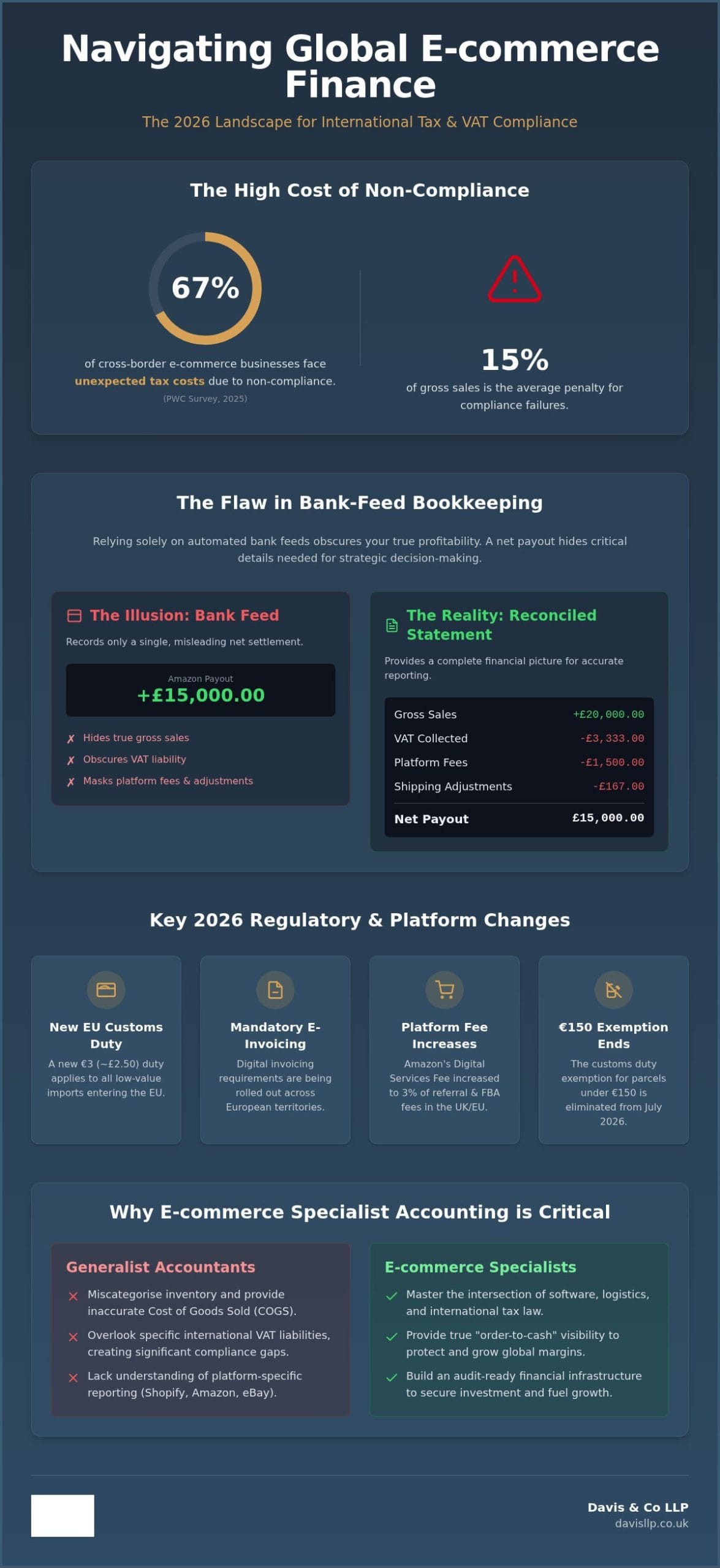
A 2025 PWC survey revealed that 67% of cross-border e-commerce businesses incurred unexpected tax costs due to non-compliance, with penalties now averaging 15% of gross sales. For the ambitious brand, managing international tax for ecommerce businesses is no longer merely a back-office administrative task. It’s a critical component of a global strategy. We recognise the anxiety that stems from inaccurate inventory tracking across multiple channels and the lack of real-time visibility into your net profitability per territory.
You deserve the confidence that comes from knowing your HMRC VAT compliance, including OSS and IOSS filings, is beyond reproach. We’ve designed this guide to help you master the complexities of cross-border VAT and strategic international tax planning to protect your global margins. We’ll examine the 2026 landscape, including the new €3 (approximately £2.50) EU customs duty on low-value imports and mandatory e-invoicing requirements across Europe. By the end, you’ll have a roadmap for creating audit-ready financial statements and strategic cash flow management to fund your next phase of growth.
Key Takeaways
- Discover why high-volume, multi-channel sales require a specialised accounting framework that moves beyond simple bank feed reconciliation to provide true financial clarity.
- Master the evolving landscape of international tax for ecommerce businesses by navigating the latest 2026 requirements for UK VAT, EU OSS, and IOSS compliance.
- Learn how transitioning from cash to accrual accounting allows you to match revenue with inventory expenditure, offering a more accurate reflection of your brand’s health.
- Establish an audit-ready financial infrastructure with robust internal controls to ensure the data integrity necessary for securing future investment or venture capital.
- Understand the role of proactive management accounts in accelerating business growth and providing the real-time visibility needed to protect global margins.
Defining Ecommerce Accounting: A Framework for Digital Growth
Ecommerce accounting is far more than a digital version of traditional ledger management. It’s a specialised discipline designed to handle the high-velocity, high-volume nature of multi-channel trade. While a traditional brick-and-mortar retailer might process a few dozen daily transactions, a scaling digital brand often manages thousands of orders across several jurisdictions simultaneously. This requires a rigorous adherence to international taxation principles to ensure that every pound earned is accounted for correctly before it ever reaches your business bank account.
In 2026, relying solely on automated bank feeds is a precarious strategy. A bank feed records a net settlement, such as a £15,000 payout from Amazon, but it fails to capture the gross sales, the deducted VAT, or the various platform fees that occurred before the transfer. Without reconciling these granular details, your financial statements will remain fundamentally flawed. This lack of precision doesn’t just impact your tax return; it obscures your true margins and complicates the process of managing international tax for ecommerce businesses.
A robust financial framework is also your most valuable asset when seeking investment or preparing for an exit. Sophisticated investors look for more than just growth; they require proof of data integrity and a clear audit trail. By moving beyond simple bookkeeping and adopting a management-led approach, we help you transform your accounts from a historical record into a strategic tool for Business Growth Acceleration. This shift ensures your brand is perceived as a professional, low-risk entity during any due diligence process.
The Complexity of Multi-Channel Reconciliation
Managing payouts from Shopify, eBay, and Amazon requires sophisticated “order-to-cash” visibility. These platforms often bundle sales, refunds, and adjustments into a single settlement report, making it difficult to identify where leakages occur. Without a dedicated reconciliation process, hidden fees and shipping adjustments can quietly erode your profitability. We focus on untangling these threads to ensure your reporting reflects the reality of your operations, providing the clarity needed to scale with confidence.
Why Generalist Accountants Often Fall Short
The risk of using a generalist firm lies in the miscategorisation of inventory and an inaccurate calculation of Cost of Goods Sold (COGS). For a digital-first business, inventory isn’t just stock on a shelf; it’s capital deployed across global warehouses. Generalist approaches often overlook specific VAT liabilities in international territories, leading to significant compliance gaps. Specialist expertise is essential because digital-first models operate without borders, requiring a deep understanding of how software, logistics, and tax law intersect to protect your global margins when handling international tax for ecommerce businesses.
Managing International Tax for Ecommerce Businesses and Global VAT
Expanding into global markets offers unparalleled scale, yet it introduces a layer of fiscal complexity that can quickly compromise your bottom line. As of 2026, the regulatory environment has become significantly more stringent. Tax authorities now utilise sophisticated AI to cross-check marketplace data against bank records. For any UK brand, managing international tax for ecommerce businesses requires a proactive stance to ensure that cross-border sales remain a driver of growth rather than a source of unexpected liability.
The operational costs of selling on major platforms have also shifted. In March 2026, Amazon increased its Digital Services Fee to 3% of referral and FBA fees across the UK and key European markets. These incremental changes, combined with the necessity of maintaining precise records for One Stop Shop (OSS) and Import One Stop Shop (IOSS) filings, mean that your financial strategy must be as agile as your marketing. Failure to account for these nuances often leads to the 15% average penalty for non-compliance seen across the industry last year.
VAT Compliance and the 2026 Threshold
Monitoring your turnover against the UK VAT registration threshold, currently maintained at £90,000, is a fundamental task. However, the true challenge lies in how VAT affects your international pricing. When selling into the EU, you must navigate the July 2026 elimination of the €150 customs duty exemption. All parcels under this value now attract a fixed €3 duty, followed by an EU-wide €2 per-line handling fee starting in November 2026. These costs must be integrated into your margins to avoid eroding the profitability of smaller transactions. Furthermore, mandatory e-invoicing is now a reality in Belgium and France, requiring your systems to be compatible with the Peppol and KSeF networks to maintain trade continuity.
Cross-Border Corporate Tax Efficiency
Beyond transactional taxes, the concept of “nexus” is vital for brands eyeing the North American market. In the United States, economic nexus laws vary by state. For example, California requires sales tax collection once you exceed $100,000 in sales or 200 transactions. Staying abreast of U.S. international tax laws is essential to avoid retroactive assessments that can cripple a growing business. We also see increased scrutiny on Chicago’s cloud computing tax, which has risen to 15% for 2026.
Strategic entity structuring is often the most effective way to protect global margins. By managing transfer pricing and intra-group transactions with precision, you can ensure your tax residency is optimised for your specific growth trajectory. A tailored approach to international tax planning ensures that your expansion is as profitable as it is ambitious, allowing you to scale with the quiet confidence that your global obligations are fully met.
Strategic Financial Frameworks: Accrual vs Cash Accounting
Selecting an accounting methodology is a foundational strategic decision that dictates how clearly you perceive your brand’s performance. While many early-stage sellers adopt the cash basis method for its simplicity, it often obscures the true financial health of a scaling business. Cash accounting merely records the movement of funds, which can create a distorted reality in inventory-heavy models. If you invest £30,000 in stock during September but don’t realise the sales until the festive period, your accounts will show a significant loss followed by an artificial profit spike, offering little utility for month-to-month decision-making.
Accrual accounting provides the necessary precision by recognising revenue and expenses at the moment they are incurred. This alignment is particularly vital when managing the complexities of international tax for ecommerce businesses. By matching the cost of your inventory to the period in which it is sold, you gain a transparent view of your gross margins across different territories. This level of detail is exactly what sophisticated lenders and venture capitalists require. Adopting accrual-based expert tax advice in the UK ensures your financial statements are robust enough to withstand the scrutiny of a due diligence process, significantly improving your funding opportunities.
For brands in the initial stages of Business Growth Acceleration, we often recommend a modified cash approach as a bridge. This allows you to maintain simplicity while beginning to track significant liabilities and inventory movements more accurately. It’s a pragmatic step toward the full accrual framework required for global expansion.
Matching Revenue with Cost of Goods Sold
The timing of expenditure is critical in ecommerce. Accrual accounting allows you to calculate true “landed costs,” which go beyond the initial supplier invoice. You must factor in freight, packaging, and the specific duties we discussed previously, such as the new EU customs handling fees. By capitalising these costs into your inventory on the Balance Sheet and only releasing them to the Profit & Loss statement when a sale occurs, you can identify the exact gross profit per channel. This clarity prevents you from overextending your marketing budget on SKUs that appear profitable but are actually being eroded by hidden logistics costs.
Financial Statements for Strategic Decision Making
Management accounts are the primary tool for proactive leadership. While a standard tax return looks backward, monthly management reports allow you to interpret your Balance Sheet to manage working capital effectively. You’ll see exactly how much cash is tied up in slow-moving stock and when you need to secure additional financing for peak seasons. Using the Profit & Loss statement to identify underperforming SKUs ensures that your resources are always allocated to the highest-margin opportunities. We believe that this shift from basic bookkeeping to strategic financial oversight is what distinguishes a lifestyle business from a global ecommerce brand.
Building an Audit-Ready Financial Infrastructure
As an ecommerce brand moves beyond its initial growth phase, the focus must shift from basic bookkeeping to institutional stability. Establishing robust internal controls is the only way to manage high-volume transaction processing without losing financial oversight. For brands handling international tax for ecommerce businesses, this infrastructure provides the “proof of work” that investors and tax authorities demand. It’s the difference between a company that looks successful on paper and one that can withstand a rigorous statutory audit.
A high business valuation is built on the bedrock of data integrity. When you eventually enter the due diligence phase for an exit or a significant funding round, every discrepancy between your sales channels and your accounting software becomes a point of negotiation for the buyer. By implementing a professional framework early, you’re ensuring that your financial statements are not just accurate but indisputable. This level of preparation positions you as a sophisticated operator in a market where many competitors still rely on manual, error-prone spreadsheets.
Automation and Tool Integration
Selecting a tech stack that integrates your cloud accounting software with your inventory management system is vital for maintaining a “single source of truth.” Whether you use Xero or QuickBooks, the connection to platforms like Amazon and Shopify must be seamless and reconciled daily. We often see the “garbage in, garbage out” phenomenon where automation is poorly configured, leading to duplicated sales or missed refunds. True automation requires human oversight to ensure that the data flowing into your ledger accurately reflects the complexities of international tax for ecommerce businesses across every territory you serve.
Inventory Management and Valuation
Accurate year-end stocktaking is a non-negotiable requirement for tax purposes and true profitability analysis. You must reconcile physical stock levels in global warehouses with your digital records to account for shrinkage, damage, or returns. This data allows you to manage stock-outs and overstock scenarios with precision, ensuring that your capital isn’t unnecessarily tied up in slow-moving SKUs. For brands reaching the size where Audit and Assurance services become a statutory or investor-led requirement, having these inventory controls in place is the most effective way to ensure a smooth, low-stress audit process.
Scaling with Confidence: The Role of a Strategic Accounting Partner
While software can reconcile transactions, it cannot provide the intellectual rigour required to architect a global expansion. Founders who attempt to manage complex fiscal obligations themselves often face a significant opportunity cost, diverted from the core product innovation that drives their brand. Transitioning from basic compliance to proactive Business Growth Acceleration requires a partnership that understands the nuances of international tax for ecommerce businesses. This strategic oversight is particularly vital when seeking venture capital; investors look for the stability that only a professional accounting framework can provide.
A partnership with a Chartered Certified firm offers a level of security that goes beyond mere bookkeeping. We act as a strategic advisor, ensuring your financial trajectory matches your commercial ambition. By integrating sophisticated International Tax Planning into your organizational structure, we help you navigate the 2026 regulatory landscape with discretion and authority. This collaboration ensures that your brand isn’t just growing, but is doing so on a foundation of professional gravitas and fiscal precision.
Cash Flow Management for Inventory Cycles
The “cash gap” remains one of the most persistent challenges for digital sellers. You’re often required to commit significant capital to suppliers months before a single unit is sold, particularly when preparing for the Q4 peak. Effective Cash Flow Management involves detailed forecasting to identify these requirements well in advance. We help you analyse lead times and negotiate supplier payment terms to ensure your liquid assets are used efficiently. This proactive approach prevents the cash-flow bottlenecks that can stall a brand exactly when demand is at its highest.
The Davis & Co LLP Approach to Ecommerce
Our firm provides bespoke advisory services designed specifically for high-growth digital brands. We don’t view accounting as a reactive year-end task; we see it as a continuous process of refinement. By leveraging a strategic small business accountant, you gain access to high-level expertise that integrates international tax for ecommerce businesses into your daily management. Our approach is defined by quiet excellence and a commitment to your long-term success, positioning us as a dependable constant in a volatile global market.
Securing Your Brand’s International Trajectory
Scaling a digital brand beyond domestic borders requires more than just high-quality products and efficient logistics. It demands a sophisticated financial framework that aligns your operational reality with your global ambitions. By transitioning to accrual accounting and establishing audit-ready internal controls, you ensure that every transaction supports your long-term valuation rather than becoming a liability. Navigating the evolving landscape of international tax for ecommerce businesses is a complex undertaking; it remains the essential foundation for protecting your margins in 2026 and beyond.
A proactive approach to fiscal management allows you to move from reactive compliance to strategic growth acceleration. As Chartered Certified Accountants with a history of excellence since 1901, we provide the dedicated Business Growth Advisory and specialised International Tax Planning necessary to secure your brand’s future. Our focus is on providing the clarity and professional gravitas required to navigate seasonal demand shifts and international expansion with ease. We invite you to consult with our strategic ecommerce advisors to discuss how we can refine your financial infrastructure. With the right partnership, you can scale your brand with the quiet confidence that your global obligations are managed with precision.
Frequently Asked Questions
Do I need a specialist ecommerce accountant if I only sell on Shopify?
Yes, because Shopify settlement reports don’t match your bank deposits on a one-to-one basis. A specialist ensures that gross sales, platform fees, and VAT are correctly untangled from the net payout you receive. We provide the precision needed to reconcile these complex data points, which is essential for managing international tax for ecommerce businesses as you scale beyond a single channel.
What is the UK VAT threshold for ecommerce businesses in 2026?
The UK VAT registration threshold remains at £90,000 for 2026. You’re required to register if your total taxable turnover over the last 12 months exceeds this limit or if you expect it to do so in the next 30 days. It’s vital to monitor this on a rolling basis, as HMRC calculates the threshold monthly rather than following the traditional tax year.
How does accrual accounting help my ecommerce business grow?
Accrual accounting matches your revenue with the actual cost of the inventory sold, providing a true reflection of your gross margins. This method eliminates the misleading profit spikes and dips often seen in cash-based accounting during heavy stock-buying periods. It provides the financial clarity required for Business Growth Acceleration and is the standard expected by sophisticated investors and lenders.
What are the main tax implications of selling products to the USA from the UK?
The primary challenge is navigating “economic nexus” laws, which vary by state. For example, California requires you to collect and remit sales tax once you exceed $100,000 in sales or 200 transactions. You must also ensure your business complies with U.S. federal tax treaties to prevent your corporate profits from being taxed twice across both jurisdictions.
Should I use Xero or QuickBooks for my ecommerce store?
Both platforms are industry leaders, but we often recommend Xero for its robust ecosystem of ecommerce integrations. Tools like A2X or Link My Books sync seamlessly with Xero to automate the reconciliation of international tax for ecommerce businesses. The right choice depends on your specific inventory management needs and the complexity of your multi-channel tech stack.
What is the difference between bookkeeping and management accounting for online sellers?
Bookkeeping is the administrative process of recording historical transactions for compliance purposes. Management accounting is a strategic discipline that uses this data to provide real-time visibility into your territory profitability and cash flow. We move beyond basic record-keeping to provide management accounts that help you identify underperforming SKUs and manage your working capital with confidence.
How do I handle VAT for digital downloads versus physical products?
Digital downloads are generally taxed in the country where the consumer is located, often requiring registration for the EU’s One Stop Shop (OSS) scheme. Physical products involve additional complexities such as customs duties and import VAT. For instance, July 2026 regulations introduced a €3 duty on EU parcels under €150, a cost that doesn’t apply to digital services.
Can my accountant help me with business growth acceleration and funding?
We provide the audit-ready financial statements and detailed cash flow management reports that venture capital firms require during due diligence. By acting as a strategic partner, we help you architect a tax-efficient global structure that protects your margins. Our advisory services ensure your brand is perceived as a stable, professional entity, which significantly improves your chances of securing competitive funding.