The introduction of ifrs 18 represents the most significant shift in financial presentation in a generation, far exceeding a simple exercise in reformatting. It’s a fundamental change that will alter how stakeholders perceive your company’s core performance and operational efficiency. We understand that many finance directors feel a sense of unease regarding the replacement of the long-standing IAS 1, particularly when considering the new requirement to audit management-defined performance measures. The prospect of restating 2026 data for the 2027 effective date adds a layer of logistical complexity that requires immediate, measured attention.
Our objective is to provide you with the strategic clarity needed to manage this transition with confidence. We’ll explore the five new categories in the statement of profit or loss and the mandatory subtotals that will now define your reporting. By the end of this guide, you’ll have a practical roadmap for audit readiness and a deeper understanding of how these disclosure rules can be used to communicate your business’s value more effectively to the market. We believe that with the right preparation, this regulatory shift can become an opportunity for greater transparency and stakeholder trust.
Key Takeaways
- Gain clarity on the new five-category structure for profit or loss statements, specifically the mandatory introduction of the ‘Operating Profit’ subtotal.
- Identify which non-GAAP metrics will now be classified as Management-defined Performance Measures (MPMs) and require disclosure within your audited financial notes.
- Establish a practical timeline for the 2027 transition to ifrs 18, ensuring your reporting systems are prepared to restate comparative data from 2026.
- Evaluate the necessary adjustments to your management accounts to meet the increased demands for granular disaggregation and data transparency.
- Understand how to leverage these reporting changes to provide stakeholders with a more consistent and sophisticated narrative of your firm’s financial health.
Understanding IFRS 18: The Successor to IAS 1
In April 2024, the International Accounting Standards Board (IASB) issued ifrs 18, titled “Presentation and Disclosure in Financial Statements.” This new standard marks a pivotal evolution in corporate reporting, entirely replacing the long-established IAS 1. While IAS 1 provided a broad framework for the structure of financial statements, it allowed for significant flexibility. This often led to a lack of comparability between entities, even those within the same sector. By introducing a more disciplined and structured approach, the IASB aims to reduce the “noise” in financial reporting, giving stakeholders a clearer view of a company’s underlying performance. It’s not a minor tweak; it’s a foundational shift.
The transition requires a fundamental re-evaluation of how financial data is captured and presented. The effective date is set for 1 January 2027, but the practical implications begin much sooner. Because the standard requires retrospective application, firms must prepare to restate their 2026 comparative figures. This means that by the start of the 2026 financial year, reporting systems and internal controls must already be aligned with the requirements of the new standard. This shift occurs within the broader context of International Financial Reporting Standards (IFRS), which continue to evolve toward higher levels of transparency and global alignment.
The Core Objectives of the New Standard
The primary ambition behind the standard is to provide a more consistent “anchor” for investor analysis. Currently, “operating profit” is one of the most frequently used metrics, yet it hasn’t been strictly defined by the existing framework. This leads to a scenario where two companies might calculate this figure in entirely different ways. Under the new rules, this calculation is standardised, ensuring that the operating category includes only those items that relate to an entity’s main business activities. This clarity helps investors compare performance across different organisations without needing to manually adjust for varying accounting treatments.
Enhanced transparency is another pillar of this change. Stricter rules on disaggregation mean that companies can no longer aggregate significant expenses within large, generic line items. Every label must be descriptive and representative of the underlying transaction. This prevents the masking of critical financial trends and ensures that the financial statements tell a more accurate story of the business’s operational health.
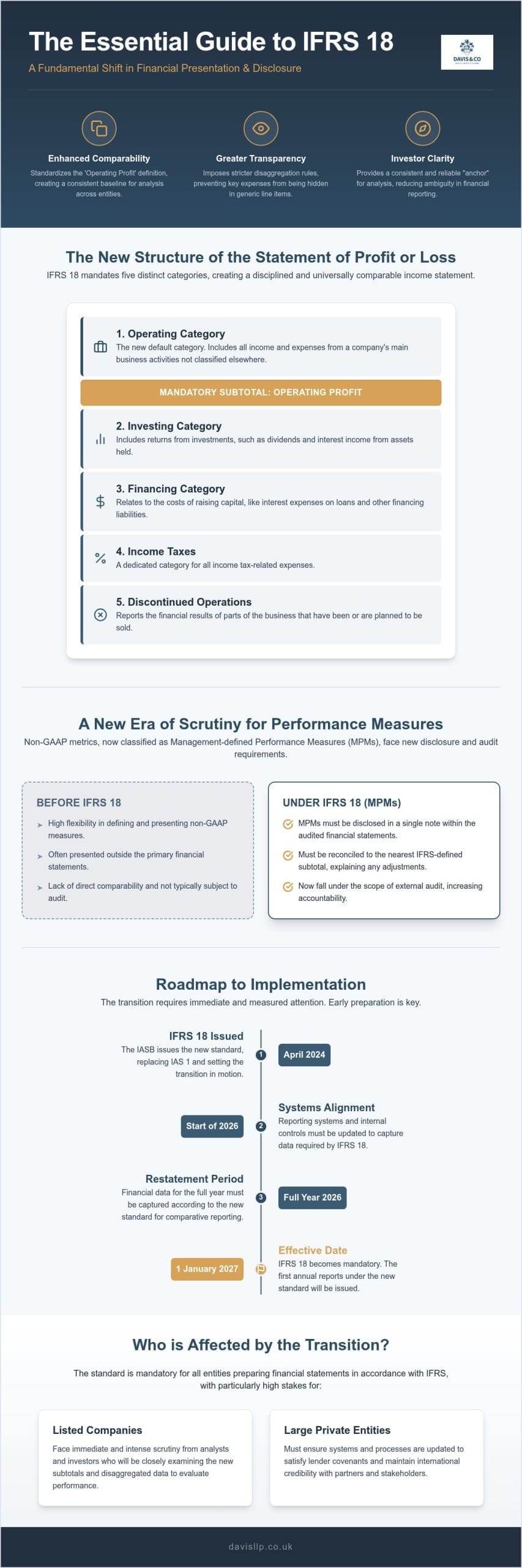
Who is Affected by the Transition?
The standard is mandatory for all entities that prepare their financial statements in accordance with ifrs 18. For listed companies, the impact is immediate and high-stakes, as analysts will scrutinise the new subtotals and categories. Large private entities that have adopted IFRS for the sake of international credibility or to satisfy lender requirements will also face a significant workload to ensure their systems can produce the necessary detail. We see this as an opportunity for these firms to refine their internal reporting and provide a more sophisticated narrative to their lenders and partners. IFRS 18 serves as the new global benchmark for financial statement transparency, ensuring that corporate performance is presented with unprecedented clarity and consistency.
The New Structure of the Statement of Profit or Loss
The most visible change brought by ifrs 18 is the mandatory redesign of the income statement. While the previous standard allowed for varied interpretations of “operating profit,” the new framework imposes a rigid five-category model. This isn’t just a cosmetic shift; it forces businesses to be extremely precise about where they attribute income and expenses. The goal is to provide a consistent starting point for analysis, ensuring that the “Operating” category remains a pure reflection of a company’s main business activities. By creating a default category for core operations, the standard removes the ambiguity that often clouded previous reports.
The Five Categories Explained
The new standard organises the statement of profit or loss into five distinct categories. The Operating category acts as the primary engine. If an item doesn’t specifically meet the criteria for investing, financing, taxes, or discontinued operations, it lands here. This ensures that the core activities of the business are clearly visible and aren’t diluted by secondary financial movements. The Investing category captures returns from assets generated independently of core operations, such as income from associates or joint ventures. This separation allows stakeholders to distinguish between profits made from selling goods or services and profits made from savvy asset management.
The Financing category is now strictly reserved for costs and income related to the entity’s capital structure. This includes interest on loans and lease liabilities. By isolating these items, The New Structure of the Statement of Profit or Loss allows stakeholders to see exactly how much profit is being generated before the impact of how that business is funded. Finally, Income Taxes and Discontinued Operations remain aligned with existing standards, maintaining continuity for those familiar with IAS 12 and IFRS 5.
Standardising Subtotals for Comparability
To aid comparability, ifrs 18 introduces three mandatory subtotals. The first is “Operating Profit.” For the first time, every company reporting under IFRS will calculate this figure using the same set of rules. This eliminates the need for analysts to manually strip out “non-operating” items that companies might have previously tucked into their operating results. It creates a level playing field for benchmarking performance across different industries and regions.
The second mandatory subtotal is “Profit or loss before financing and income taxes.” This metric is particularly useful for comparing companies with different capital structures, as it provides a view of performance that isn’t skewed by debt levels or specific tax jurisdictions. We’ve found that early preparation is key to ensuring these subtotals accurately reflect your firm’s value. If you’re concerned about how your current chart of accounts will map to these new requirements, our team provides expert audit and assurance to help you navigate the transition smoothly. These subtotals don’t just change the look of the accounts; they change the conversation you have with your investors and lenders.
Management-defined Performance Measures (MPMs) and Transparency
Historically, management teams have used “alternative performance measures” or non-GAAP metrics to tell their business’s story in investor presentations and press releases. These figures often sat outside the reach of the external auditor, creating a gap between the official accounts and the narrative shared with the market. The Official IFRS 18 Standard closes this gap by formally introducing Management-defined Performance Measures (MPMs). If a company uses a specific subtotal of income or expenses in its public communications to describe performance, it must now bring that measure into the audited financial statements.
This requirement isn’t merely a change in location. It’s a move toward greater accountability. Every MPM must be disclosed in a single, dedicated note. This note must explain why the measure provides useful information and how it’s calculated. Companies are also required to provide a clear reconciliation between the MPM and the most directly comparable subtotal defined by ifrs 18. This ensures that investors can see exactly how management’s internal view of performance bridges to the standardised accounting view. It removes the opacity that has sometimes characterised non-GAAP reporting.
The Audit Implication of MPMs
Bringing these measures into the financial statements means they’re now subject to the same level of scrutiny as your revenue or cash flow. Auditors will verify the accuracy of the calculations and ensure the measures are presented fairly and consistently. This shift significantly impacts Audit and Assurance workflows. Management will need to maintain robust evidence for every adjustment made to arrive at an MPM. It’s no longer enough for a metric to be useful for an earnings call; it must now be underpinned by verifiable data and a consistent accounting policy that stands up to professional challenge.
Strategic Disclosure: Maintaining Investor Trust
Transparency is the currency of modern investor relations. By codifying MPMs, the new standard helps to eliminate the “cherry-picking” of metrics that can occur when performance fluctuates. Companies must be consistent in their use of MPMs from one year to the next. If a measure is changed or discontinued, the entity must explain the rationale and provide restated comparatives. This level of discipline prevents the use of misleading labels and ensures that the financial story remains coherent over time.
We believe that clear, honest disclosure actually fosters business growth acceleration by building long-term credibility with stakeholders. When investors understand exactly how you measure success, and they see those measures validated by an independent audit, their confidence in your strategic direction grows. This disciplined approach to reporting ensures that your performance narrative is both compelling and compliant, positioning your firm as a reliable and transparent partner in the eyes of the market.
Preparing for the 2027 Transition: A Practical Roadmap
Transitioning to the new standard requires more than a year-end adjustment. While the official effective date is 1 January 2027, the requirement for retrospective application means that companies must present comparative information for the 2026 financial year. In practice, this means your reporting systems must be capable of capturing and categorising data under the ifrs 18 framework by the start of 2026. Waiting until the deadline to assess your internal controls and chart of accounts presents a significant operational risk. We recommend a phased approach to ensure that your transition is both orderly and strategically sound.
Phase 1: Impact Assessment and System Calibration
The initial phase focuses on a technical mapping of your current financial data. You’ll need to review every line item in your existing income statement and determine its appropriate home within the five new categories. This is also the time to address the new disaggregation requirements. Items that were previously grouped together for simplicity may now require separate disclosure if they are deemed material or distinct in nature. It’s often during this process that gaps in data collection become apparent, requiring updates to your accounting software or internal reporting templates.
During this calibration, it’s vital to consult with tax planning and advice specialists. Because the “Income Taxes” category is now more strictly defined, ensuring that tax-sensitive items are correctly isolated is essential for maintaining accuracy and avoiding future restatements. A precise mapping at this stage prevents the need for disruptive corrections later in the cycle.
Phase 2: Stakeholder Communication and Comparative Reporting
Once your systems are aligned, the focus shifts to the narrative. Drafting your 2026 restatements early provides a “dry run” that reveals how your perceived profitability might change. Because ifrs 18 standardises the calculation of operating profit, some entities may see a shift in this key subtotal compared to their previous IAS 1 reporting. Understanding these variances early allows you to educate your board and investors on why these changes are occurring and what they mean for the business’s long-term story.
Early engagement with your auditors is essential to ensure that your proposed classifications and MPM definitions are robust, thereby avoiding year-end reporting delays. This collaborative approach ensures that by the time you reach your first official reporting period, your stakeholders are already comfortable with the new format. If you require a tailored assessment of your current reporting structure to ensure you are prepared for these changes, our audit and assurance team can provide the professional oversight necessary to secure your transition.
Strategic Audit and Assurance: Navigating IFRS 18 with Davis & Co
At Davis & Co LLP, we believe that the transition to ifrs 18 shouldn’t be viewed as a mere regulatory hurdle. Instead, it serves as a catalyst for refining internal processes and improving the quality of financial dialogue with your stakeholders. Our role is to ensure that your reporting remains a sharp tool for strategic decision-making, rather than a burden of compliance. High-quality management accounts are the foundation of this shift. They provide the granular data needed to satisfy new disaggregation rules while offering management a more precise view of operational health. We approach every engagement with the understated confidence that comes from a long history of supporting businesses through complex regulatory evolutions.
Our Approach to IFRS 18 Implementation
We provide a tailored gap analysis of your current financial statement presentation to identify exactly where your existing reporting falls short of the new standard. This isn’t a generic exercise. We look deeply at your specific revenue streams and expense structures to ensure that the categorisation of complex items is technically sound and strategically aligned. Our team provides the professional gravitas required to navigate the complexities of the new disclosure notes, particularly when defining and justifying your Management-defined Performance Measures (MPMs).
Our commitment is to act as a composed partner throughout this journey. We understand the sensitivity involved in changing how performance is presented to the market. By providing clear, intellectual rigour, we help you build a reporting framework that is both robust and transparent. This ensures that when your first ifrs 18 compliant accounts are released, they carry the authority and reliability that your investors expect from a well-governed entity.
Beyond Compliance: Driving Value through Clarity
The new framework offers more than just consistency; it provides deeper insights into cash flow management by tightening the link between the income statement and the statement of cash flows. By adopting these standards early, we help you leverage standardised subtotals for more accurate competitive benchmarking. This allows you to see how your operational efficiency truly compares to your peers, stripped of the accounting “noise” that previously made such comparisons difficult. It’s about turning a mandatory change into a competitive advantage.
We invite you to view this transition as an opportunity to enhance your firm’s reputation for excellence and transparency. Our experts are ready to guide you through every phase of the roadmap, from the initial impact assessment to the final audit of your restated comparatives. To ensure your business is positioned for success in this new era of reporting, contact Davis & Co LLP for a strategic review of your IFRS 18 transition plan. We provide the steady hand and deep-seated expertise needed to secure your firm’s financial narrative for 2027 and beyond.
Securing Your Reporting Future
The introduction of ifrs 18 marks a significant milestone in the evolution of financial transparency. By standardising the “Operating Profit” subtotal and bringing management-defined metrics into the audited notes, the IASB has fundamentally redefined how stakeholders will evaluate your firm’s performance. These changes demand a rigorous re-evaluation of your reporting systems and internal controls, particularly as you prepare for the 2026 comparative period. It’s a transition that requires both technical precision and strategic foresight.
As Chartered Certified Accountants with over 120 years of expertise, we provide the professional gravitas and intellectual rigour required to navigate this new era. Our specialist audit and assurance services are designed to offer more than just compliance; we act as strategic advisors to help you maintain a reliable and sophisticated narrative for your investors. We understand that clear, audited data is the bedrock of market confidence and long-term business growth.
Partner with Davis & Co for Strategic IFRS 18 Guidance and ensure your reporting reflects the true value of your business. With the right preparation, this transition becomes an opportunity to strengthen stakeholder trust and project a clear, confident vision of your firm’s future.
Frequently Asked Questions
What is the main difference between IAS 1 and IFRS 18?
The primary difference lies in the level of prescription regarding the structure of the income statement. While IAS 1 offered significant flexibility, ifrs 18 introduces a disciplined framework with five distinct categories and three mandatory subtotals. This shift moves away from the “choose your own” approach to presentation, ensuring that every company provides a consistent and comparable view of its financial performance.
When do I need to start reporting under IFRS 18?
The new standard is effective for annual reporting periods beginning on or after 1 January 2027. Early application is permitted, though most firms are focusing on the mandatory deadline. Because the standard requires full retrospective application, you’ll need to restate your 2026 comparative data, making it essential to have your systems aligned by the start of the 2026 financial year.
How does IFRS 18 define ‘Operating Profit’?
Operating profit is now a mandatory subtotal that includes all income and expenses not classified into the investing, financing, tax, or discontinued operations categories. It acts as the default “anchor” for the statement, specifically designed to capture the results of an entity’s main business activities. This standardised definition removes the inconsistencies that previously made benchmarking between different companies difficult.
What are Management-defined Performance Measures (MPMs)?
MPMs are subtotals of income and expenses that management uses in public communications, such as investor decks or press releases, to describe financial performance. Under ifrs 18, these measures must be brought into the audited financial statements. They require a dedicated note explaining their calculation and a formal reconciliation to the most directly comparable IFRS-defined subtotal.
Will IFRS 18 change how I report my cash flow statement?
Yes, the standard introduces consequential amendments to IAS 7. Specifically, companies using the indirect method must now use the newly defined “operating profit” subtotal as the starting point for reconciling to operating cash flows. This change ensures a more transparent and consistent link between the profit or loss statement and the cash flow statement across all reporting entities.
Do I need to restate my 2026 accounts for IFRS 18?
Restatement of the 2026 comparative period is a mandatory requirement for the first year of application in 2027. This retrospective approach ensures that stakeholders can make meaningful year-on-year comparisons under the new framework. We recommend beginning the mapping process now to ensure your 2026 data is captured with the necessary level of detail for these future restatements.
How does IFRS 18 affect the disclosure of interest and dividends?
The classification of interest and dividends will now depend on the entity’s primary business activities. For most non-financial companies, interest income and dividends received will be classified in the “Investing” category, while interest paid on loans will move to “Financing.” This clears the “Operating” category of items related to how a business is funded or where it invests its excess cash.
Can I still use EBITDA under the new IFRS 18 rules?
You can continue to use EBITDA, but it will likely be classified as an MPM if it doesn’t match a subtotal specifically defined by IFRS. This means your calculation of EBITDA will be subject to audit and must be disclosed in the notes with a full reconciliation. It’s no longer a voluntary metric that sits outside the scrutiny of your formal financial statements.