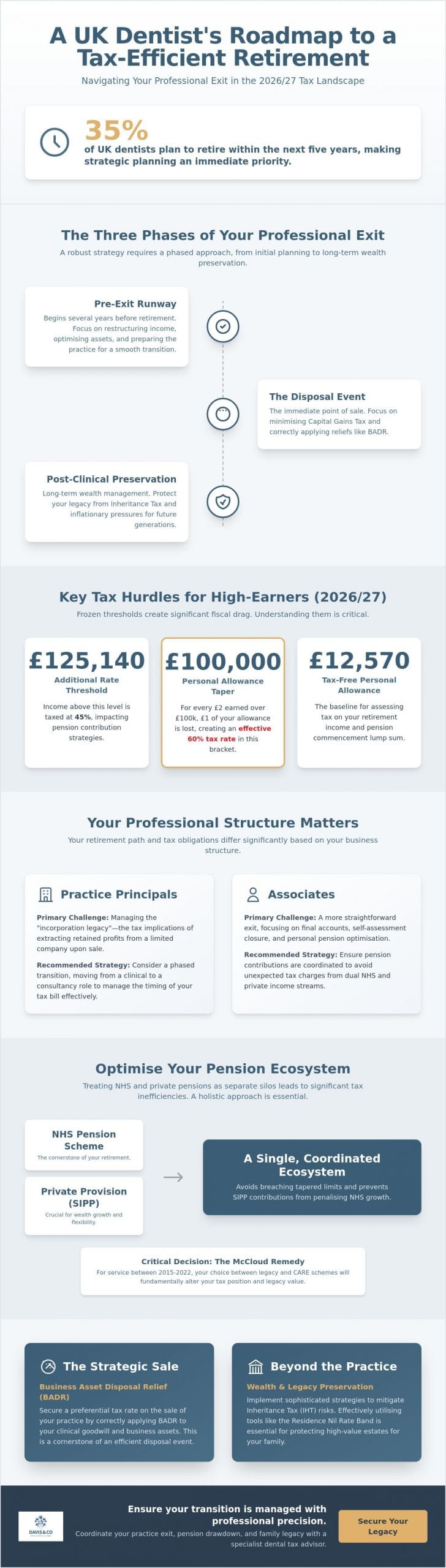
With 35% of all UK dentists planning to retire within the next five years, the transition from clinical practice to private wealth is no longer a distant consideration; it’s an immediate strategic priority. You’ve spent decades building a clinical legacy, yet the complexity of the NHS Pension Scheme and the nuanced impact of the tapered annual allowance can make the final exit feel unnecessarily fraught. We understand that for many practitioners, the concern isn’t just about the date of departure, but about ensuring that decades of hard work aren’t eroded by avoidable fiscal drag or poorly timed asset liquidation. Effective retirement tax planning for dentists uk requires a level of precision that mirrors your own clinical standards.
We’ll provide the clarity you need to navigate this high-stakes transition with composure. You’ll discover how to protect your clinical legacy and optimise your wealth through sophisticated, dentist-specific tax transition strategies tailored for the 2026/27 tax year. We’ll examine the specific mechanics of Business Asset Disposal Relief (BADR), the strategic balancing of private SIPPs against NHS benefits, and the essential frameworks required to protect your family wealth from Inheritance Tax. By the end of this guide, you’ll have a clear, tax-efficient roadmap for your professional exit.
Key Takeaways
- Identify the three distinct phases of a professional exit to ensure your strategy remains robust from the initial pre-exit runway through to long-term wealth preservation.
- Navigate the nuanced interplay between the NHS Pension Scheme and private provision, including the specific implications of the McCloud Remedy for your 2026 retirement timeline.
- Optimise the sale of your practice by correctly applying Business Asset Disposal Relief (BADR) to secure a preferential tax rate on your clinical goodwill and business assets.
- Implement sophisticated retirement tax planning for dentists uk to mitigate Inheritance Tax risks and effectively utilise the Residence Nil Rate Band for high-value estates.
- Coordinate your transition with a specialist dental tax advisor to ensure your practice exit, pension drawdown, and family legacy are managed with professional precision.
Navigating the Retirement Tax Landscape for UK Dental Professionals
Effective retirement tax planning for dentists uk represents the strategic coordination of three critical events: the disposal of practice goodwill, the commencement of pension drawdowns, and the long-term preservation of your estate. We approach this transition through three distinct phases. The pre-exit runway begins several years before retirement, allowing for the restructuring of income and assets. The disposal event focuses on the immediate tax implications of the sale. Finally, post-clinical preservation ensures that your accumulated wealth is protected against inflationary pressures and inheritance tax liabilities.
The 2026 fiscal environment presents specific challenges for the dental profession. Unlike many other high-earning sectors, dentists often manage a complex interplay of NHS and private revenue streams. This dual-income model complicates the calculation of pensionable earnings and the application of tax reliefs. While the NHS Pension Scheme provides a reliable foundation, its interaction with private pension contributions can lead to unexpected tax charges if not managed with professional precision. The 2026 tax landscape, characterized by frozen thresholds and the withdrawal of allowances, requires a proactive approach to maintain your wealth.
The Principal vs. Associate Retirement Path
The tax obligations you face depend heavily on your professional structure. Associates operating as sole traders generally face a more straightforward exit, focusing on final accounts and self-assessment closure. Conversely, principals using limited company structures must contend with their “incorporation legacy.” This involves managing retained profits and the tax implications of extracting capital from the company upon sale. We often advise principals to consider a phased transition, moving from a clinical role into a consultancy position to manage the timing of their exit tax bill more effectively and maintain an active link to the practice during the sale process.
The 2026 Tax Thresholds and the Dental High-Earner
For high earners, the 45% additional rate threshold, which applies to income over £125,140, remains a critical factor in pension contribution strategies. There is also the “hidden” tax of the personal allowance withdrawal; for every £2 earned over £100,000, your personal allowance is reduced by £1. This creates an effective tax rate of 60% for many successful practitioners within that specific income bracket. The tax-free personal allowance for the 2026/27 tax year is £12,570, which provides a critical baseline for assessing the tax-free portion of your pension commencement lump sum and ongoing retirement income.
Optimising the NHS Pension and Private Provision Interplay
The NHS Pension Scheme remains the cornerstone of retirement for most practitioners, but the 2026 landscape requires a holistic view where NHS benefits and private Self-Invested Personal Pensions (SIPPs) are managed as a single ecosystem. We’ve seen that treating these as separate silos often leads to significant tax inefficiencies. For those retiring in the next 12 to 24 months, the McCloud Remedy adds a layer of decision making. You’ll need to choose whether your service between 2015 and 2022 sits within the legacy 1995/2008 sections or the 2015 CARE scheme. This choice doesn’t just affect your monthly income; it fundamentally alters your tax position and the value of your clinical legacy.
High-performing private dentists face a specific risk where aggressive SIPP contributions can inadvertently penalise their NHS pension growth. While pension assets often sit outside the estate for tax purposes, it’s vital to contrast this with the more stringent Inheritance Tax rules and allowances that apply to your practice sale proceeds and property holdings. Balancing these different asset classes is the core of effective retirement tax planning for dentists uk. Coordinating these contributions requires the foresight of a dental tax specialist to avoid breaching the tapered limits that currently affect many in the profession.
Managing the Annual Allowance Taper
The 2026 annual allowance stands at £60,000, but for many successful dentists, the taper is a constant threat. Your “Threshold Income” must be below £200,000 and your “Adjusted Income” below £260,000 to retain the full allowance. If you exceed these, your allowance reduces by £1 for every £2 of income, potentially dropping to a minimum of £10,000 for those earning over £360,000. If you face a tax charge, the “Scheme Pays” election allows the NHS pension to settle the bill. It’s a useful tool for maintaining cash flow, though it does reduce your final benefits. We also recommend utilizing carry-forward rules from the previous three tax years to absorb any spikes in pension growth.
The 2026 Lifetime Allowance (LTA) Legacy
Although the Lifetime Allowance was abolished in April 2024, its ghost remains in the form of the Pension Commencement Lump Sum (PCLS) cap. Most individuals are limited to a tax-free lump sum of £268,275, regardless of the total value of their pension pots. For younger associates or those with significant private income, the Lifetime ISA (LISA) serves as a tax-efficient supplement, offering a 25% government bonus on annual contributions up to £4,000. It’s an excellent way to build a tax-free pot alongside your main pension provision without triggering the complex annual allowance calculations that plague high earners.
The Strategic Sale: Capital Gains and Business Asset Disposal Relief
The disposal of your dental practice is likely the most significant financial transaction of your professional life. In the 2026 tax year, the difference between a well-structured exit and a hurried sale can amount to hundreds of thousands of pounds in tax liability. This is where retirement tax planning for dentists uk becomes truly tangible. Central to this process is Business Asset Disposal Relief (BADR), which allows qualifying gains to be taxed at a preferential rate of 18%. Given that standard Capital Gains Tax (CGT) rates for higher rate taxpayers now sit at 24% for non-residential assets, securing BADR is essential for protecting your clinical legacy.
A primary challenge for many principals is the treatment of “Goodwill.” This intangible asset often represents the bulk of the practice value. We distinguish between personal goodwill, which is tied to your individual reputation, and practice goodwill, which belongs to the business entity. HMRC scrutinises these valuations closely. If the disposal involves retaining the freehold property while selling the business, “associated disposal” rules apply. To qualify for the 18% BADR rate on the property gain, the sale must be part of a meaningful withdrawal from the business, and the property must have been used for the business for at least two years prior to the sale.
Maximising Business Asset Disposal Relief (BADR)
To qualify for BADR in 2026, you must meet the two-year ownership requirement and remain within the £1 million lifetime limit. The structure of your sale is paramount. A share sale, specifically selling the company itself, is often the most tax-efficient route for the seller, though many corporate buyers prefer an asset sale to avoid historic liabilities. We also monitor “excess cash” within limited companies. If your company holds significant non-trading cash reserves, HMRC may reclassify it as an investment company, which would immediately disqualify you from BADR. Proactive extraction of these funds is a vital pre-exit step.
Goodwill Valuation and Equipment Timing
The timing of equipment upgrades before a sale requires careful calculation. While final-year capital expenditure can reduce your immediate corporation tax, it interacts with the eventual sale price. If you sell equipment that has previously received 100% tax relief, a “balancing charge” occurs. This charge is taxed as trading income rather than capital gain, effectively clawing back the earlier relief at a higher tax rate. Balancing this against the capital gains on practice goodwill is a core component of our strategic advice. We ensure that your final accounts reflect a valuation that HMRC accepts as commercially justifiable.
Beyond the Practice: Wealth Preservation and Inheritance Tax
Securing your clinical legacy doesn’t end with the final patient consultation. Once the proceeds from your practice sale are realised and your pension drawdowns begin, the objective shifts toward shielding that wealth from the 40% Inheritance Tax (IHT) threshold. For many successful practitioners, the combined value of a practice sale, property portfolio, and pension assets easily exceeds the standard Nil Rate Band of £325,000. While the Residence Nil Rate Band provides an additional £175,000 allowance for those passing a main residence to direct descendants, this benefit tapers significantly for estates valued over £2 million. Effective retirement tax planning for dentists uk must account for these thresholds to prevent the erosion of family wealth.
We also recognise that many modern dental families operate across borders. If you hold overseas property or have family members residing outside the UK, integrating international tax planning into your retirement strategy is essential. This ensures that your succession plan remains compliant with multiple jurisdictions while minimising global tax exposure. Coordinating these complex elements requires the steady hand of a dental tax specialist who understands the specific financial trajectory of a retiring principal.
Family Investment Companies (FICs) for Dental Retirees
Family Investment Companies have become an increasingly popular vehicle for dentists who wish to reinvest practice sale proceeds. Unlike a traditional trust, which can face entry and periodic charges, a FIC is a private limited company where you retain control as a director while gifting shares to your heirs. In the 2026 fiscal climate, the ability to manage investment income within a corporate structure allows for more flexible dividend planning. It’s an effective way to transfer value to the next generation without losing the ability to dictate how those assets are managed and grown over time.
The 7-Year Rule and Strategic Gifting
The 7-year rule for Potentially Exempt Transfers (PETs) remains a primary consideration for estate reduction. However, we often look beyond simple gifting to the “normal expenditure out of income” exemption. This allows you to make regular gifts from surplus income that are immediately exempt from IHT, provided they don’t impact your standard of living. If you’re still in the pre-exit phase, gifting shares in your limited company to family members can be a potent strategy. It’s a high-stakes calculation. This must be done well in advance of a sale to ensure you don’t inadvertently compromise your eligibility for Business Asset Disposal Relief.
Securing Your Legacy with Davis & Co LLP
Navigating the final stages of a dental career requires more than just a standard accounting service; it demands a partnership based on discretion and deep-seated expertise. At Davis & Co LLP, we position ourselves as the strategic partner for practitioners facing the complexities of retirement tax planning for dentists uk. Our dual expertise in providing expert tax advice in the UK and specialist dental accounting allows us to bridge the gap between your practice’s commercial reality and your personal wealth goals. We propose a proactive approach through our Retirement Tax Audit, a process designed to identify potential liabilities while they are still manageable. Our national reach ensures that whether you operate a single-chair private practice or a multi-site group, your personal and practice-level tax affairs are handled with uniform precision.
The Davis & Co Bespoke Dental Audit
The core of our service lies in the meticulous synchronisation of your NHS pension forecasts with your private wealth projections. We understand that these two elements are often treated as separate entities, which can lead to the annual allowance breaches discussed earlier. Our audit process brings these data points together, providing a single, coherent view of your retirement readiness. During the sensitive period of a practice sale, we manage all HMRC compliance requirements, ensuring that every disclosure is accurate and every relief is correctly claimed. For those looking to find a chartered accountant who truly understands the nuances of the dental sector, we offer a level of specialisation that standard firms cannot replicate.
Long-term Partnership and Discretion
Our commitment to your success extends well beyond the point of sale. Many of our clients transition into a “consultancy phase” post-retirement, where they continue to provide clinical oversight or mentorship. During this period, the need for robust management accounts and clear personal tax reporting remains vital. We maintain a steady, measured rhythm in our communication, ensuring you feel well-advised as your financial needs evolve from wealth accumulation to sustainable drawdown. We invite you to contact us for a confidential consultation to discuss your transition. Together, we’ll ensure that your clinical legacy is protected and your wealth is structured to serve your family for generations to come.
Realising Your Professional Exit Strategy
Transitioning from clinical practice to a secure retirement is a multi-faceted process that extends far beyond simple asset disposal. We’ve explored how the strategic coordination of NHS pension drawdowns and the meticulous timing of practice sales can significantly mitigate your tax burden. By addressing the complexities of the 2026 fiscal landscape now, you ensure that your clinical legacy translates into lasting financial security for your family. Success in this transition depends on the precise alignment of your professional achievements with sophisticated wealth preservation structures.
Effective retirement tax planning for dentists uk requires a partner who understands the specific pressures and opportunities of your profession. As Chartered Certified Accountants since 1901, we bring over a century of reliability and discretion to every client engagement. Our firm combines specialist dental tax expertise with strategic international and trust tax capabilities to provide a truly bespoke advisory service. We invite you to Consult with our specialist dental tax team today to refine your exit strategy and secure your wealth with confidence. Your future deserves the same level of precision you’ve dedicated to your patients throughout your career.
Frequently Asked Questions
Can I still claim Business Asset Disposal Relief if I sell my dental practice in 2026?
You can certainly claim Business Asset Disposal Relief (BADR) for a practice sale in 2026, provided you meet the specific qualifying criteria. The relief applies an 18% tax rate to qualifying gains up to a lifetime limit of £1 million. You must have owned the business for at least two years and ensure the practice remains a trading entity rather than an investment vehicle at the point of disposal.
How does the NHS Pension Scheme interact with my private SIPP for tax purposes?
Your NHS pension and private SIPP are assessed together against the total annual allowance, which is £60,000 for the 2026/27 tax year. The “pension input amount” from your NHS service, combined with your SIPP contributions, must stay within this limit to avoid an annual allowance tax charge. This interplay is a core focus of retirement tax planning for dentists uk to prevent unexpected fiscal liabilities arising from growth in both schemes.
What is the “Scheme Pays” option, and is it beneficial for dentists?
The “Scheme Pays” option allows the NHS Pension Scheme to settle your annual allowance tax charge on your behalf. In return, the scheme applies a permanent reduction to your future pension benefits. This is often beneficial for practitioners who wish to preserve their immediate cash flow, although the long-term reduction in retirement income should be carefully calculated against the cost of paying the charge personally from your own capital.
Are there specific tax deductions I can claim in the final year of dental practice?
In your final year of practice, you can utilise terminal loss relief to carry back any final losses against profits from the previous three tax years. You may also claim capital allowances on equipment purchases, though you must be mindful of balancing charges that arise if equipment is sold for more than its tax written-down value. Professional fees directly related to the cessation of the business are also typically deductible against your final trading profits.
How can I reduce Inheritance Tax on my dental practice sale proceeds?
Reducing Inheritance Tax (IHT) on sale proceeds often involves the strategic use of gifting or corporate structures like Family Investment Companies (FICs). By utilising the “normal expenditure out of income” rule, you can transfer surplus income into trusts or directly to heirs without waiting for the seven-year potentially exempt transfer period to pass. This helps keep your estate value closer to the available nil-rate bands while providing for your family.
What happens to my limited company when I retire from dentistry?
Upon retirement, you can either close your limited company via a Member’s Voluntary Liquidation (MVL) or repurpose it as an investment vehicle. An MVL allows you to extract retained profits as capital, which may qualify for the 18% BADR rate. Alternatively, keeping the company active as a FIC allows you to manage practice sale proceeds while retaining control over asset distribution and investment strategy for your heirs.
Is it better to sell my dental practice as a share sale or an asset sale for tax efficiency?
A share sale is generally more tax-efficient for a retiring principal because the entire gain typically qualifies for the 18% BADR rate. In contrast, an asset sale can result in the company paying corporation tax on the sale of goodwill and equipment, followed by a second layer of tax when you extract those funds personally. Most corporate buyers prefer asset sales to limit their liability, making this a critical point of commercial negotiation.
How does the tapered annual allowance affect high-earning private dentists in 2026?
The tapered annual allowance reduces the amount you can save into your pension tax-free if your adjusted income exceeds £260,000. For every £2 earned above this threshold, your £60,000 allowance is reduced by £1, potentially falling to a minimum of £10,000 for those earning £360,000 or more. High-earning private dentists must monitor these thresholds closely to avoid significant tax charges on their total pension growth across both NHS and private schemes.