For many high-net-worth individuals, the traditional reliance on non-domicile status ended on 6 April 2025, rendering decades of established tax planning obsolete. You’ve likely found that the transition to the new residence-based regime has introduced a layer of complexity that makes simple compliance feel like a moving target. It’s a common concern; the fear of double taxation and the reality of increased HMRC scrutiny over offshore interests can weigh heavily on those with global footprints. Securing a qualified international tax advisor london is no longer a matter of administrative convenience but a strategic necessity to shield your wealth from avoidable erosion.
This 2026 buying guide provides the framework you need to evaluate and select a partner who can provide the intellectual rigour your portfolio demands. You’ll learn how to identify firms that offer more than just technical accuracy, focusing instead on those who provide bespoke strategies for cross-border compliance and long-term asset protection. We’ll outline the specific benchmarks for expertise, the importance of jurisdictional depth, and how to ensure your global wealth succession remains secure under these rigorous new standards.
Key Takeaways
- Understand the critical shift from domicile-based to residence-based taxation in 2026 and why this transition necessitates a more sophisticated approach to global asset protection.
- Learn to evaluate potential advisors by balancing their technical proficiency against the strategic commercial awareness required for your specific target jurisdictions.
- Identify the essential distinctions between private client and corporate advisory to ensure you secure an international tax advisor london whose expertise aligns with your unique objectives.
- Recognise the significant financial and legal risks associated with HMRC non-compliance and why specialist oversight is a vital investment for mitigating these liabilities.
- Discover how a partner-led, bespoke advisory model provides the professional gravitas and intellectual rigour needed to navigate an increasingly complex international landscape.
The Evolution of Cross-Border Taxation: Why 2026 is a Turning Point
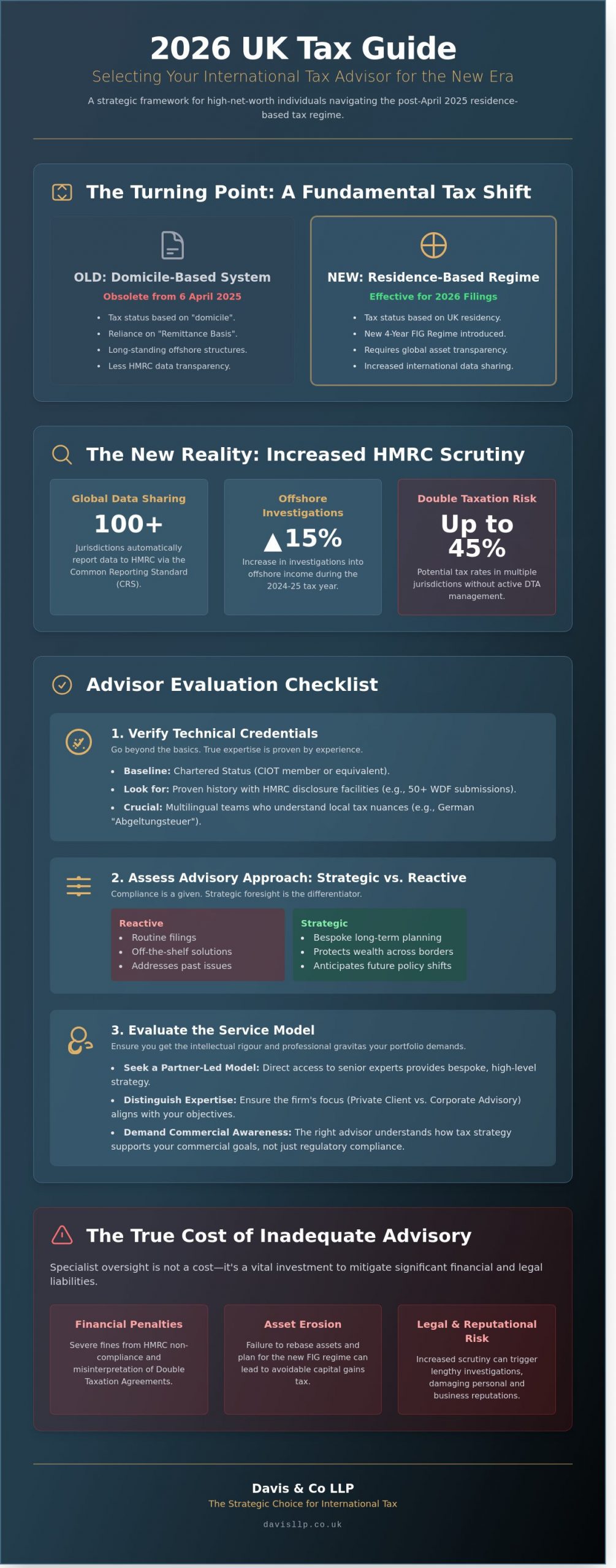
The year 2026 represents a structural realignment for private and corporate wealth in the United Kingdom. Following the legislative overhaul initiated on 6 April 2025, the historical reliance on domicile as a primary tax determinant has been replaced by a residence-based framework. This transition demands the technical precision of an international tax advisor london to manage the shift from long-standing offshore structures to the new four-year Foreign Income and Gains (FIG) regime. The change is not merely administrative; it’s a fundamental shift in how the UK asserts its taxing rights over global interests.
Standard accounting practices often struggle to keep pace with the rapid integration of global tax systems. With HMRC now receiving automatic data updates from over 100 jurisdictions via the Common Reporting Standard (CRS), the era of offshore opacity has ended. Our role as advisors has evolved from simple compliance to providing bespoke, forward-looking strategies that protect wealth while maintaining absolute statutory transparency. We focus on the practical realities of these regulations, ensuring that our clients’ commercial objectives remain undisturbed by shifting international protocols.
The End of the Non-Dom Era
The 2025 reforms have fundamentally altered the tax treatment of non-domiciled individuals. By 2026, the transition from the remittance basis to the residence-based system will be in full effect for all UK residents. We are currently assisting clients with critical deadlines for rebasing offshore assets to their 5 April 2019 values. This is a one-time opportunity to reset the base cost for capital gains purposes. It’s a vital step for those looking to mitigate future liabilities before the 2026 filing cycle begins.
Global Regulatory Pressure
HMRC’s “No Safe Havens” strategy has led to a 15% increase in investigations into offshore income during the 2024-25 tax year. Reliance on Double Taxation Agreements (DTAs) is no longer a passive benefit; it’s a technical necessity that requires active management to avoid 45% tax rates being applied in multiple jurisdictions. Having an international tax advisor london who understands the interplay between UK law and foreign statutory requirements is vital for any commercial entity operating across borders in 2026. This involves anticipating how future policy shifts in jurisdictions like the EU or the US might impact a UK-based holding structure, allowing for a more resilient approach to international expansion.
Key Benchmarks for Evaluating an International Tax Advisor
Selecting an international tax advisor london requires a shift in perspective from simple compliance to strategic oversight. By 2026, the UK tax landscape has undergone significant structural changes, notably the 6 April 2025 abolition of the remittance basis for non-domiciled individuals. This shift means that an advisor’s value is no longer found in routine filings but in their ability to protect wealth across multiple jurisdictions simultaneously. We believe that true expertise is found where technical precision meets commercial pragmatism.
Assessing Technical Credentials
Chartered Certified status or membership in the Chartered Institute of Taxation (CIOT) remains the non-negotiable baseline for any UK-based practitioner. However, for cross-border matters, you should verify their specific history with HMRC disclosure facilities. For instance, an advisor who has successfully managed over 50 submissions through the Worldwide Disclosure Facility since its inception will offer a level of security that a generalist cannot. Multilingual teams are also vital; they ensure that the nuance of a French “prélèvement” or a German “Abgeltungsteuer” isn’t lost in translation when coordinating with local counsel.
Strategic vs. Reactive Advice
The most effective advisors move beyond off-the-shelf compliance to offer bespoke planning that accounts for long-term objectives. This is particularly relevant when aligning with international tax standards, such as the Pillar Two global minimum tax rules which now affect groups with consolidated revenues exceeding £630 million (€750 million). A reactive advisor tells you what you owe; a strategic partner tells you how to restructure to remain compliant while maintaining efficiency.
When vetting a potential international tax advisor london, it’s essential to look for “quiet excellence.” This is the hallmark of a firm that doesn’t rely on aggressive marketing but instead builds a reputation through the successful management of complex trust and estate structures. You should ask about their partner-to-staff ratio. High-value international matters shouldn’t be delegated to junior teams; they require the steady hand of a senior partner who understands the interplay between UK statutory residency tests and foreign tax credits.
- Jurisdictional Depth: Ensure the firm has a proven track record in your specific target markets, whether that’s the US, EU, or emerging markets in Southeast Asia.
- Affiliate Networks: Evaluate whether their international affiliates are vetted, long-term partners or merely a list of names in a directory.
- Commercial Awareness: The advice must reflect the reality of your business operations, not just the theoretical application of tax law.
A bespoke consultation can often reveal whether an advisor’s network is truly integrated or merely a loose collection of independent firms. This distinction is critical when you require a unified strategy that holds up under the scrutiny of multiple tax authorities. Reliable advisors will always prioritise discretion and a measured approach over high-risk, aggressive tax positions.
Essential Services: Matching Advisory to Your Profile
Choosing the right expertise requires a clear understanding of your specific requirements. We find that clients often fall into two distinct categories: those seeking to protect personal wealth and those scaling a commercial enterprise. An international tax advisor london must bridge the gap between these needs while maintaining a focus on the 2026 regulatory environment. The complexity of cross-border tax means that a generalist approach is rarely sufficient for those with significant global footprints.
For the 184,000 non-resident landlords currently registered with HMRC, property accounting is no longer a simple compliance task. It involves navigating the 2024 changes to the Furnished Holiday Lettings (FHL) regime and managing the nuances of the Non-Resident Landlord Scheme. Niche sectors, such as the medical and dental professions, require even deeper specialisation. A dental practice expanding into the EU faces unique challenges regarding VAT on associate contracts and the cross-border recognition of professional corporations. We provide the technical precision needed to manage these specific sector risks.
Private Client and Expat Services
Wealth preservation across borders requires a proactive stance. We focus on pre-arrival planning for High Net Worth Individuals (HNWIs) moving to the UK. It’s vital to ensure their worldwide asset structure is resilient before they become tax residents. Inheritance Tax (IHT) planning is equally critical. With the current 40% rate applying to worldwide assets for those deemed domiciled, we implement bespoke solutions. These often involve offshore trusts and family office structures to mitigate exposure and ensure a legacy is protected across generations. For those living abroad, accessing specialist uk expat tax advice is an essential first step in understanding how the new FIG regime affects your worldwide income and inheritance planning obligations.
Corporate and Business Tax
Scaling a business beyond the UK borders demands strategic management accounting and robust transfer pricing policies. We assist firms in optimising their corporate structures to ensure that cash flow remains fluid across multiple jurisdictions. Compliance is a primary concern. The OECD’s Pillar Two rules, effective for accounting periods starting on or after 31 December 2023, have changed how we approach global minimum tax for larger groups. We provide pragmatic advice on VAT compliance and the statutory requirements of each territory to ensure your expansion is both profitable and compliant.
Our approach is built on a few core pillars of service:
- Bespoke Structuring: Tailoring corporate entities to balance tax efficiency with operational agility.
- Risk Mitigation: Identifying potential permanent establishment risks before they lead to litigation.
- Cash Flow Optimisation: Managing withholding taxes on dividends, interest, and royalties to keep capital working.
Success in international trade or personal relocation depends on the quality of the advice received at the outset. By partnering with a dedicated international tax advisor london, you gain access to a level of intellectual rigour that safeguards your interests against an increasingly transparent global tax net.
Mitigating Risk: The True Cost of Inadequate Advisory
Attempting to manage cross-border tax obligations without professional oversight often results in a false economy. While the initial saving on fees might seem attractive, the financial exposure created by a single miscalculation in residency status or treaty application can be devastating. We’ve observed that the complexity of the 2026 regulatory environment leaves little room for the “DIY” approach. Errors in reporting aren’t just administrative hurdles; they’re triggers for invasive scrutiny that can last years. A robust approach to international tax planning is therefore essential to maintaining stability and protecting your global footprint against an increasingly transparent regulatory environment.
Discretion is the cornerstone of our practice. For high-net-worth individuals and corporate entities, a breach of confidentiality or a public dispute with HMRC carries a reputational price that far exceeds any monetary fine. A sophisticated international tax advisor london ensures that sensitive financial data remains protected while maintaining a transparent, defensible position with tax authorities. This balance of professional gravitas and technical precision is what defines a secure advisory partnership.
HMRC Scrutiny and Investigations
HMRC’s Connect system now cross-references data from over 100 jurisdictions via the Common Reporting Standard. This automation has led to a 28% increase in “nudge letters” sent to UK residents with offshore interests since 2023. These letters aren’t mere reminders; they’re often the precursor to a full enquiry. We act as a critical buffer, managing all correspondence to ensure that technical nuances aren’t misinterpreted. Our team establishes robust audit trails for international transfers, ensuring every pound is accounted for long before an investigator asks the question.
The ROI of Specialist Tax Planning
The value of specialist advice is best measured by what it prevents. Under the “Failure to Correct” (FTC) legislation, penalties for offshore inaccuracies can reach 200% of the tax due. When compared to these figures, advisory fees represent a modest insurance premium for wealth preservation. We focus on bespoke trust structures and pragmatic capital gains strategies that prevent “tax leakage” during asset disposals. In a volatile environment, the stability of a well-structured plan offers more than just financial savings; it provides the intellectual rigour required to navigate shifting statutory requirements with confidence.
The precision of your tax strategy shouldn’t be left to chance. To protect your global interests with a tailored approach, consult our international tax specialists today.
Why Davis & Co LLP is the Strategic Choice for International Tax
Davis & Co LLP has operated with a distinct sense of quiet excellence since its establishment in 1901. Our firm provides the intellectual rigour necessary to manage complex fiscal obligations without the need for loud marketing or aggressive hyperbole. As a premier international tax advisor london, we act as a bridge between the UK’s regulatory environment and global markets, ensuring our clients benefit from a legacy of reliability built over 125 years. We don’t offer generic advice; instead, we provide partner-led solutions where 100% of our clients receive direct access to senior expertise. This structure ensures that your commercial objectives are met with precision, whether you require a statutory audit or bespoke personal tax planning.
Our London hub provides a gateway to national and global reach, managing affairs across more than 45 jurisdictions. We integrate diverse services into a single, cohesive strategy. This includes:
- Comprehensive statutory audits for entities with global footprints.
- Sophisticated personal tax planning for non-domiciled individuals and expatriates.
- Corporate restructuring to optimise cross-border efficiency.
- Advisory services for the 2026 implementation of OECD Pillar Two regulations for groups exceeding £630 million in revenue.
Our position as a leading international tax advisor london allows us to coordinate with global authorities while maintaining a central, trusted point of contact for our clients. We understand the practical realities of modern business, blending technical legal terminology with a pragmatic focus on your bottom line.
Our Approach to International Partnership
We view our role as a strategic partnership rather than a transactional service. Our team organises complex cross-border affairs with a focus on absolute clarity, removing the ambiguity often found in international tax law. We maintain a strict commitment to discretion and intellectual rigour, ensuring that every solution is legally robust and commercially viable. By prioritising the human and business impact of tax decisions, we help you feel secure in your global operations.
Next Steps: Securing Your Global Tax Position
Preparation for the 2026/27 tax year requires an immediate assessment of your jurisdictional exposure. Our experts will develop a bespoke roadmap that addresses the specific challenges of your portfolio, from transfer pricing to evolving digital services taxes. We invite you to contact our London office for a confidential discussion. This initial consultation serves as the foundation for a long-term, professional partnership built on trust and expert guidance.
Securing Your Global Interests for 2026 and Beyond
The transition into 2026 marks a significant shift in how cross-border assets are governed. It’s no longer enough to rely on reactive planning. Proactive strategies are essential to manage the complexities of modern trust structures and international statutory requirements. Selecting a qualified international tax advisor london defines your long-term financial security. Since 1901, Davis & Co LLP has served as Chartered Certified Accountants, offering a level of stability that’s rare in today’s volatile market. We specialise in cross-border tax and trust management, ensuring every bespoke solution we provide is grounded in over a century of professional excellence. Our partner-led service model means you’ll always work directly with senior experts who understand the pragmatism required for high-stakes matters. By prioritising direct access to senior counsel, we help you avoid the pitfalls of inadequate advisory. We’re here to provide the intellectual rigour and steady guidance your affairs deserve. Your success remains our primary objective. Consult our international tax experts at Davis & Co LLP to begin your journey toward a more secure global position.
Frequently Asked Questions
What does an international tax advisor in London actually do?
An international tax advisor in London provides the strategic oversight needed to manage assets across multiple jurisdictions while ensuring full compliance with HMRC and foreign revenue services. We focus on navigating double taxation treaties and statutory residency tests to prevent the erosion of your global wealth. This involves structuring cross-border investments and managing the tax implications of relocating between the UK and 150+ treaty partners.
How much should I expect to pay for international tax advice in 2026?
You should expect to pay hourly rates between £350 and £850 for senior advisory services in 2026. Complex cross-border restructuring projects often command fixed fees starting at £5,000, while a standard residency review might cost approximately £2,500. These figures reflect the high level of technical expertise required to manage multi-jurisdictional compliance and the significant professional indemnity insurance carried by top-tier London firms.
Can a standard UK accountant handle my international tax affairs?
Most standard accountants lack the specific training in foreign tax codes and international treaties to manage complex cross-border affairs safely. Engaging an international tax advisor in London ensures that your strategy accounts for foreign legislation, such as US FATCA or EU reporting requirements. Without this specific expertise, you risk 100% penalties for unintentional non-compliance with offshore disclosure rules. You’re essentially gambling with your wealth if you rely on a generalist.
What are the main tax risks for UK expats living abroad?
The primary risks include losing UK non-resident status and facing unexpected Capital Gains Tax on UK property disposals. Expats frequently trigger UK tax residency by exceeding the permitted days under the Statutory Residence Test, which can lead to a 45% tax rate on global income. Additionally, failing to account for the 60-day window for reporting UK residential property disposals results in immediate financial penalties. We help clients navigate these 2026 regulations to ensure their status remains robust.
How do the 2025/2026 non-dom changes affect my existing offshore assets?
The removal of the remittance basis in April 2025 means your existing offshore assets are now subject to a 4-year limit on tax-free foreign income. After this period, you’ll pay UK tax on all worldwide earnings regardless of whether the funds are brought into the country. We provide bespoke restructuring to help you manage this transition, focusing on the new 10-year inheritance tax window that now applies to global estates. Our detailed uk expat tax advice guide explains how the new four-year FIG model interacts with your existing offshore structures and what steps you should take before the 2026 filing cycle.
Do I need an international tax advisor for a single overseas property?
You require professional advice for a single property to manage the interaction between UK tax law and local foreign property taxes. You must report foreign rental income to HMRC while simultaneously complying with local filing deadlines, which often fall on different dates. We ensure you claim the correct double tax relief to avoid paying twice on the same Euro or Pound of profit. It’s a small investment to prevent costly enquiries from two different tax authorities.
How often should my international tax plan be reviewed?
We recommend a comprehensive review every 12 months or immediately following any significant legislative change. Legislative shifts, such as the 2025 non-dom reforms, can render previously efficient structures obsolete overnight. Regular check-ins allow us to adjust your strategy in line with your evolving commercial objectives and the latest statutory requirements. This proactive approach ensures your global wealth remains protected against shifting political and economic landscapes.
What is the difference between tax avoidance and tax mitigation in an international context?
Tax mitigation is the professional application of statutory reliefs, such as using double taxation treaties to ensure you don’t pay more than is legally required. Tax avoidance involves aggressive, artificial structures that often fall foul of the General Anti-Abuse Rule (GAAR). We focus exclusively on legitimate, pragmatic mitigation strategies that protect your reputation and keep you clear of the 100% penalties associated with failed avoidance schemes. It’s about being efficient, not evasive.