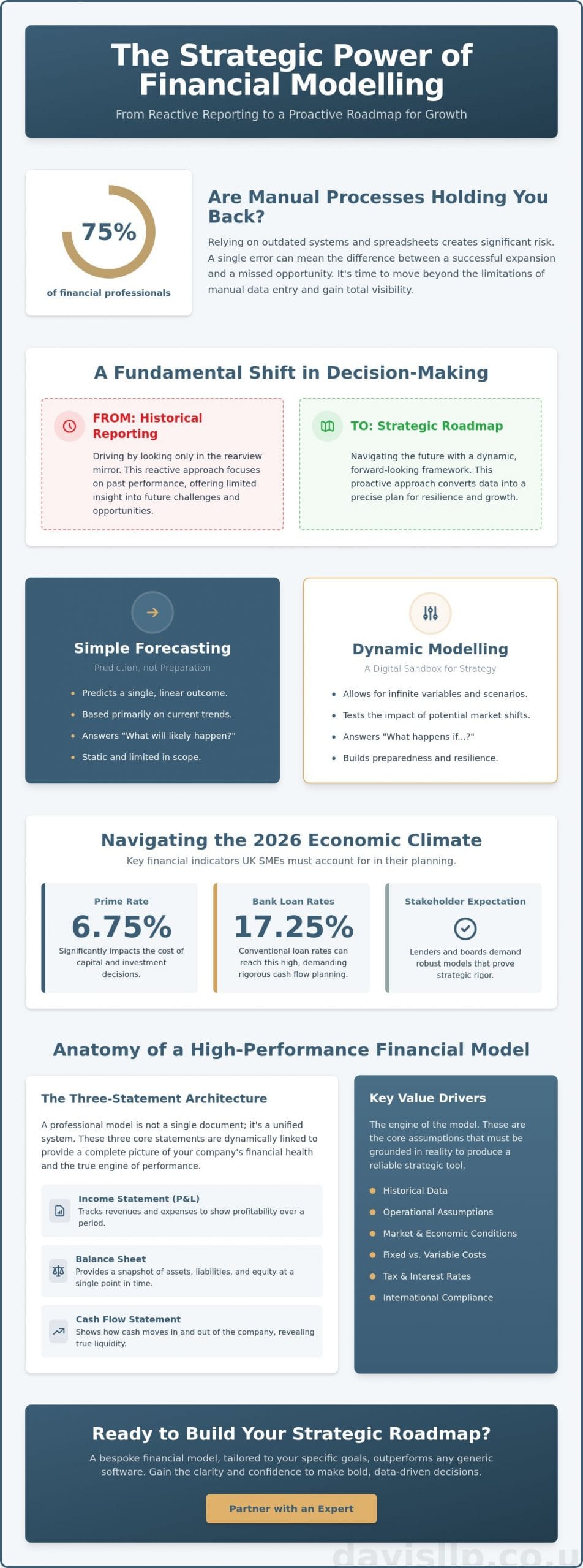
Could a single spreadsheet error be the difference between a successful expansion and a missed opportunity? With 75% of financial professionals reporting that manual processes remain a primary pain point, the risks of relying on outdated systems have never been higher. We understand the pressure of explaining your firm’s financial health to stakeholders while managing a 6.75% prime rate and evolving tax regulations. Effective financial modelling for business planning is no longer a luxury; it’s a foundational requirement for any organization seeking to maintain its competitive edge.
We agree that the current economic climate demands more than just a backward-looking balance sheet. You deserve a clear framework for decision-making that provides total visibility over your cash flow and the confidence to commit to long-term strategic investments. This guide reveals how professional modelling converts fragmented data into a precise roadmap for growth and resilience. We’ll examine the shift toward predictive AI-driven insights and how these tools allow you to anticipate market shifts before they impact your operations.
Key Takeaways
- Learn why shifting from historical reporting to a forward-looking mathematical framework is essential for modern decision-making.
- Discover how sophisticated financial modelling for business planning connects your income statement and cash flow to reveal the true engine of your performance.
- Recognize the limitations of static budgets in a non-linear market and how dynamic assumptions provide a more accurate roadmap for 2026.
- Explore the integration of international tax planning into your growth strategy to ensure your expansion remains both compliant and capital-efficient.
- Understand how a bespoke model, tailored to your specific organizational intuition, outperforms generic software for long-term strategic planning.
The Role of Financial Modelling in Strategic Business Planning
At its core, Financial modeling is the process of creating a mathematical representation of a company’s financial performance. It’s a sophisticated architecture that translates operational assumptions into numerical outcomes. While traditional accounting focuses on the precision of the past, financial modelling for business planning is fundamentally about the integrity of the future. It provides a structured framework where leadership teams can evaluate the viability of a new project, the impact of a potential acquisition, or the sustainability of a dividend policy.
In the volatile economic climate of 2026, relying on historical reports is akin to driving a car by looking only in the rearview mirror. High-calibre modelling acts as a bridge between today’s raw data and tomorrow’s strategic growth. It transforms static figures into a dynamic roadmap. This allows you to visualize how complex market forces will affect your bottom line before those forces fully manifest. It’s a shift from reactive bookkeeping to proactive strategic partnership.
Distinguishing Forecasting from Dynamic Modelling
Many businesses confuse a simple forecast with a robust model. A forecast typically predicts a single, linear outcome based on current trends. In contrast, dynamic financial modelling for business planning allows for infinite variables. It shifts the conversation from “what happened” to “what happens if.” This creates a safe digital sandbox. You can test the impact of a 2% rise in raw material costs or a sudden shift in consumer demand without risking actual capital. It’s about preparedness, not just prediction. It gives you the power to see the financial impact of your intuition before you commit resources.
Why UK SMEs Require Sophisticated Modelling in 2026
For UK-based SMEs, the current landscape presents unique challenges that demand rigorous precision. With the prime rate sitting at 6.75% and conventional bank loan rates reaching up to 17.25%, the cost of capital is significant. Lenders and stakeholders now expect a level of quiet excellence in financial reporting. They want to see that you’ve accounted for interest rate shifts and supply chain fluctuations. A bespoke model demonstrates deep-seated expertise. It shows that your strategy for Business Growth Acceleration isn’t based on guesswork, but on a rigorous, analytical foundation. This clarity is essential when presenting Management Accounts to a board or negotiating terms with a lender. It builds the confidence required to secure capital and maintain long-term resilience.
Core Components of a High-Performance Financial Model
A high-performance model is not merely a collection of isolated data points. It’s a cohesive system designed to reflect the specific nuances of your operation. When executed with precision, financial modeling for business planning provides a reliable framework for testing hypotheses before they’re implemented in the real world. This structural integrity ensures that every strategic move is backed by analytical rigour rather than just optimism. It serves as the bridge between your long-term vision and your daily operational reality.
The Three-Statement Architecture
Many business leaders mistakenly focus solely on the Profit and Loss statement. While revenue and expenses are vital, an isolated P&L fails to account for the timing of cash movements or the health of the balance sheet. A professional model links the Income Statement, Balance Sheet, and Cash Flow Statement into a unified whole. This integration is critical. For example, a surge in sales might look promising on paper, but if it’s accompanied by a significant lag in accounts receivable, it could cripple your liquidity. Ensuring these statements are balanced allows for more effective Cash Flow Management, providing a clear view of when you might need to access capital or when you can safely reinvest surplus funds.
Identifying Key Value Drivers
The engine of any financial model is its assumptions. These drivers must be grounded in reality, using historical data to inform future expectations while accounting for the current 2026 economic environment. With the U.S. federal corporate tax rate remaining at 21% and the prime rate sitting at 6.75%, these figures must be hardcoded into your logic to maintain accuracy. It’s essential to distinguish between fixed and variable cost drivers. Understanding how your overhead scales with volume allows you to identify your true break-even point. This level of detail transforms a generic template into a bespoke strategic tool that mirrors your actual business logic.
Sensitivity Analysis and Visual Clarity
A model’s true value is revealed through sensitivity analysis. This involves testing how small shifts in your primary drivers, such as a 5% increase in supplier costs or a shift in interest rates, ripple through your entire financial structure. It identifies your vulnerabilities before they become crises. However, raw data alone is rarely sufficient for decision-making. Since 70% of financial professionals report difficulty translating data into actionable insights, the final component of a high-performance model is sophisticated visualization. Interactive dashboards and clean charts allow you to communicate complex risks and opportunities to stakeholders with clarity. This ensures that the intelligence gathered from the model is actually used to drive the business forward with confidence.
Beyond the Spreadsheet: Why Static Budgets Fail in 2026
Many organizations operate under the assumption that a traditional annual budget is sufficient for steering their course. While a budget provides a useful baseline, it’s essentially a fixed point in time, reflecting a reality that may no longer exist mere weeks into the financial year. In a market characterized by non-linear shifts, relying on linear projections is a strategic risk. We find that high-calibre financial modelling for business planning serves as a living document, evolving alongside your operation rather than sitting dormant in a file. It moves your team away from static figures and toward a culture of rolling forecasts.
The limitations of a spreadsheet-based budget become clear when market conditions change. If the prime rate fluctuates or new accounting standards like ASU 2026-01 alter your dividend measurements, a static budget cannot adapt. It lacks the interconnected logic required to show how a change in one area ripples through your entire organization. By adopting a dynamic model, you ensure that your strategic roadmap remains relevant, regardless of external volatility. This transition is less about replacing your budget and more about augmenting it with a tool that can breathe and respond in real time.
Scenario Analysis and Stress Testing
True resilience is found in the ability to pivot with confidence. Scenario analysis allows us to construct “best case,” “base case,” and “worst case” outcomes with equal rigour. By stress testing liquidity, we ensure your firm can withstand a sudden downturn or capitalize on an unexpected surge in demand. This is particularly relevant for those pursuing Business Growth Acceleration, where the break-even point of a new product launch must be understood with surgical precision. We don’t just ask if a project is profitable; we ask how much market stress it can endure before it isn’t.
From Data Collection to Decision-Making
Data collection alone doesn’t yield progress. In fact, an overabundance of raw data often leads to paralysis by analysis. A refined model filters this noise, presenting only the insights that matter for your specific objectives. This provides the professional gravitas required for board-level discussions or lender negotiations. By integrating real-time performance data into your Management Accounts, we ensure the model remains a relevant, actionable tool. It transforms the finance function from a department that reports on the past into a strategic partner that illuminates the path forward.
Practical Applications for Growth and Tax Efficiency
Growth is often viewed through the lens of increasing revenue, yet sustainable expansion requires a deeper understanding of capital efficiency. Without a robust framework, rapid scaling can inadvertently lead to liquidity crises. High-calibre financial modelling for business planning allows us to move beyond optimistic projections and focus on the structural health of your operation. It ensures that every new contract or market entry is supported by a clear understanding of its impact on your net position. This analytical approach transforms growth from a risk into a controlled, strategic evolution.
Managing Cash Flow for Scalability
One of the most significant risks for expanding firms is the “cash trap.” This occurs when the capital required to fund new inventory, debtors, or additional headcount exceeds the cash generated by the growth itself. By modelling these variables, we can predict exactly when your liquidity might be strained and determine the precise moment external capital is required. We also use these models to plan for the timing of significant tax payments. This prevents the common pitfall of a cash flow crunch caused by unexpected VAT or Corporation Tax liabilities. Effective Cash Flow Management involves optimizing your working capital through more disciplined debtor management and inventory turnover, ensuring your liquidity keeps pace with your ambition.
Integrating Tax Planning into the Business Model
Tax is not merely a year-end compliance obligation; it’s a primary variable that dictates your actual reinvestment capacity. When we integrate international tax planning into your growth model, we can visualize the impact of cross-border operations on your overall financial structure. This is particularly relevant as firms navigate different regional gross receipts taxes or the 15% Corporate Alternative Minimum Tax for larger entities. Our models factor in specific incentives, such as research and development (R&D) tax credits, to ensure you aren’t overpaying on your liabilities. Accessing expert tax advice in the UK allows us to refine your net profit projections with surgical precision.
A sophisticated model also provides a clear ROI analysis for capital expenditure and headcount expansion. It allows you to ask whether a new hire or a piece of equipment will generate sufficient margin to justify its cost over its useful life. This level of intellectual rigour ensures that your resources are always allocated to their most productive use. If you are ready to build a more resilient roadmap for your expansion, we invite you to explore our specialized Business Growth Acceleration services to align your financial structure with your long-term vision.
Partnering with Davis & Co LLP for Strategic Financial Modelling
While automated tools and generic templates offer a superficial level of structure, they often lack the nuance required for complex strategic planning. We believe that true financial clarity comes from a bespoke model that mirrors your unique business logic. At Davis & Co LLP, we combine our deep-seated expertise with your organizational intuition to create a tool that’s both technically robust and practically applicable. This isn’t just about the mechanics of a spreadsheet. It’s about providing the steady hand and discretion necessary for sensitive commercial decisions. Our collaborative approach ensures that the resulting model serves as a strategic asset, reflecting your actual market reality and risk appetite.
Generic software often fails to capture the specific operational drivers that define a successful enterprise. For a professional practice or an established SME, a template-driven approach can lead to misleading conclusions. We prioritize a partnership where our technical proficiency in financial modelling for business planning serves as a natural extension of your leadership team. This allows us to provide a level of quiet excellence that supports your most critical decisions with analytical rigour and intellectual depth.
A Bespoke Approach to Business Growth
As your strategic small business accountant, we act as a virtual CFO, providing high-level oversight and strategic direction. We tailor our models to support your specific long-term objectives, whether that involves an eventual exit strategy or a complex succession plan. For those in specialized sectors, such as dental practices or property investors, our Property Accounting and dental tax specialist services ensure that your model accounts for industry-specific regulations and tax structures. This level of customization ensures your financial architecture is robust enough to withstand the rigours of Audit and Assurance, providing stakeholders and lenders with total confidence in your projections.
The First Step Toward Financial Clarity
Building a strategic model begins with a clean, verified historical data set. We work with you to refine your existing records, ensuring the foundation of your model is beyond reproach. This process often reveals hidden inefficiencies or untapped opportunities that were obscured by manual reporting. By moving toward a proactive strategic partnership, you’re no longer simply documenting what has occurred. You’re actively shaping what happens next. We invite you to discuss how a customized approach to financial modelling for business planning can provide the roadmap your business requires for its next phase of growth and long-term resilience.
Securing Your Future with Analytical Precision
Transitioning from historical accounting to dynamic financial modelling for business planning is a fundamental shift that empowers leadership teams. By moving beyond static budgets and integrating sophisticated tax logic into your growth strategy, you ensure your organization is prepared for the complexities of 2026. We’ve explored how a cohesive three-statement model provides the visibility needed to manage cash flow effectively and capitalize on new opportunities with total confidence.
At Davis & Co LLP, our Chartered Certified Accountants bring over a century of expertise to every partnership. We provide a partner-led service characterized by discretion and professional gravitas, specializing in international tax and the unique needs of professional practices. We don’t just deliver spreadsheets; we provide the strategic architecture required for long-term resilience and quiet excellence. We invite you to consult with our strategic advisors to build your growth roadmap and take the first step toward a more predictable and prosperous future. Your vision deserves a foundation built on precision and deep-seated expertise.
Frequently Asked Questions
What is the difference between a budget and a financial model?
A budget is a fixed financial target for a specific period, whereas a financial model is a dynamic tool that simulates how different variables affect your entire business logic. While a budget tells you what you intend to spend, a model shows you what will happen to your cash flow and balance sheet if sales drop or costs rise. It’s the difference between a static map and a live GPS system.
Why does an established UK business need a financial model in 2026?
Established UK businesses require financial modelling for business planning to navigate a 2026 landscape defined by a 6.75% prime rate and persistent market fluctuations. Without a model, you’re making decisions in a vacuum. A robust model allows you to stress test your resilience against economic shifts and ensures that your strategy for Business Growth Acceleration remains grounded in analytical reality rather than historical guesswork.
How long does it typically take to build a bespoke financial model?
The timeline for constructing a bespoke model typically depends on the complexity of your operations and the quality of your existing records. Generally, a comprehensive three-statement model takes several weeks to develop and refine. The process begins with a thorough review of your historical data to ensure the foundation is accurate. This deliberate pace ensures the final architecture is reliable and ready for sensitive commercial use.
Can financial modelling help my business secure a bank loan or investment?
Yes, a professional model significantly enhances your credibility with lenders by demonstrating deep-seated expertise. With conventional bank loan rates ranging from 8% to 17.25% in 2026, lenders require more than just optimism; they need to see a precise roadmap for repayment. A model provides the quiet excellence that suggests your business is a secure and well-advised investment, greatly increasing your chances of securing necessary capital.
Do I need special software to maintain a financial model?
You don’t necessarily need specialized platforms, as industry-standard spreadsheets remain highly effective when built with professional logic. However, the trend in 2026 is moving toward integrating AI and big data with traditional methods to create more predictive engines. The value lies not in the software itself, but in the bespoke architecture and expert assumptions that power the calculations, ensuring the tool remains accessible yet sophisticated.
How often should a business update its financial model?
We recommend updating your model at least monthly to align with your Management Accounts. This regular cadence allows you to compare actual performance against your projections and adjust your strategy in real time. In a volatile environment, waiting for a quarterly review might mean missing critical warning signs. Regular updates transform financial modelling for business planning from a one-time project into a continuous decision-making framework.
What are the most common mistakes in financial modelling for SMEs?
The most frequent error is relying on manual processes, which 75% of professionals identify as a significant pain point. Other mistakes include focusing solely on the Profit and Loss statement while ignoring the Balance Sheet, or using generic templates that don’t reflect your industry’s specific value drivers. These flaws often lead to inaccurate cash flow forecasts, causing leaders to miss opportunities or face unexpected liquidity shortages.
How does tax planning integrate with a financial model?
Tax planning is a core variable that dictates your actual reinvestment capacity and net profitability. By factoring in the 21% corporate tax rate or specific VAT compliance obligations, the model provides a realistic view of your available cash. Integrating International Tax Planning allows you to visualize the impact of cross-border operations, ensuring that your growth roadmap accounts for all fiscal obligations before they affect your liquidity.