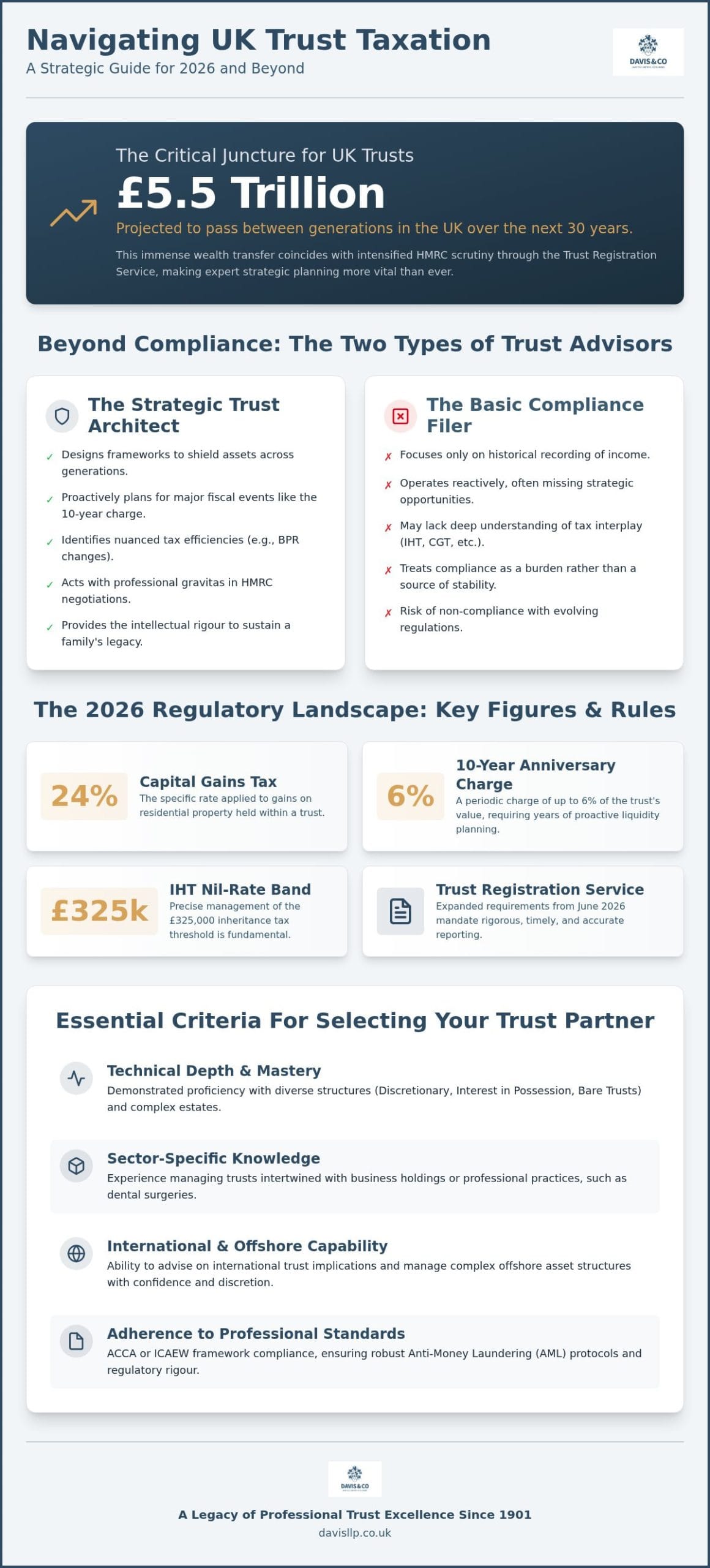
With an estimated £5.5 trillion projected to pass between generations in the UK over the next thirty years, the fiscal responsibility of managing a trust has reached a critical juncture. You likely recognise that a trust is no longer a static arrangement, but a dynamic entity that requires constant, expert vigilance. As HMRC intensifies its scrutiny through the Trust Registration Service and revised inheritance tax thresholds, the fear of non-compliance and the resulting penalties is a valid concern for many families. We understand that your priority isn’t just to meet current obligations, but to ensure the long-term security of your beneficiaries.
This guide provides a definitive framework for selecting a trust tax accountant uk capable of shielding your legacy through rigorous strategic planning. You will learn how to identify a specialist who can master the nuances of the 2026 regulatory environment, including the 24% capital gains tax rate and the shifting landscape of business property reliefs. We shall explore the essential benchmarks of high-calibre advisory, ensuring your chosen partner offers both the technical depth to handle international implications and the professional discretion your private matters deserve.
Key Takeaways
- Understand why proactive trust administration in 2026 must move beyond basic compliance to encompass strategic, multi-generational wealth protection.
- Identify the technical benchmarks required when selecting a trust tax accountant uk, specifically regarding their proficiency in managing complex inheritance tax and capital gains tax liabilities.
- Learn how to navigate the intricate requirements of the Trust Registration Service and the unique succession challenges faced by sector-specific professionals, such as dental practice owners.
- Master the discovery process by asking targeted questions that assess an advisor’s experience with international trust implications and offshore asset structures.
- Discover the value of partnering with a firm that combines a 125-year heritage of stability with a bespoke, client-centric approach to modern trust governance.
The Strategic Role of a Trust Tax Accountant in 2026
The distinction between basic tax compliance and strategic trust administration has never been more pronounced. While a generalist might focus on the historical recording of income, a specialist trust tax accountant uk operates as a strategic architect. This role involves designing and maintaining frameworks that shield assets across multiple generations while ensuring every action remains within the strictures of UK trust taxation principles. It’s a discipline that requires more than technical ability; it demands a deep-seated understanding of how various taxes-income, capital gains, and inheritance-interact within a single structure.
Professional gravitas is a prerequisite when managing interactions with HMRC, especially regarding complex settlements or significant asset transfers. Since our firm was established in 1901, we’ve maintained that a calm, authoritative presence is essential for successful negotiations. This reliability is built on over a century of expertise, allowing us to handle sensitive commercial and personal matters with the discretion they deserve. We don’t just file returns; we provide the intellectual rigour necessary to sustain a family’s financial legacy.
Beyond Compliance: The Value of Strategic Foresight
Strategic foresight involves looking far beyond the current tax year to anticipate significant fiscal events. For instance, the ten-year anniversary charge, which can reach up to 6% of the trust’s value, requires years of proactive planning to manage liquidity and valuation. A strategic partner identifies opportunities for tax efficiency that generalists often miss, such as the nuanced application of Business Property Relief (BPR) after the April 2026 allowance changes. A specialist trust tax accountant serves as the steadfast custodian of family legacy and financial order.
Regulatory Rigour and Professional Standards
The UK regulatory environment is in a state of constant evolution, making the ACCA or ICAEW framework more vital than ever for trust management. Adherence to these high professional standards ensures that every trust remains compliant with the expanded Trust Registration Service (TRS) requirements that took effect in June 2026. This rigour extends to robust anti-money laundering (AML) protocols, which protect the trust from unnecessary legal risk. For a broader perspective on how these standards apply to your wider financial interests, you may find it helpful to review our analysis of Expert Tax Advice in the UK: A Comprehensive Guide for 2026. Our approach ensures that compliance is a source of stability rather than a burden.
Essential Criteria for Selecting a Trust Tax Partner
Selecting a high-calibre partner requires moving beyond basic service lists; it necessitates an assessment of technical mastery and qualitative value. You need an advisor who understands the granular detail of official government guidance on trusts and taxes to manage the interplay of various fiscal obligations. This includes the nuanced application of the 24% Capital Gains Tax rate on residential property and the precise management of the £325,000 nil-rate band for inheritance tax. A proficient trust tax accountant uk must demonstrate deep familiarity with diverse structures, from Discretionary and Interest in Possession trusts to Bare Trusts, ensuring each is administered with absolute precision.
The most effective advisors manage the inevitable friction between personal wealth and corporate interests. For many families, trust assets are inextricably linked to business holdings or professional practices. We focus on this intersection, ensuring that trust administration supports, rather than hinders, your broader commercial objectives. This requires a commitment to discretion and a composed partnership that remains steady as regulations shift. It’s about finding a steady hand to guide the family through the complexities of intergenerational wealth transfer without sacrificing financial stability.
Evaluating Technical Depth and Sector Knowledge
Technical depth is verified through a firm’s history of managing complex estates and their ability to offer integrated capabilities, such as audit and international planning. This holistic view ensures that your bespoke trust tax services are informed by a clear understanding of global tax obligations. Furthermore, modern compliance demands high levels of technological proficiency. Your chosen trust tax accountant uk should use sophisticated systems to manage the Trust Registration Service (TRS) digital interface efficiently, reducing the risk of administrative errors that could lead to HMRC penalties.
The Importance of Professional Rapport
A strategic partner should always prioritise a bespoke model over a one-size-fits-all approach. When an advisor naturally uses “we” in communication, it signals a collaborative, strategic alignment with your family’s specific goals. This sense of shared purpose is essential when a firm must scale its support to meet the evolving needs of a growing family office. Reliability in this context means more than just meeting deadlines; it involves providing a consistent, intellectual presence that your family can depend on for decades. We believe that professional rapport is the foundation of long-term security for your beneficiaries.
Specialist Trust Needs: International and Sector-Specific Complexity
High-stakes trust administration often extends beyond simple domestic portfolios. When a trust holds offshore assets or involves non-UK resident beneficiaries, the margin for error narrows significantly. A specialist trust tax accountant uk provides the necessary oversight to ensure that international interests don’t trigger unintended tax liabilities or double taxation. This level of niche knowledge is essential for preventing costly compliance oversights that generalist firms might miss. We focus on integrating property accounting within a wider estate plan to ensure every asset class is positioned for maximum efficiency.
Managing Cross-Border and International Trust Interests
The conflict between UK law and international tax treaties can create significant friction for families with global footprints. Managing wealth across multiple jurisdictions carries the risk of punitive tax charges if reporting isn’t handled with absolute precision. We focus on aligning your trust’s objectives with global fiscal realities, ensuring that Inheritance Tax rules for trusts are respected even when assets are held abroad. For those with significant interests outside the UK, our broader framework for International Tax Planning: A Strategic Guide for 2026 offers an integrated approach to wealth preservation.
Trust Planning for the Dental and Medical Professions
Dental practice owners face specific challenges when planning for succession or protecting professional income. Generalist accountants often overlook the sector-specific efficiencies available to practitioners, such as the strategic use of trusts to manage practice equity. We understand that your practice isn’t just a business; it’s a vital part of your family’s future security. By applying specialist knowledge, we create a robust estate plan that protects your professional assets. This is particularly relevant given the reforms to Business Property Relief effective from 6 April 2026, where the £2.5 million allowance requires careful navigation to avoid a 50% reduction in relief on excess value. A specialist trust tax accountant uk ensures these thresholds are managed with the necessary rigour.
The Selection Process: Questions to Ask Potential Advisors
The discovery meeting is the primary mechanism for assessing whether a potential trust tax accountant uk aligns with your family’s values and long-term objectives. It shouldn’t be a passive exchange of information but a rigorous exploration of the advisor’s strategic depth. You are looking for an intellectual partner who can articulate how they will protect your wealth through various economic cycles. We suggest preparing a brief that outlines your trust’s history and current asset base, allowing the advisor to demonstrate their specific insight into your situation.
Understanding how a firm manages HMRC investigations is equally vital. Ask about their internal protocols for compliance audits and how they handle complex enquiries. A firm with deep-seated expertise will have a measured, methodical approach to these challenges, ensuring that your interests are defended with the necessary professional gravitas. This reliability provides the peace of mind that your trust is in capable hands, especially when dealing with sensitive commercial or personal matters.
Vetting for Strategic Alignment and Proactivity
Proactivity is the hallmark of a high-calibre specialist. You should specifically ask: “How do you identify tax-saving opportunities for ten-year anniversary charges well in advance?” A strategic advisor will have a clear process for monitoring these milestones and managing liquidity requirements. Inquire about their track record with the Trust Registration Service (TRS) and how they ensure all transitional deadlines are met. For business owners, this proactivity often mirrors the approach described in our guide to The Strategic Small Business Accountant: A Guide to Growth and Compliance in 2026.
Defining the Relationship and Point of Contact
Success in trust administration depends on the quality of the personal partnership. You must determine who will lead the day-to-day administration and whether you will have direct access to a senior partner. Ask for examples of how they’ve protected wealth or accelerated growth for clients with similar trust values. An advisor’s quiet excellence provides a more profound sense of security than the loudest marketing claims, as it reflects a focus on substance over style. We believe that a dedicated, consistent point of contact is essential for maintaining the intellectual continuity your family legacy requires from a trust tax accountant uk. If you are ready to discuss your requirements with a seasoned specialist, contact us to arrange a private consultation.
Davis & Co LLP: A Legacy of Professional Trust Excellence
Davis & Co LLP operates with a sense of quiet excellence that only a century of experience can provide. Since our firm was established in 1901, we’ve served as a dependable constant for families and professionals navigating the intricacies of wealth preservation. As a trust tax accountant uk, we understand that the current economic climate requires more than technical accuracy; it demands a partner who offers both stability and sophisticated strategic insight. Our independent partnership structure allows us to prioritise individual client outcomes, ensuring that every trust arrangement is treated as a unique legacy rather than a standard administrative task.
We believe that a strategic partner should act as a guardian of your financial order. This role is particularly vital when dealing with the sensitive intersections of family wealth and professional interests. By maintaining a composed, authoritative presence, we ensure that our clients feel secure and well-advised even as the regulatory landscape shifts. Our reputation is built on a history of success and a commitment to the highest professional standards, providing the intellectual rigour necessary to manage complex multi-generational settlements.
A Tradition of Reliability and Discretion
Our 125-year history informs our approach to 21st-century tax challenges. We’ve navigated decades of fiscal reform, which allows us to view modern changes, such as the 2026 Trust Registration Service (TRS) updates, through a lens of long-term stability. This heritage is the foundation of our discretion, a quality essential for managing the sensitive commercial and personal matters inherent in trust administration. For those seeking to understand the standards we uphold as a firm of Chartered Certified Accountants, our guide on How to Find a Chartered Accountant: A Strategic Selection Guide for 2026 provides further context on our professional framework.
Initiating Your Strategic Trust Partnership
Our trust tax services are built upon three essential pillars: compliance, planning, and protection. By focusing on specialist niches like international tax planning and dental practice succession, we provide a level of technical depth that generalist firms cannot match. This sector-specific expertise ensures that your trust is not only compliant but also optimised for the specific challenges of your profession or cross-border interests. We don’t just react to changes; we anticipate them to protect your beneficiaries.
Engaging our team begins with a professional consultation designed to assess your unique needs and strategic goals. We aim to ensure that our clients feel secure at every stage of their financial journey. Whether you are establishing a new settlement or seeking more rigorous oversight for an existing one, we provide the composed partnership necessary to sustain your legacy. A trust tax accountant uk from our firm acts as a strategic partner, providing the clarity and order required in an increasingly complex fiscal world.
Securing Your Legacy through Strategic Oversight
As the UK fiscal landscape becomes increasingly intricate, the role of a trust tax accountant uk has transitioned from simple reporting to complex strategic architecture. Protecting multi-generational wealth now requires a proactive approach to the Trust Registration Service and a deep understanding of shifting inheritance tax reliefs. We’ve explored how technical proficiency, combined with sector-specific knowledge in areas like international planning and dental practice succession, forms the foundation of a resilient estate plan.
Selecting an advisor who offers both professional gravitas and a history of stability is essential for the long-term security of your beneficiaries. Since 1901, Davis & Co LLP has operated as an independent partnership, prioritising discretion and reliability as Chartered Certified Accountants specialising in international and trust tax. We invite you to discuss your strategic trust requirements with Davis & Co LLP to ensure your family’s financial interests are managed with the precision they deserve. Taking the step toward professional partnership today provides the intellectual rigour needed to sustain your legacy for decades to come.
Frequently Asked Questions
What is the role of a trust tax accountant?
A trust tax accountant provides strategic administration and compliance oversight for trust structures. Their role extends beyond filing annual returns; it includes managing periodic inheritance tax charges, calculating exit charges, and ensuring adherence to the Trust Registration Service. By acting as a strategic partner, they help protect multi-generational wealth through rigorous planning and regulatory adherence. This ensures that the trust’s objectives are met while minimising the risk of HMRC penalties for non-compliance.
How much does trust tax advice cost in the UK?
The cost of trust tax advice varies significantly based on the complexity of the assets and the specific requirements of the trust deed. Fees are typically structured around the level of technical expertise required and the frequency of reporting. While we don’t provide a flat pricing model, a high-calibre firm will offer a transparent fee structure that reflects the tangible value-add of their strategic advisory services. Clients should prioritise the quality of the intellectual partnership over the initial cost.
Do I need a specialist accountant for a discretionary trust?
Yes, a specialist is essential for discretionary trusts due to their complex tax treatment and administrative requirements. These structures often face the highest rates of income tax, currently 45% on non-dividend income, and require precise management of the £500 tax-free amount. A specialist trust tax accountant uk ensures that distributions to beneficiaries are handled efficiently and that the trust’s long-term tax positioning is optimised against periodic and exit charges.
Can a UK accountant help with a non-resident trust?
A UK-based accountant with specific expertise in international tax planning can provide vital assistance with non-resident trusts. These structures involve complex interactions between UK law and international tax treaties, particularly regarding UK-situs assets or beneficiaries living in the UK. Managing these interests requires a deep understanding of the residency-based system that replaced the non-domicile regime in 2025. Expert oversight prevents unintended tax liabilities and ensures compliance with global reporting standards.
How often should a trust be reviewed for tax efficiency?
Trusts should undergo a comprehensive review at least annually to ensure they remain aligned with current legislation and family objectives. More frequent reviews are necessary when significant regulatory changes occur, such as the 2026 reforms to Business Property Relief allowances. These assessments identify opportunities for tax efficiency and ensure that the trust is prepared for upcoming events, such as a ten-year anniversary charge or changes in beneficiary circumstances. Regular reviews provide long-term financial security.
What are the penalties for missing Trust Registration Service deadlines?
HMRC can impose significant financial penalties for failure to register a trust or update details on the Trust Registration Service (TRS). Following the June 2026 expansion of TRS requirements, the scrutiny on non-UK trusts holding UK property has intensified. Penalties are often based on the length of the delay and the tax liability involved. Engaging a professional ensures that all transitional deadlines, including the September 2027 cut-off for certain trusts, are met with absolute precision.
Is a Chartered Accountant better than a generalist for trust tax?
A Chartered Certified trust tax accountant uk offers a level of intellectual rigour and professional gravitas that generalists often lack. The ACCA and ICAEW frameworks demand high standards of technical proficiency and ethical conduct, which are essential when dealing with complex settlements and HMRC enquiries. This specialised expertise is particularly valuable for high-net-worth individuals and professionals, such as dental practice owners, who require bespoke solutions rather than a one-size-fits-all compliance model.
How do I switch my trust administration to a new accounting firm?
Switching trust administration is a straightforward professional process that begins with a formal letter of engagement from your new firm. We handle the transition by contacting your previous accountant to request the necessary professional clearance and historical tax records. This ensures a seamless transfer of data without disrupting the trust’s day-to-day administration. A reputable firm will manage this change with the discretion and reliability required to maintain the continuity of your family legacy.